


The choice between a shuttle ASRS and a unit-load stacker crane ASRS is not a contest with one universal winner. 自動倉庫保管・取り出しシステムs cover fixed rack storage, automated retrieval, and supporting control software across crane, shuttle, and vertical lift categories [4]. The real question is which architecture best fits the building, pallet profile, throughput pattern, SKU mix, and lifecycle budget.
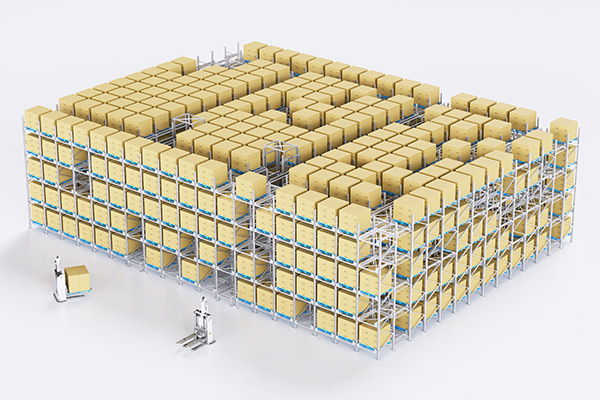
How the Two ASRS Architectures Work
A unit-load stacker crane ASRS uses one or more rail-guided mast cranes per aisle. The crane travels along the aisle, lifts a pallet to the target level, and places it into storage. Each aisle typically has a dedicated crane, so every storage position in that aisle shares a single access path. Throughput is therefore bounded by crane cycle time, lift height, horizontal travel distance, and load handling. Rail-dependent storage and retrieval equipment is covered by EN 528 safety requirements [2].
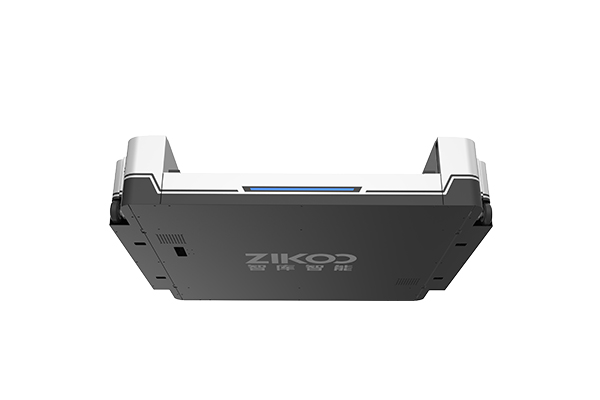
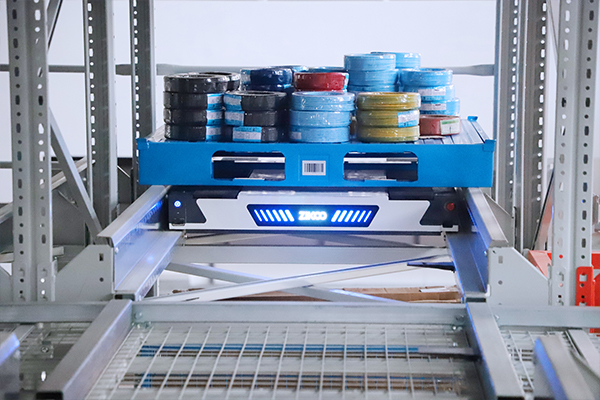
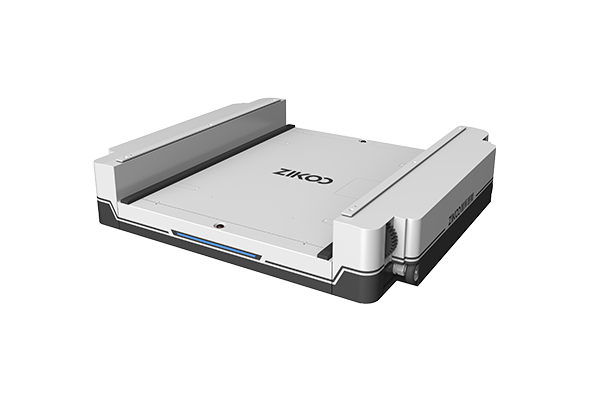
A shuttle ASRS decouples movement. A 四方向シャトル drives on rails inside the rack lanes, changes direction, and moves between levels through lifts or vertical transfer vehicles. In a six-way configuration, a vertical bidirectional shuttle works with horizontal shuttles to create a three-dimensional movement network. The access model is different: instead of one machine per aisle, multiple shuttles can operate in the same rack, while lift positions become the main convergence points.
That architectural difference drives most of the performance, cost, and risk trade-offs in the rest of this article.
Density, Throughput, and Storage Geometry
On pure pallet-position density, a well-designed shuttle grid usually has the advantage when building height is moderate. Because shuttles travel inside the rack structure, the system removes most fixed crane aisles and supports deeper storage lanes. Storage density becomes a function of lane depth, rack configuration, and lift placement rather than crane aisle geometry.
A crane ASRS consumes more floor area for aisles, but it can compensate with height. High-bay crane systems are often selected because they can serve racks far taller than many shuttle and lift configurations. The density gap narrows when the building can support substantial clear height and when each aisle can be extended vertically without multiplying lift complexity.
Throughput follows a different logic. Crane throughput is easy to model because one crane creates one handling stream per aisle. Cycle-time calculation follows the FEM 9.851 method [1]. It works well for steady, predictable pallet movement over long lifts. Shuttle throughput scales horizontally: adding vehicles adds parallel retrieval capacity. The main bottleneck becomes the vertical lift or transfer station, not the storage aisle itself.
Storage geometry is usually won or lost at the lane-depth and aisle-count stage, before any equipment price is compared. <六方向シャトルが密集ストレージを可能にし、空間制限を打破> covers how shuttle configurations convert unused cubic space into active pallet positions.
Capital Cost, Lifecycle Cost, and Energy
Unit-load crane systems concentrate capital in a small number of cranes, masts, and aisle structures. Shuttle systems distribute capital across many vehicles, lifts, charging points, and control nodes. Neither is universally cheaper. Crane systems often require more rack steel and building preparation, while shuttle systems carry more mobile hardware and battery inventory.
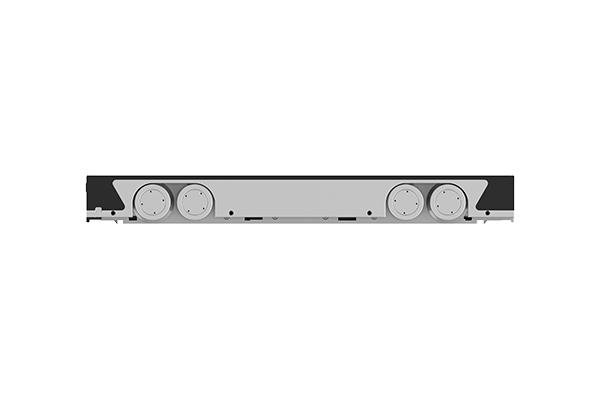
Lifecycle cost also differs by maintenance model. A crane fleet has fewer moving machines, but the mast, rail alignment, and hoist systems require disciplined inspection. A shuttle fleet has many more wheels, drives, and lithium batteries. Battery replacement cycles, charging infrastructure, and software updates become permanent operating costs. In cold storage, battery performance and charging behavior must be specified explicitly.
Energy consumption is also architecture-sensitive. Crane systems use direct electric drives with high peak draw during lifting. Shuttle systems use battery-electric vehicles with charging cycles and lower individual peak loads. The most efficient choice depends on whether the warehouse runs continuous shifts or starts and stops in bursts.
Because capex depends on building height, lane depth, throughput, grid size, fire protection, and software integration, a valid quote requires a load profile and layout drawing. For a preliminary fit calculation, send SKU profile, pallet size, clear height, and daily inbound/outbound pallet volumes to info@zikoo-int.com. The engineering team can compare shuttle, crane, and hybrid configurations against the same operating scenario.
Throughput and density are often treated as separate goals, but the winning architecture usually balances them inside the same rack. <六方向シャトル:高密度と高スループットのための二重エンジンソリューション> covers how combined horizontal and vertical shuttle networks address 密な収納 without sacrificing access speed.
Flexibility, SKU Mix, and Expansion Risk
Shuttle ASRS is generally more modular. Vehicles can be added to increase throughput, lifts can be added to relieve bottlenecks, and lane depths can be reconfigured as inventory velocity changes. That makes shuttle systems attractive for high-SKU, medium-turnover operations and for businesses that expect seasonal or promotional peaks.
Unit-load stacker cranes are strongest with uniform pallet footprints, longer dwell times, and stable slotting. Pallet dimensions matter in both systems. ISO 6780 defines the principal pallet sizes used in intercontinental materials handling [3]. Each crane and shuttle model must be specified to the actual pallet footprint, weight, and load center rather than a generic “standard pallet” assumption.
Expansion risk separates the two technologies. A crane system often grows by adding an entire aisle, which is a large capital step. A shuttle system typically grows by adding vehicles or lift positions, which is a smaller incremental step. However, shuttle expansion still requires rack structure, power, Wi-Fi or equivalent communication, and software capacity.
Choosing a system because it looks flexible in a brochure is a procurement mistake; flexibility must be verified against SKU dimensions, weight distribution, and real order patterns. <cURL Too many subrequests by single Worker invocation. To configure this limit, refer to https://developers.cloudflare.com/workers/wrangler/configuration/#limits cURL Too many subrequests by single Worker invocation. To configure this limit, refer to https://developers.cloudflare.com/workers/wrangler/configuration/#limits > covers the practical fit drivers to audit before selecting either architecture.
The Fit Model: When Each Technology Wins
The decision becomes clearer when grouped around five factors: height, throughput pattern, SKU variety, expansion model, and failure behavior.
| Decision factor | Unit-load stacker crane often preferred | Shuttle ASRS often preferred |
|---|---|---|
| Clear building height | High-bay with stable long lifts | Medium-height dense rack |
| cURL Too many subrequests by single Worker invocation. To configure this limit, refer to https://developers.cloudflare.com/workers/wrangler/configuration/#limits | cURL Too many subrequests by single Worker invocation. To configure this limit, refer to https://developers.cloudflare.com/workers/wrangler/configuration/#limits | cURL Too many subrequests by single Worker invocation. To configure this limit, refer to https://developers.cloudflare.com/workers/wrangler/configuration/#limits |
| cURL Too many subrequests by single Worker invocation. To configure this limit, refer to https://developers.cloudflare.com/workers/wrangler/configuration/#limits | cURL Too many subrequests by single Worker invocation. To configure this limit, refer to https://developers.cloudflare.com/workers/wrangler/configuration/#limits | cURL Too many subrequests by single Worker invocation. To configure this limit, refer to https://developers.cloudflare.com/workers/wrangler/configuration/#limits |
| cURL Too many subrequests by single Worker invocation. To configure this limit, refer to https://developers.cloudflare.com/workers/wrangler/configuration/#limits | cURL Too many subrequests by single Worker invocation. To configure this limit, refer to https://developers.cloudflare.com/workers/wrangler/configuration/#limits | cURL Too many subrequests by single Worker invocation. To configure this limit, refer to https://developers.cloudflare.com/workers/wrangler/configuration/#limits |
| Aisle dependency | cURL Too many subrequests by single Worker invocation. To configure this limit, refer to https://developers.cloudflare.com/workers/wrangler/configuration/#limits | cURL Too many subrequests by single Worker invocation. To configure this limit, refer to https://developers.cloudflare.com/workers/wrangler/configuration/#limits |
| cURL Too many subrequests by single Worker invocation. To configure this limit, refer to https://developers.cloudflare.com/workers/wrangler/configuration/#limits | cURL Too many subrequests by single Worker invocation. To configure this limit, refer to https://developers.cloudflare.com/workers/wrangler/configuration/#limits | cURL Too many subrequests by single Worker invocation. To configure this limit, refer to https://developers.cloudflare.com/workers/wrangler/configuration/#limits |
cURL Too many subrequests by single Worker invocation. To configure this limit, refer to https://developers.cloudflare.com/workers/wrangler/configuration/#limits
cURL Too many subrequests by single Worker invocation. To configure this limit, refer to https://developers.cloudflare.com/workers/wrangler/configuration/#limits
cURL Too many subrequests by single Worker invocation. To configure this limit, refer to https://developers.cloudflare.com/workers/wrangler/configuration/#limits
cURL Too many subrequests by single Worker invocation. To configure this limit, refer to https://developers.cloudflare.com/workers/wrangler/configuration/#limits
よくある質問
cURL Too many subrequests by single Worker invocation. To configure this limit, refer to https://developers.cloudflare.com/workers/wrangler/configuration/#limits
cURL Too many subrequests by single Worker invocation. To configure this limit, refer to https://developers.cloudflare.com/workers/wrangler/configuration/#limits
cURL Too many subrequests by single Worker invocation. To configure this limit, refer to https://developers.cloudflare.com/workers/wrangler/configuration/#limits
cURL Too many subrequests by single Worker invocation. To configure this limit, refer to https://developers.cloudflare.com/workers/wrangler/configuration/#limits
cURL Too many subrequests by single Worker invocation. To configure this limit, refer to https://developers.cloudflare.com/workers/wrangler/configuration/#limits
cURL Too many subrequests by single Worker invocation. To configure this limit, refer to https://developers.cloudflare.com/workers/wrangler/configuration/#limits
cURL Too many subrequests by single Worker invocation. To configure this limit, refer to https://developers.cloudflare.com/workers/wrangler/configuration/#limits
cURL Too many subrequests by single Worker invocation. To configure this limit, refer to https://developers.cloudflare.com/workers/wrangler/configuration/#limits
cURL Too many subrequests by single Worker invocation. To configure this limit, refer to https://developers.cloudflare.com/workers/wrangler/configuration/#limits
cURL Too many subrequests by single Worker invocation. To configure this limit, refer to https://developers.cloudflare.com/workers/wrangler/configuration/#limits
cURL Too many subrequests by single Worker invocation. To configure this limit, refer to https://developers.cloudflare.com/workers/wrangler/configuration/#limits
cURL Too many subrequests by single Worker invocation. To configure this limit, refer to https://developers.cloudflare.com/workers/wrangler/configuration/#limits
参考文献
cURL Too many subrequests by single Worker invocation. To configure this limit, refer to https://developers.cloudflare.com/workers/wrangler/configuration/#limits
cURL Too many subrequests by single Worker invocation. To configure this limit, refer to https://developers.cloudflare.com/workers/wrangler/configuration/#limits
cURL Too many subrequests by single Worker invocation. To configure this limit, refer to https://developers.cloudflare.com/workers/wrangler/configuration/#limits
cURL Too many subrequests by single Worker invocation. To configure this limit, refer to https://developers.cloudflare.com/workers/wrangler/configuration/#limits
If you’re interested, check out these related articles:
スマート倉庫の始まり:コスト効果の高いフォーウェイシャトルシステム》をお読みください。
コールドチェーン物流の革新:Zikoo Robotics六方向シャトルが高密度・高効率倉庫を実現
スマートストレージ革命:自動3D倉庫向け四方向シャトルシステムの包括的な概要
スタッカークレーン対フォーウェイシャトル:あなたのASRS倉庫に最適なのはどちら?


