


Choosing between a four-way shuttle and a two-way shuttle is one of the most consequential decisions in dense storage automation. The right choice impacts long-term scalability, operational efficiency, and total cost of ownership far more than initial hardware pricing suggests. Most comparisons focus on movement—four directions versus two—but the real difference lies in how each technology integrates with your overall warehouse system and whether it can adapt to change over the next decade. From an engineering perspective, I’ve seen that a four-way shuttle’s added flexibility typically pays for itself when you consider the cost of retrofitting a simpler system later.
What Are the Key Technical Differences Between Four-Way and Two-Way Shuttles?
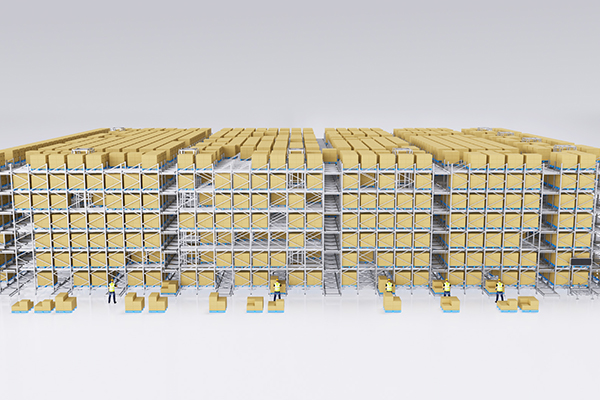
At the hardware level, the fundamental distinction is how the shuttle navigates within the racking structure. A two-way shuttle moves along a single lane: forward and backward in a straight line. It can access only the pallets in its assigned row, and changing lanes usually requires a transfer car or manual intervention. A four-way shuttle, by contrast, can traverse the length and width of a storage level. It uses a set of roller wheels and a lifting mechanism to change direction without external assistance, allowing it to cover an entire level and even change levels when paired with a vertical lift.
| Feature | Four-Way Shuttle | Two-Way Shuttle |
|---|---|---|
| Movement axes | Longitudinal and transverse (four directions) | Lane-bound (forward/reverse) |
| Level access | Full level coverage | Single lane only |
| Lane change | Autonomous via lifting mechanism | Requires transfer car or manual handling |
| Vertical integration | Works seamlessly with elevators for 3D movement | Limited vertical integration; lane changes add complexity |
| Typical load capacity | 1,200–2,000 kg | 500–1,500 kg |
| Body height | As low as 125 mm (e.g., R-bot) | Typically 150–250 mm |
| Energy | Lithium battery, 8-hour continuous operation | Varies; often lead-acid or lithium |
| Control complexity | Higher—requires multi-shuttle coordination | Lower—simpler sequence control |
The four-way shuttle’s ability to move in any direction on a plane means it can reach any pallet position on a level without dedicated lane infrastructure. That changes the entire throughput model because the system does not wait for a transfer car when a shuttle needs a different lane.
Where Does Each Shuttle Type Perform Best in Real Operations?
Two-way shuttles still have a place in certain low-complexity, high-volume pallet flows. They work well in deep-shelf FIFO environments where every lane stores the same SKU and the retrieval order is predictable—for example, in beverage distribution or bulk raw material storage. If your operation has fewer than 50 SKUs and throughput demands are modest, a two-way system can deliver acceptable efficiency at a lower upfront investment.
The four-way shuttle becomes the more practical choice when SKU count increases, pallet sizes vary, or the warehouse must support both storage and order picking. In facilities handling thousands of SKUs—e-commerce, spare parts, or third-party logistics—the ability to dynamically route any shuttle to any position eliminates waiting time and avoids the need for dedicated transfer aisles. I’ve worked on projects where a four-way system reduced retrieval time by over 40 percent compared to a lane-based setup because the WCS could send the nearest shuttle instead of waiting for a specific lane to clear.
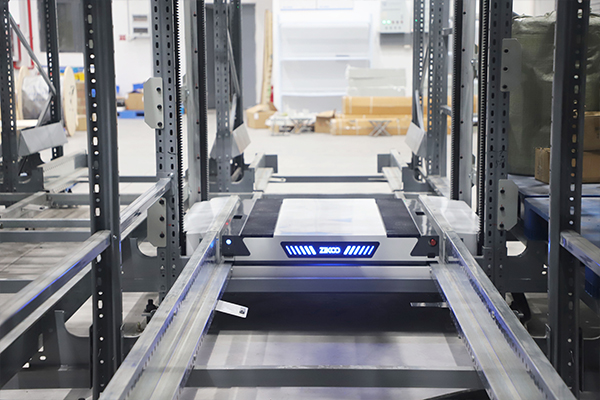
Temperature-controlled environments add another layer. In cold chain warehouses, fewer pieces of equipment moving in freezing conditions mean lower failure rates. A four-way shuttle’s on-level autonomy reduces the number of moving parts exposed to condensation and frost, and with a purpose-built low-temperature lithium battery—such as the -25°C rated battery used in Zikoo’s R-bot cold chain configuration—continuous operation can reach eight hours without degradation. Two-way shuttles rarely offer that depth of environmental hardening.
How Does Shuttle Choice Affect System Integration and Future Scalability?
This is where many comparisons stop short. A shuttle is not an isolated robot—it is a node in a software-controlled network that includes conveyors, lifts, picking stations, and the WMS/WCS layer. The tighter the integration, the higher the system’s effective throughput and the lower the operational risk. When you buy a two-way shuttle from one vendor and a lift from another, you bear the burden of integration testing. When the same engineering team designs both the shuttle and the vertical lift, they can optimize acceleration profiles, positioning, and handshake protocols down to the millisecond.
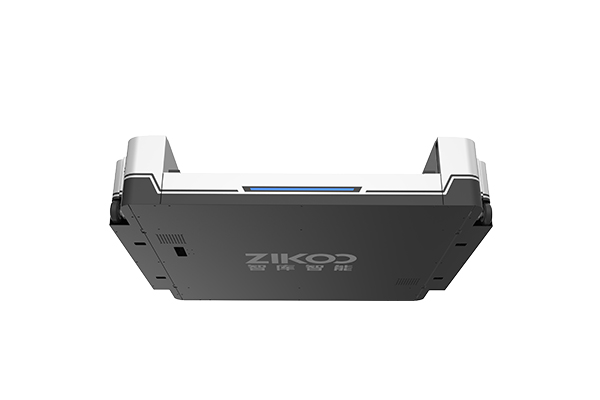
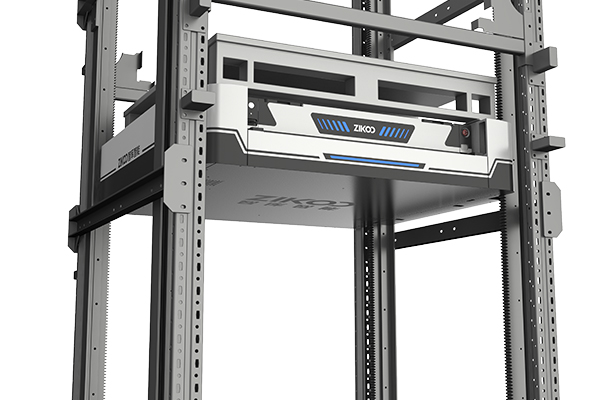
With a four-way shuttle platform, adding a vertical lift—like the H-bot—creates a six-way shuttle system. The shuttle moves freely in the horizontal plane and the lift transports it between levels. That three-dimensional mobility means you can expand vertically or horizontally later without redesigning the control logic. A two-way shuttle system, on the other hand, often hits a scalability ceiling because each lane addition requires reconfiguring the transfer car routes and updating the sequence controller. I have personally seen a project where the client chose a two-way system for initial cost savings, only to face a six-figure retrofit bill two years later when their SKU growth demanded more dynamic routing.
Software complexity is another hidden factor. A four-way shuttle fleet runs on a real-time multi-agent scheduling algorithm—the WCS assigns tasks to shuttles dynamically, avoiding deadlocks and predicting maintenance windows. Two-way shuttles, by contrast, operate on simpler deterministic sequences. The software difference matters because as the number of shuttles grows, a multi-agent approach maintains throughput; a deterministic approach sees diminishing returns. If your growth plan calls for increasing storage density or throughput over time, a four-way system’s scheduling layer is an asset that two-way logic cannot easily replicate.
What Are the True Total Cost of Ownership Comparisons?
Hardware price is only the first layer. A four-way shuttle system costs more upfront—typically 15–30 percent more for equivalent storage capacity—but that gap often narrows or reverses when you factor in space utilization, labor savings, and retrofit avoidance.
| Cost Element | Four-Way Shuttle System | Two-Way Shuttle System |
|---|---|---|
| Hardware (racks, shuttles, lifts) | Higher—more shuttle complexity, lift integration required | Lower—simpler shuttle, fewer lifts needed |
| Installation & commissioning | 6–10 weeks including software tuning | 4–6 weeks, simple sequences |
| Software integration | Full WMS/WCS tailored to multi-shuttle coordination | Basic WCS, less customization |
| Energy | Lithium battery, 8 hours runtime; lower per-move energy due to direct routing | Shorter cycles, less routing overhead, but more idle transfer car moves |
| Maintenance | Higher parts cost, but predictive maintenance reduces unplanned downtime; cold chain builds reduce corrosion | Lower parts cost, but lane-change mechanisms are failure-prone under high cycles |
| Scalability cost | Low—add shuttles and levels modularly; software already supports expansion | High—each lane addition may require new transfer cars and control rework |
| Operational efficiency (throughput) | 25–40% higher in multi-SKU environments, thanks to dynamic routing | Adequate for single-SKU FIFO, degrades rapidly with SKU variety |
The maintenance profile is worth examining closely. A four-way shuttle’s onboard lifting mechanism requires regular inspection, but the trade-off is that it eliminates transfer cars—the most common failure point in lane-based systems. In cold storage, the specialized lithium batteries and PCB protection add upfront cost, but they extend service intervals significantly. We’ve seen facilities using standard batteries in sub-zero environments suffer capacity loss within 12 months; a battery designed for the temperature maintains rated capacity for three years or more.
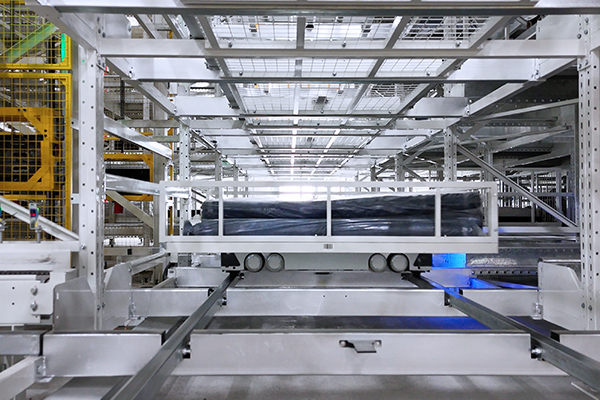
If your operation requires handling multiple pallet types—European 1200x800mm, American 1016x1219mm, Japanese 1100x1100mm—the shuttle fleet must be compatible. The R-bot series, for instance, offers dedicated models for each pallet standard, as well as heavy-duty versions for 2000 kg loads. A mismatched shuttle adds wear and causes positioning errors, driving up maintenance cost and slowing throughput. Two-way shuttles are less frequently offered in such fine-tuned variants, which restricts their ability to handle a mixed pallet fleet without compromise.
How Should You Decide Between a Four-Way and Two-Way Shuttle System?
I recommend running through a short checklist before requesting a quotation. If you answer “yes” to three or more of the following questions, a four-way shuttle system likely aligns better with your long-term goals:
- Do you operate more than 200 SKUs requiring palletized storage?
- Is your throughput target above 60 pallets per hour?
- Will your storage density requirement exceed 60 percent of the building footprint?
- Do you need to support mixed pallet sizes in the same system?
- Is your facility subject to temperature extremes (below 0°C or above 35°C)?
- Do you anticipate SKU growth or a shift to e-commerce fulfillment within five years?
- Is your tolerance for production downtime low enough to justify redundant shuttle paths?
For lower-complexity operations with stable, single-SKU throughput and tight capital constraints, a two-way shuttle may still be the right answer. But in such cases, I always advise clients to reserve space for future expansion lanes and to select a WCS that can later coordinate with more advanced routing logic—even if it is not activated immediately. That small amount of upfront planning makes a painful migration much easier.
A final point on supplier selection: a shuttle is a long-term asset. Choose a manufacturer that offers both the shuttle and the lift, because the day you decide to go vertical, you do not want two vendors pointing fingers. When the R-bot and H-bot are part of the same engineering environment, the entire motion control stack—acceleration, positioning, handover—is tested as one system, not patched together during commissioning. That integration directly reduces project risk and speeds time to full productivity.
What Should You Consider Before Choosing a Shuttle System?
Can a two-way shuttle be upgraded to a four-way shuttle later?
In practice, no. The racking structure, guide rails, and control logic are built around the shuttle’s movement axis. Converting a lane-based system to full-level autonomy would require replacing not just the shuttles but also the rails, power rails, and probably the entire WCS. You are essentially building a new system. That is why the decision is a one-way door—choosing two-way today locks you into that architecture for the life of the racks.
What is the typical ROI period for a four-way shuttle system?
Most projects I’ve been involved with achieve full ROI within 2.5 to 4 years, depending on labor savings, throughput gains, and real estate efficiency. Systems with higher electricity costs and labor wages recover their investment faster. In cold storage, ROI often comes quicker because the reduction in freezer-floor labor and product damage directly lowers the cost per pallet moved.
Are four-way shuttles suitable for handling heavy or oversized pallets?
Yes, when the shuttle is designed for it. The R-bot heavy-duty model handles up to 2000 kg with a 1250×1300 mm body, and the standard model supports 1200 kg with a 125 mm body height. The critical factor is matching the wheelbase, lifting mechanism, and battery rating to the load—not just the rated capacity. A 1500 kg pallet that is loaded off-center will stress a shuttle that is borderline for weight; a 2000 kg-rated shuttle with a wider platform provides the safety margin needed for industrial use.
How long does a four-way shuttle system take to implement?
From contract signing to go-live, a standard installation takes 12 to 18 weeks. The timeline depends on the level of software integration required—if you already have a WMS that needs API connections, testing and validation extend the schedule by a few weeks. New warehouses with a pre-integrated software stack (WMS/WCS/RCS from a single supplier) can be up and running in under 10 weeks.
What kind of maintenance does a four-way shuttle require?
Regular maintenance includes battery health checks every 500 cycles, roller and lift mechanism inspection every 1000 cycles, and annual software health audits. In cold chain installations, we also recommend quarterly checks on the battery heating circuit and the PCB protective coating. The benefit of a lithium battery system is that it provides detailed telemetry—charge-discharge curves and cell balance data—so failures rarely occur without warning. I always advise clients to negotiate a maintenance contract that includes remote monitoring; it is far cheaper than on-site emergency repair.
If your project involves extreme temperatures, mixed pallet types, or high SKU volume, the difference between a well-integrated four-way system and a two-way setup becomes very clear during the first year of operation. Send your warehouse layout and pallet specifications to info@zikoo-int.com, and we can run a throughput simulation that compares both options against your actual order profile. You can also reach us at (+86)-19941778955 to discuss your project timeline and technical requirements directly with our engineering team.
If you’re interested, check out these related articles:
Six-Way Shuttle: Empowering Industries to Embrace Smart Warehousing
Six-Way Shuttle: Pioneering the Future of Smart Warehousing


