


E-fulfillment distribution hubs operate under conditions that most conventional warehouses were never designed to handle: high SKU variety, shrinking order windows, unpredictable peak surges, and rising pressure to ship the same day. In this environment, storage is not the primary constraint. Order flow is. That is why AS/RS applications in e-fulfillment and distribution hubs have moved from a niche engineering topic to a core operational planning issue.
The most effective systems do not simply store pallets. They compress inventory into a smaller footprint, sequence work, feed picking stations, buffer outbound orders, and make material movement deterministic. For distribution leaders, the question is no longer whether automation fits. It is how to apply the right AS/RS configuration to the right point in the fulfillment flow.
<img src="https://www.zikooint.com/wp-content/uploads/2025/12/automated-3d-warehouse-overview_20251205_100537.jpg" alt="Automated-3D-Warehouse-Overview" style="max-width: 600px; height: auto; display: block; margin: 20px auto;" />
What Makes E-Fulfillment Distribution Hubs Different
A distribution hub supporting e-commerce fulfillment rarely looks like a production warehouse. Inbound volume may arrive in truckloads, but outbound demand breaks into thousands of individual orders. Pallets must be stored densely, then split into cases or eaches at high speed. Order profiles shift daily, and seasonal peaks can double or triple throughput for weeks.
This creates four simultaneous requirements. First, the facility needs dense pallet storage to keep more inventory close to the picking process. Second, it needs fast retrieval to avoid starving workstations. Third, it needs software that can sequence mixed pallet, case, and piece-level work. Fourth, it needs the ability to scale throughput without adding floor space.
Safety and system design should follow recognized equipment standards. Rail-dependent storage and retrieval equipment is covered by EN 528:2008 [1]. Automated vehicle safety and verification should be assessed under ISO 3691-4:2023 [2]. These references matter because an e-fulfillment AS/RS is not a single machine. It is a coordinated system of rack, shuttle, lift, conveyor, workstation, and software.
Core AS/RS Applications in the Fulfillment Flow
AS/RS technology is not used the same way in every part of a distribution hub. The highest-value applications are usually clustered around the highest-touch material flows.
Receiving and Putaway Buffering
Inbound trailers arrive on tight schedules. An AS/RS can act as a receiving buffer by accepting pallets from dock conveyors and moving them into storage without requiring forklift travel through the rack face. This shortens dock-to-stock time and reduces double handling.
Dense Pallet Storage
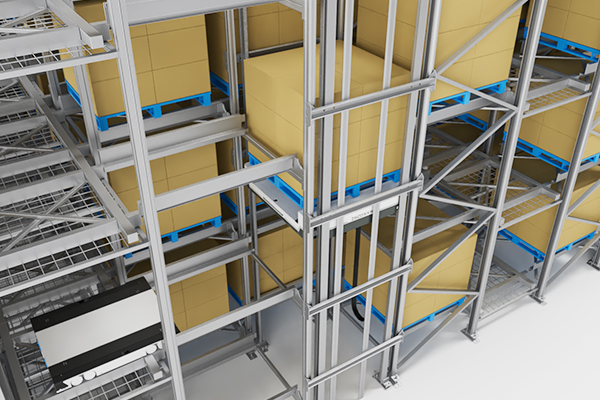
E-fulfillment hubs often carry more inventory than traditional retail distribution centers because online assortments are broader and demand is less predictable. High-density storage can reduce the building footprint, particularly when vertical height is available. In dense configurations, a four-way shuttle such as the R-bot Four-way Shuttle can support rated loads up to 1.5 tons with a body height of 125 mm, enabling more storage levels in the same building envelope.
Order Picking Replenishment
One of the strongest AS/RS applications is continuous replenishment of case-pick and piece-pick stations. Instead of picking from static forward locations, the system delivers pallets or totes to goods-to-person workstations. This shortens travel time, improves pick accuracy, and allows operators to stay in ergonomic work zones.
Sorting and Outbound Buffering
After picking, orders often need to be staged before carrier collection. An AS/RS can provide temporary outbound buffering, using storage positions to organize orders by route, carrier, or departure window. This is especially useful during late-day wave peaks when docks become congested.
Returns Processing
Returns are a permanent part of e-commerce. A well-designed system can route returned pallets into a quarantine or inspection zone and later move them back into available stock. This avoids blocking active picking locations.
Dense storage is one of the clearest levers for space-constrained distribution hubs. <Six-Way Shuttle Powers Dense Storage: Breaking Space Limitations> covers how a six-way shuttle layout recovers storage capacity without expanding the building footprint.
<img src="https://www.zikooint.com/wp-content/uploads/2025/12/six-way-shuttle-path-optimization_20251205_100435.jpg" alt="Six-Way-Shuttle-Path-Optimization" style="max-width: 600px; height: auto; display: block; margin: 20px auto;" />
Choosing the Right AS/RS Configuration for E-Fulfillment
The right configuration depends on pallet type, SKU depth, order profile, building height, and peak throughput. Three common options are stacker crane AS/RS, four-way shuttle systems, and hybrid shuttle-and-lift systems.
Stacker cranes deliver high reliability in narrow-aisle, high-bay installations. They are a strong fit when pallet weights are consistent and the layout can support fixed aisle geometry. Four-way shuttle systems provide more flexibility because shuttles can change levels and aisles through lifts. This allows the system to allocate robots dynamically across zones, which is valuable when order activity is uneven.
Hybrid systems often combine a four-way shuttle with a vertical transfer device. In Zikoo’s product architecture, the R-bot Four-way Shuttle works with the H-bot Vertical Bidirectional Shuttle to create a six-way shuttle network. The H-bot achieves positioning accuracy of ±1 mm and supports dense vertical transfer. This type of layout can be useful where a distribution hub needs both high storage density and dynamic task assignment.
The selection process should also consider the U-bot Omnidirectional Stacking Robot for narrow-aisle pallet access. With a minimum aisle requirement of 2100 mm and lifting heights up to 8000 mm, it can be an alternative where existing warehouse columns or ceiling heights limit traditional rack design.
When comparing configurations, decision makers should avoid choosing on a single specification such as travel speed. Throughput is the result of shuttle count, lift capacity, acceleration, workstation design, and software task timing. A system with slightly lower travel speed but better task orchestration can outperform a faster machine with poor queue management.
A broader system view helps avoid over-specifying one component while under-designing another. <Smart Storage Revolution: Comprehensive Overview of Four-Way Shuttle Systems for [Automatic 3D Warehouse](https://www.zikooint.com/asrs-automated-storage-and-retrieval-system-solutions)s> covers the system-level decisions behind automatic 3D warehouse design.
<img src="https://www.zikooint.com/wp-content/uploads/2025/12/retail-multi-sku-storage-scenario_20251205_100130.jpg" alt="Retail-Multi-SKU-Storage-Scenario" style="max-width: 600px; height: auto; display: block; margin: 20px auto;" />
Throughput, Peak Capacity, and Software Orchestration
In e-fulfillment, average throughput is less important than peak-hour throughput. An AS/RS that handles average volume comfortably may fail during the 4:00 p.m. wave or a flash promotion. That is why capacity planning should start from order profiles, not storage positions.
A useful method is to define the worst repeating hour, then design the system to handle that hour with adequate recovery time. Planners should model inbound arrivals, picking demand, replenishment tasks, and outbound staging together. This exposes bottlenecks that static capacity calculations miss.
Warehouse software is the connective tissue. The PTP Smart Warehouse Software suite covers WMS, WES, WCS, and RCS functions. In practice, that means the software must manage inventory, release orders to the right zone, coordinate robot tasks, and resolve exceptions without human intervention. A WES layer becomes important in e-fulfillment because it can balance work across subsystems and reorder tasks based on real-time conditions. Shuttle systems under poor software control will still collapse under peak load.
One practical build pattern is to use the AS/RS for reserve storage and buffering while using goods-to-person stations for active picking. In that architecture, the AS/RS does not pick eaches directly. It feeds the stations and absorbs surge inventory. The result is more stable labor planning and better use of vertical space.
Industry analysis consistently points to labor availability, e-commerce growth, and the need for faster cycle times as key drivers of warehouse automation [3]. The operational benefit of an AS/RS in e-fulfillment is not simply labor replacement. It is the ability to make fulfillment capacity repeatable across shifts and seasons.
<img src="https://www.zikooint.com/wp-content/uploads/2025/12/warehouse-future-automation-scene_20251205_100609.jpg" alt="Warehouse-Future-Automation-Scene" style="max-width: 600px; height: auto; display: block; margin: 20px auto;" />
Sizing, Risk Management, and ROI Planning
A credible AS/RS business case requires three data sets. First, the facility must supply real order data: lines per order, order cycle time, pallet dimensions, SKU velocity, and seasonal curves. Second, the project team must define the physical constraints: clear height, floor condition, column spacing, aisle width, and dock locations. Third, the buyer must define business rules for order release, returns, and carrier cutoffs.
With those inputs, the supplier can produce a material-flow simulation rather than a simple quote. Simulation is valuable because it tests whether the design can absorb peak-hour demand and what happens if one shuttle or lift is out of service. It also prevents overinvestment in automation where a simpler layout would do.
Risk management should cover equipment availability, software fallback, and maintenance response. A shuttle failure should not stop the entire distribution center. The control architecture should isolate failure to a zone or vehicle, allowing other shuttles to continue. Maintenance access must be designed into the rack and lift positions from the start.
The financial analysis should compare not only capital cost but also total cost per pallet handled, labor hours per 1,000 lines, space saved, and the cost of missed peak capacity. In many e-fulfillment projects, the majority of value comes from avoiding the need for a larger building, reducing overtime during peaks, and increasing order accuracy.
Implementation phasing usually works best when the AS/RS zone is separated from active operations. Existing distribution hubs can be retrofitted in stages without disrupting current fulfillment, but this requires a realistic site survey and a phased commissioning plan. Buyers should require defined acceptance criteria tied to throughput, uptime, and system accuracy. Safety verification should remain part of commissioning because AS/RS equipment and automated vehicles must meet applicable standards throughout the system lifecycle [1], [2].
Different industries stretch the same shuttle platform in different directions. <Multi-Scenario Smart Adaptation: Zikoo’s Six-Way Shuttle Powers the Digital Transformation of Warehousing> covers how the same automation principles adapt across warehousing scenarios.
If you are evaluating both shuttle and stacker configurations, avoid waiting until the layout is fixed before involving an automation engineer. A preliminary design review can expose whether your clear height, column grid, and dock flow are workable. For a technical review, contact Zikoo at info@zikoo-int.com or (+86)-19941778955 with your pallet profile and peak-hour order data.
Build a Distribution Hub AS/RS Business Case
The difference between a successful AS/RS deployment and an expensive storage system is usually planning, not hardware. Start with an operational question, not a product question: Where in your fulfillment flow are you losing the most time and space?
Use the following structure to run an effective assessment:
- Map pallet, case, and piece flow from dock to ship.
- Identify the three worst peak hours per week and per season.
- Define storage-density targets in pallets per square meter or per cubic meter.
- Test shuttle, stacker, and hybrid configurations against the same order data.
- Require simulation results before final vendor selection.
- Define acceptance criteria for throughput, accuracy, uptime, and recovery.
- Confirm the WMS, WES, WCS, and RCS integration scope.
- Review maintenance access and spares strategy before commissioning.
For a structured assessment from Zikoo Smart Technology, contact info@zikoo-int.com or call (+86)-19941778955.
FAQ
Is AS/RS suitable for e-fulfillment hubs with high SKU counts?
Yes, but only if the system is designed around replenishment and buffering rather than static storage. High SKU counts require dynamic task management, fast pallet retrieval, and software that can prioritize replenishment based on real-time order demand.
Can an AS/RS be installed in an existing distribution center?
In many cases, yes. The feasibility depends on clear height, column spacing, floor flatness, and dock access. Existing buildings with at least 9 to 12 meters of clear height and suitable floor load capacity often support high-density AS/RS configurations.
How do shuttle systems compare with stacker cranes for e-commerce fulfillment?
Stacker cranes offer strong reliability in predictable, narrow-aisle environments. Shuttle systems provide more dynamic vehicle allocation and can be more flexible in multi-zone, high-SKU operations. The best choice depends on order profiles and peak-hour constraints rather than any single machine specification.
What data is needed before sizing an AS/RS?
You need pallet dimensions and weights, SKU velocity, order lines per day, order cycle time, inbound schedule, seasonal volume changes, building drawings, and carrier cutoff times. Missing order-profile data is a common cause of oversized or undersized systems.
How should warehouse operators plan for peak season?
Plan from the worst repeating hour, not average throughput. Use simulation to test whether the system can recover after a peak wave, and confirm that maintenance windows do not conflict with peak operations.
What are common causes of automation project risk?
Incomplete order data, unclear software integration scope, aggressive commissioning schedules, and insufficient maintenance planning are among the most common risks. Defining acceptance tests early and isolating the automation zone during installation help reduce project disruption.
References
[1] CEN, EN 528:2008 — Rail dependent storage and retrieval equipment — Safety requirements. European Committee for Standardization, 2008.
[2] ISO, ISO 3691-4:2023 — Industrial trucks — Safety requirements and verification — Part 4: Driverless industrial trucks and their systems. International Organization for Standardization, 2023.
[3] MHI, The 2024 MHI Annual Industry Report. MHI, 2024. [Online]. Available: https://www.mhi.org/publications/report
If you’re interested, check out these related articles:
Six-Way Shuttle: The Smart Warehousing Tool for Cost Reduction and Efficiency
PTP Intelligent Warehouse Software Empowers Enterprises for Smart Upgrades
Smart Cold Chain Era: Six-Way Shuttle System Redefines Storage Efficiency with Maximum Density


