


Standard automated storage and retrieval systems are usually engineered around common pallet footprints, moderate temperatures, and stable software interfaces. Most projects start there because standard modules reduce mechanical design time and use proven rack clearances. Clearance and deformation limits for steel static storage systems are defined in EN 15620 [1], and suppliers build pallet shuttles to match a small set of standard footprints.
But warehouses with oversized pallets, cold rooms, contamination-sensitive products, or irregular building grids often find that a standard ASRS fits only on paper. Customization then becomes an engineering filter. This article explains where standard design stops being enough, what should be customized, and where to hold the line.
Where Standard ASRS Design Starts to Fail
Standard warehouse automation works because it limits variables. A four-way shuttle can be produced in defined widths and battery compartments; rack profiles and aisle clearances are repeated; WCS functions map to familiar inbound, storage, picking, and outbound flows. That repetition cuts cost and shortens delivery.
The standard approach depends on several assumptions:
- The pallet fits one of the common footprints.
- The operating temperature stays within standard battery and component envelopes.
- The warehouse grid allows regular rack bays and aisle widths.
- The software exchange remains close to standard WMS/WCS interfaces.
- The product does not require special contamination or cleanliness controls.
When one or more assumptions break, a “standard” system either requires expensive workarounds or fails after commissioning. In that situation, a customized design is not an upsell. It is usually the lower-risk path.
The Five Triggers for a Customized Design
1. Pallet geometry and load outside the standard envelope
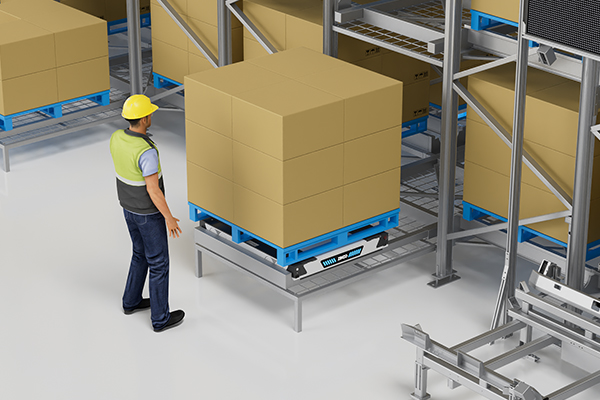
Common pallet footprints include 1200 × 800 mm and 1200 × 1000 mm, but many operations run American, Japanese, or oversized industrial pallets. The R-bot Four-way Shuttle shows how one platform can be customized across variants.
| Model | Rated load | Supported pallet sizes | Body height |
|---|---|---|---|
| Standard | 1200 kg | 1200 × 800–1000 mm | 125 mm |
| American | 1200 kg | 1016 × 1219 mm | 125 mm |
| Japanese | 1500 kg | 1100 × 1100 mm | 125 mm |
| Heavy-duty | 1500 kg | 1200 mm | 125 mm |
| Heavy-duty Large Pallet | 2000 kg | 1400 mm | 150 mm |
The 125 mm body height on most models supports dense rack storage, while the large-pallet variant adapts the same architecture to 1400 mm pallets without re-engineering the entire building.
2. Temperature and humidity outside component limits
Standard components are not automatically validated for -25°C. A customized cold chain solution may use low-temperature lithium batteries, a low-temperature charging port, and special PCBA coating for high-humidity environments. This changes battery management, charging architecture, and service access—not just the battery cell.
3. Existing buildings and tight aisles
A new warehouse can be designed around a rack grid; a brownfield building cannot. The U-bot Omnidirectional Stacking Robot supports aisle widths as narrow as 2100 mm, with lifting heights from 4500 mm to 8000 mm depending on model. This matters when columns, docks, or mezzanine levels prevent standard shuttle lanes.
4. Contamination and material restrictions
For new energy and battery-related production, conventional robots may introduce copper, zinc, nickel, or lead. A customized design can specify stainless steel frames with blackening treatment and all-rubber buffer wheels, removing direct metallic contamination risk. That is a material specification decision made during design, not a site retrofit.
5. Software and material flow outside the default template
Customization is not only mechanical. If the warehouse must handle mixed full-pallet and split-case picking, software needs two-way handshakes across WMS, WES, WCS, and RCS. ANSI/ISA-95 [2] provides a reference framework for separating enterprise, manufacturing operations, and control system functions, but the data mapping still must be custom.
Customization often begins when pallet dimensions, temperature bands, or contamination controls push a project outside a standard shuttle bill of materials. Six-Way Shuttle Powers the Digital Transformation of Warehousing>(https://www.zikooint.com/multi-scenario-smart-adaptation-zikoos-six-way-shuttle-powers-the-digital-transformation-of-warehousing) covers how six-way shuttle cells adapt across mixed temperature and load scenarios without re-platforming.
Engineering Customization Without Over-Engineering
The goal is not to redesign every component. It is to identify the constraint layer—pallet interface, battery, material, or software—and change only what is required.
Start from the load path. A pallet moves from receiving to rack, rack to shuttle, shuttle to lift, and lift to pick station. Each interface has tolerances. The rack clearance must respect EN 15620 [1]; the shuttle must match pallet dimensions and mass; the lift must handle the highest expected load. If all three are changed at once, design risk rises sharply.
Use standard modules where possible. Standard four-way shuttle drive modules, lift frames, and rack profiles can often be retained. Customization can be limited to pallet guides, battery packs, or software workflows. This modular approach is central to dense storage architectures such as the R-bot and H-bot six-way shuttle system.
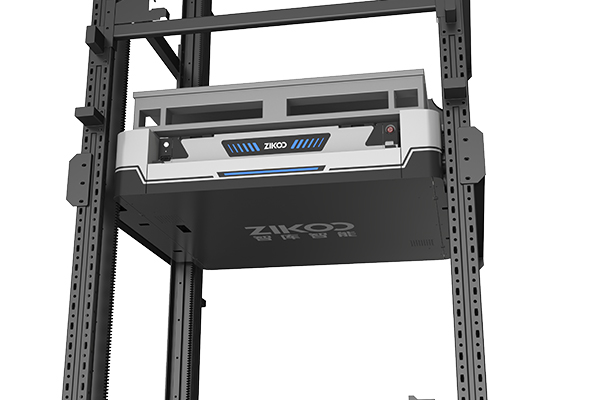
The vertical interface deserves special attention. H-bot Vertical Bidirectional Shuttle lifts reach positioning accuracy of ±1 mm and support rated loads up to 1800 kg across standard, American, and Japanese models. In a customized project, that accuracy becomes important when pallet stops, guide rails, and shuttle entry points are adapted to non-standard pallets.
Get a Feasibility Review Before Locking the Layout
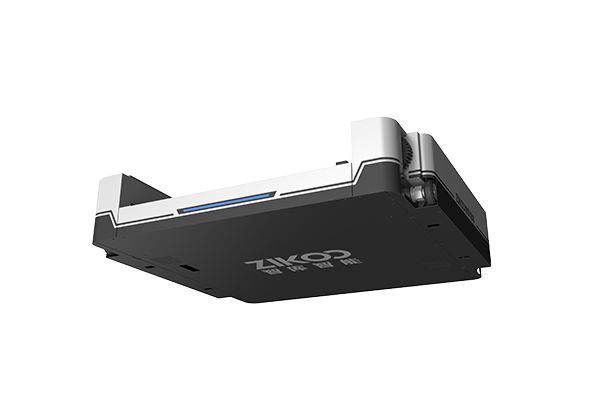
If your pallet geometry, temperature band, or software integration sits outside standard modules, a feasibility review can identify which layer actually needs customization. Email info@zikoo-int.com with your pallet dimensions, load, temperature range, SKU count, and throughput target.
Customizing for Cold Chain and Contamination-Sensitive Environments
Cold chain design for -25°C
Cold storage is more than lowering a thermostat. Condensation, battery capacity loss, lubrication changes, and operator access all change at low temperatures.
A cold chain shuttle system may include:
- Low-temperature lithium battery pack designed for -25°C.
- Automatic low-temperature charging ports so batteries do not need to be removed and warmed.
- Special PCBA coating for high humidity.
- Continuous operation windows of 6–8 hours per charge depending on model.
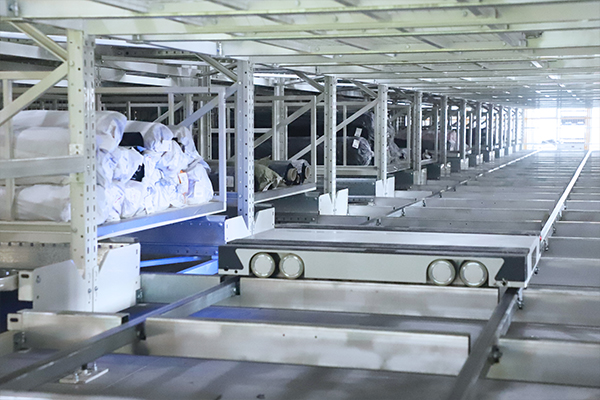
This is why a cold storage project rarely succeeds by taking a standard shuttle and changing only the battery. The battery compartment, charging station placement, cable management, and condensation path must be reviewed together. In pharmaceutical and temperature-controlled distribution centers, that system-level view is often the difference between commissioning on schedule and repeated dew-point failures.
New energy and material restrictions
In new energy storage, metal contamination is a critical quality risk. A customized pallet robot can avoid copper, zinc, nickel, and lead in the vehicle design. Stainless steel frames with blackening treatment and all-rubber buffer wheels eliminate direct metal contact on the floor path.
This is not standard in general logistics equipment. It requires material traceability, changed fastener selection, and different surface treatment processes. Procurement teams should treat it as an engineering specification, not a feature line.
Software Customization: The Invisible Part of the System
Mechanical customization is visible in drawings; software customization is visible only in exception handling. A fully customized system still fails if the WCS cannot handle priority orders, locked lanes, replenishment waves, or integration to existing ERP and MES systems.
A useful approach is to define system boundaries before detailing robot motion. ANSI/ISA-95 [2] separates Level 3 manufacturing operations from Level 2 control, which helps define what WMS, WES, WCS, and RCS should each own. When the customer already uses SAP or a production MES, this mapping becomes as important as the rack layout.
Customized automation often stalls when WMS, WCS, and RCS boundaries are not defined before the first rack is installed. (https://www.zikooint.com/ptp-intelligent-warehouse-software-empowers-enterprises-for-smart-upgrades) covers how a unified WMS/WES/WCS/RCS layer turns custom mechanical design into stable daily operation.
When a Customized Shuttle Beats a Standard Shuttle
The business case for customization should not be based on novelty. It should be based on measurable outputs:
- Higher pallet density per cubic meter.
- Fewer manual interventions at the pallet interface.
- Lower energy consumption in cold rooms because fewer charging cycles are lost.
- Reduced product damage through better pallet guides.
- Cleaner data flow between WMS and supervisory control.
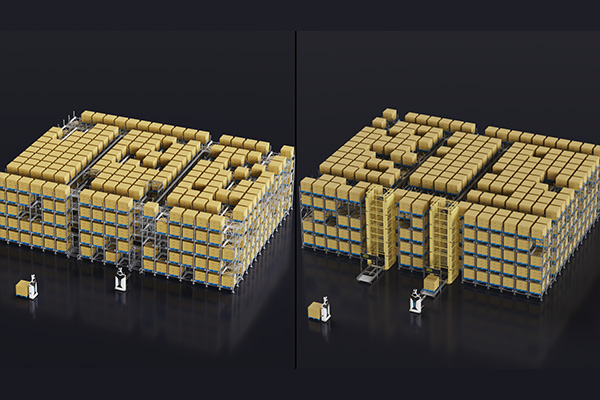
A standard shuttle may require a fixed lane depth and pallet width. A customized shuttle can match actual pallet size and rack depth, avoiding the need to relocate existing rack or compromise storage depth. The result is often better cube utilization rather than higher robot speed. That is where customization pays back.
Evaluating Suppliers for Customized Projects
A customized order is only as safe as the supplier’s engineering change process. Look for:
- A documented requirement trace from pallet size, temperature, and load to design output.
- Prototype or sample validation before serial production.
- A quality management system consistent with ISO 9001:2015 [3].
- Safety conformance for rail dependent storage and retrieval equipment under EN 528 [4].
- Reference projects with similar constraints, not just similar industries.
Also verify that the supplier owns the engineering authority to change mechanical, electrical, and software layers. A trading company can sell a standard product, but a mixed-material or cold chain customization requires design ownership.
A customized shuttle project is only as reliable as the manufacturer behind the engineering change list. (https://www.zikooint.com/looking-for-reliable-four-way-shuttle-manufacturers-choose-zikoo-robotics) covers the reference checks and engineering audit points that matter when standard product catalogs are not enough.
Plan the Customization Around the Constraint
Customized warehouse automation should start with a technical clarification, not a product selection. If your operation includes oversized pallets, -25°C storage, contamination-sensitive materials, narrow aisles, or difficult software integration, document each constraint and ask for a feasibility study.
To prepare the request, include:
- Pallet dimensions, maximum weight, and inbound/outbound volumes.
- Temperature and humidity range.
- SKU count and order profile.
- Warehouse layout, column grid, and usable height.
- ERP/WMS systems and interface requirements.
For a technical review of your requirements, contact Zikoo Smart Technology Co., Ltd.
Email: info@zikoo-int.com
Phone: (+86)-19941778955
Address: 4F, Building 4, No. 170-1 Software Avenue, Yuhuatai District, Nanjing, China
FAQ
When should I customize a warehouse automation solution instead of buying a standard system?
Customize when at least one hard constraint falls outside the standard envelope: pallet footprint or load, operating temperature, building clearances, contamination requirements, or software integration needs. If all constraints fit a standard module, stay standard.
Does a customized four-way shuttle system cost more than a standard one?
It usually costs more in engineering and validation, but the total project cost can be lower when customization avoids building changes, manual handling, or failed standard equipment. Evaluate cost against the whole system, not the shuttle unit price.
Can a customized system be expanded later?
Yes, if the control architecture and rack grid are designed for expansion. Customization should preserve standard interfaces where possible so future phases can reuse software, lifts, and charging infrastructure.
Will customizing the robot delay the project?
Engineering changes can add time during design review, but they often reduce site rework. The safest approach is to freeze the constraint list before detailed design begins and require a design verification report for each changed module.
How can I verify that a supplier can handle a custom cold chain or contamination-sensitive project?
Ask for engineering calculations for the changed modules, battery and charging test reports, material compliance documents, reference site details, and a documented change control process. ISO 9001:2015 [3] and EN 528 [4] provide baseline quality and safety expectations for evaluating the supplier.
References
[1] European Committee for Standardization, EN 15620: Steel static storage systems — Tolerances, deformations and clearances, CEN, Brussels, 2021.
[2] International Society of Automation, ANSI/ISA-95.00.01-2018: Enterprise-Control System Integration — Part 1: Models and Terminology, ISA, 2018.
[3] International Organization for Standardization, ISO 9001:2015: Quality management systems — Requirements, ISO, Geneva, 2015.
[4] European Committee for Standardization, EN 528:2008: Rail dependent storage and retrieval equipment — Safety requirements, CEN, Brussels, 2008.
If you’re interested, check out these related articles:
Smart Cold Chain Era: Six-Way Shuttle System Redefines Storage Efficiency with Maximum Density
Six-Way Shuttle: The Smart Warehousing Tool for Cost Reduction and Efficiency


