


Robotic picking solutions in e-commerce warehouses depend on pallet flow more than on picker speed. When the robot is scoped before the pallet flow, projects drift: the picking cell may be fast, but upstream storage cannot stage pallets fast enough. The constraint sits in pallet access, slotting density, and peak-hour dock sequencing. Deployment becomes predictable when the system is planned as a pallet-to-person whole, not as an isolated picking island. This article walks through the storage, order profile, SKU architecture, software cutover, and failure recovery decisions we use to evaluate e-commerce picking automation before a single robot is ordered.
Deploy Robotic Picking After Confirming Storage Access
Robotic picking in an e-commerce warehouse starts with the pallet buffer behind the workstation. If the upstream storage cannot stage pallets fast enough, the picking robot waits, and the per-piece pick rate becomes useless. I usually check two things first: whether the existing rack layout can handle dense pallet buffering without adding aisles, and whether the vertical transfer path can feed multiple floor levels without a forklift loop.
Storage access means pallet buffer, not aisle count
Many e-commerce teams measure storage readiness by total rack locations, but picking throughput depends on how many pallets can be extracted per hour and how quickly they reach the workstation. A rack can hold 10,000 pallets and still starve a picking cell if the retrieval path is a forklift moving through traffic. That is why we check dense shuttle retrieval and vertical shuttle capacity before deciding how many picking workstations the floor can actually feed.
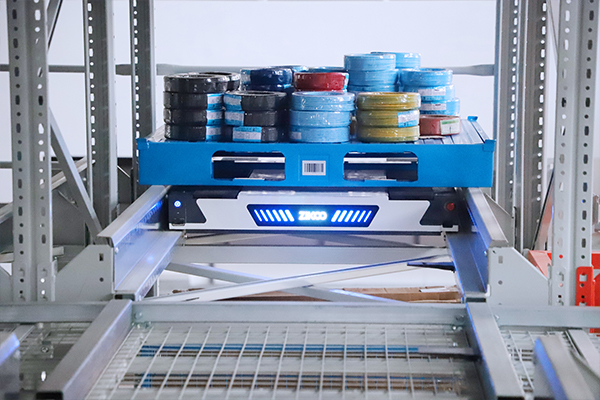
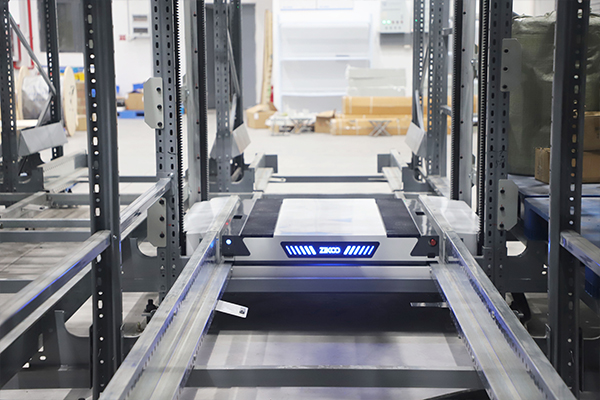
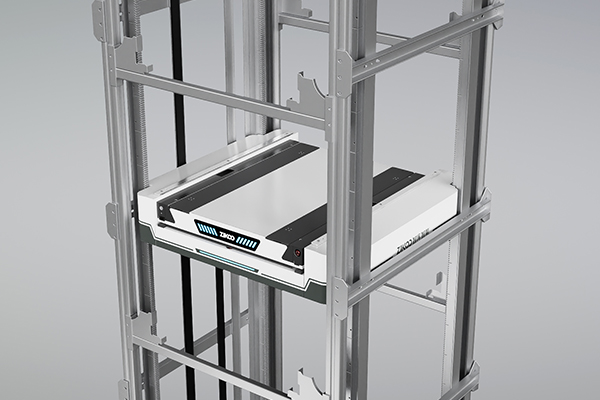
For dense pallet buffering, the R-bot Four-way Shuttle has a 125 mm body height and runs at 1.6 m/s empty and 1.2 m/s loaded, with models from 1200 kg to 2000 kg. It pairs with the H-bot vertical shuttle to create a six-way path, using a single storage position as the vertical hub. That combination raises storage density without consuming the aisle width that a picking workstation needs. The table shows the R-bot model spread we most often review in e-commerce and distribution environments.
| Model | Rated load | Body height | Pallet size |
|---|---|---|---|
| Standard R1200B | 1200 kg | 125 mm | 1200 x 800-1000 mm |
| American R1200A | 1200 kg | 125 mm | 1016 x 1219 mm |
| Japanese R1500J | 1500 kg | 125 mm | 1100 x 1100 mm |
| Heavy-duty R1500B | 1500 kg | 125 mm | 1200 mm |
A picking island cannot run faster than the pallet buffer behind it. <Six-Way Shuttle: The Smart Warehousing Tool for Cost Reduction and Efficiency> covers how six-way shuttle configurations reduce forklift travel and raise turnover, which changes how many workstations the same order volume actually requires.
Build the Order Profile Before Selecting Picking Robots
Robotic picking does not have one correct architecture. A site shipping full pallets from deep reserve storage needs a different system from one shipping thousands of split-case lines per shift. We start with daily and peak hour outbound lines, SKU count, pallet dimensions, and the share of single-line orders. The U-bot + AMR Narrow Aisle Picking System is designed for mixed full pallet and split-case work. It handles up to 10,000 SKUs, picks at least 300 pieces per hour at a workstation, and moves inbound and outbound pallets at 80 pallets per hour.
Separate split-case and full-pallet flows early
One recurring mistake is forcing one robot type to handle both a 1,000 kg pallet and single-unit eaches. The result is a slow workstation and a complicated gripper. In hybrid profiles, we separate pallet outbound through the dense shuttle buffer and route split-case tasks to AMR-assisted workstations. The split cuts exception handling and keeps pallet transport from crowding picking aisles.
If your peak hour mixes full pallet outbound with high-volume eaches, do not finalize the robot count until the workstation mix is checked. Send your daily outbound line profile, SKU count, and pallet size to info@zikoo-int.com and we will confirm how many pallet workstations and split-case stations your layout actually needs.
Match the Robotic Picking System to SKU and Aisle Conditions
After the order profile is clear, the next filter is physical. Aisle width, lift height, pallet type, and cold chain conditions eliminate more picking robots than any comparison checklist. The U-bot Omnidirectional Stacking Robot needs a minimum aisle width of 2100 mm to 2140 mm depending on lift model, and it lifts from 4.5 m to 8 m. Its U-shaped body and 1370 mm turning radius work in narrow aisles, but the rack must be straight and the floor condition must hold positioning accuracy of ±10 mm. The R-bot Four-way Shuttle runs at -15°C as standard, while the cold chain configuration uses a -25°C lithium battery for 6 to 8 hours. High-humidity or frozen e-commerce grocery environments therefore need a different electrical protection conversation before the rack layout is fixed.
We have quoted e-commerce projects where the same picking robot model looked identical on paper, but the cold storage detail changed the battery charging port, PCBA coating, and aisle floor tolerance. A standard robot placed in -25°C without that configuration loses runtime unpredictably. That decision has to be forced before the BOM is frozen, because it is not a software parameter and it cannot be fixed after the rack is installed.
Plan Software Cutover and Failure Recovery Before Go Live
Warehouse software is usually the longest lead item in robotic picking deployment. The picking robot itself can be installed quickly, but the order release logic, path planning, and workstation handshakes take longer to stabilize. PTP Smart Warehouse Software coordinates WMS, WES, WCS, and RCS so that pallet movement and piece picking share one control layer. Without that layer, a picking cell can run well during factory acceptance testing and then stall at go live because the WMS releases orders in waves the robot scheduler cannot absorb.
Test the software handshake and the mechanical failure path
Factory acceptance tests usually prove the robot can lift and move. They rarely test what happens when the WMS sends a cancellation after the shuttle has reserved a pallet. Before go live we run a targeted failure set: order release interruption, workstation jam, shuttle low battery, elevator fault, and network drop. The site needs a known state for each. If the operations team cannot describe the recovery state, the system is not ready for peak volume.
Failure recovery is not only a service task. The R-bot cluster can reroute pallets among multiple shuttles, and the U-bot uses dual laser SLAM navigation with ±50 mm pallet position compensation so a badly stacked pallet does not stop the aisle. But a single vertical shuttle serving one aisle still needs a manual bypass or buffer space. Emergency operation, pallet rework areas, and software fallback instructions belong in the deployment plan, not in a post-installation manual.
Warehouse software and hardware procured separately tend to collide at integration. <Software-Driven Hardware: Six-Way Shuttle Maximizes Warehouse Efficiency> covers why shuttle dispatch, elevator sequencing, and order release logic work best as one control loop instead of as connections made after machine selection.
Confirm the Robotic Picking Integration Path Before Buying
If your e-commerce warehouse is heading into peak season or adding SKUs, the clock on a bad robotic picking deployment starts before the first machine ships. Most failures are not weak pick rates; they come from a mismatch between pallet flow, order profile, aisle conditions, and software scope.
The workable path is to fix those four variables before the BOM. A Zikoo Smart Technology engineer will walk the layout against the order data and tell you whether a shuttle dense buffer, a narrow aisle picking robot, or a combined workstation flow fits best.
Send your pallet dimensions, SKU count, daily order lines, peak hour throughput, and layout drawings to info@zikoo-int.com, or call (+86)-19941778955. We will run the feasibility check and confirm which shuttle, workstation, and software combination fits before you commit to hardware.
Review Common Questions About Robotic Picking Deployment
Does an e-commerce picking cell need robots, shuttles, and elevators all at once?
Usually yes for pallet-dense operations, but not every picking cell needs all three on day one. A four-way shuttle provides dense pallet buffer, an H-bot or vertical shuttle transfers pallets across levels, and a picking workstation handles the final piece movement. If the site starts with lower SKU count and lower throughput, the deployment can begin with shuttle storage and add U-bot picking later. The key is to reserve rack and control-system capacity so later automation does not require a second retrofit.
Can robotic picking be installed in an existing e-commerce warehouse without a major rebuild?
A common assumption is that robotic picking only fits new builds with flat floors and high ceilings. Existing buildings can often work when the aisle width, column spacing, and floor tolerance are checked early. The U-bot needs 2100 mm to 2140 mm aisles and can be engineered into a current layout if the rack runs are straight. The limiting factor is usually not the building; it is whether the existing WMS can handle live pallet movement and station-level order release without a heavy custom integration.
How do I decide between a dense shuttle system and a narrow aisle picking robot for e-commerce?
It depends on whether outbound is mostly pallet or mostly split-case pieces. Dense shuttle storage works better for deep pallet reserves and high SKU count at pallet level. A narrow aisle picking robot with AMR workstations is stronger for high piece counts, mixed orders, and same-day shipping profiles. If pallet outbound is roughly 70% or more, shuttle storage dominates. If split-case lines are higher, the U-bot + AMR layer does more of the daily work. Many sites need both layers.
How long should deployment take after layout and software scope are fixed?
In projects we have reviewed, 10 to 16 weeks is realistic for an existing e-commerce warehouse after rack drawings, workstation positions, and WMS integration points are fixed. The wider range comes from cold storage electrical protection, floor repairs, and the WMS team’s availability. A greenfield automated 3D warehouse takes longer because the building, rack, and fire suppression interfaces are part of the same schedule. Share your layout drawings and daily order line counts and we will confirm the workable window. Send those files to info@zikoo-int.com.
If you’re interested, check out these related articles:
Smart Cold Chain Era: Six-Way Shuttle System Redefines Storage Efficiency with Maximum Density
Six-Way Shuttle Unlocks the Era of True 3D Intelligent Warehousing
Six-Way Shuttle: The Ultimate Warehousing Solution for Cost Reduction and Efficiency
PTP Intelligent Warehouse Software Empowers Enterprises for Smart Upgrades


