


Four-way shuttle automation changes the pallet storage problem by separating horizontal travel from vertical transport. Instead of sending a stacker crane down a narrow aisle for every load, a four-way shuttle moves across rack lanes and through transfer paths at pallet level, while lifts handle level changes only when a pallet must leave its storage depth. The result is a dense, flexible storage system in which retrieval speed is less dependent on a single machine and more dependent on how well the shuttle fleet, vertical lifts, and software tasks are synchronized. Four-way shuttles are a specific class of rail-guided automated industrial truck [1], but their real value only appears when pallet handling is connected to WMS-orchestrated retrieval.
What Four-Way Shuttle Automation Actually Changes
A conventional pallet storage system often ties movement to aisles. Narrow-aisle forklifts require wide operating clearances, and stacker cranes usually serve one aisle per machine. A four-way shuttle system changes that geometry. The shuttle can move forward and backward along a storage lane, then travel laterally across a cross-aisle to another lane, all without leaving the rack structure.
That capability allows a smaller number of horizontal robots to serve many storage locations. Vertical movement is delegated to lifts or vertical shuttles, so the system can keep pallets moving even when one lift or one shuttle is busy. The architecture also supports denser layouts because operating clearances are reduced to the shuttle body height and rack geometry.
Rack-Side Mechanics: How the Four-Way Shuttle Moves and Picks
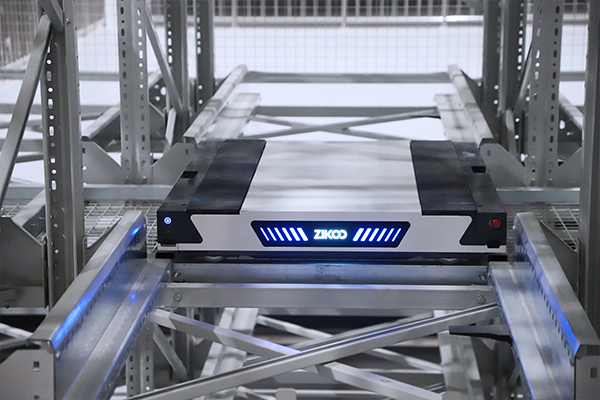
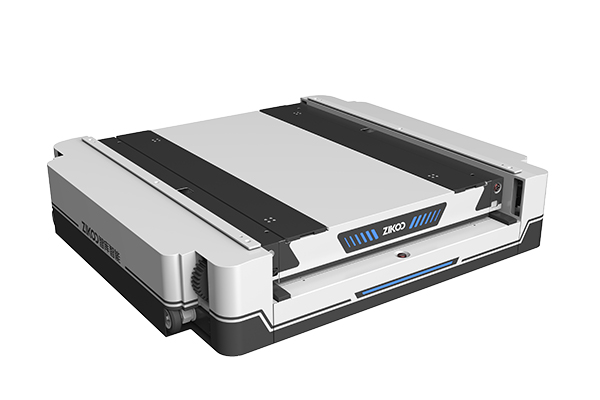
The four-way shuttle is a low-profile robot that travels directly beneath a pallet. A slim body height of 125 mm allows the shuttle to operate in dense racking without consuming the vertical space that a forklift mast or crane would require. The shuttle lifts the pallet slightly, transports it, and sets it down at the destination lane or transfer point.
The Zikoo R-bot Four-Way Shuttle is available in several configurations matched to regional pallet sizes and load ranges. The table below shows the main variants.
| Model | Rated Load | Body Dimensions (L × W × H) | Pallet Size Support |
|---|---|---|---|
| R1200B Standard | 1,200 kg | 1,000 × 972 × 125 mm | 1,200 × 800–1,000 mm |
| R1200A American | 1,200 kg | 1,192 × 840 × 125 mm | 1,016 × 1,219 mm |
| R1500J Japanese | 1,500 kg | 1,192 × 900 × 125 mm | 1,100 × 1,100 mm |
| R1500B Heavy-Duty | 1,500 kg | 1,192 × 972 × 125 mm | 1,200 mm |
| R2000B Heavy-Duty Large Pallet | 2,000 kg | 1,250 × 1,300 × 150 mm | 1,400 mm |
The standard, American, Japanese, and heavy-duty models travel at up to 1.6 m/s empty and 1.2 m/s loaded. The heavy-duty large-pallet model runs at up to 1.35 m/s empty and 1.0 m/s loaded. For cold-chain applications, the same platform can be configured with a low-temperature lithium battery for operation at -25°C, with 6–8 hours of continuous operation depending on load and cycle mix.
From a safety and design standpoint, four-way shuttle systems operating on fixed rack rails fall under the same rail-dependent storage and retrieval equipment safety logic as other automated storage machines [2]. That means the rack interface, shuttle clearances, access restriction, and emergency stop behavior must be treated as part of the system rather than as isolated vehicle features.
Software Orchestration: WMS, WES, WCS, and RCS in One Retrieval Chain
Pallet handling is only the mechanical half of the system. The retrieval half is software. In a well-designed four-way shuttle installation, a WMS holds inventory and order priorities. A WES or WCS layer translates those priorities into equipment assignments, release timing, dock sequencing, and exception handling. The RCS then sends task-level commands to individual shuttles.
A typical retrieval chain works like this: the WMS releases an order wave because a truck is scheduled at a dock; the WCS checks whether the pallet should go directly to shipping, to a staging lane, or to a picking station; the RCS assigns a shuttle and lift; the shuttle travels to the source lane, lifts the pallet, moves to the lift, and transfers the load; the lift lowers or raises the pallet to the outbound level; and a conveyor, AMR, or forklift takes over.
Each retrieval is a command cycle. Cycle-time analysis for storage and retrieval machines treats the total time as the sum of horizontal travel, vertical travel, and load handling time [3]. In a four-way shuttle system, that calculation becomes more distributed because multiple shuttles can move simultaneously. The key metric is no longer how fast one machine completes a dual cycle, but how many complete retrieval tasks the fleet and lift arrangement can finish per hour without queueing at transfer points.
PTP software coordinates the transition from inventory-level planning to machine-level task assignment. <PTP Intelligent Warehouse Software Empowers Enterprises for Smart Upgrades> covers how WMS, WES, WCS, and RCS work together to keep dense storage systems responsive.
“
Engineering Variables That Determine Retrieval Throughput
Four-way shuttle throughput is not a single number. It depends on pallet dimensions, SKU velocity, building height, the number of lifts, the number of shuttle chargers, and how orders are grouped in the WMS. Before selecting a fleet size, an engineer should define the following inputs:
- Pallet footprint and maximum load
- Hourly inbound and outbound pallet volumes
- Peak-hour skew and dock cut-off times
- Order wave size and priority rules
- Storage depth and lane count per level
- Number of vertical transfer positions
- Operating temperature and humidity
These variables determine whether the bottleneck is horizontal travel, lift capacity, or outbound staging. A system that works well in a distribution center with full-pallet outbound flow may need a different software strategy in a manufacturing site where pallets move to line-side buffer positions. The most effective retrievals are not always the shortest physical path; they are often the ones that align with the next downstream process.
Technical review checkpoint. If you already have pallet dimensions, SKU counts, and hourly retrieval targets, send them to info@zikoo-int.com for a WMS-to-shuttle task-flow review. A short data exchange can show whether the bottleneck is horizontal, vertical, or software-related before you commit to a fleet size or rack depth.
Six-Way Expansion: Adding Vertical Movement to Dense Storage
A four-way shuttle moves in two horizontal axes. When vertical transport must also be automated inside the rack, the shuttle can be paired with a vertical bidirectional shuttle such as the H-bot. The H-bot occupies a single storage position and transfers pallets between levels, creating a six-direction material flow: forward, backward, left, right, up, and down.
The Zikoo H-bot Vertical Bidirectional Shuttle has a rated load of 1,800 kg in standard, American, and Japanese pallet configurations. Standard models operate from -25°C to 45°C, with a positioning accuracy of ±1 mm. Standard, American, and Japanese types travel at 1 m/s empty and 0.5 m/s loaded, with acceleration of 1 m/s² empty and 0.3 m/s² loaded. This kind of vertical transfer capability allows a single lift point to serve multiple storage levels without requiring a full stacker crane aisle.
The move from four-way horizontal travel to six-way spatial flow changes shuttle system design. <Six-Way Shuttle: Pioneering the Future of Smart Warehousing> covers how six-way shuttle networks extend dense storage across more levels and higher throughput points.
Specifying a Four-Way Shuttle System: Practical Audit Questions
A four-way shuttle system is not automatically the best solution for every warehouse. Low-turnover storage, very low ceilings, extremely variable pallet quality, or limited software integration capacity can favor a different architecture. A practical audit should answer these questions before committing:
- Are pallet dimensions stable, or do loads vary widely from supplier to supplier?
- Is the warehouse height sufficient to create multiple storage levels?
- What is the required pallet-per-hour inbound and outbound rate during the peak hour?
- Does the WMS already support task-level warehouse control, or will a WCS/WES layer be added?
- Will the rack structure need fire suppression, seismic, or cold-chain modifications?
- Is there enough floor flatness and rack alignment tolerance for rail-guided shuttle travel?
- What is the maintenance plan for batteries, chargers, lift drives, and rail joints?
A specification should define operational performance as a system-level KPI: completed pallet movements per hour, not just shuttle travel speed. It should also require clear interface boundaries between WMS, WCS, and RCS, so the customer does not end up owning a machine that vendors treat as outside their scope.
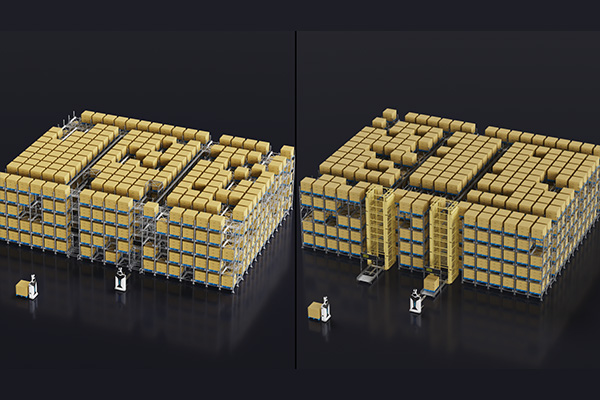
For facilities comparing four-way shuttle automation with stacker crane ASRS, the deciding factors usually include storage depth, height, order profile, and system redundancy. <Stacker Crane vs Four-Way Shuttle: Which Fits Your ASRS Warehouse Best> covers the trade-offs that shape final architecture selection.
Plan Your Four-Way Shuttle Retrieval Architecture
A four-way shuttle project should not start with a robot count. It should start with an order-flow model, a pallet profile, and a clear software interface plan. If you are evaluating dense pallet storage, automated retrieval, or WMS integration, send your warehouse footprint, pallet data, SKU profile, and target throughput to Zikoo Smart Technology Co., Ltd. at info@zikoo-int.com or call (+86)-19941778955. Ask for a technical review covering rack depth, shuttle fleet sizing, lift placement, WMS/WCS boundaries, and a phased go-live plan.
FAQ
What is the difference between a four-way shuttle and a two-way pallet shuttle?
A two-way shuttle travels forward and backward within a single lane, usually for deep-lane pallet flow or semi-automatic storage. A four-way shuttle can also travel laterally across cross-aisles, so it can change lanes without being lifted out by a forklift. That extra axis reduces manual pallet repositioning and enables more flexible retrieval.
Can a four-way shuttle system operate at -25°C?
Yes, if the shuttle is specified with a low-temperature battery and suitable component protection. Cold-chain versions can use low-temperature lithium batteries, low-temperature charging ports, and coated PCBA assemblies for humidity resistance. The rack, lift, and charger placement must also be designed for frost, condensation, and limited maintenance access.
Do I need to replace my WMS to adopt four-way shuttle automation?
Not necessarily. The four-way shuttle system can be controlled through a WES or WCS layer that sits between the existing WMS and the shuttle group. The WMS needs to send task-level outbound and inbound requirements, but it does not need to know how many shuttles are moving or which lift is available. Integration quality is more important than replacing the WMS.
How many shuttles are required for a given throughput?
The number depends on travel distances, lift capacity, charge cycles, and order grouping. A small site with moderate throughput may need only a few shuttles, while a high-throughput distribution center may require a fleet with redundant chargers and multiple lifts. The correct method is to build a task-flow simulation from actual pallet-per-hour data rather than selecting a fleet size from a catalog.
Is four-way shuttle automation only for new warehouses?
No. Four-way shuttle systems are also used in existing warehouses that have sufficient floor flatness and rack tolerance for rail-guided travel. In brownfield projects, the main design constraints are usually column spacing, floor load, available height, and the ability to phase the retrofit without stopping daily operations.
What pallet sizes does a four-way shuttle support?
Common models support regional pallet footprints such as 1,200 × 800–1,000 mm, 1,016 × 1,219 mm, 1,100 × 1,100 mm, 1,200 mm, and heavy-duty pallets up to 1,400 mm. Load capacity typically ranges from 1,200 kg to 2,000 kg, depending on the shuttle model. Pallet condition, bottom-board spacing, and deflection under load should be verified during specification.
How does WCS differ from WMS in four-way shuttle retrieval?
A WMS manages inventory, orders, and business priorities. A WCS manages real-time equipment decisions such as which shuttle picks which pallet, when a lift should move, and how to handle a blocked transfer point. The RCS layer then translates those decisions into movement commands for individual robots. In four-way shuttle systems, a clean separation between WMS and WCS prevents order-level logic from interfering with real-time equipment control.
References
[1] ISO 5053-1:2020. Industrial trucks — Vocabulary — Part 1: Types of industrial trucks.
[2] EN 528:2008+A1:2022. Rail dependent storage and retrieval equipment — Safety requirements.
[3] FEM 9.851. Performance Data of S/R Machines — Cycle Times.
If you’re interested, check out these related articles:
Smart Warehousing Starts Here: Cost-Effective Four-Way Shuttle Systems
Six-Way Shuttle Powers Dense Storage: Breaking Space Limitations
Six-Way Shuttle: The Smart Warehousing Tool for Cost Reduction and Efficiency


