


Four-way shuttle systems sit at the intersection of two warehouse goals that often pull in opposite directions: dense pallet storage and fast retrieval. A four-way shuttle moves along rack rails and can change direction without leaving the storage face. When paired with vertical lifts and WCS software, it turns a static rack block into a dynamic pallet-to-person network. This article explains how the system is engineered, where it fits, and what to check before procurement.
What a Four-Way Shuttle System Actually Is
A four-way shuttle is a compact, battery-powered robot that travels forward, backward, left, and right within a storage grid. It uses crossing devices or integrated mechanics to switch between longitudinal and transverse directions at lane intersections. Unlike a two-way pallet shuttle that stays in one lane, a four-way shuttle can move across lanes and levels, reducing the number of transfer devices needed in the rack block.
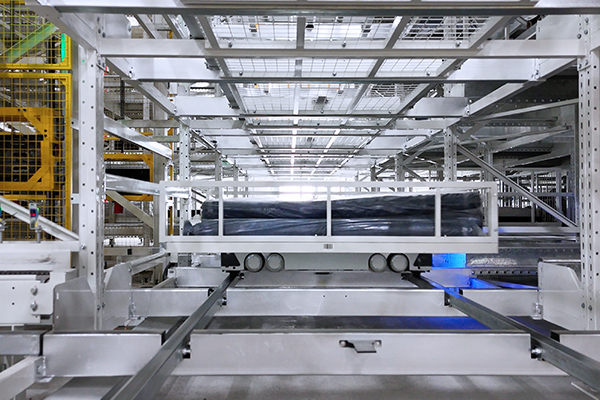
In a typical configuration, a rack block is divided into multiple storage levels. Each level has horizontal lanes and cross aisles. The shuttle picks a pallet, travels along the lane, crosses to the transfer point, and hands the pallet to a vertical bidirectional shuttle or lift. The lift moves the pallet to a ground-level conveyor or picking station. This is why the system is often described as pallet-to-person automation: operators stay at a workstation while pallets are delivered automatically.
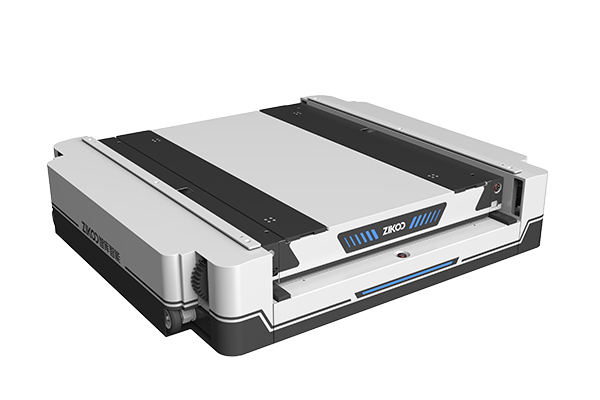
The difference between four-way and two-way is not simply “more directions.” It changes the architecture of the storage block. A four-way fleet can serve many lanes with one shuttle instead of requiring one shuttle per lane, which reduces equipment count and improves flexibility. At the same time, mission orchestration becomes more complex; the WMS/WCS layer must assign the right shuttle, level, and lift for each task without creating route conflicts or queue bottlenecks.
Four-way shuttle systems become most useful when horizontal shuttle lanes, vertical lifts, and WCS missions are planned as one continuous material-flow network. <Smart Storage Revolution: Comprehensive Overview of Four-Way Shuttle Systems for Automatic 3D Warehouses> covers rack-level movement, 3D storage architecture, and the equipment combinations that make automatic warehouses practical.
For a deeper look at vehicle options, see the four-way pallet shuttle product overview.
How Flexibility and High Throughput Are Engineered in the Same Vehicle
Flexibility in a four-way shuttle starts with mechanical design. A low-profile body — 125 mm on most R-bot models — allows high-density racking with minimal vertical clearance per level. The lower profile increases usable levels for a given building height. Rated load capacity ranges from 1,200 kg to 2,000 kg across standard, American, Japanese, and heavy-duty large-pallet variants, covering pallets from 1,016 mm to 1,400 mm. This means the same architecture can handle 1,200 × 800 mm European pallets, 1,016 × 1,219 mm US pallets, 1,100 × 1,100 mm Japanese pallets, and larger industrial pallets.
Throughput depends on more than shuttle speed. R-bot standard models travel at 1.6 m/s empty and 1.2 m/s loaded; heavy-duty large-pallet models operate at 1.35 m/s empty and 1.0 m/s loaded. However, pallet-per-hour throughput also depends on WCS path assignment, lift capacity, lane depth, and retrieval sequence. Two numbers matter: cycle time and system throughput. Cycle time is the average time for one inbound or outbound mission. System throughput is how many pallets per hour the whole configuration can sustain across multiple levels and workstations.
A four-way shuttle system keeps flexibility when mission logic can reorder tasks. The WCS can sequence retrievals so that one deep lane does not block the lift while another lane has idle capacity. It can also assign multiple shuttles to the level with the highest outbound workload. This makes the system suitable for peak periods because capacity can be redirected to where demand is currently highest.
Project check: If you are mapping SKU velocity and inbound/outbound peaks, a short simulation usually reveals whether four-way shuttle architecture fits the building before you commit to rack changes. Send warehouse dimensions, SKU profile, and target pallet throughput to info@zikoo-int.com for a technical review.
Dense Storage Math: Lanes, Levels, and the H-Bot Link
The storage density gain comes from removing multiple access aisles. In conventional selective racking, every pallet position has direct forklift access, so aisles can consume a large share of the floor area. In a four-way shuttle block, shuttles enter deep lanes, allowing pallets to be stored one behind another. A rack block becomes a cube: multiple lanes in the X direction, multiple cross-aisle positions in the Y direction, and multiple levels in the Z direction.
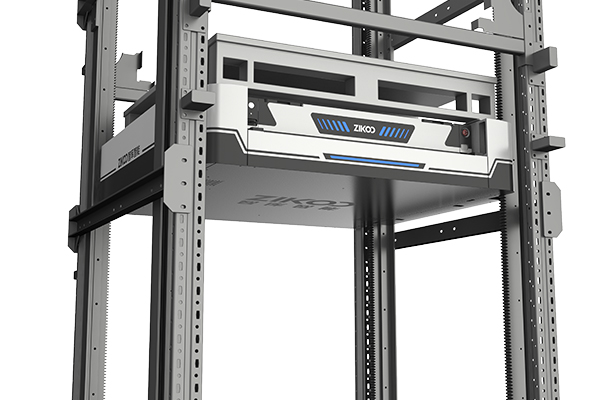
Vertical transfer is the link that makes the cube work. The H-bot vertical bidirectional shuttle occupies a single storage position and moves pallets between levels. It achieves positioning accuracy of ±1 mm and is rated for loads up to 1,800 kg. Travel speed is 1 m/s empty and 0.5 m/s loaded, with acceleration of 1 m/s² empty and 0.3 m/s² loaded. Those figures may look modest compared with a horizontal shuttle, but vertical movement is short and frequent. The real performance question is not the lift alone; it is how many dual cycles the lift and shuttle groups can complete within an hour.
Rack engineering must be compatible with the shuttle. Pallet openings, beam levels, rail alignment, and floor flatness all affect whether the shuttle can enter and exit a lane repeatedly. Rack tolerances and deformations should be checked against EN 15620 [1]. Rack design, testing, and utilization should follow ANSI MH16.1 [2]. These standards matter because a four-way shuttle travels inside the rack structure, not just adjacent to it. Small deviations that a forklift can tolerate may cause wheel slip or positioning errors in a shuttle.
Vertical transfer is often the hidden constraint in otherwise high-throughput shuttle installations. <Six-Way Shuttle Unlocks the Era of True 3D Intelligent Warehousing> covers how four-way shuttle fleets and vertical bidirectional shuttles create a true 3D storage network.
Brownfield note: For existing warehouses, bring floor flatness and column grid drawings early in the review. The application team can evaluate whether the current slab and clear height can support shuttle-and-lift automation. Contact info@zikoo-int.com or (+86)-19941778955.
Four-Way vs. Two-Way Shuttle and Stacker Crane AS/RS
A two-way shuttle moves forward and backward inside a single lane. It is simpler and usually lower cost per shuttle, but a lane or small lane group needs a dedicated shuttle. A four-way shuttle can cross lanes and cover a larger rack footprint. That reduces shuttle count at the cost of more complex control software and crossing points.
A stacker crane AS/RS uses a crane in an aisle to place and retrieve pallets. It is strong in high-bay warehouses with long, straight aisles and relatively stable movement patterns. A four-way shuttle system is usually stronger where storage density, scalability, and modular expansion matter more than extreme lift height. Because the shuttle moves inside the rack cube, the system can grow by adding rack blocks, shuttles, and lifts.
| Criterion | Four-way shuttle | Two-way shuttle | Stacker crane AS/RS |
|---|---|---|---|
| Movement | Four directions across lanes and levels via lift | Forward/reverse in one lane | Aisle crane with vertical and horizontal movement |
| Equipment per lane | One fleet can serve multiple lanes | Often one shuttle per lane or small group | One crane per aisle |
| Best application | Dense, modular, high-SKU pallet storage | Deep-lane FIFO or high-volume single-SKU lanes | High-bay, long-aisle, high-throughput pallet storage |
| Expansion path | Add shuttles, lifts, and rack blocks | Add shuttle lanes and transfer devices | Extend aisles or add cranes; building height dependent |
| WMS/WCS complexity | Higher due to multi-direction missions | Lower | Medium to high |
This comparison should not be read as “better” in absolute terms. The right choice depends on building height, SKU profile, inbound/outbound peaks, and expansion plan. A four-way shuttle system generally fits medium-height buildings where density and modular growth are priorities. A stacker crane may be more economical when the building is very high and aisle-based movement is acceptable. For lower-height narrow-aisle operations, an Omnidirectional Stacker Robot can be a better alternative.
A single shuttle architecture must adapt to different pallet footprints, temperature classes, and order profiles to stay economical across industries. <Multi-Scenario Smart Adaptation: Zikoo’s Six-Way Shuttle Powers the Digital Transformation of Warehousing> covers scenario-specific design choices and digital transformation pathways for dense storage.
Industry Applications Where Four-Way Shuttles Earn Their Keep
Four-way shuttle systems are used in cold storage, pharmaceutical distribution, food and beverage, manufacturing raw material storage, e-commerce fulfillment, and third-party logistics. The common factor is palletized inventory that needs compact storage without losing retrieval speed.
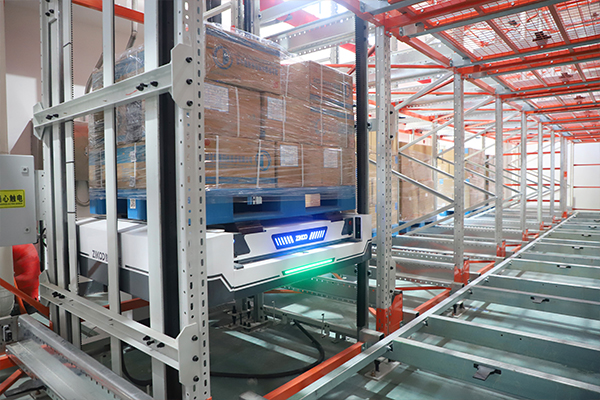
In food and beverage operations, deep lanes help store high-volume products while the WMS rotates batches to protect shelf life. In cold storage, the standard R-bot operates at temperatures down to −15°C, while a cold-chain configured version uses a dedicated low-temperature lithium battery for −25°C operation and can run 6–8 hours continuously on a full charge. Low-temperature charging port design and special PCBA coating support high-humidity freezer environments.
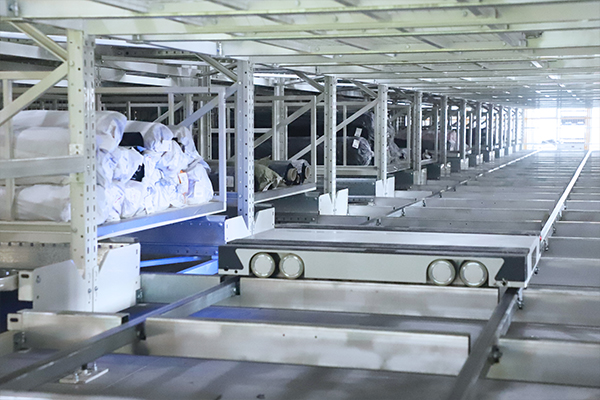
Pharmaceutical and constant-temperature warehouses benefit from pallet-level traceability and reduced operator travel. Instead of driving forklifts through multiple temperature zones, staff can work at a fixed picking station while the shuttle delivers pallets. This helps maintain temperature stability and supports lot-controlled workflows.
In manufacturing, four-way shuttles handle raw materials and finished goods in one compact system. They can interface with automated conveyors, robotic arms, or forklift drop-off points. Because the system is modular, a production warehouse can start with a smaller block and expand when product lines grow. E-commerce and 3PL operations benefit from mixed pallet profiles and peak-demand redistribution.
Planning and Procurement Checklist for High-Throughput Pallet Automation
Before comparing suppliers, collect the data that determines whether a four-way shuttle system will meet operational targets.
- Pallet types and dimensions, including damaged pallet share.
- Maximum and average pallet weights.
- Inbound and outbound pallets per hour at peak.
- SKU count and velocity profile.
- Building clear height, column grid, floor flatness, and dock locations.
- Temperature and humidity class.
- Required inventory depth and future expansion space.
- Current WMS/ERP integration constraints.
- Battery charging, maintenance access, and fire safety requirements.
- Acceptance test criteria and spare parts lead time.
Ask the supplier for a performance simulation, not only a shuttle speed specification. The throughput calculation should show shuttle count, lift count, workstations, and mission logic under peak load. Request a reference site with a similar SKU and order profile. Check whether the software layer is WMS, WES, WCS, and RCS compatible, because a four-way shuttle system is a software-driven material-flow system as much as a piece of hardware. Reference performance data should be measured using methods aligned with VDI 3561 or equivalent test parameters [3].
Get a Four-Way Shuttle Configuration Review
If you are planning a new dense-storage project or upgrading an existing warehouse, send the building layout, pallet specification, and throughput target to info@zikoo-int.com or call (+86)-19941778955. A focused technical review can identify whether a four-way shuttle system is the right architecture, what rack-and-lift combination fits the building, and how the PTP Smart Warehouse Software should be configured.
FAQ
What warehouse types are best for a four-way shuttle system?
Four-way shuttle systems fit medium- to high-density pallet storage with enough clear height for multiple storage levels. They are common in cold storage, pharmaceutical, food and beverage, manufacturing, e-commerce, and 3PL warehouses. They are less suitable when pallet movement is extremely simple, building height is very low, or SKU turnover is almost zero.
How is a four-way shuttle different from a stacker crane AS/RS?
A stacker crane AS/RS moves in an aisle between rack rows and is usually better for very high buildings with long, stable aisles. A four-way shuttle moves inside the rack cube across lanes and levels with the help of vertical lifts. It is generally more flexible and modular in medium-height buildings where storage density and expansion matter most.
What throughput can a four-way shuttle system achieve?
There is no universal pallet-per-hour figure because throughput depends on shuttle speed, lift capacity, lane depth, workstation count, and WCS mission logic. A supplier should provide a simulation based on your SKU profile, building constraints, and peak workload. Vehicle speed alone does not predict system throughput.
Can four-way shuttle systems work in cold storage?
Yes. Four-way shuttle systems are used in freezer and chiller environments. Standard R-bot shuttles operate at temperatures down to −15°C, and a cold-chain configured version supports −25°C operation with a dedicated low-temperature lithium battery. The design also supports low-temperature charging and high-humidity conditions.
What should buyers check before selecting a supplier?
Buyers should check real project references, software integration capability, rack compliance with EN 15620 and ANSI MH16.1, spare parts lead time, battery configuration, and acceptance test criteria. The supplier should also provide a performance simulation and a detailed implementation plan rather than only a hardware quotation.
Does a four-way shuttle system require a WMS/WCS upgrade?
In most cases, yes. The shuttle system needs WCS or RCS-level mission management to coordinate shuttle routes, lifts, and workstations. It must integrate with the existing WMS or ERP for inventory, orders, and replenishment. The integration effort should be part of the project scope and timeline.
References
- European Committee for Standardization. EN 15620:2008. Steel static storage systems — Adjustable pallet racking — Tolerances, deformations and clearances. Brussels: CEN.
- Rack Manufacturers Institute. ANSI MH16.1-2012 (R2019). Specification for the Design, Testing and Utilization of Industrial Steel Storage Racks. Charlotte, NC: RMI.
- Association of German Engineers. VDI 3561. Test parameters for storage and retrieval systems. Düsseldorf: VDI.
If you’re interested, check out these related articles:
Revolutionizing Cold Chain Logistics: Zikoo Robotics Six-Way Shuttle Powers High-Density, High-Efficiency Warehousing
Six-Way Shuttle: The Dual-Engine Solution for High-D
Six-Way Shuttle: Pioneering the Future of Smart Warehousing
Smart Cold Chain Era: Six-Way Shuttle System Redefines Storage Efficiency with Maximum Density


