


Managing low-turnover inventory creates a specific problem for warehouse operators: how to justify the floor space and labor costs when goods sit for months between picks. Conventional racking wastes vertical capacity and forces wide aisles that serve no purpose when forklifts visit a location twice a year. Four-way shuttle systems address this directly by compressing storage density and eliminating dedicated aisle requirements, which changes the cost structure for slow-moving SKUs in ways that static racking cannot match.
Why Low-Turnover Warehouses Face Different Cost Pressures
Low-turnover operations carry inventory that moves infrequently, sometimes only a few times annually. The challenge is not throughput but fixed cost allocation. Rent, utilities, and baseline staffing remain constant regardless of how often a pallet leaves the rack. When slow-moving SKUs occupy prime locations near dock doors or picking stations, they block faster inventory and inflate the cost per pick across the entire facility.
I have seen distribution centers where C-class items consumed 60% of available rack faces while generating under 10% of outbound volume. The math does not work. Space utilization becomes the primary lever for cost control in these environments, which means any storage method that increases density without sacrificing accessibility has a direct impact on operating margin.
How Four-Way Shuttles Differ from Conventional AS/RS
Four-way shuttle systems are a category of automated storage and retrieval systems designed specifically for high-density pallet handling. The defining characteristic is movement capability: these robots travel forward, backward, and laterally between lanes without requiring dedicated aisles for each storage channel. A two-way shuttle needs an aisle at the end of every lane to transfer pallets. A four-way shuttle does not.
This distinction matters for density calculations. Removing dedicated aisles typically recovers 25% to 35% of floor space compared to conventional selective racking. The shuttle accesses any pallet position independently, which eliminates the LIFO constraints of drive-in racking while maintaining comparable density.
The R-bot Four-Way Shuttle demonstrates current capabilities in this category. The unit measures 125 mm in body height, handles loads up to 1.5 tons, and operates in temperatures down to -15°C. When paired with vertical transfer equipment like the H-bot bidirectional shuttle, the system achieves six-way movement across multiple rack levels. This configuration adapts to facilities with varying ceiling heights and product dimensions without structural modifications to the racking. 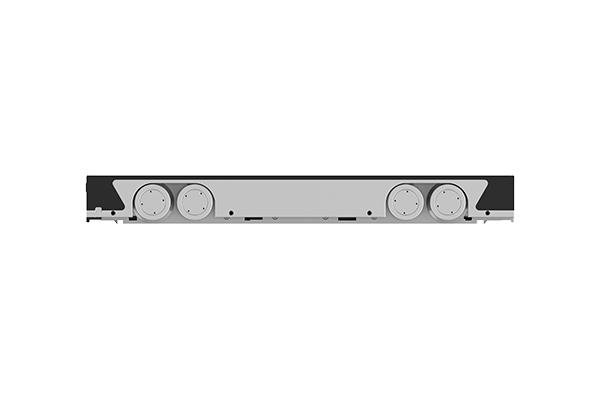
Where the Density Gains Actually Come From
The space recovery in four-way shuttle installations comes from three sources. First, aisle elimination compresses the horizontal footprint. Second, the shuttle’s low profile allows tighter vertical spacing between load beams. Third, the system stores pallets in deep lanes without the selectivity penalty that makes drive-in racking impractical for mixed SKUs.
A pharmaceutical client needed temperature-controlled storage for slow-moving raw materials with strict lot tracking requirements. Their existing cold storage facility was at capacity, and offsite warehousing was costing them roughly $180,000 annually in handling and transport fees. After installing a four-way shuttle system, they increased storage capacity by 40% within the same refrigerated footprint. The offsite storage requirement dropped to zero, and annual logistics costs fell by 25%. The payback period was under four years despite the low retrieval frequency.
Evaluating Whether the Investment Makes Sense for Slow Movers
Four-way shuttles require significant capital expenditure, and the ROI calculation differs from high-throughput applications. In a fulfillment center processing thousands of picks daily, labor savings dominate the payback model. In a low-turnover warehouse, space savings and inventory accuracy carry more weight.
| Factor | Benefit for Low-Turnover Operations | Consideration |
|---|---|---|
| Space density | Reduces facility footprint or delays expansion | High initial capital requirement |
| Labor reduction | Automates retrieval for infrequent picks | Requires trained technicians for system maintenance |
| Inventory accuracy | Eliminates location errors and cycle count discrepancies | Integration with existing WMS adds implementation complexity |
| Scalability | Modular design supports incremental capacity additions | ROI timeline extends compared to high-velocity applications |
| Safety | Removes operators from cold storage and high-rack environments | Demands reliable power and network infrastructure |
The decision depends on facility-specific variables. If your current space cost exceeds $8 per square foot annually and slow-moving inventory occupies more than 40% of your rack positions, the density improvement alone may justify the investment. If labor costs dominate your operating budget but retrieval frequency is genuinely low, the automation benefit diminishes relative to simpler mechanized solutions.
What Software Integration Actually Requires
Hardware alone does not deliver the efficiency gains. The shuttle system needs a software stack that manages inventory location, coordinates robot movement, and interfaces with upstream order management systems. This typically involves three layers: a Warehouse Management System for inventory visibility and task generation, a Warehouse Execution System for workflow orchestration, and a Warehouse Control System for real-time equipment commands.
The PTP Smart Warehouse Software suite integrates WMS, WES, WCS, and Robot Control System functions into a unified platform. This architecture handles dynamic slotting, which relocates inventory based on velocity changes, and coordinates multi-shuttle operations when several robots work the same rack block simultaneously. For low-turnover environments, the software’s value lies in maintaining location accuracy over long storage periods and optimizing retrieval sequences when batch picks do occur. 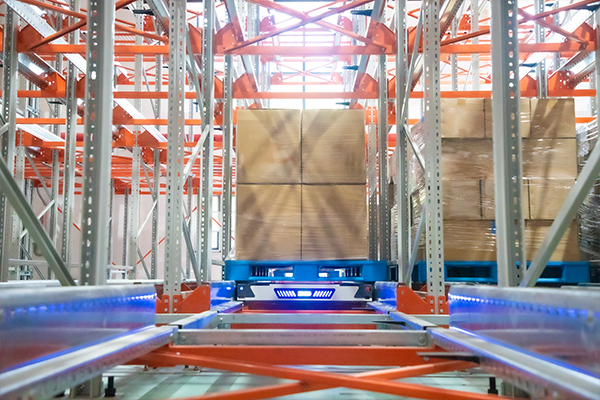
Comparing Alternatives Before Committing
Four-way shuttles are not the only option for improving low-turnover storage economics. The alternatives differ in capital intensity, automation level, and suitability for different product profiles.
Narrow-aisle racking with turret trucks increases density by 25% to 30% over conventional selective racking at a fraction of the automation cost. The tradeoff is continued labor dependency and the ergonomic limits of operating turret trucks for extended shifts.
Vertical Lift Modules provide exceptional density for small parts and cartons but cannot handle full pallets. They suit slow-moving components in manufacturing environments, not distribution centers with palletized inventory.
Pallet flow racking with FIFO lanes works for slow movers with expiration dates or lot rotation requirements but sacrifices selectivity. If your slow-moving inventory includes hundreds of SKUs with unpredictable retrieval patterns, flow racking creates operational constraints that four-way shuttles avoid.
The R-bot system’s cold storage capability becomes decisive in temperature-controlled applications. Manual picking in -15°C environments faces strict exposure limits, and labor availability for freezer work continues to tighten. Automating retrieval in these conditions removes a constraint that no amount of conventional racking optimization can address. 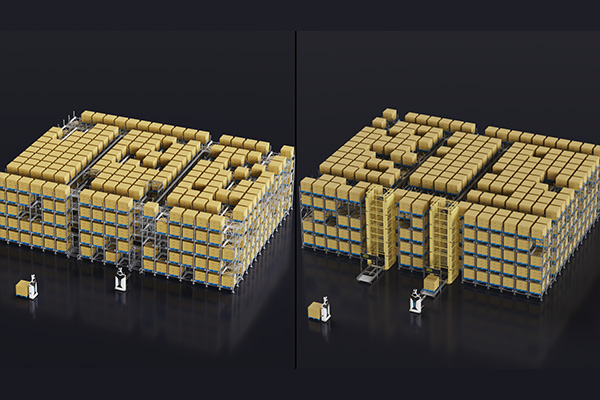
Frequently Asked Questions
Can four-way shuttle systems achieve positive ROI when retrieval frequency is genuinely low?
The ROI depends more on space cost and labor rates than on retrieval frequency. A facility paying $12 per square foot in a constrained market recovers capital faster through density gains than a facility paying $5 per square foot in a region with available land. The calculation should include avoided expansion costs, not just direct labor savings. In environments where slow movers currently occupy space that could serve faster inventory, the indirect benefit of freeing premium locations adds to the return.
How do these systems handle changes in SKU mix or storage volume over time?
The modular architecture allows capacity expansion by adding rack bays and shuttles without redesigning the installation. If SKU velocity shifts and former slow movers become active, the software adjusts slotting to relocate them closer to pick stations. This adaptability matters for operations where product lifecycles or seasonal patterns change storage requirements unpredictably. The system reconfigures through software rather than physical racking modifications.
What does ongoing maintenance involve for automated shuttle systems?
Preventive maintenance covers battery conditioning, wheel and rail inspection, and software updates. Most current systems include remote diagnostics that flag component wear before failures occur, which allows scheduled replacement during planned downtime rather than emergency repairs. Maintenance labor is specialized but infrequent compared to the daily attention conventional material handling equipment requires. If your situation involves temperature-controlled storage or high rack heights, it is worth discussing maintenance access provisions before finalizing the layout.
To discuss specific requirements for improving storage density in your low-turnover operation, contact us at info@zikoo-int.com or (+86)-19941778955.
If you’re interested, check out these related articles:
PTP Intelligent Warehousing Platform: Building a Flexible and Smart Logistics Ecosystem
Six-Way Shuttle: The Dual-Engine Solution for High-D
Six-Way Shuttle: The Smart Warehousing Tool for Cost Reduction and Efficiency
Six-Way Shuttle: Pioneering the Future of Smart Warehousing
Multi-Scenario Smart Adaptation: Zikoo’s Six-Way Shuttle Powers the Digital Transformation of Warehousing


