


When comparing a four-way shuttle system vs high-bay racking, the key metrics go beyond cost per pallet. Throughput, storage density, environmental tolerance, and software integration often determine which system delivers the better long-term return. In over a decade of designing pallet storage systems, I’ve seen warehouses overspend on high-bay racking when a shuttle system would have delivered more flexibility, and others adopt shuttles without fully planning the software layer. This article breaks down the engineering realities that separate the two, so you can choose based on how your operation actually runs.
What Sets a Four-Way Shuttle System Apart from High-Bay Racking?
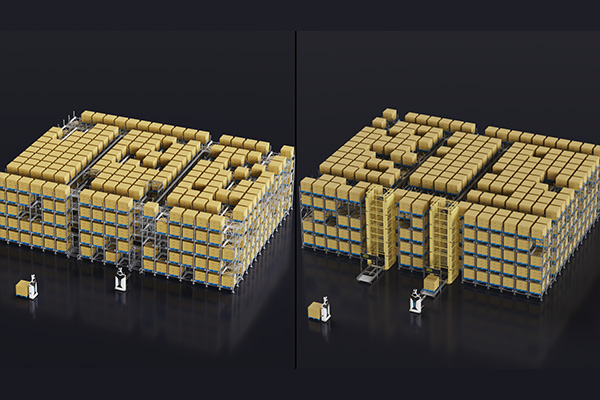
A four-way shuttle system is a dense storage solution where autonomous robots (shuttles) travel along rails to retrieve and store pallets at multiple depths within a rack structure. Unlike high-bay racking, which relies on stacker cranes in individual aisles, shuttles operate on multiple levels and can change direction at intersections, hence “four-way.” The shuttle’s ability to roam the rack’s lattice means it can access any pallet from any lane, while high-bay racking typically uses one crane per aisle with limited lateral reach. This architecture drastically reduces aisle space and allows higher storage density.
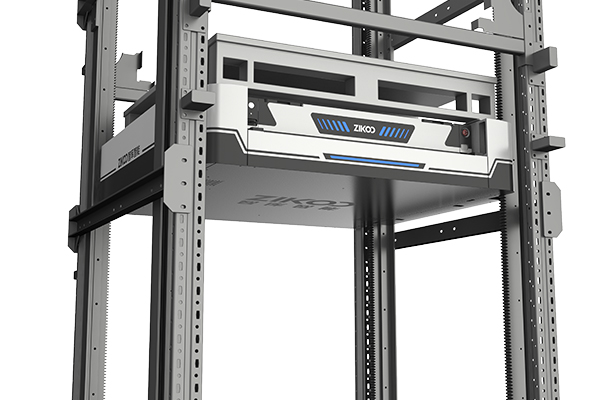
Shuttle systems also integrate with vertical lifts, such as Zikoo’s H-bot, to move pallets between levels, creating a six-way shuttle model for even denser storage. High-bay racking, in contrast, is a more established technology with a proven track record in single-deep, high-throughput environments. The choice often starts with this fundamental difference: shuttles trade higher initial complexity for better space utilization and flexible access, while racking offers simplicity and predictable performance.
Which System Delivers Better Storage Density and Throughput?
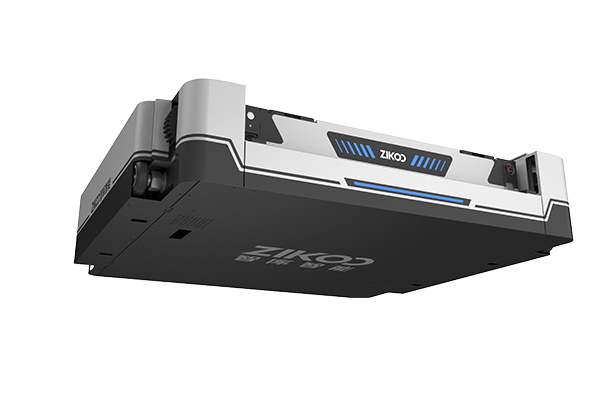
Storage density is where shuttle systems excel. With multi-deep lane storage, shuttles can place pallets multiple rows deep, compressing footprint by 30–50% compared to single-deep high-bay racking. Standard four-way shuttle systems can handle lanes up to 5–10 deep, while high-bay racking is limited to one pallet per aisle. The R-bot Four-way Shuttle from Zikoo, with a body thickness of just 125 mm and a load capacity of up to 1.5 tons, illustrates how compact design maximizes vertical storage as well, reducing floor-level obstructions.
Throughput, however, depends on configuration. A single shuttle can achieve travel speeds of 1.6 m/s (empty) and 1.2 m/s (loaded), and multiple shuttles work in parallel to fulfill orders. In high-movement scenarios, the system’s software orchestrates path optimization, effectively scaling throughput with the number of shuttles. High-bay racking with stacker cranes typically offers lower concurrent access because each aisle is served by one crane; adding more cranes raises cost and reduces space efficiency.
Here’s a side-by-side view:
| Feature | Four-Way Shuttle System | High-Bay Racking |
|---|---|---|
| Storage depth | Up to 10+ pallets deep | Usually single-deep |
| Access granularity | Independent shuttle per level | One crane per aisle, limited lanes |
| Throughput scaling | Linear with additional shuttles | Limited by crane speed and aisle count |
| Space utilization | 30-50% higher than racking | Standard, predictable |
| Typical robot speed | 1.6 m/s empty, 1.2 m/s loaded | Crane 2-3 m/s horizontal, 0.5 m/s vertical |
| Building height utilization | Economical up to 25 m | Can reach 40 m, but with wider aisles |
Building height influences the choice as well. Shuttle systems with vertical lifts work economically up to about 12–25 meters; high-bay racking can extend to 40 meters in rack-supported buildings, but at the cost of much wider aisles. In our projects, we’ve seen shuttle systems achieve 80–120 double cycles per hour per aisle, whereas a high-bay stacker crane in a comparable setup typically handles 40–60 cycles. The difference stems from shuttle independence and the path optimization algorithms that prevent bottlenecks.
How Does the Cost of Four-Way Shuttles Compare to High-Bay Racking?
Initial capital outlay for a shuttle system is generally higher because it includes robots, rails, software licenses, and integration. High-bay racking leans more on steel structure and fewer automated components, so upfront costs can be 20–30% lower. However, total cost of ownership (TCO) shifts over time. Shuttle systems reduce labor dramatically: a fully automated warehouse might need only a handful of operators versus a dozen forklift drivers in a manual racking environment.
Consider these cost buckets:
| Cost Category | Four-Way Shuttle System | High-Bay Racking |
|---|---|---|
| Racking structure | 30-40% of total | 40-50% of total |
| Automation (robots, cranes, lifts) | 40-50% | 20-30% |
| Software (WMS/WES/WCS) | 10-15% | 5-10% |
| Installation and commissioning | 10-15% | 10-15% |
| Annual maintenance | 3-5% of automation value | 2-4% of crane/mechanical value |
| Labor savings | 60-80% reduction | 30-50% reduction |
Shuttle systems also scale more gracefully. Adding more shuttles to existing lanes is simpler and less disruptive than installing a new crane aisle. Over 7–10 years, labor savings and increased throughput often recoup the higher initial investment. In cold storage environments, shuttles reduce the need for human access in harsh temperatures, further justifying the cost.
If your financial analysis depends on precise throughput targets or extreme temperature operation, it’s worth verifying the shuttle’s capacity before finalizing the budget. Reach out at info@zikoo-int.com for a detailed discussion of how these numbers apply to your facility.
Can Four-Way Shuttles Match High-Bay Racking’s Reliability?
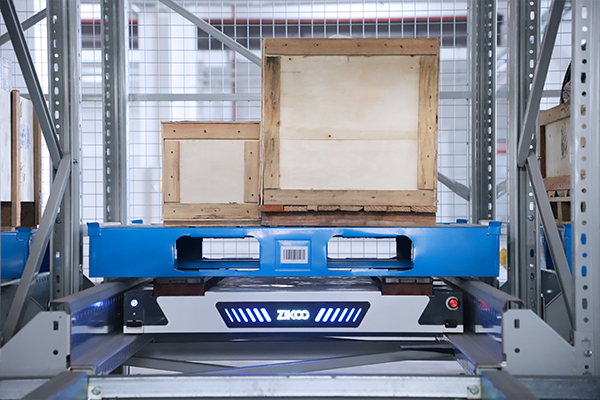
High-bay racking itself has few moving parts, so structural reliability is excellent. The vulnerability lies in the stacker crane: motors, bearings, and cables require regular maintenance. Shuttle systems add more robots, each with its own battery and drive components, but modern shuttles are designed for high uptime. Our R-bot series, for example, uses lithium batteries (51.2V/40Ah) that run 8 hours on a full charge and support opportunity charging during idle periods.
In demanding environments like cold storage at -25°C, shuttles with specialized low-temperature batteries and conformal coating on electronics maintain performance. We’ve deployed shuttle systems for seafood and pharmaceutical distribution where temperatures remain consistently at -25°C, and the shuttles achieve 6–8 hours of continuous operation with automated charging. High-bay racking cranes can also operate in cold, but often require heated enclosures on components, adding complexity.
Maintenance-wise, a failed shuttle robot can be removed and replaced in minutes without stopping overall operations, because multiple shuttles share the workload. A crane failure, in contrast, can shut down an entire aisle until repaired. However, shuttle systems demand more software oversight—network failures or WCS bugs can affect fleet coordination. Having a robust software platform with failover capabilities is essential.
From a reliability standpoint, shuttle systems are no longer an experiment. With proper thermal management and a strong software layer, they match or exceed racking crane uptime in many applications. The key is selecting components rated for your environment.
How to Decide Between a Four-Way Shuttle System and High-Bay Racking
Start with your operational data: SKU count, pallet dimensions, throughput per hour, and any special storage conditions (temperature, load weight). If your warehouse holds a wide variety of SKUs with variable demand, a shuttle system’s flexible access and ability to handle mixed pallet sizes—our R-bot handles standard, American, Japanese, and heavy-duty 1400 mm pallets—gives it an edge. For stable, high-volume, low-SKU operations, high-bay racking with a stacker crane may still be the most cost-effective.
Software integration is another decision point. Shuttle systems rely on WMS/WES/WCS to orchestrate movement; if your facility already has a mature WMS, integration is manageable but needs planning. Zikoo’s PTP Smart Warehouse Software (WMS/WES/WCS/RCS) is designed to unify shuttle, lift, and conveyor control, which reduces integration risk. Without strong software, a shuttle fleet cannot deliver its full potential.
Building constraints also matter: shuttle systems need a flat floor and sufficient height for vertical lifts, while high-bay racking may require taller, rack-supported structures. Retrofitting an older warehouse with a shuttle system often demands limited modifications compared to installing new cranes.
Ultimately, the best system is the one that aligns with your long-term material flow. I recommend mapping your last 12 months of inventory movement, including peaks, and running a simulation with both configurations. Many suppliers offer simulation services to visualize performance.
Are You Ready to Explore a Custom Comparison?
Deciding between a four-way shuttle system and high-bay racking is rarely straightforward, and a misstep can cost years of inefficiency. Our engineering team at Zikoo Smart Technology—with real-world deployments across cold chain, manufacturing, and e-commerce—can build a detailed simulation based on your SKU profiles and facility layout. Send your warehouse dimensions, throughput targets, and any special requirements to info@zikoo-int.com or call (+86)-19941778955, and we’ll deliver a clarity-driven comparison that shows the actual numbers for your operation.
Common Questions About Shuttle and Racking System Selection
Is a four-way shuttle system more expensive than high-bay racking in the long run?
Over a 7–10 year period, shuttle systems often have lower total cost thanks to labor savings and higher throughput. Upfront costs are higher, but the ROI can be as short as 2–3 years in high-throughput environments. In our experience, cold storage facilities recoup investment faster due to reduced heating costs.
Can an existing warehouse be retrofitted with a four-way shuttle system?
Yes, in most cases. Shuttles can be installed into existing racking with minimal modifications, as long as the floor is flat and the rack structure is compatible. Retrofitting high-bay racking with cranes is more invasive. We’ve completed renovations where standard pallet rack was converted to shuttle lanes within weeks.
What industries benefit most from four-way shuttle systems over high-bay racking?
E-commerce, cold storage, pharmaceuticals, and manufacturing with high SKU variability see the biggest gains. Shuttles handle mixed pallet sizes and temperature requirements easily. High-bay racking still suits dedicated production lines with stable demand.
How does software integration differ between the two systems?
Both require WMS/WCS, but shuttle systems need more advanced fleet management and path planning. A unified platform like PTP Smart Warehouse Software simplifies this by combining WMS, WES, WCS, and RCS in one suite, reducing integration complexity. If your existing software can’t handle dynamic routing, the shuttle’s advantage narrows. Share your requirements to evaluate compatibility—reach us at info@zikoo-int.com for a quick assessment.
If you’re interested, check out these related articles:
PTP Intelligent Warehouse Software Empowers Enterprises for Smart Upgrades
Multi-Scenario Smart Adaptation: Zikoo’s Six-Way Shuttle Powers the Digital Transformation of Warehousing


