


Pallet movement is the backbone of warehouse performance, but the robot choice changes the entire building design. Two automation paths dominate today: rack-resident four-way shuttles that move pallets inside storage lanes, and AGV fleets that move pallets across the floor. The better question is not which machine is faster in a lab, but which architecture better fits your pallet profile, ceiling height, throughput peaks, and long-term operating cost.
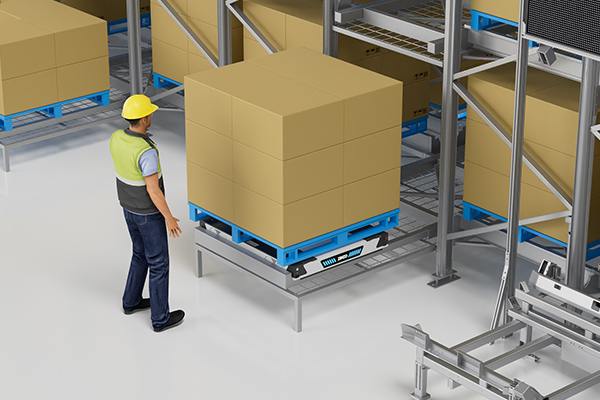
The Architecture Divide: Rack-Resident Shuttles vs Floor-Run AGVs
A four-way shuttle operates on rails embedded in the racking structure. It moves forward, backward, left, and right within a storage level, then uses a vertical transfer unit such as an H-bot lift to move between levels. The rack itself becomes the shuttle’s working surface, so the system can place pallets into deep lanes without forklift aisles.
An AGV or AMR pallet mover operates on the warehouse floor. It follows traffic paths, picks a pallet from a conveyor or drop station, and transports it to another floor location. This is useful for point-to-point movement, but the AGV still depends on traditional racking, lift trucks, or transfer equipment to put pallets into storage at height.
The regulatory boundary also differs. Rack-integrated shuttle systems fall under rail-dependent storage and retrieval equipment covered by EN 528 [1], while driverless pallet trucks and AGV systems are addressed by ISO 3691-4 [2]. Both require risk assessment, but the safety zones, emergency stops, and control system logic are different because the travel envelope is different.
Storage Density and Throughput: Two Different Kinds of Efficiency
Four-way shuttle systems tend to win when the warehouse is constrained by floor area or building height. Because the shuttle moves inside the rack, lane depth can be increased without adding an aisle for every storage position. The result is more pallet positions per square meter and less dead floor space for robot traffic.
AGV fleets trade some storage density for operational flexibility. They can move between production lines, docks, and storage areas without fixed rail infrastructure, and route changes can be made by redrawing maps in software. But every AGV still needs a travel lane, a turning zone, a charging area, and a pick-and-drop interface.
The accurate way to model these differences is a simulation study using standard cycle-time methods such as FEM 9.851 [3] and VDI 4480 [4]. A pallet mover that is always waiting for an aisle to clear will not deliver the throughput promised by a catalog cycle time.
| Decision factor | Four-way shuttle system | AGV fleet |
|---|---|---|
| Storage depth | Deep multi-deep lanes | Usually single- or double-deep rack |
| Floor aisles | Minimal, rack-integrated travel | Fixed traffic lanes needed |
| Vertical travel | Built-in lift between levels | Usually one level unless served by lift |
| Pallet handoff | Direct rack transfer | Conveyor or drop station required |
| Route flexibility | Defined by rack layout | Software-defined paths |
| Typical failure response | Reroute to another shuttle | Reroute to another AGV |
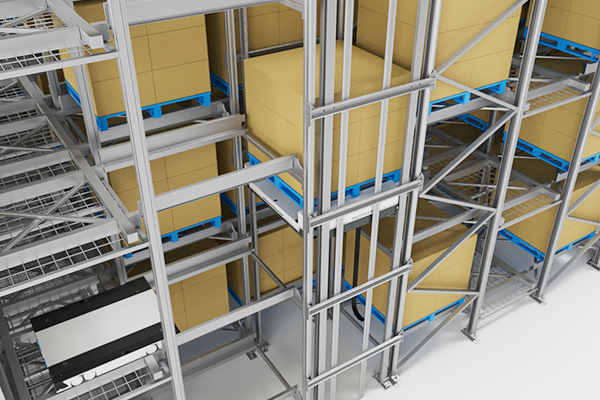
When pallet density is the bottleneck, the rack itself becomes the workspace. <Six-Way Shuttle Powers Dense Storage: Breaking Space Limitations> covers the layout and space trade-offs in dense storage design.
Need a first-pass layout check for your pallet dimensions and rack height? Email your SKU and pallet data to info@zikoo-int.com or call (+86)-19941778955, and the engineering team can compare shuttle lane and AGV aisle options against your warehouse geometry.
Software Orchestration: WCS Mission Control vs AGV Fleet Manager
Four-way shuttles are usually controlled by a warehouse control system that assigns tasks, reserves lanes, coordinates lifts, and prevents deadlock. The WCS connects to WMS orders and releases retrieval commands only when the outbound station is ready. This makes shuttle behavior predictable at high throughput because the rack, lift, and shuttle are modeled as one system.
AGV fleets use a fleet manager for traffic control, charging, and mission dispatch. The fleet manager may need to integrate with separate WMS and warehouse equipment, especially when AGVs depend on conveyors or ASRS interfaces. In complex facilities, that integration effort can be larger than the robot configuration itself.
Fleet orchestration is only as good as the control layer behind it. <PTP Intelligent Warehousing Platform: Building a Flexible and Smart Logistics Ecosystem> covers how WMS, WES, WCS, and RCS layers coordinate pallet moves across equipment.
Operating Envelope: Cold Storage, Peaks, and Redundancy
Cold storage is one of the clearest differentiators. Four-way shuttles operate inside the rack structure, so fewer machines need to travel through sub-zero zones with personnel. Engineering variants can use low-temperature lithium batteries and protected electronics. For example, the R-bot Four-way Shuttle standard models operate down to -15°C, while a cold-chain version is configured for -25°C operation with a dedicated low-temperature battery and charging arrangement. The H-bot vertical lift provides pallet transfer between levels with ±1 mm positioning accuracy, which reduces the risk of misaligned pallet drops in an unmanned freezer.
AGVs can work in cold storage, but the floor surface, battery capacity, condensation, and tire or wheel material all require careful specification. Battery runtime drops in cold environments, and charging zones may need to be placed outside the freezer to preserve cycle life.
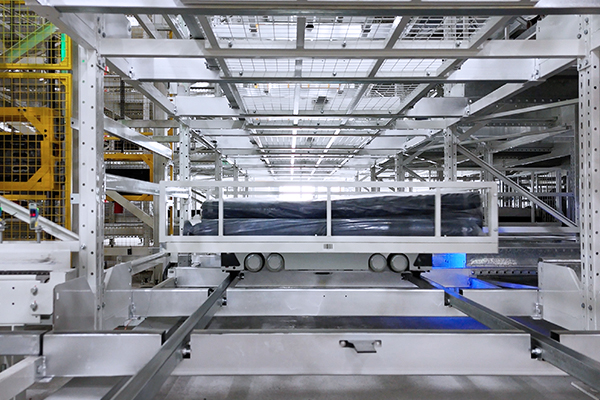
For peak demand, shuttle systems can usually add more shuttles per level or redistribute shuttles across zones. AGV fleets can also scale by adding vehicles, but the added traffic can reduce average speed unless the facility has enough floor space for clear routes.
Cost and ROI: Upfront Scope vs Long-Term Floor Space
A four-way shuttle system often carries a higher initial automation scope because it includes racking, rails, lifts, and WCS integration. An AGV fleet may have a lower first-stage cost because it can be implemented with existing racking and floor operations. That does not mean it is cheaper per pallet position.
The better method is to compare cost per stored pallet, cost per completed pallet movement, and labor removed per shift. The calculation should include energy, maintenance, spare parts, software licenses, facility changes, and charging infrastructure [4]. In dense high-bay buildings, the shuttle may be cheaper per pallet position because it eliminates many square meters of aisle space. In a low, spread-out building with long travel distances, an AGV fleet may be the lower-cost path.
If you are comparing quotes, send your facility height, pallet mix, and expected throughput profile to info@zikoo-int.com. A layout-level comparison will show whether the business case favors rack-integrated shuttles or an AGV fleet.

Where Each Technology Fits
Choose a four-way shuttle system when pallet storage density is high, ceiling height is significant, order profiles require fast pallet access, or the warehouse must operate in cold or narrow-aisle conditions. It is especially strong for distribution centers, 3PL hubs, cold-chain facilities, and manufacturing plants with dense finished-goods inventory.
Choose an AGV fleet when the main need is flexible floor-level transport between production cells, docks, and staging areas. AGVs also suit facilities with low clear heights, short lease terms, or production routes that change frequently. In many large operations, the strongest design uses both: four-way shuttles for dense storage and AGVs or AMRs for line-side delivery and floor transport.
Before choosing, it helps to compare shuttle-based storage with conventional ASRS. <Stacker Crane vs Four-Way Shuttle: Which Fits Your ASRS Warehouse Best> covers the performance and layout factors that separate shuttle architectures from crane architectures.
Engineering Verification Before You Compare Quotes
A paper comparison can hide the most important details. Before accepting any robot comparison, verify these engineering points:
- Pallet type and condition: are pallets standardized, or will damaged pallets cause shuttle positioning errors?
- Load center and weight range: the system must handle your heaviest pallet, not only the average pallet.
- Cycle count: daily pallet moves should be modeled, not estimated as a single average.
- Battery runtime and charging strategy: confirm cold-start performance and opportunity charging behavior.
- Rack compliance: shuttle rails must match rack tolerances, floor flatness, and deflection limits.
- WCS integration scope: clarify who owns the handoff between WMS, WCS, and the robot layer.
- Redundancy: what happens when one shuttle or one lift is offline?
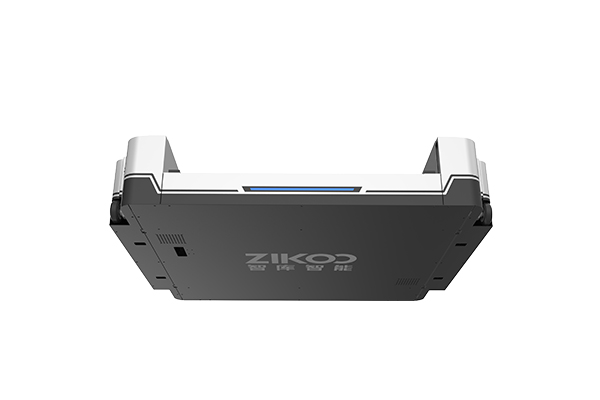
As a reference point, a shuttle family should cover multiple pallet standards. The R-bot Four-way Shuttle, for example, includes European, American, Japanese, and heavy-duty large-pallet models with rated loads from 1,200 kg to 2,000 kg and a body height as low as 125 mm. That matters because a 125 mm-high shuttle can enter racking positions that a floor AGV cannot reach, which is an architectural advantage rather than a software feature.
Start Your Pallet Mover Comparison
The best decision comes from a layout-level study that compares pallet positions, cycle times, energy, labor, and service continuity. Send your CAD layout, SKU profile, pallet type, facility height, and peak throughput to info@zikoo-int.com or call (+86)-19941778955. The engineering team can assess whether a four-way shuttle, an AGV fleet, or a hybrid design gives the lowest total cost per pallet movement for your operation.
FAQ
Is a four-way shuttle always better than an AGV fleet for pallet movement?
No. A four-way shuttle is usually stronger for dense, high-bay pallet storage and high-throughput retrieval. An AGV fleet is often better for flexible floor transport, production line feeding, and facilities with low clear heights. The right choice depends on building geometry and operating logic.
What warehouse size justifies a four-way shuttle system?
There is no fixed minimum, but the strongest case appears when storage density and vertical travel matter. If the warehouse has sufficient ceiling height and a large enough pallet population, the shuttle system can exploit cubic space that an AGV fleet cannot.
Can four-way shuttles operate in cold storage?
Yes. Cold-chain shuttle configurations can use low-temperature batteries, protected electronics, and cold-compatible charging arrangements. For example, the R-bot Four-way Shuttle standard models operate down to -15°C, and a dedicated cold-chain version is configured for -25°C.
Does a four-way shuttle require a full ASRS rack installation?
Yes, a four-way shuttle requires racking with integrated rails and a vertical transfer unit such as an H-bot lift. This makes it a larger initial project than adding AGVs to existing rack, but it removes many floor aisles from the design.
Which system is easier to scale after installation?
Both can scale, but in different ways. A shuttle system scales by adding shuttles per level, expanding rack lanes, or adding lifts. An AGV fleet scales by adding vehicles and charging stations, but traffic congestion can become a limiting factor.
How do four-way shuttles and AGVs compare on maintenance?
Four-way shuttles have fewer floor-contact wear parts in some designs, but rack, rail, and lift maintenance require specialized service. AGVs need floor surface, wheel, battery, and sensor maintenance. Both require a disciplined spare-parts and service plan.
References
[1] European Committee for Standardization. EN 528:2008+A1:2020, Rail dependent storage and retrieval equipment — Safety requirements. CEN, Brussels, 2020.
[2] International Organization for Standardization. ISO 3691-4:2023, Industrial trucks — Safety requirements and verification — Part 4: Driverless industrial trucks and their systems. ISO, Geneva, 2023.
[3] European Materials Handling Federation. FEM 9.851, Performance Data of S/R Machines — Cycle Times. FEM, 2003.
[4] Association of German Engineers. VDI 4480 Part 1, Throughput of automatic warehouses with lane-bound shelves. Beuth Verlag, Berlin, 2002.
If you’re interested, check out these related articles:
Reshaping Warehouse Value: Six-Way Shuttle Leads the Digital Transformation
Looking for Reliable Four-Way Shuttle Manufacturers? Choose Zikoo Robotics
Stacker Crane vs Four-Way Shuttle: Which Fits Your ASRS Warehouse Best


