


In a manufacturing warehouse, raw material and finished goods rarely follow the same movement pattern. Raw pallets arrive in bulk, wait for production, and move out in bursts; finished pallets accumulate after production and leave on shipping schedules. 4-way shuttles for raw material and finished goods handling solve a specific problem: dense storage without locking pallets into fixed lanes. In projects I have supported, the same shuttle aisle served incoming raw aluminum coils during the day and wrapped finished pallets at night; throughput held because the shuttle could bypass slow-moving pallets instead of waiting in line. The deciding factor was not speed alone. It was route flexibility under real production pressure.
Where Do 4-Way Shuttles Fit in Raw Material and Finished Goods Handling?
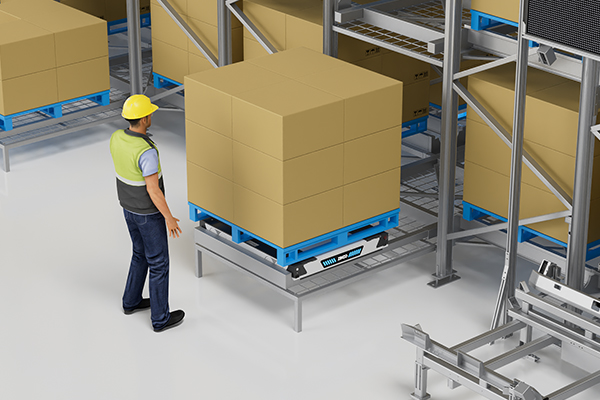
A four-way shuttle system combines a horizontal pallet shuttle with vertical lifts to store and retrieve pallets in dense racking. The shuttle travels in four directions inside the racking, changes lanes, and transfers pallets to a vertical shuttle at the face of the rack. For manufacturing warehouses, this creates a buffer that operates without dedicated forklift aisles between every storage row.
Raw material and finished goods handling covers two different flows. Raw material pallets normally wait for production line issue, while finished goods pallets wait for outbound staging. A fixed-lane AS/RS may work when each SKU has a stable location, but many manufacturing sites cannot commit pallets to permanent positions because lot numbers, order changes, and urgent production calls move buffers every shift.
In those cases, the four-way shuttle earns its place by letting pallets occupy any open location and by letting the WCS recalculate routes as order priorities change. This is the main reason I recommend it for factories that have multiple production lines pulling from the same inbound buffer.
What Should You Check Before Applying 4-Way Shuttles to Raw Material and Finished Goods?
Before evaluating suppliers, I ask for three data sets: pallet dimensions, hourly pallet movements, and the shelf life or batch rule for each material category. These inputs change the shuttle model, rack depth, and lift count more than the warehouse total square meters.
| Check | What it affects | Raw material and finished goods difference |
|---|---|---|
| Pallet size and load | Shuttle model selection | Raw pallets may arrive on nonstandard timber pallets; finished pallets may be smaller but heavier. |
| Hourly pallet throughput | Number of shuttles and lifts | Raw issue spikes around production shifts; finished goods peaks before dispatch. |
| Storage temperature | Battery and component coating | Cold chain raw materials need low-temperature battery; finished goods may stay ambient. |
| SKU count and lot control | WMS batch rules and location strategy | Raw materials often lot-controlled; finished goods require SKU-level picking. |
| Rack depth | Travel time and lane capacity | Deeper lanes raise density but slow access to blocked pallets. |
The table explains why two factories with the same square meters can end up with different shuttle counts. A raw material buffer that moves 40 pallets per hour in two bursts is not the same load as a finished goods buffer that moves 40 pallets per hour evenly across a shift. The shuttle fleet needs to handle the burst, not the average.
The layout decision should not wait until after the racking quote. <Smart Warehousing Starts Here: Cost-Effective Four-Way Shuttle Systems> covers how starting with pallet dimensions and aisle constraints avoids paying for machine capacity the warehouse cannot use.
Which R-bot Four-Way Shuttle Specifications Matter for Mixed Pallet Loads?
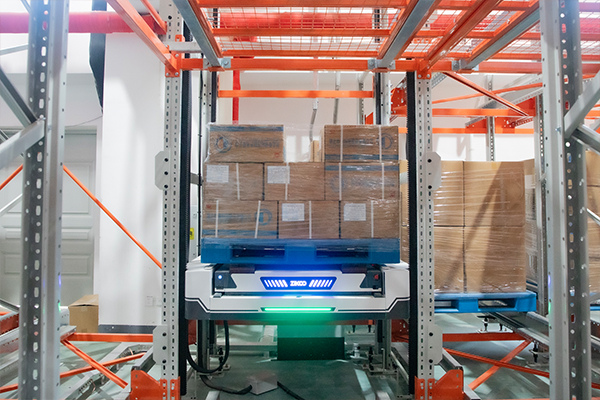
We run the R-bot four-way shuttle as the horizontal carrier in dense storage blocks. The specification I check first is not the empty speed. It is the loaded speed and the body height, because raw material and finished goods pallets rarely arrive at the same quality of base or the same flatness.
| Model type | Rated load | Body dimensions | Pallet size handled |
|---|---|---|---|
| Standard R1200B | 1200 kg | L1000 × W972 × H125 mm | 1200 × 800–1000 mm |
| American R1200A | 1200 kg | L1192 × W840 × H125 mm | 1016 × 1219 mm |
| Japanese R1500J | 1500 kg | L1192 × W900 × H125 mm | 1100 × 1100 mm |
| Heavy-duty R1500B | 1500 kg | L1192 × W972 × H125 mm | 1200 mm |
| Heavy-duty Large Pallet R2000B | 2000 kg | L1250 × W1300 × H150 mm | 1400 mm |
All models except the large pallet type run at 1.2 m/s loaded and 1.6 m/s empty. The heavy-duty large pallet type runs at 1.0 m/s loaded and 1.35 m/s empty. Those differences matter when a warehouse mixes standard 1200 mm pallets with larger export pallets. A system sized for standard pallets may still transport the bigger base, but it does so with more wear on the wheels and a slower cycle, which cuts throughput at the lift.
Battery life is the second filter. Most R-bot models operate in temperatures down to -15°C and run 8 hours on a full charge. The heavy-duty large pallet type runs 7 hours. For cold chain raw material, the solution uses a -25°C low-temperature lithium battery with a low-temperature charging port, so the shuttle can stay inside the cold room instead of leaving to charge. That saves floor space and avoids condensation problems.
If your finished goods pallets exceed 1200 kg or use nonstandard bases, the shuttle model decision affects rack depth and lift sizing. It is worth confirming the pallet load and base condition before finalizing the layout. Send those two details to info@zikoo-int.com.
Why Is Finished Goods Buffering Different from Raw Material Storage?
Production teams often ask whether one shuttle zone can serve both raw material and finished goods. The answer is yes, but only if the software separates the two movement patterns. Raw material retrieval is batch-driven. Finished goods buffering is order-driven.
The shuttle does not care whether it is moving an incoming steel coil or a wrapped finished pallet. The lift and the rack depth do. Raw material pallets usually move by lot or SKU in large quantities. Finished goods pallets often need to stage by customer order, carrier cut-off, or route. That creates more partial pallet moves and more priority changes.
On one project, we placed heavier raw material pallets in first in, first out lanes and finished goods in random-access deeper lanes. The WCS kept a protected allocation for the production line while releasing finished stock to the dock. The separation was not physical; it was route logic. That prevented the dock from stealing the shuttle time production needed, which kept line-side replenishment stable.
Finished goods buffering multiplies the pallet positions you need before dock doors. <Six-Way Shuttle Powers Dense Storage: Breaking Space Limitations> shows why vertical depth changes the space equation more than adding another rack row.
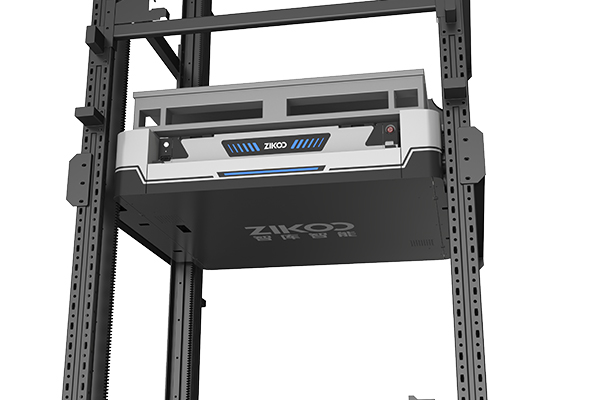
If the building height permits, adding an H-bot vertical shuttle turns the same racking block into a six-way shuttle network. Pallet movement then has vertical, horizontal, and lane-change options, which shortens the path from high rack to dock. For finished goods, that means late orders can be retrieved without emptying the whole lane.
How Do You Plan a Four-Way Shuttle Project Inquiry?
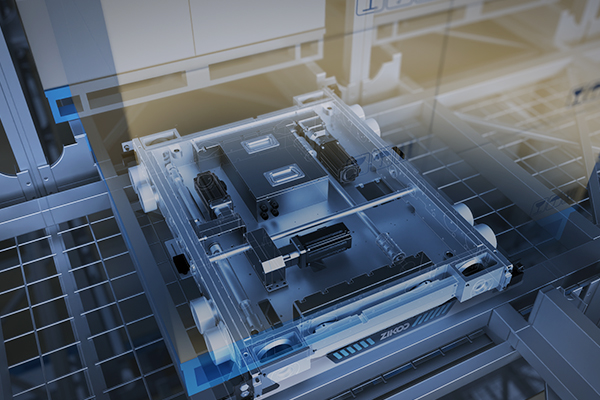
Most manufacturing inquiries stall because the first message is too broad. The fastest way to get a realistic design is to send the pallet type, maximum load, hourly inbound and outbound pallet counts, warehouse height, and temperature range. If finished goods leave through multiple dock doors at different times, include the dispatch schedule. These details let a supplier check shuttle count, lift count, and rack depth before the first meeting.
The physical shuttle is only one layer. <Six-Way Shuttle System Leads the Shift from Machines to Robots in Dense Storage Automation> covers why the control logic and robot coordination matter more than the hardware count when raw material and finished goods share one system.
At Zikoo Smart Technology, the next step is not a generic quote. It is a layout check against your actual pallet flow. If your warehouse handles raw material and finished goods in the same block, share the pallet sizes, maximum load, hourly movements, and temperature range. We can confirm the shuttle model, rack depth, and lift count that fit the operation, then return a technical proposal. Send those details to info@zikoo-int.com or call (+86)-19941778955.
What Questions Do Buyers Ask About 4-Way Shuttles for Raw Material and Finished Goods Handling?
Can one four-way shuttle system handle raw material and finished goods in the same racking block?
Yes, but the layout and WCS rules must separate the two flows. Raw material pallets usually operate by lot and production issue priority, while finished goods pallets operate by customer order, carrier cut-off, and dock schedule. If both share the same racking block, the shuttle can move pallets for either flow. The risk is not the hardware; it is a WCS rule that lets dockside requests consume shuttle time needed for line supply. Set separate allocation windows or priority thresholds so production replenishment stays ahead of dispatch.
Is a four-way shuttle overkill for a low-throughput raw material warehouse?
A low pallet count does not automatically make a four-way shuttle the wrong choice. The decision turns on density, mix, and future expansion. If 300 pallet positions are enough and all pallets are the same size, a simpler lane-based shuttle may cost less. If the warehouse must store raw material and finished goods in the same footprint, or if pallet sizes vary between 1200 mm and 1400 mm, the route flexibility of a four-way shuttle avoids adding more aisle infrastructure later. I would not size it from today’s pallet count alone; I would size it from the peak pallet count plus one line expansion.
What temperature conditions can four-way shuttles handle?
The answer depends on whether the warehouse is ambient or cold chain. Standard R-bot models operate down to -15°C and run 8 hours on a full charge. For cold chain raw material or frozen finished goods, we use a -25°C low-temperature lithium battery with a low-temperature charging port, which lets the shuttle stay inside the cold room instead of traveling out to charge. The main operational difference is battery swap or charging strategy, not the basic pallet movement. Check the temperature profile of the exact material before committing to a standard model.
How do we verify the shuttle model fits our pallet base before buying?
In projects we have supported, the fastest check is to send a photo of the pallet underside and the rated load. Pallet bases with broken boards, wide gaps, or protruding nails can reduce shuttle transfer reliability, so the model selection should follow the worst pallet in the fleet, not the best. We also ask for the maximum pallet height and the load distribution. That information confirms whether a standard R1200B or a heavy-duty R2000B is appropriate. Share your pallet dimensions, underside condition, and peak hourly pallet moves, and we will confirm the correct model and rack depth at info@zikoo-int.com.
If you’re interested, check out these related articles:
Six-Way Shuttle Empowers 3PL Providers to Build Next-Generation Smart Logistics Hubs
Multi-Scenario Smart Adaptation: Zikoo’s Six-Way Shuttle Powers the Digital Transformation of Warehousing


