


Modern warehouse operations are under more pressure than ever, and the old playbook isn’t cutting it. We’ve seen firsthand how Automated Storage and Retrieval Systems (ASRS) can turn that pressure into performance. On a recent site visit, for example, we watched a four-way shuttle glide through a dense rack and pull a pallet in seconds—what used to take minutes on foot. That moment summed up the promise: better use of space, faster throughput, and leaner costs. In the pages below, we break down where traditional setups struggle, how ASRS address those pain points, and the practical, measurable wins we’ve watched clients achieve.
Understanding the Challenges in Traditional Warehouse Operations
Traditional warehouses come with built-in constraints that slow teams down and chip away at margins. As e-commerce grows and labor dynamics shift, those issues get louder. We run into these same themes time and again when helping clients update their operations.
1. The Growing Demands on Modern Logistics
Rising e-commerce volumes and “I want it tomorrow” expectations push warehouses to move more, faster, and with greater flexibility. Manual processes simply struggle to keep pace when order spikes hit or SKU counts climb.
2. Common Inefficiencies and Bottlenecks
Manual picking invites mispicks and inventory mismatches, which trigger delays and rework. Wide aisles and low-density layouts waste precious cubic space, compounding congestion and slowing flow. The result is higher operating costs and a hit to customer satisfaction.
3. The Impact of Labor Shortages and Rising Costs
Skilled warehouse labor is hard to find—and expensive. When a process leans heavily on people for repetitive tasks, daily performance becomes vulnerable to staffing gaps and wage inflation. Automation helps stabilize output while reducing exposure to those fluctuations.
How Automated Storage and Retrieval Systems Enhance Efficiency
ASRS bring a step-change to warehouse management by automating the very tasks that bog down traditional operations. Using robotics and intelligent software, these systems streamline movement, tighten control, and make better use of space and time. If you are interested in how these systems enhance efficiency, check 《Understanding ASRS Systems for Modern Warehouse Efficiency》.
1. Maximizing Space Utilization with High-Density Storage
ASRS capitalize on vertical space, packing more inventory into the same footprint—a major win where real estate is costly. Our R-bot Four-way Shuttle and H-bot Vertical Bidirectional Shuttle are built for this, enabling high-density configurations without sacrificing access.
2. Boosting Throughput and Speed in Order Fulfillment
By automating storage, retrieval, and handoff, ASRS cut travel time and manual touches. Orders move faster and more predictably, and peak periods become far easier to manage without adding headcount.
3. Reducing Operational Costs Through Automation
Automating repetitive motions reduces labor dependency and the errors that come with fatigue and manual handling. Combine that with smarter space use and energy-efficient designs, and the cost savings add up. For many teams, the ROI is both compelling and quick to materialize.
Exploring Key Technologies Within ASRS Solutions
ASRS solutions blend multiple technologies into a cohesive system. Each piece—robotics, lifts, shuttles, and software—plays a role in how inventory is stored, retrieved, and moved across the facility.
1. The Role of Pallet-to-Person Robotics in Automation
Pallet-to-person robotics bring the work to the operator instead of the other way around. That means less walking, safer conditions, and far higher pick efficiency. Zikoo’s R-bot Four-way Shuttle is a strong example of this approach in action.
2. Integrating Four-Way Shuttles for Flexible Movement
Four-Way Pallet Shuttle systems, like our R-bot, offer unmatched agility in dense storage. Moving in all four directions unlocks dynamic slotting and fast access to any pallet, which is critical for maximizing space and throughput in busy operations.
R-bot Four-way Shuttle Specifications
| Model | Weight (kg) | Rated Load (kg) | Dimensions (L×W×H mm) | Pallet Sizes Supported (mm) | Empty Speed (m/s) | Loaded Speed (m/s) | Continuous Operation (hours) |
|---|---|---|---|---|---|---|---|
| Standard (R1200B) | 270 | 1200 | 1000 × 972 × 125 | 1200 × 800–1000 | 1.6 | 1.2 | 8 |
| American (R1200A) | 265 | 1200 | 1192 × 840 × 125 | 1016 × 1219 | 1.6 | 1.2 | 8 |
| Japanese (R1500J) | 270 | 1500 | 1192 × 900 × 125 | 1100 × 1100 | 1.6 | 1.2 | 8 |
| Heavy-duty (R1500B) | 275 | 1500 | 1192 × 972 × 125 | 1200 | 1.6 | 1.2 | 8 |
| Heavy-duty Large Pallet (R2000B) | 400 | 2000 | 1250 × 1300 × 150 | 1400 | 1.35 | 1.0 | 7 |
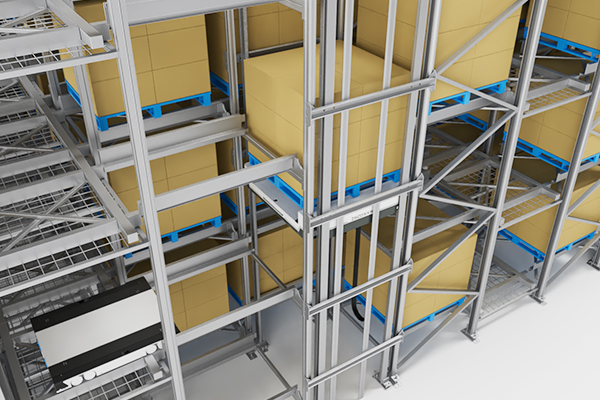
3. Utilizing Vertical Bidirectional Shuttles for Multi-Level Transfer
Vertical bidirectional shuttles—our H-bot, for instance—act as fast, reliable elevators in a multi-level system. Paired with horizontal shuttles, they knit together a true 3D network, lifting overall throughput while keeping flows consistent.
4. Leveraging Omnidirectional Stacking Robots for Narrow Aisle Efficiency
Omnidirectional Stacker Robot like Zikoo’s U-bot thrive in tight aisles, squeezing more storage into existing buildings. Their maneuverability makes them ideal for legacy sites or space-constrained layouts, and with lift heights up to 8 meters, they substantially increase storage density.
5. The Power of Smart Warehouse Software (WMS/WES/WCS/RCS) for Seamless Control
The brains of the operation are the software layers—WMS, WES, WCS, and RCS. They handle everything from inventory accuracy and slotting to robot routing and flow orchestration. Our PTP Smart Warehouse Software ties it all together for clean integration and centralized control.
Real-World Applications of ASRS Across Industries
ASRS isn’t a one-industry tool—it adapts to different environments with ease. We’ve deployed these systems across varied use cases, and the results are consistently strong.
1. Transforming E-commerce Warehousing and Distribution Centers
E-commerce lives and dies by speed and accuracy. ASRS deliver both, enabling teams to process large order volumes without expanding the building or the payroll at the same rate. For more information on e-commerce warehousing, check 《E-commerce Warehousing Revolution: Fast, Flexible and Smart》.
2. Optimizing Cold Chain and Special Environment Storage
Cold chain storage demands precision and consistency. ASRS—especially R-bot systems customized for low temperatures—help maintain stable conditions while minimizing human exposure to freezer environments. That safeguards product integrity and team safety. For more information on cold chain logistics, check 《Cold Chain Logistics Reinvented by Zikoo Robotics》.
3. Enhancing Manufacturing Logistics for Raw Materials and Finished Goods
Production lines depend on the right parts at the right time. ASRS automate component storage and retrieval, feeding lines reliably and shipping finished goods efficiently—reducing delays and keeping schedules intact.
4. Modernizing Existing Warehouse Infrastructures with ASRS
When expansion isn’t feasible, ASRS can unlock capacity in the building you already have. By going vertical and tightening aisle widths, organizations avoid costly moves or new construction while extending the life of current assets.
The Tangible Benefits of Implementing ASRS in Your Warehouse
Beyond automation for its own sake, ASRS deliver clear, measurable gains that show up on the P&L and in daily operations.
1. Achieving Significant Improvements in Storage Density
By using vertical space and shrinking aisle requirements, ASRS can cut floor space needs by 30% or more—often increasing inventory capacity without increasing the footprint. That’s especially valuable where rent or land costs are climbing.
2. Ensuring High Accuracy and Reducing Errors in Inventory Management
Automation drives near-perfect picking and inventory accuracy, reducing damage, mispicks, and stock variances. Fewer errors mean fewer returns and a smoother customer experience.
3. Providing Scalability and Adaptability for Future Growth
ASRS are modular. You can add capacity, reconfigure zones, or adjust to seasonal peaks and SKU growth without overhauling the entire system. Your infrastructure evolves as your business does.
4. Delivering a Strong Return on Investment for Warehouse Automation
Put the gains together—throughput, labor savings, space optimization, and accuracy—and the ROI is compelling. Many operations see payback within a few years, followed by sustained savings. If you want to know more about automated warehousing trends, check 《Automated Warehousing Trends: Efficiency, Flexibility, and Cost – The Advantages of Four-Way Shuttle Systems》.
Partner with Zikoo Smart Technology for Your ASRS Solution
Ready to rework your warehouse for speed, density, and control? Zikoo Smart Technology Co., Ltd. is a global leader in pallet-to-person robotics, offering the U-bot Omnidirectional Stacker Robots, R-bot Four-Way Shuttle, and H-bot High-Speed Elevators—unified by our PTP Smart Warehouse Software. Let’s talk about your workflows and constraints, and we’ll chart a path to sharper efficiency and lower costs.
Email: info@zikoo-int.com
Phone: (+86)-19941778955
FAQs
1. What is an ASRS system and how does it work?
An Automated Storage and Retrieval System (ASRS) is a computer-controlled setup that automatically stores and retrieves loads from defined locations. It typically uses robots, shuttles, and conveyors, coordinated by advanced software, to maximize space and streamline warehouse operations.
2. What types of warehouses benefit most from ASRS implementation?
High-volume operations, facilities with tight space, and sites that demand high throughput and accuracy—think e-commerce fulfillment, cold storage, and manufacturing logistics hubs—see the biggest gains from ASRS.
3. How do ASRS systems integrate with existing warehouse management software?
ASRS connect to your current Warehouse Management System (WMS) or ERP via Warehouse Execution Systems (WES) or Warehouse Control Systems (WCS). That integration keeps data unified and ensures consistent, centralized operational control.
4. What are the typical costs and ROI associated with ASRS?
Costs vary by design and scale, but ROI is typically strong thanks to labor savings, better space utilization, and higher efficiency. Many deployments recoup their investment within a few years.
5. Can ASRS systems operate in challenging environments like cold storage?
Yes. Many ASRS solutions are engineered for extreme environments, including freezers. Specialized components and materials keep performance reliable at low temperatures, protecting product quality and uptime.


