


Four-way shuttle systems reduce product damage because they remove most manual and forklift contact from pallet handling and replace it with repeatable, software-directed movement. In conventional pallet storage, damage usually begins at the handoff: fork tines strike stringers, pallets scrape rack beams, or loads shift during sudden stops. A four-way shuttle carries the pallet on its own deck, enters lanes under the load, and positions it at the storage location without impact. This article explains which damage sources disappear after deployment, which ones remain, and what to verify in the shuttle, rack, and WCS before purchase.
Why Product Damage Happens in Conventional Pallet Handling
Most pallet damage does not come from the storage position itself. It comes from transitions. A forklift enters an aisle, lifts a pallet, accelerates, brakes, and places the load into a rack bay. Each step contains a chance for impact, and the impact force is not always visible. A fork tine can crack a stringer without breaking the pallet immediately; the pallet then fails weeks later during retrieval or outbound shipping.
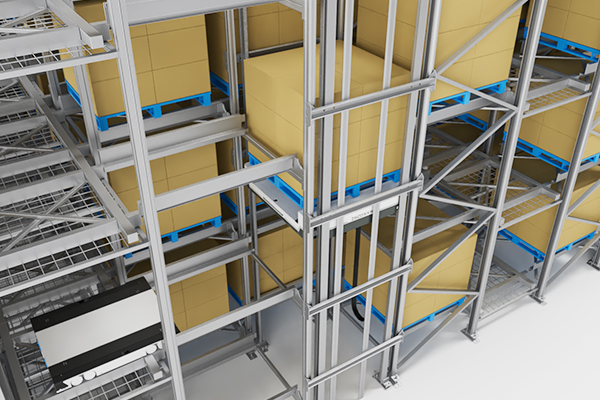
| Damage source | Conventional failure | Four-way shuttle control |
|---|---|---|
| Fork tine strike | Fork tines hit pallet stringers or product during pickup | Pallet rests on the shuttle deck; no tine entry |
| Rack beam scrape | Pallet enters the bay off-center and scrapes the rail or beam | Shuttle follows a fixed rail path to the assigned lane |
| Load shift under braking | Forklift stops hard and shifts product on the pallet | Loaded travel speed is lower than empty speed by design |
| Drop or misplace | Operator sets the pallet edge on a beam, then lowers | WCS directs putaway to the designated location |
| Double handling | Pallets staged and moved several times before storage | Pallets move once from inbound to the rack |
Loaded travel speed is a useful example. An R-bot four-way shuttle runs at 1.6 m/s when empty and 1.2 m/s when carrying up to 1500 kg. The loaded speed is intentionally lower. Speed reduction is not about motor capability, it is about keeping the pallet stable until the shuttle has stopped. A forklift operator may not have that same consistency during a busy shift, especially when travel distance is long and the load is heavy.
How Four-Way Shuttle Systems Control Pallet Movement
A four-way shuttle system controls pallet movement in three places: under the pallet, along the rail, and at the rack mouth. The shuttle lifts the pallet from below and carries it on a flat deck. There are no fork tines, so the most common stringer impact disappears. The shuttle then travels on its own rail in two horizontal directions, which keeps lateral position stable. At the assigned storage lane, the shuttle sets the pallet down without transferring it to another device unless a vertical shuttle is used.
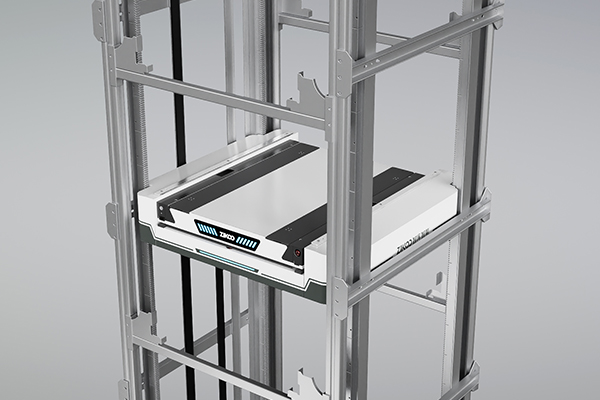
An H-bot vertical bidirectional shuttle adds the vertical leg. Its positioning accuracy is ±1 mm at the rack mouth. That matters because the vertical handoff is where a pallet can catch the beam edge if the level is not reached accurately.
The vehicle speed and lift sequence are set by the WCS. A putaway task is not left to the operator’s judgment. If the WCS detects a pallet type that does not match the lane profile, the task is blocked and the pallet is routed to a check station. That is a different failure pattern from a warehouse where a forklift driver tries to fit a marginal pallet into a too-small bay.
Damage prevention depends on the full handling loop, not just the shuttle deck. <Stacker Crane vs Four-Way Shuttle: Which Fits Your [ASRS Warehouse](https://www.zikooint.com/asrs-automated-storage-and-retrieval-system-solutions) Best> covers where stacker cranes still introduce pallet handling variation and when a four-way shuttle becomes the gentler motion path for dense storage.
Which Damage Points a Four-Way Shuttle System Can Eliminate
Four-way shuttle systems reduce three damage types consistently: impact from fork tines, scraping from off-center pallet entry, and product shifting from rough acceleration. Fork tine damage is removed by design because the shuttle has no tines. Rack scraping is reduced because the shuttle follows a fixed rail path and does not rely on a driver to align the pallet. Acceleration damage is reduced because loaded travel speed is limited and braking is controlled by the motion profile.
But a four-way shuttle does not remove every source of damage. A pallet with broken boards will still fail when lifted. A rack bay that was installed out of square will still catch the pallet side. Product that overhangs the pallet edge will still collide with adjacent loads. Those conditions have to be caught before putaway, either at the inbound quality check or by WCS rules that block a nonconforming pallet.
That is the practical difference between suppliers. Some vendors treat damage control as a vehicle feature. Others treat it as a system feature: pallet check, rack survey, lane assignment, and shuttle motion all have to be aligned. In projects with high-value or fragile loads, I have found the second approach matters more than the shuttle model itself.
If your operation stores fragile or high-value pallet loads, confirm the shuttle acceleration profile, rack pocket tolerance, and pallet condition rules before committing to a layout. Send your load type and rack drawings to info@zikoo-int.com and our engineers will check the relevant clearance and control parameters.
Why Racks and WCS Software Decide Whether Damage Stays Low
A shuttle moves within a rack system, so the rack is as much a motion component as the vehicle. If the beam levels differ from one bay to the next, the shuttle may enter one side slightly lower than the other and scrape the pallet base. That kind of damage is often blamed on the shuttle when the root cause is the steel installation. For this reason, rack straightness and pocket tolerance should be part of every damage-focused project review.
The WCS software then controls how a pallet enters the system. It assigns the lane, checks the pallet dimensions, and can block a task when the load is outside tolerance. That level of control does not exist in a manual warehouse. A warehouse management system can record a damaged pallet after the fact. A WCS can stop the damaged pallet from entering the rack in the first place.
The same control logic also changes storage density. Denser layouts reduce travel distance and aisle traffic, which removes more contact points from the handling loop. If the product is damaged mainly by being moved too many times, density and task-flow reduction matter as much as the shuttle’s motion profile.
Dense layouts can work against damage control if they multiply transfer points. <Six-Way Shuttle Powers Dense Storage: Breaking Space Limitations> covers how vertical shuttles and four-way shuttles compress aisle space without adding collision points, which is the key design test for damage-sensitive operations.
What Should Buyers Verify Before Selecting a Four-Way Shuttle System?
Before choosing four-way shuttle systems for damage-sensitive storage, verify five things:
- Pallet condition rules at inbound. What happens when a pallet has cracked boards or loose wrap?
- Rack survey tolerance. Has the installer measured beam straightness and bay squareness?
- Load speed and acceleration profile. Is the loaded speed lower than empty speed on the actual model?
- WCS pallet check logic. Can the software block a nonconforming pallet automatically?
- Supplier references with similar load profiles. Ask for projects handling comparable pallet weight, height, and fragility.
These checks matter more than a generic promise that the shuttle handles pallets gently. A shuttle with excellent motion control can still damage product if the rack is out of square or if the WCS accepts a pallet that should have been stopped at inbound.
Damage in pallet storage is expensive because the loss often appears after inbound, after putaway, and after a customer order has been promised. Four-way shuttle systems reduce that loss by removing the least controlled part of the handling loop. If you want to confirm whether your pallet profile, rack accuracy, and WCS task flow can fit a low-damage shuttle deployment, send your building layout, pallet type, and current damage data to info@zikoo-int.com or call (+86)-19941778955. We will check the rack pocket tolerance and acceleration settings that matter for your loads and return a compliance check before quoting.
What Else Should Buyers Ask About Four-Way Shuttle Damage Prevention?
Does a four-way shuttle system eliminate all pallet damage?
No. It removes fork tine impact and much of the rack scraping caused by manual alignment, but it cannot repair a pallet that is already broken. Shuttle putaway becomes reliable only when the inbound pallet condition and rack installation tolerance are controlled. If a pallet has cracked boards or loose wrap, the shuttle will carry it, but the load may still collapse during retrieval. That is why the first damage-related decision is not the shuttle model but the inbound check rule in the WCS.
What pallet condition is needed before a four-way shuttle can handle a load safely?
Many buyers assume a four-way shuttle can accept any pallet a forklift can carry. That is not true. A shuttle is designed around specific pallet footprints, such as 1200 × 800 to 1200 × 1000 mm for the R-bot standard type or 1016 × 1219 mm for the American type. The pallet must be flat and free of broken stringers. If the pallet is warped, the shuttle can still lift it, but the deck may not make even contact, and that uneven contact turns into product shifting inside the lane.
Is a four-way shuttle still safe for damage-sensitive loads in a cold storage warehouse?
It depends on the temperature profile. At -25°C, a four-way shuttle needs a low-temperature lithium battery, but the motion control itself does not become rougher. The pallet and the load change more than the machine: frozen goods can suffer surface damage if adjacent pallets touch, so lane clearance and overhang rules matter more than shuttle speed. If your cold storage uses thin-walled packaging or easily marked products, verify the lane spacing before locking the rack design.
How do I know whether an existing rack is accurate enough for a four-way shuttle system?
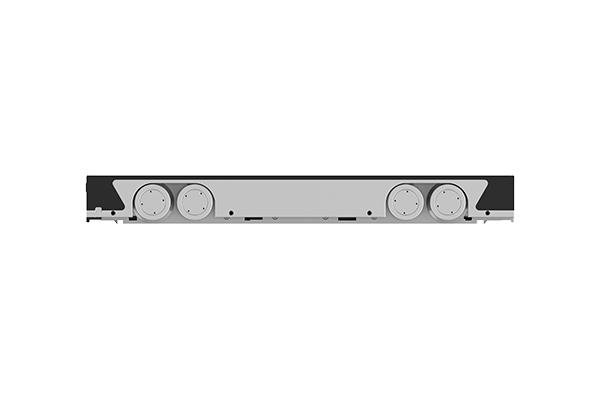
The more precise question is not whether the rack is old but whether beam levels and bay openings are repeatable across every lane. A ten-year-old rack that was installed square can carry shuttle loads; a one-year-old rack with uneven beam levels cannot. Before a four-way shuttle system is installed, the supplier surveys the rack or the drawing to confirm pocket height and lane width for a shuttle body as thin as 125 mm. If your rack has never been surveyed for automation, share the rack drawings and a few level measurements with info@zikoo-int.com or call (+86)-19941778955 and we will confirm whether the existing structure can stay.
If you’re interested, check out these related articles:
Six-Way Shuttle Powers Dense Storage: Breaking Space Limitations
Six-Way Shuttle Unlocks the Era of True 3D Intelligent Warehousing


