


Warehouse robots and 4-way shuttle systems produce real throughput gains only when they are planned as one pallet handoff chain, not as two separate islands. I have seen projects where the shuttle storage layer was sound and the robot picking layer was sound, but the interface between them became the bottleneck. This article works through that interface: how pallets move from dense storage to picking robots, which software functions hold the system together, and which specifications to confirm before procurement. The focus is on the integration seams that decide whether a combined robot and shuttle project hits its throughput target.
Why Do Four-Way Shuttle Systems Need a Robot Interface?
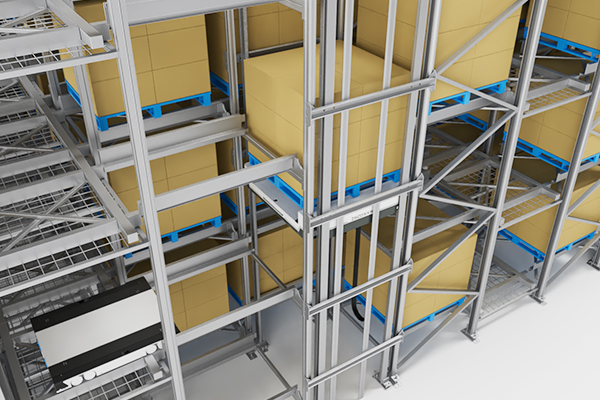
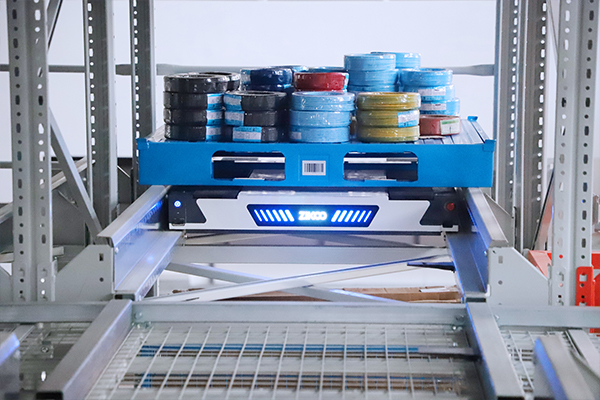
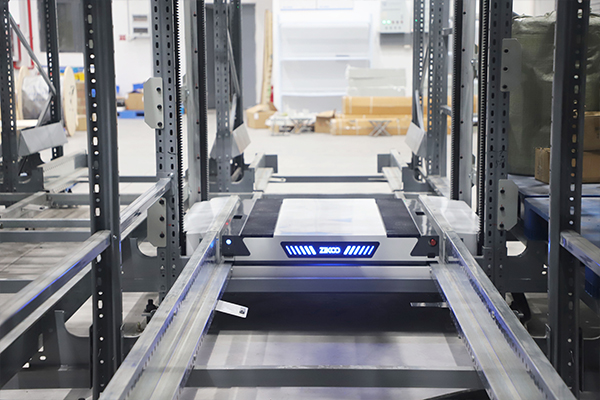
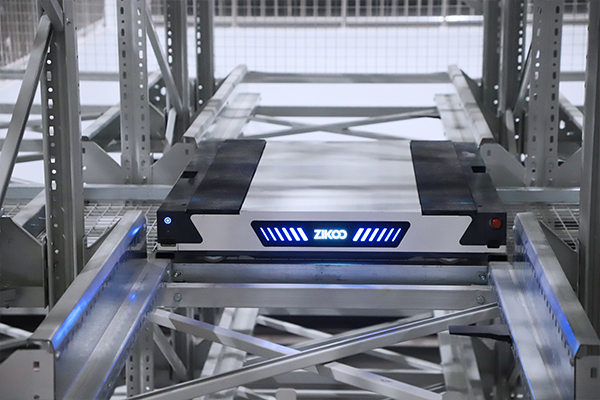
Four-way shuttle systems already solve a hard problem: dense pallet storage. The R-bot Four-way Shuttle moves in four directions within rack lanes, with a body thickness from 125 mm and rated loads from 1,200 kg to 2,000 kg across model options. When paired with the H-bot vertical bidirectional shuttle, pallets move vertically as well, forming a six-way movement network inside the rack. That combination is strong at storing pallets and bringing them to a lift or pick station.
It is not strong at unloading a truck, depalletizing, moving cases across the warehouse floor, or picking mixed SKUs. Those jobs belong to robots: the U-bot omnidirectional stacker for narrow aisle pallet movement, AMRs for horizontal transport, and picking robots or robotic arms for case-level work. In layout planning I treat the shuttle zone as a high-density buffer and the robot zone as a flexible dispatch layer. The interface between the two is where a project either gains speed or loses it.
Adding vertical transfer changes the shuttle network from a flat layer to a three-dimensional one. <Six-Way Shuttle Drives Warehouse Upgrades: Building an Intelligent Automatic 3D Warehouse> covers how R-bot and H-bot combinations keep pallets accessible inside dense storage.
How Do Warehouse Robots and Four-Way Shuttles Share Pallet Flow?
The handoff sequence matters more than the individual speed of either machine. In a typical combined flow, a pallet arrives at the inbound dock, is checked and placed on a shuttle inbound station, enters the R-bot storage zone, and waits for an order. When an order appears, the software decides which pallet to retrieve. The R-bot brings it to a lift or a transfer point, and a robot or conveyor takes it to a workstation. After picking, the pallet either returns to storage or moves to outbound staging.
The U-bot + AMR narrow aisle picking system demonstrates why this works in mixed operations. The U-bot handles goods access in high-level storage while AMRs handle movement and picking in low-level areas. The system can pick at least 300 pieces per hour, move 80 pallets per hour inbound and outbound, and improve storage density by more than 30%. These figures reflect a designed handoff, not a collection of independent machines.
One common mistake is planning the shuttle and robot speeds but ignoring the transfer point. If the shuttle delivers a pallet faster than the robot can accept it, the pallet waits in a buffer. If the robot waits at the transfer point before the shuttle arrives, the robot wastes cycle time. The fix is to model pallets per hour at each handoff, not just peak machine speed.
What Changes When Picking Robots Join a Four-Way Shuttle System?
Adding picking robots changes the order release logic, not just the equipment list. A four-way shuttle system can retrieve full pallets quickly. A picking robot becomes productive only after the WMS groups orders so each retrieved pallet feeds enough picks. Without that grouping, the robot waits and the shuttle makes extra retrieval cycles.
For multi-SKU split-case work, the U-bot + AMR system handles up to 10,000 SKUs and picks at least 300 pieces per hour at a workstation. That number depends on slotting. Fast-moving cases should sit close to the workstation and in positions the shuttle can reach with a single lane change. Slow movers can sit deeper. If all SKUs are slotted by category rather than by order frequency, the robot travels more and throughput falls. I have watched a well-designed shuttle storage zone in a retail distribution layout underperform because the slotting logic treated every SKU as equal.
Another change appears in inventory timing. A traditional shuttle system may batch inbound pallets by wave. A robot-supported picking operation works better with continuous fulfilment cues, because cases leave the system as soon as a pallet is presented. The WMS must decide whether the shuttle zone is a storage reserve or an active picking source. That decision changes shuttle count, buffer size, and lift placement.
What Must You Confirm Before Combining Warehouse Robots and Four-Way Shuttles?
Five items need to be fixed before any layout is locked.
Pallet data to lock down first
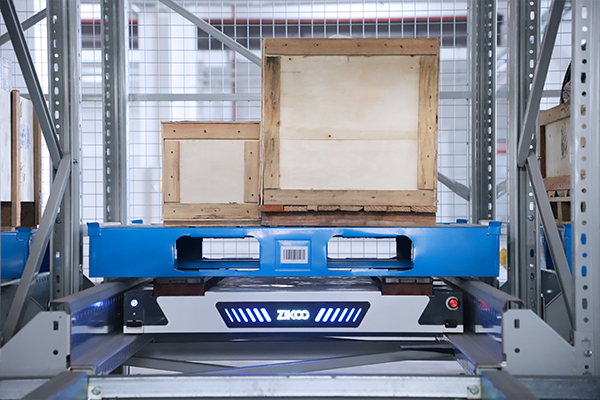
- Confirm pallet dimensions, weight, and bottom board pattern at every handoff point. The R-bot model range covers pallet sizes from 1200 by 800 mm up to 1400 mm, but a mixed fleet must match both shuttle forks and robot lifting surfaces.
- Confirm the case size mix and order lines per order. This determines whether shuttle-to-robot picking is worth the investment or whether full pallet outbound is enough.
- Confirm the peak hour profile. Pallets per hour and cases per hour during the highest shift set the number of shuttles, robots, lifts, and workstations.
Throughput peaks and fallback paths
- Confirm the temperature range. The R-bot standard models operate down to -15℃; cold chain projects need the dedicated low-temperature lithium battery option. The robot layer must meet the same environment, or condensation and battery performance become the constraint.
- Decide what happens when one component fails. If a shuttle is offline, can a robot take a different route? If a robot is offline, can pallets be delivered to a manual station? A fallback path keeps order flow moving and makes the system easier to justify.
| Checkpoint | What to confirm | Why it matters |
|---|---|---|
| Pallet dimensions | Length, width, height, weight, bottom board pattern | Shuttle forks and robot lifts must clear the pallet at handoff |
| Environment | Temperature range, humidity, condensation risk | Battery and component selection differ for cold storage |
| Peak throughput | Cases per hour and pallets per hour by shift | Drives robot, shuttle, lift, and workstation counts |
| SKU profile | Case size mix, SKU count, order lines per order | Determines whether shuttle to robot picking is viable |
| Failure path | Robot offline, shuttle offline, WCS connection loss | Defines manual fallback and queue behaviour |
If your program involves mixed pallet sizes or sub-zero cold storage, confirm the shuttle model and charging strategy before finalizing your integration plan. Send your pallet dimensions and SKU profile to info@zikoo-int.com and we can check which R-bot model and charging setup fits.
How Does Software Keep Warehouse Robots and Four-Way Shuttles in Sync?
Software is where the combined system lives or dies. WMS holds order priority and inventory. WES decides how to release orders, split waves, and balance work. WCS manages equipment-level tasks, and RCS dispatches those tasks to shuttles and robots. If these layers do not share event timing, a pallet can arrive at a transfer point before the next task is assigned, or a robot can reserve a path while the shuttle is still clearing the lane.
Task allocation only works when the software treats robots and shuttles as one resource pool. <Software-Driven Hardware: [Six-Way Shuttle](https://www.zikooint.com/solution/r-bot-h-bot-six-way-shuttle-dense-storage-system) Maximizes Warehouse Efficiency> covers why WES-level orchestration decides more throughput than any single hardware parameter.
The handoff between WCS and RCS matters most. The WCS must expose shuttle location, task status, and estimated completion time. The RCS must consume that data and route robots without blocking shuttle paths. When one supplier controls both layers, the interface is tested during development. When two suppliers share the interface, the project needs a written handshake specification before deployment. I usually ask for a simulator run before site installation because interface errors are cheaper to find in simulation than on the warehouse floor.
At the end, the system should present a single resource pool: shuttles, lifts, robots, and workstations all visible to the same scheduler. That is what the PTP Smart Warehouse Software stack from Zikoo is built to do, with WMS, WES, WCS, and RCS in one platform. It does not eliminate integration work, but it removes the vendor boundary that often causes task handoff delays.
For a specific layout and sequence recommendation, send your warehouse dimensions and required pallets per hour to info@zikoo-int.com or call (+86)-19941778955. We can run the handoff logic against your SKU profile and peak shift before you commit to equipment.
What Else Should Buyers Ask About Combined Robot and Shuttle Systems?
Do we need to replace our WMS to connect robots and shuttles?
No. You can keep the WMS if it can pass order and inventory data to a WES or WCS through a stable interface. The heavier work happens below the WMS: the WES groups orders, the WCS directs shuttle tasks, and the RCS dispatches robots. Before replacing anything, map the required data fields for location, status, and exception messages. A modern middleware layer is often less disruptive than a full WMS replacement.
Can a four-way shuttle system run with robots from a different supplier?
It can, but the real constraint is interface definition. The shuttle supplier must specify pallet transfer height, timing, barcode location, and stop point accuracy. The robot supplier must match those values or the handoff fails. The more mixed the vendor set, the more important it is to freeze the handshake specification early and test it with a simulator before installation. Do not rely on goodwill between suppliers; write the interface down.
What is the first failure mode to plan for?
The first failure mode is usually pallet handoff timing. A shuttle may deliver a pallet before the robot is in position, or a robot may arrive before the shuttle clears the transfer point. This shows up as queuing, stops, and lost cycle time rather than a hard equipment fault. The cheapest safeguard is a buffer position at the handoff point and clear task status messages that both the shuttle and robot systems can read.
Does this kind of integration make sense for a single-site operation?
In smaller sites, the threshold is usually throughput and SKU count, not square footage. A combined system starts to make sense when full pallet storage alone cannot keep up with split-case picking or when peak labour costs are unstable. If you are handling fewer than a few hundred order lines per hour, full automation may be more than you need. Share your SKU profile and throughput target with info@zikoo-int.com and we can confirm whether the combined system clears the project threshold.
If you’re interested, check out these related articles:
Stacker Crane vs Four-Way Shuttle: Which Fits Your ASRS Warehouse Best
Six-Way Shuttle Empowers 3PL Providers to Build Next-Generation Smart Logistics Hubs
Multi-Scenario Smart Adaptation: Zikoo’s Six-Way Shuttle Powers the Digital Transformation of Warehousing
PTP Intelligent Warehousing Platform: Building a Flexible and Smart Logistics Ecosystem


