


Warehouse automation has moved from a capital project for very large facilities into a practical engineering decision for operations that need more throughput without adding land. The systems that used to sit in separate categories — racking, shuttles, stacker cranes, robots, and software — now have to work as one control problem. That shift is changing how buyers evaluate every major component.
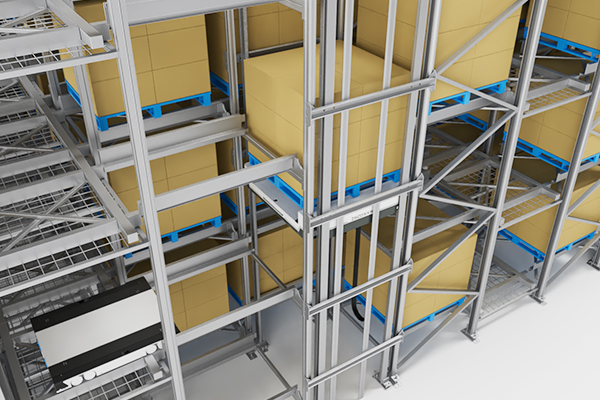
This guide looks at the core technologies currently delivering the largest operational gains: dense storage shuttles, pallet-to-person robotics, vertical transfer, and the software layer that ties them together. It also covers the safety and data requirements that separate a reference-grade system from a pilot that never scales.
The New Performance Baseline for Warehouse Automation
Two forces now dominate almost every automation decision: throughput density and labor predictability. Facility owners want more pallet positions per square meter while reducing reliance on manual equipment that becomes difficult to staff on second and third shifts. Automation is not evaluated as a simple forklift replacement. It is measured against a combined score of storage density, response time, error rate, uptime, and flexibility.
In practice, a modern system must connect storage and retrieval at pallet level with software that adjusts to daily order changes. Safety requirements also set the boundary conditions. Driverless industrial trucks and automated storage and retrieval equipment are covered by evolving standards; [1] sets safety requirements for driverless trucks, while [2] addresses rail-dependent storage and retrieval equipment. A realistic project plan therefore starts from the constraint set: building, pallet, temperature, throughput, and the available maintenance team.
Dense Storage, Shuttle Robotics, and Vertical Movement
The most visible change in pallet storage is the move from fixed aisle cranes to four-way shuttle systems. A four-way shuttle travels in multiple directions within a rail system, so it can change aisles instead of waiting for one machine to serve an entire row. That architecture supports dense storage without forcing every access point to wait in a single queue.
Shuttle-based storage works best when the horizontal layer is paired with a vertical transfer unit. The combination of an R-bot-type four-way shuttle and an H-bot-style vertical shuttle creates a six-way shuttle system: the shuttle handles the floor plane, the vertical unit handles lift, and the pallet path no longer depends on one lift position. In product terms, shuttle bodies can be as thin as 125 mm, with rated loads from 1,200 kg to 2,000 kg across variants and empty travel speeds around 1.6 m/s on standard configurations. The vertical unit can position at ±1 mm in certain designs, which matters when pallet transfers require repeatable alignment.
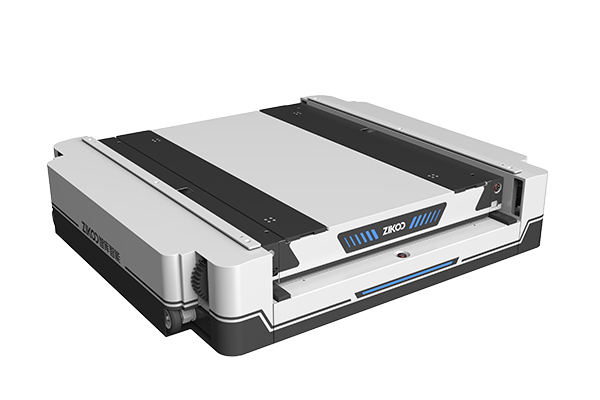
For narrow-aisle facilities, another automation path is a pallet-handling robot designed for aisle widths as low as 2,100 mm. This approach suits existing buildings where installing deep shuttle racking would be too invasive, but where the operation still needs to remove forklift traffic from the storage row. A stacker crane ASRS remains a strong comparison point for high-throughput aisles with stable SKU profiles.
Pallet storage decisions usually come down to a familiar tension: dense capacity versus responsive access. <Six-Way Shuttle: The Dual-Engine Solution for High-Density and High-Throughput> covers the dual-engine approach to balancing both requirements.
Software-Defined Operations: From WMS to Robotic Control
The physical robots gain most of their flexibility from the software stack. A warehouse management system decides what should move; a warehouse execution system or warehouse control system sequences and directs those moves; a robot control system handles traffic, battery state, charging, and exception recovery. When these layers are loosely integrated, the equipment may still run but often loses the performance that justified the capital. When they are tightly integrated, the system can reassign work when one shuttle is unavailable, change putaway logic for peak periods, and track every pallet position without manual cycle counts.
In a pallet-to-person configuration, software decides which task should be released next based on order age, available workstation capacity, and rack congestion. This is where warehouse automation moves from fixed conveyor logic to process control. Real-time orchestration is also a reliability factor: a well-configured WCS can reduce stop-start cycles, route around a blocked aisle, and limit deadheading.
A multi-layer platform such as PTP Smart Warehouse Software spans WMS, WES, WCS, and RCS. The integration point is often more important than any single feature, because the warehouse team must see the same pallet state across receiving, storage, replenishment, picking, and dispatch.
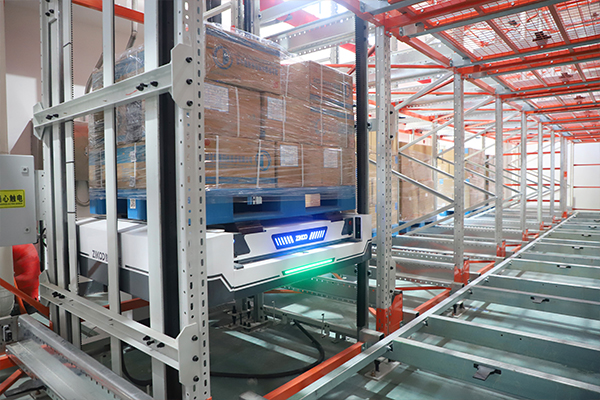
Hardware specifications are only part of the performance story — the control architecture determines how much of that specification becomes usable throughput. <Software-Driven Hardware: Six-Way Shuttle Maximizes Warehouse Efficiency> covers the relationship between software and hardware in high-density shuttle operations.
Engineering review: If you are evaluating whether WMS/WCS integration will hold back a shuttle project, send your current software stack, daily order lines, pallet volume, and building layout to info@zikoo-int.com. The automation team can identify the practical integration risk before you allocate budget.
Data, Safety, and Practical Evaluation
Automation projects live or die on operational data. A credible supplier evaluation should include tested cycle times, not just peak speeds. Performance data for storage and retrieval machines is more useful when it follows a repeatable method; [3] provides a structure for cycle-time comparisons. Battery choice is another long-term cost driver. Lithium iron phosphate and similar lithium chemistries have different thermal limits, cycle life, and charging behavior, and industrial safety requirements for secondary lithium cells are addressed in [4].
The safety framework is now more specific than a generic “CE mark” conversation. Rail-dependent storage and retrieval equipment must meet mechanical safety requirements in [2]; driverless trucks fall under [1]. Industrial lithium battery systems have separate safety requirements under [4], and machinery placed on the EU market is governed by the machinery regulation in [5]. Buyers should request a compliance matrix rather than a single certificate.
When comparing four-way shuttle systems, stacker crane ASRS, and narrow-aisle robots, start with seven inputs:
- Pallet type, dimensions, weight, and packaging stability
- SKU count and stock depth per SKU
- Daily inbound and outbound pallet volume and peak shape
- Building clear height, column grid, floor flatness, and floor load
- Temperature, humidity, and contamination requirements
- Current WMS/WCS landscape and integration expectations
- Five-year growth plan and seasonal uplift
These inputs produce a technology shortlist, but the deeper question is how well the supplier can prove control-level performance. Ask for a functional description that shows what happens when a shuttle fails, how charging is scheduled, and how the system recovers after a communication break.
The conversation has shifted from “does the WMS work” to “how tightly does it orchestrate the equipment layer.” <PTP Intelligent Warehouse Software Empowers Enterprises for Smart Upgrades> covers the multi-layer integration path for smart upgrades.
Get an Engineering-Led Warehouse Automation Roadmap
Before moving to quotation, the most valuable step is a constraints review. A clean requirement package normally includes:
- Warehouse location and available clear height
- Pallet dimensions, maximum load, and stacking stability
- SKU count and required pallet positions
- Daily inbound/outbound volume and peak-period uplift
- Temperature, humidity, and contamination constraints
- Current software systems and expansion plans
Send the information to info@zikoo-int.com or call (+86)-19941778955. Zikoo Smart Technology Co., Ltd. works on pallet-to-person robotics, four-way shuttle systems, vertical transfer, and PTP warehouse software across cold chain, manufacturing, 3PL, pharmaceutical, and e-commerce projects. The initial engineering review can help you decide whether to automate the whole warehouse or improve one flow first.
Frequently Asked Questions
Which technology should be prioritized: shuttle, crane, robot, or software?
Start with the operational constraint. If the goal is high-density pallet storage with flexible access, a four-way shuttle system is usually the strongest fit. If the facility has a stable SKU base and very high single-aisle throughput, a stacker crane ASRS can be competitive. If the building has narrow aisles and limited height, a narrow-aisle pallet robot may be more practical. Software should be evaluated with the hardware as one system, because control performance determines whether the mechanical speed becomes real throughput.
Are these technologies suitable for existing warehouses?
Often yes, but the answer depends on floor flatness, clear height, column spacing, fire protection, and access for installation. Shuttle systems and narrow-aisle robots can be configured around existing constraints when they are assessed early. The building survey should happen before equipment selection, not after.
What is a realistic payback period?
Payback depends on labor costs, land cost, throughput growth, energy cost, and maintenance organization. A project in a low-cost manual warehouse may have a longer payback than the same system in a high-cost, high-growth operation. The more reliable approach is to model operating cost per pallet over five years rather than rely on a single benchmark.
Do automated warehouses require dedicated maintenance staff?
Yes, they require a planned maintenance discipline. The team does not always need to be large, but it must cover mechanical inspection, sensor calibration, software updates, battery management, and spare parts. The best projects pair a modest internal team with a supplier that provides remote diagnostics and scheduled service.
What information do suppliers need to produce a reliable quote?
A useful quote requires pallet data, SKU profile, throughput targets, peak assumptions, building drawings, temperature requirements, and integration boundaries. Without these inputs, a quote is a budget placeholder rather than an engineering proposal. Suppliers should be able to explain the assumptions behind every major quantity.
References
[1] ISO 3691-4:2023, Industrial trucks — Safety requirements and verification — Part 4: Driverless industrial trucks and their systems, International Organization for Standardization, Geneva, 2023.
[2] EN 528:2008, Rail dependent storage and retrieval equipment — Safety requirements, CEN, Brussels, 2008.
[3] FEM 9.851, Performance data of storage/retrieval machines — Cycle times, European Materials Handling Federation, Frankfurt.
[4] IEC 62619:2022, Secondary cells and batteries containing alkaline or other non-acid electrolytes — Safety requirements for secondary lithium cells and batteries, for use in industrial applications, IEC, Geneva, 2022.
[5] Regulation (EU) 2023/1230 on machinery, Official Journal of the European Union, L 135, 2023.
If you’re interested, check out these related articles:
Looking for Reliable Four-Way Shuttle Manufacturers? Choose Zikoo Robotics
Multi-Scenario Smart Adaptation: Zikoo’s Six-Way Shuttle Powers the Digital Transformation of Warehousing
PTP Intelligent Warehousing Platform: Building a Flexible and Smart Logistics Ecosystem
Six-Way Shuttle System Leads the Shift from Machines to Robots in Dense Storage Automation
Revolutionizing Cold Chain Logistics: Zikoo Robotics Six-Way Shuttle Powers High-Density, High-Efficiency Warehousing


