


An end-to-end smart logistics warehouse system is not a storage machine with software attached. It is a coordinated chain of receiving, pallet storage, retrieval, order picking, sorting, packing, and dispatch functions operating under one digital control layer. The design objective is to make every pallet movement traceable, predictable, and schedulable from the inbound dock to the outbound trailer.
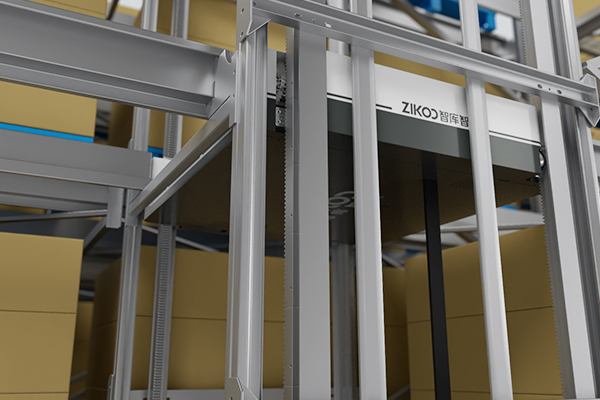
What “End-to-End” Really Means in a Smart Warehouse System
In practice, an end-to-end design connects several layers that are often purchased separately:
- A common data model for pallets, locations, orders, equipment, and tasks
- A material flow that remains continuous across receiving, storage, picking, and shipping
- A robot and conveyor control layer that can execute the same task definition across subsystems
- Defined exception workflows when a barcode is unreadable, a pallet is damaged, or a shuttle faults
- A maintenance and safety record tied to physical locations and equipment histories
A stand-alone 자동 보관 및 검색 시스템 can improve density or throughput in one zone. A smart logistics warehouse system goes further because the storage layer, picking workstations, and warehouse software are designed together to prevent the common “black box” gaps between vendor scopes.
Design the Flow Backward from Customer Orders
The most reliable starting point is not the building. It is the order profile.
Before selecting equipment, the design team should analyze how many order lines are full pallets, case picks, or split-case picks; how many SKUs must be accessible daily; and how sharply peak periods rise. This determines whether the system should favor high-density pallet storage, narrow-aisle case picking, or a hybrid.
For high-SKU split-case operations, a U-bot plus AMR narrow aisle picking system can be specified to support up to 10,000 SKUs, with picking efficiency of at least 300 pieces per hour and inbound/outbound capacity of at least 80 pallets per hour. Those figures are solution-level design targets that only make sense when the SKU profile and order lines justify the workstation count and robot fleet size.
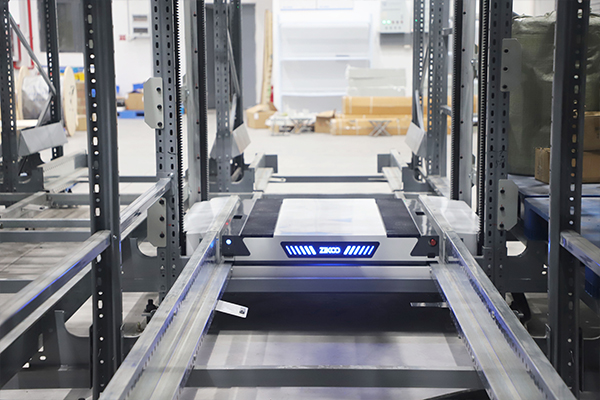
If the data shows that most order lines ship as full pallets, the smarter investment is usually deep-lane shuttle storage rather than large split-case picking zones. Designing backward from customer orders prevents over-automating a process that accounts for only a small percentage of outbound volume.
Choose the Storage and Robot Layer as a Single System
집약 저장 robots should be selected by pallet type, load class, travel requirements, and temperature range rather than by product name alone.
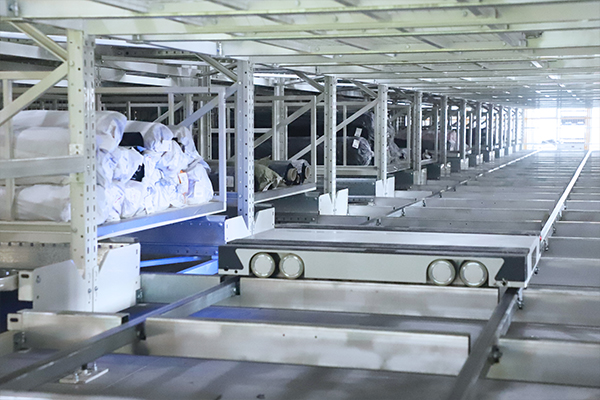
R-봇 4방향 셔틀 is available in configurations supporting loaded pallets from 1,200 kg to 2,000 kg. Standard models use a 125 mm body height and loaded travel speed of 1.2 m/s, while the heavy-duty large pallet type handles up to 2,000 kg with a 1.0 m/s loaded speed. Pallet compatibility matters: models support 1,200 × 800 mm, 1,200 × 1,000 mm, 1,016 × 1,219 mm, 1,100 × 1,100 mm, and 1,400 mm configurations. If the facility handles more than one pallet footprint, that constraint must be resolved before rack dimensions are frozen.
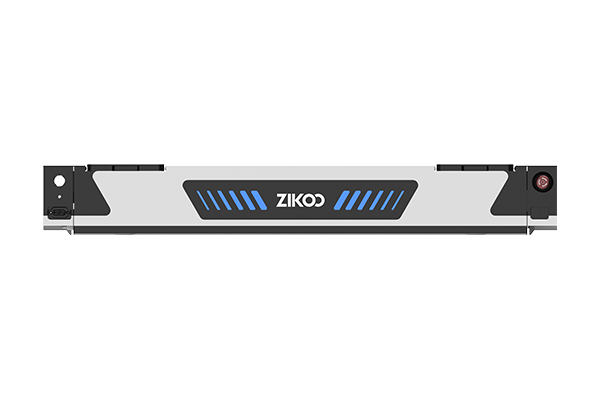
When vertical movement is required, the H-bot vertical bidirectional shuttle adds the lift function that converts a four-way shuttle lane into a six-direction storage network. The standard H-bot model carries 1,800 kg with positioning accuracy of ±1 mm. In brownfield or low-clearance buildings, the U-bot omnidirectional stacking robot may be the better fit because it can operate in aisle widths as narrow as 2,100 mm and lift loads up to 8 m.
For the vehicle-level architecture behind these flows, the robot layer is best understood as a distributed system rather than a set of isolated trucks. Six-Way Shuttle System은 고밀도 스토리지 자동화에서 기계에서 로봇으로의 전환을 주도합니다. covers the robot-side architecture in more detail.
Make Software, Data, and WMS/WCS Integration the Control Layer
The software architecture usually separates into four roles: warehouse management, warehouse execution, warehouse control, and robot control. WMS manages orders, inventory, and business rules. WES sequences work and allocates resources. WCS connects automated equipment such as shuttles, elevators, conveyors, and workstations. RCS manages path planning and robot-level commands.
An end-to-end smart logistics warehouse system should keep those roles visible to the operator, but they should share one task lifecycle. If the WMS creates a replenishment task, that same task should be traceable through WES assignment, WCS equipment execution, and RCS movement without re-keying or side files.
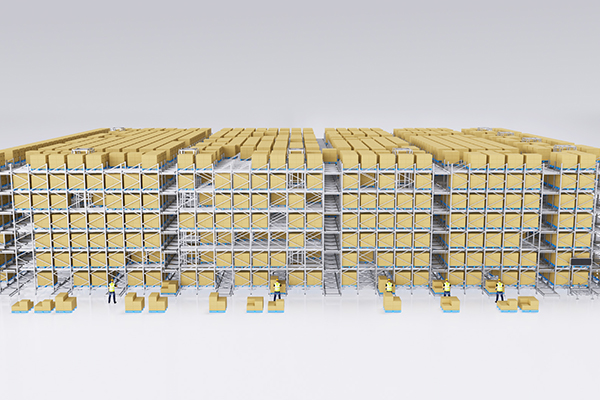
The strongest integration value appears when exceptions are handled by the software layer rather than by manual phone calls. A blocked lane, a low-battery shuttle, or a priority outbound pallet should trigger automatic reassignment instead of shutting down the aisle.
After the control layer is defined, the integration logic between WMS, WES, WCS, and RCS becomes the main source of day-to-day operational flexibility. PTP 지능형 창고 소프트웨어는 기업의 스마트 업그레이드를 지원합니다 covers how the software layer supports enterprise-level upgrades.
When the warehouse must connect multiple automation islands into one logistics ecosystem, the platform architecture matters as much as the robot specification. PTP 지능형 창고 플랫폼: 유연하고 스마트한 물류 생태계 구축 covers the platform-level decisions that hold the system together.
If you are moving from concept to a verified layout, send current CAD drawings, pallet profiles, and target daily throughput to info@zikoo-int.com. A warehouse-automation engineer can identify which storage density model fits the building and where the ROI case is strongest before capital is committed.
Engineer for Site Constraints, Temperature, and Safety
The best robot layout fails if the building cannot support it cleanly. Ceiling height, column spacing, floor flatness, dock positions, and fire-safety clearances must be part of the same feasibility pass as robot selection. New buildings allow more freedom, but many end-to-end systems are retrofitted into existing warehouses where aisle widths and clear heights are already fixed.
Cold storage and pharmaceutical facilities add another layer of constraint. The R-bot cold chain solution uses a low-temperature lithium battery design for continuous operation in -25°C environments, with 6–8 hours of autonomy and a low-temperature charging port. Special PCBA coating protects electronics in high-humidity conditions, which is especially relevant for frozen food and pharmaceutical constant-temperature storage.
Safety planning should be defined during design, not added after installation. Robot travel zones, rack protection, maintenance lockout points, and emergency stop interfaces need to be documented in the control system. Storage equipment inspection and maintenance schedules should follow recognized standards such as EN 15635 [1]. Design verification should be supported by a documented quality management framework such as ISO 9001:2015 [2]. In the European Union, robot and machinery interfaces must also be evaluated under the Machinery Directive 2006/42/EC [3].
Plan Your End-to-End Smart Logistics Warehouse System
If you are evaluating a smart logistics warehouse system, share the following with the engineering team:
- cURL Too many subrequests by single Worker invocation. To configure this limit, refer to https://developers.cloudflare.com/workers/wrangler/configuration/#limits
- cURL Too many subrequests by single Worker invocation. To configure this limit, refer to https://developers.cloudflare.com/workers/wrangler/configuration/#limits
- cURL Too many subrequests by single Worker invocation. To configure this limit, refer to https://developers.cloudflare.com/workers/wrangler/configuration/#limits
- cURL Too many subrequests by single Worker invocation. To configure this limit, refer to https://developers.cloudflare.com/workers/wrangler/configuration/#limits
- cURL Too many subrequests by single Worker invocation. To configure this limit, refer to https://developers.cloudflare.com/workers/wrangler/configuration/#limits
cURL Too many subrequests by single Worker invocation. To configure this limit, refer to https://developers.cloudflare.com/workers/wrangler/configuration/#limits
자주 묻는 질문
cURL Too many subrequests by single Worker invocation. To configure this limit, refer to https://developers.cloudflare.com/workers/wrangler/configuration/#limits
cURL Too many subrequests by single Worker invocation. To configure this limit, refer to https://developers.cloudflare.com/workers/wrangler/configuration/#limits
cURL Too many subrequests by single Worker invocation. To configure this limit, refer to https://developers.cloudflare.com/workers/wrangler/configuration/#limits
cURL Too many subrequests by single Worker invocation. To configure this limit, refer to https://developers.cloudflare.com/workers/wrangler/configuration/#limits
cURL Too many subrequests by single Worker invocation. To configure this limit, refer to https://developers.cloudflare.com/workers/wrangler/configuration/#limits
cURL Too many subrequests by single Worker invocation. To configure this limit, refer to https://developers.cloudflare.com/workers/wrangler/configuration/#limits
cURL Too many subrequests by single Worker invocation. To configure this limit, refer to https://developers.cloudflare.com/workers/wrangler/configuration/#limits
cURL Too many subrequests by single Worker invocation. To configure this limit, refer to https://developers.cloudflare.com/workers/wrangler/configuration/#limits
cURL Too many subrequests by single Worker invocation. To configure this limit, refer to https://developers.cloudflare.com/workers/wrangler/configuration/#limits
cURL Too many subrequests by single Worker invocation. To configure this limit, refer to https://developers.cloudflare.com/workers/wrangler/configuration/#limits
cURL Too many subrequests by single Worker invocation. To configure this limit, refer to https://developers.cloudflare.com/workers/wrangler/configuration/#limits
cURL Too many subrequests by single Worker invocation. To configure this limit, refer to https://developers.cloudflare.com/workers/wrangler/configuration/#limits
참고 문헌
cURL Too many subrequests by single Worker invocation. To configure this limit, refer to https://developers.cloudflare.com/workers/wrangler/configuration/#limits
cURL Too many subrequests by single Worker invocation. To configure this limit, refer to https://developers.cloudflare.com/workers/wrangler/configuration/#limits
cURL Too many subrequests by single Worker invocation. To configure this limit, refer to https://developers.cloudflare.com/workers/wrangler/configuration/#limits
관심이 있다면, 관련 기사들을 확인하세요:
육방 셔틀이 창고 업그레이드를 주도하며 지능형 자동 3D 창고를 구축하다
Multi-Scenario Smart Adaptation: Zikoo’s Six-Way Shuttle Powers the Digital Transformation of Warehousing


