


If you are evaluating high-density pallet storage, shuttle-based ASRS is no longer an experimental option. It is now a mainstream architecture for distribution centers, cold-chain warehouses, and production logistics because it decouples horizontal pallet movement from vertical transport. Instead of one heavy stacker crane per aisle, multiple small shuttles operate on each storage level while vertical lifts handle floor changes. The result is greater parallel work, deeper lanes, and more pallet positions in the same cube. This guide explains the architecture, compares it with crane-based ASRS, and walks through the engineering and buying criteria that determine project success.
What Is a Shuttle-Based ASRS?
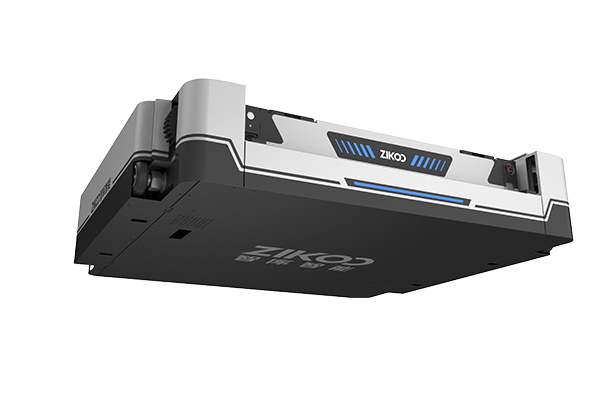
A shuttle-based ASRS is a pallet-to-person storage system in which autonomous four-way shuttles move inside racking structures on rails. A four-way shuttle can travel forward, backward, and laterally across a storage level. When vertical movement is added through a lift or vertical shuttle, the configuration is often called a six-way shuttle system.
The racking uses standardized pallet storage positions. Pallet dimensions and base conditions therefore matter before the first design meeting, because lane widths, rail positions, and lift forks are built around a target pallet footprint [5]. In practice, a shuttle with a thin body height allows more storage levels in the same building envelope, but that advantage only appears if racking tolerances, floor flatness, and pallet quality are controlled from day one.
How Shuttle-Based ASRS Differs from Crane-Based ASRS
At a system level, the biggest difference is how work is distributed. A stacker-crane ASRS assigns one heavy machine to a narrow aisle, so every pallet move in that aisle depends on one cycle. A shuttle-based system places several small vehicles on each level, which lets the system run many retrieval tasks at the same time and route them through shared lifts and pick stations.
| Factor | Shuttle-Based ASRS | Crane-Based ASRS |
|---|---|---|
| Movement model | Multiple shuttles per level plus vertical lifts | One crane per aisle |
| Storage density | Very high; fewer fixed aisles | High, but aisle geometry constrains cube use |
| Parallel work | Strong; tasks run across levels and shuttles | Limited by crane cycle time per aisle |
| Scalability | Add shuttles, lifts, or levels incrementally | Add cranes and aisles in larger blocks |
| Payload fit | Commonly 1,200–2,000 kg per shuttle | Can suit heavier single unit loads |
| Software dependency | High; WCS must coordinate shuttle traffic and lifts | High; crane control must optimize cycle sequencing |
Cycle-time comparisons should follow FEM 9.851 methods rather than comparing headline shuttle speed ratings alone [2]. A fast shuttle can still produce slow end-to-end retrieval if lift capacity or task sequencing becomes the bottleneck.
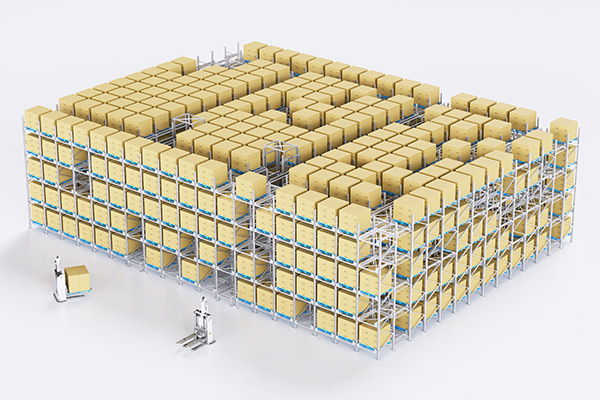
The shuttle-versus-crane decision often comes down to whether your profile is deep-lane full-pallet movement or high-SKU split-case fulfillment. <Stacker Crane vs Four-Way Shuttle: Which Fits Your ASRS Warehouse Best> covers aisle geometry, ROI logic, and the operating conditions where each architecture is the stronger engineering choice.
Core Components: Shuttles, Lifts, Racking, and Control Software
A shuttle-based ASRS has four main layers: racking, autonomous shuttles, vertical transport, and control software.
The R-bot four-way shuttle family covers standard, American, Japanese, heavy-duty, and heavy-duty large-pallet formats. Rated loads run from 1,200 kg to 2,000 kg, with body heights of 125 mm for most models and 150 mm for the heavy-duty large-pallet version. Standard models move at 1.6 m/s empty and 1.2 m/s loaded; the heavy-duty large-pallet model moves at 1.35 m/s empty and 1.0 m/s loaded. These are design specifications, not the sole indicator of warehouse throughput.
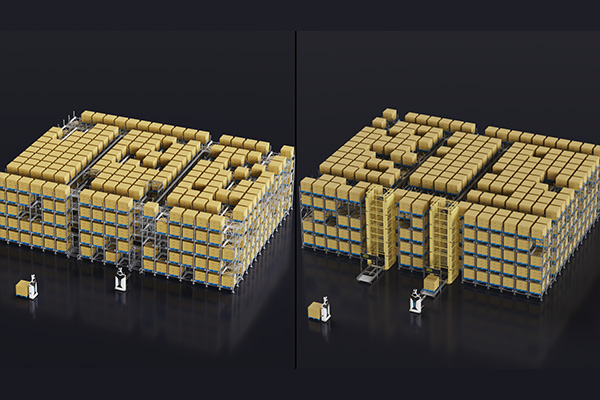
The H-bot vertical bidirectional shuttle acts as the vertical transport hub. It occupies about one storage location, supports pallet moves between levels, and achieves ±1 mm positioning accuracy in standard configurations. Because vertical cycle time directly influences total retrieval time, the lift and the shuttle fleet must be sized together.
Above the hardware, PTP Smart Warehouse Software provides WMS, WES, WCS, and RCS functions. The WCS layer is especially important: it releases missions, manages intersections, prevents deadlock, and decides which shuttle or lift handles each task.
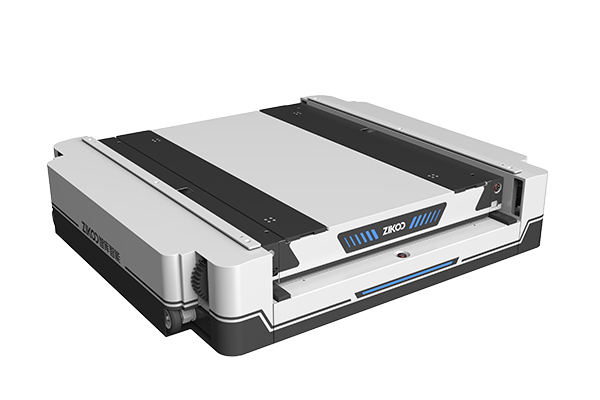
A six-way shuttle system is not just hardware; the warehouse control layer decides which shuttle fetches which pallet, which lift serves which floor, and how pick stations are fed. <Six-Way Shuttle: The Smart Warehousing Tool for Cost Reduction and Efficiency> covers mission logic, cost-reduction levers, and the operational changes that unlock full system throughput.
Throughput and Storage Density: What Actually Matters
Throughput in a four-way shuttle system is not a single shuttle speed. It is the combined result of shuttle count per level, lift cycles, pick station count, and task orchestration. From an engineering perspective, the most common reason for underperformance is not shuttle speed but poor task sequencing and lift conflicts.
Vendor design points can help frame expectations. The U-bot Omnidirectional Stacking Robot plus AMR narrow-aisle picking configuration, for example, is specified for ≥80 inbound/outbound pallets per hour, ≥300 picks per hour, and more than 30% storage-density improvement in certain multi-SKU settings. Treat these as design references rather than universal guarantees: actual results depend on SKU velocity, order lines, inbound/outbound overlap, and racking configuration.
Storage density is where shuttle ASRS usually gains the most. Because lanes can be deep and vertical travel is handled by lifts, the system can exploit the full building cube more effectively than manually intensive storage. At the same time, density should not be pursued without a clear retrieval strategy. Every additional lane depth increases space efficiency but may increase the number of shuttle moves needed to access a pallet.
Safety, Cold Storage, and Reliability
Shuttle-based automated storage changes the safety profile of the warehouse. Operators are largely kept out of racking lanes, but new requirements appear: restricted access, interlocks, E-stop zones, fire protection integration, battery charging ventilation, and maintenance lockout procedures.
Shuttle and crane systems operating in Europe are assessed against EN 528 for rail-dependent storage and retrieval equipment [1]. In North America, ASME B30.13 covers storage/retrieval machines and associated equipment [3]. These standards are not a substitute for a project-specific risk assessment, but they provide the baseline machine-safety framework buyers should expect from a supplier.
Cold storage is one of the strongest use cases for shuttle ASRS. Standard R-bot models operate down to -15°C. For frozen environments, the cold-chain configuration uses low-temperature lithium batteries rated for -25°C, with 6–8 hours of continuous operation and a low-temperature charging port. In high-humidity environments, additional PCBA coating and charging-port design details reduce electrical risk.
If you are comparing shuttle-based ASRS against a crane retrofit, fixed-cycle assumptions are risky. Send your warehouse footprint, pallet type, SKU count, temperature range, and daily pallet flows to info@zikoo-int.com. The engineering team can return a rough layout and cycle-time feasibility view before you spend on detailed design.
Implementation Path and Layout Planning
A shuttle ASRS project is not just steel and robots. The implementation sequence typically includes inventory profiling, racking survey, software integration, commissioning, and acceptance testing. In brownfield buildings, floor flatness and racking alignment matter more than in manual storage because shuttles depend on precise rail geometry. For this reason, retrofits should begin with a measured survey of the existing slab, columns, and clear height rather than a simple layout drawing.
Software integration is equally important. The shuttle control system must receive orders from WMS, release missions through WCS, and manage charging, maintenance, and exception handling. A phased rollout can reduce risk: starting with one storage zone or one pick station often reveals integration issues before the full system goes live.
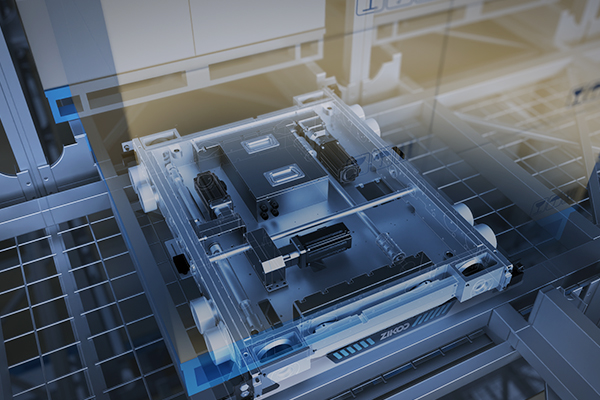
Automated storage is increasingly specified as a platform strategy rather than a single equipment purchase. <Smart Storage Revolution: Comprehensive Overview of Four-Way Shuttle Systems for Automatic 3D Warehouses> covers system-level design choices for automatic 3D warehouses, including level count, lane depth, and lift positioning.
When Shuttle-Based ASRS Is the Right Architecture
Shuttle-based ASRS is typically the better engineering choice when:
- SKU count is high and pick stations must serve parallel flows.
- The building height allows multiple storage levels without major structural work.
- Peak periods require many simultaneous pallet moves.
- Cold chain, narrow aisle, or high-density constraints dominate the design.
- The operation expects future expansion without a complete racking redesign.
It is less suitable when pallet quality is inconsistent, when most loads exceed the available shuttle payload class, or when order volumes are so low that a simpler semi-automated pallet shuttle system would serve at a lower capital cost. Across the warehouse industry, automation investment continues to shift toward robotics, warehouse execution systems, and integrated software [4]. That trend favors shuttle architectures, but the final decision still belongs to the data profile of the specific site, not to the technology narrative alone.
Get a System-Level Feasibility Review
A shuttle-based ASRS is a long-term investment, and the right specification depends heavily on your pallet data, order profile, building constraints, and software integration plan. Zikoo Smart Technology Co., Ltd. supports projects across cold chain, new energy, manufacturing, pharmaceuticals, and 3PL operations.
To start the engineering conversation, share:
- Warehouse dimensions and available clear height
- Pallet size, weight range, and substrate condition
- SKU count, storage locations, and daily pallet movements
- Temperature and humidity range
- Current WMS/WCS/ERP environment
Email: info@zikoo-int.com
Phone: (+86)-19941778955
Address: 4F, Building 4, No. 170-1 Software Avenue, Yuhuatai District, Nanjing, China
Frequently Asked Questions
What warehouse size is suitable for a shuttle-based ASRS?
There is no single minimum, but the system reaches its best cost-performance when the project has enough pallet positions to justify the required lifts, rails, and control software. High-SKU operations with 5,000 or more pallet locations and multiple pick stations often benefit most. Smaller operations should compare a semi-automated pallet shuttle system before committing to full ASRS.
Is shuttle-based ASRS suitable for cold storage?
Yes. Shuttles can be specified with low-temperature batteries and coated electronics. The building, fire suppression, and battery charging areas must be designed for the same temperature class. Frozen applications require special attention to charging behavior, humidity, and maintenance access because cold rooms reduce the window for manual intervention.
How do I choose between shuttle-based ASRS and stacker-crane ASRS?
Model both architectures against your actual order lines rather than only pallet-in and pallet-out totals. Shuttle ASRS generally wins when parallel work and storage density are the main priorities; crane ASRS remains relevant for very heavy unit loads and warehouses with a small number of simple, deep-lane flows.
What software integration is required?
At minimum, the shuttle control system must integrate with WMS for orders and inventory. In many sites, a WCS layer handles mission release, traffic management, and lift coordination. Buyers should verify that the supplier can demonstrate order flow, exception handling, and interface testing before go-live.
How long does implementation take?
It depends on building readiness, software integration, and acceptance terms. A greenfield automatic 3D warehouse may run from design to go-live over several months; brownfield projects can be phased by storage lane or work zone to keep operations running. A site-specific schedule should be confirmed after as-built survey and simulation.
References
[1] European Committee for Standardization, EN 528:2008, Rail dependent storage and retrieval equipment — Safety requirements.
[2] European Materials Handling Federation, FEM 9.851, Performance Data of S/R Machines — Cycle Times.
[3] American Society of Mechanical Engineers, ASME B30.13-2017, Storage/Retrieval (S/R) Machines and Associated Equipment.
[4] MHI, 2024 Annual Industry Report: Innovation Driven Resilience. https://www.mhi.org/publications/annual-industry-report.
[5] American National Standards Institute, ANSI MH1-2020, Pallets, Slip Sheets, and Other Bases for Unit Loads.
If you’re interested, check out these related articles:
Six-Way Shuttle: The Smart Warehousing Tool for Cost Reduction and Efficiency
Looking for Reliable Four-Way Shuttle Manufacturers? Choose Zikoo Robotics
Multi-Scenario Smart Adaptation: Zikoo’s Six-Way Shuttle Powers the Digital Transformation of Warehousing
Six-Way Shuttle Empowers 3PL Providers to Build Next-Generation Smart Logistics Hubs
Revolutionizing Cold Chain Logistics: Zikoo Robotics Six-Way Shuttle Powers High-Density, High-Efficiency Warehousing


