


High SKU count warehouses look different from single-product distribution centers. Instead of moving a few pallet types in steady waves, operations must manage hundreds or thousands of SKU profiles, uneven order profiles, frequent slotting changes, slow movers, fast movers, and seasonal spikes in the same physical space. Smart storage for high SKU count warehouses is therefore less about raw storage volume and more about orchestration: the warehouse needs to balance dense pallet storage, accurate inventory visibility, short replenishment cycles, and flexible picking logic without multiplying travel time or labor. Research on automated storage and retrieval systems [1] consistently shows that performance depends on how well storage depth, throughput, and software control are aligned with order profiles.
The practical answer is usually a pallet-to-person dense storage system built on four-way shuttle robots, vertical lifts, and a software layer that manages both equipment and SKU behavior. The advantage is not that automation removes variability; it makes variability schedulable.
Why High SKU Warehouses Break Traditional Storage Logic
In a traditional rack and forklift warehouse, each SKU tends to get a fixed location. That works until the SKU mix changes, new product lines enter the warehouse, or order quantities no longer match pallet sizing. High SKU operations then experience common failure patterns: fast movers are stored too far from picking, slow movers occupy prime floor-level positions, partial pallets consume more locations than they should, and travel time rises faster than throughput.
The issue is not only space. It is decision latency. When a warehouse runs thousands of SKUs, the number of possible putaway and replenishment combinations becomes too large for static rules. A smart storage system changes this dynamic by making storage location assignment dynamic and system-directed.
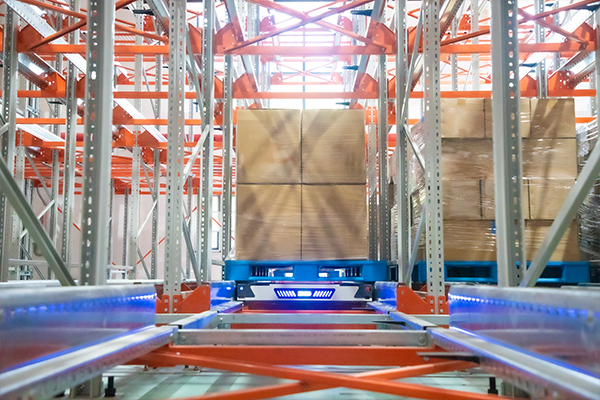
A warehouse should not treat all SKUs as equal. It needs an ABC velocity matrix, a pallet-type profile, and a replenishment policy for each class. For example, high-velocity SKUs can be placed in shallow shuttle lanes close to the lift, while low-velocity SKUs can be consolidated in deep storage without creating bottlenecks. This is where four-way shuttle systems provide the most benefit: they can handle deep storage for inventory density while still changing position quickly when the velocity profile changes.
Four-Way Shuttle Systems: The Core Mechanism for Dense High-SKU Storage
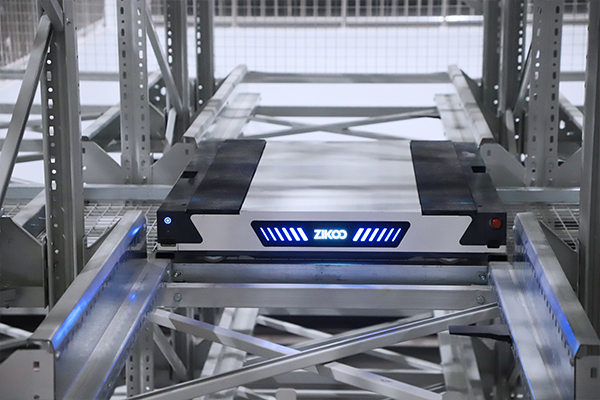
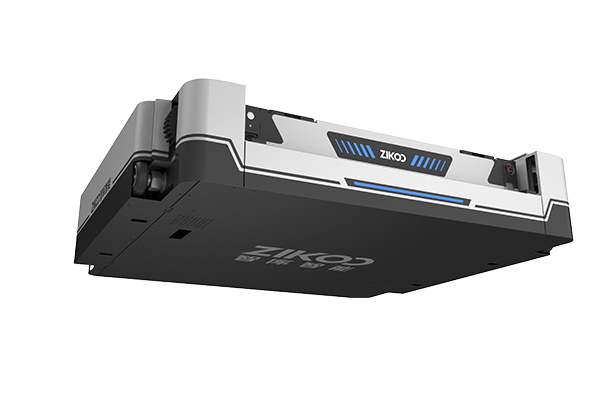
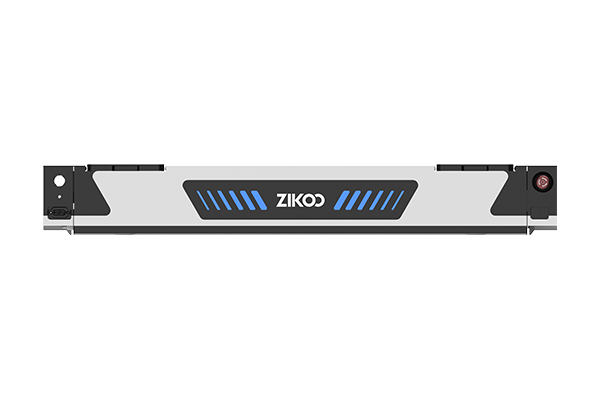
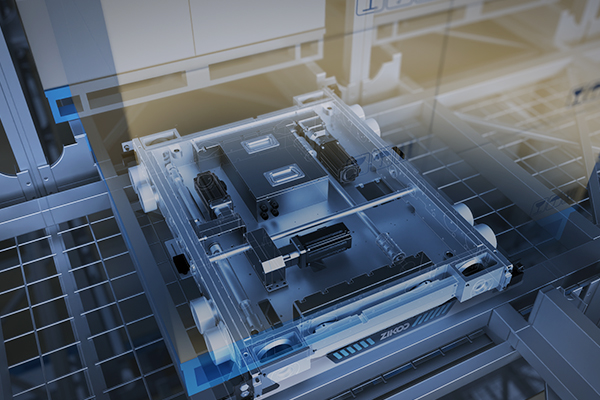
The R-bot Four-way Shuttle is built for dense pallet-to-person scenarios. In Zikoo’s product range, it has a body height of only 125 mm, allowing a very compact rack footprint, while load capacity extends from 1,200 kg to 2,000 kg depending on the model variant. Standard, American, Japanese, heavy-duty, and heavy-duty large-pallet types cover pallet sizes including 1200 × 800 mm, 1200 × 1000 mm, 1016 × 1219 mm, 1100 × 1100 mm, 1200 mm, and 1400 mm. That range matters in high SKU warehouses because mixed pallet standards are common when suppliers and customers operate in different markets.
The shuttle moves in four directions inside the rack, so it does not need a wide aisle in front of every position. Empty travel speed reaches 1.6 m/s on most models, with loaded travel at 1.2 m/s. When combined with the H-bot vertical bidirectional shuttle, the system becomes a six-way shuttle network: horizontal motion on the shuttle level and vertical transfer through dedicated lift positions. The H-bot achieves positioning accuracy of ±1 mm and works across a temperature range of -25°C to 45°C.
That technical envelope matters for high SKU facilities because mixed SKU storage often mixes product families, case counts, and pallet weights. A 1,500 kg Japanese-type pallet, a 1,200 kg standard pallet, and a 1400 mm large pallet should all be able to flow through the same system without manual re-slotting.
Dense shuttle systems change how a warehouse allocates fast and slow movers. <Smart Storage Revolution: Comprehensive Overview of Four-Way Shuttle Systems for Automatic 3D Warehouses> covers the full system architecture behind automatic 3D warehouses.
Software: The Real Control Layer for SKU Complexity
Hardware creates capacity. Software creates usable capacity. In a high SKU environment, the control layer must align warehouse execution decisions with physical robot movements.
The PTP Smart Warehouse Software covers WMS, WES, WCS, and RCS functions. Each layer has a distinct job. WMS manages orders, inventory, receipts, and shipping logic. WES sequences and releases work based on order waves, labor constraints, and equipment capacity. WCS translates those work instructions into equipment-level commands. RCS dispatches shuttles, lifts, and other robots so that movements do not collide or deadlock.
Without this separation, a warehouse either sends too much work to the equipment layer or waits for manual confirmation between steps. High SKU operations rely on software to manage batch picking, order grouping, dynamic reallocation, and replenishment waves. A digital twin or simulation environment [3] can be used during design to test how a specific SKU profile will flow through the shuttle system before the rack is built.
Software also matters because slotting should change over time. A SKU that was slow-moving in the first quarter may become fast-moving during a promotion. If the warehouse management layer cannot push a new slotting recommendation to the shuttle control layer, the physical system cannot follow the business change quickly enough.
Modern high-SKU operations rarely fail because a shuttle cannot move a pallet; they fail when WMS, WES, and RCS handoffs are ambiguous. <PTP Intelligent Warehouse Software Empowers Enterprises for Smart Upgrades> covers how a unified software layer supports enterprise smart upgrades.
High SKU Storage Profiles: From E-Commerce to Manufacturing
High SKU counts appear in several different operational contexts, and the correct system shape changes accordingly.
E-commerce and retail warehouses typically need split-case picking, many order lines, and tight outbound windows. In these environments, pallet shuttle storage may feed a piece-picking or goods-to-person workstation. Zikoo’s U-bot + AMR narrow aisle system, for example, supports up to 10,000 SKUs and can combine pallet access in high storage with AMR-based movement in lower picking areas. Its published picking efficiency is 300 pieces per hour or more, with inbound and outbound capability of 80 pallets per hour or more. That hybrid approach keeps dense storage while allowing multi-category picking at workstations.
Manufacturing and industrial warehouses, by contrast, often hold raw materials, work-in-progress, and finished goods with fewer order lines but higher pallet weights. The R-bot range fits well because the rack can be arranged for deep storage and the shuttle can move directly to the required pallet type.
Cold chain and pharmaceutical high SKU environments add temperature, material, and compliance constraints. The R-bot operates down to -15°C in standard configuration, while the cold-chain solution supports -25°C low-temperature batteries with 6–8 hours of continuous operation. New energy applications, where metal contamination is a concern, use stainless steel structural components, blackening treatment, and rubber buffer wheels to avoid introducing copper, zinc, nickel, or lead into the storage environment.
The key point is not to force every high SKU warehouse into the same template. The system should match the order profile, pallet population, temperature range, and software integration level.
Need a SKU profiling session? Map your SKU dimensions, velocity, pallet types, and order-line structure before selecting a shuttle layout. Contact Zikoo’s engineering team at info@zikoo-int.com or call (+86)-19941778955 for a structured evaluation.
Choosing the Right Automation Mix for High-SKU Warehouses
A four-way shuttle is not the only automation option, but it is one of the strongest choices for dense, multi-deep pallet storage with many SKU profiles. The comparison should be based on storage depth, building height, throughput, and how often the SKU mix changes.
| Evaluation factor | Four-way shuttle system | Stacker crane AS/RS | Manual rack and forklift |
|---|---|---|---|
| Deep multi-pallet storage | Good for high-density, multi-deep lanes | Usually single-deep or limited depth | Limited by reach and aisle |
| SKU changeover flexibility | Strong: system-directed location changes | Moderate: fixed rack logic | High labor dependence |
| Split-case or piece picking support | Feeds goods-to-person stations | Less direct | Manual picking only |
| Building height requirement | Can work in lower heights and renovation projects | Typically benefits from high-bay buildings | Wide aisles required |
| Scalability during growth | Shuttle and lift count can be expanded in stages | Crane count changes require larger structural impact | Easier to add but space-hungry |
For a high SKU warehouse with many replenishment transactions, the four-way shuttle system offers a balance between storage density and piece accessibility. Stacker cranes can deliver higher single-position throughput in some layouts, but they often create longer travel paths when the SKU mix is dispersed. Manual and forklift-based storage remains workable when SKU counts are low and labor availability is stable, but it becomes harder to sustain when order lines multiply.
Cost, Implementation, and Risk Realities
Cost for high SKU smart storage should be evaluated as a system, not as a shuttle price per unit. The investment includes racking, shuttle fleet, vertical lifts, conveyance, control software, integration with host systems, installation, testing, training, and ongoing maintenance support. Quoting practices can vary widely between suppliers, so an automation budget should be broken into physical equipment, software licenses, integration services, and after-sales service rather than treated as a single opaque package.
Material handling standards and lifecycle support practices [2] recommend validating system availability, maintenance access, spare-part supply, and software update procedures before contract signing. In a high SKU environment, the software support path is as important as mechanical spare parts because slotting adjustments, interface changes, and seasonal WMS modifications occur more often.
Implementation time is case-specific. It depends on customer data quality, building readiness, interface readiness, and the complexity of changeover. A warehouse should not expect a single standard delivery schedule for a 10,000 SKU hybrid system versus a smaller pallet-only shuttle system. The stronger the SKU and order data upfront, the fewer change orders and downstream disruptions.
Maintenance planning should include battery strategy, lift inspection, shuttle wheel replacement, sensor calibration, and software monitoring. Zikoo’s R-bot models run for about 8 hours on a full charge under normal operation, with 7 hours for the heavy-duty large-pallet version. That operational cycle should be part of shift planning so charging windows are deliberate rather than reactive.
Every SKU profile carries a different trade-off among pallet depth, shuttle count, and lift capacity. <Multi-Scenario Smart Adaptation: Zikoo’s Six-Way Shuttle Powers the Digital Transformation of Warehousing> covers how scenario-specific shuttle configurations support digital transformation.
Plan your high-SKU storage upgrade with data, not guesswork. Send your SKU profile, pallet dimensions, current layout, and throughput targets to info@zikoo-int.com or call (+86)-19941778955. Zikoo Smart Technology can review the requirements, propose a shuttle-and-lift architecture, and provide a structured project delivery plan.
FAQ
Are four-way shuttle systems suitable for high-SKU warehouses?
Yes. They are especially suitable when the warehouse stores many palletized SKU types across different pallet sizes and velocity classes. The system can place slow movers in deep storage and fast movers closer to picking positions, with software controlling location changes.
Which AS/RS solution is best for high-SKU warehouses?
There is no single best solution. Dense pallet storage often fits a four-way shuttle system. Single-deep high-throughput operations may prefer a stacker crane. Split-case and multi-SKU piece picking may need a hybrid such as a shuttle-to-person system with AMR support. The right choice depends on order lines, pallet types, SKU count, and building constraints.
What data is needed before designing a smart storage system?
Plan to provide SKU master data, pallet dimensions and weights, inbound and outbound volumes, order-line profiles, seasonal peaks, facility drawings, floor capability, power availability, and host-system interface requirements. Poor data quality is one of the main sources of design change during automation projects.
Can a high-SKU warehouse combine pallet storage and piece picking?
Yes. A hybrid design can use four-way shuttle storage for pallet inventory and an AMR or goods-to-person layer for split-case picking. The U-bot + AMR system, for example, supports up to 10,000 SKUs and combines upper storage with lower picking or buffering zones.
How can we avoid pricing surprises in warehouse automation?
Request a transparent quotation separated into racking, shuttle and lift hardware, software licenses, integration, commissioning, training, and maintenance. Ask the supplier to identify interface boundaries, site readiness responsibilities, and long-lead items before contract award.
What if our pallet dimensions are not standard?
Automation should be designed around the actual pallet population. Zikoo’s R-bot models cover multiple pallet formats, including 1200 × 800 mm, 1200 × 1000 mm, 1016 × 1219 mm, 1100 × 1100 mm, 1200 mm, and 1400 mm pallets, so mixed pallet standards can be accommodated in one system.
References
[1] Roodbergen, K.J., & Vis, I.F.A. (2009). A survey of literature on automated storage and retrieval systems. European Journal of Operational Research, 194(2), 343–362. https://doi.org/10.1016/j.ejor.2008.01.038
[2] FEM European Materials Handling Federation. (2024). Automated storage and retrieval systems: system validation and lifecycle support. https://www.fem-eur.com/
[3] ISO 23247-1:2021. Automation systems and integration — Digital twin framework for manufacturing — Part 1: Overview and general principles. https://www.iso.org/standard/75066.html
If you’re interested, check out these related articles:
Six-Way Shuttle: Pioneering the Future of Smart Warehousing
Software-Driven Hardware: Six-Way Shuttle Maximizes Warehouse Efficiency
Smart Cold Chain Era: Six-Way Shuttle System Redefines Storage Efficiency with Maximum Density
Six-Way Shuttle Unlocks the Era of True 3D Intelligent Warehousing


