


Warehouse operations have shifted faster than most of us expected. What used to work—more staff, longer shifts, bigger facilities—doesn’t scale the way it once did. E-commerce volumes keep climbing, delivery windows keep shrinking, and the math on manual processes just doesn’t add up anymore. Robotics and intelligent automation have moved from “nice to have” to “how do we stay in business.” This piece looks at what’s actually working in modern warehouse optimization, with particular attention to pallet-to-person approaches that are reshaping how goods move through facilities.
Why Warehouse Optimization Has Become Non-Negotiable
The pressure on warehouses today comes from multiple directions at once. E-commerce customers expect two-day delivery as standard, not a premium service. Global supply chains have grown more complex, with more SKUs, more suppliers, and more variability in demand patterns. When processes can’t keep pace, the problems compound quickly—bottlenecks form, labor costs spike, and customer satisfaction erodes.
What makes this particularly challenging is that traditional solutions have hit their limits. You can’t simply hire your way out of a throughput problem when labor markets are tight and training takes time. You can’t expand your footprint indefinitely when real estate costs keep rising. The warehouses that are pulling ahead have recognized that efficiency gains now require fundamentally different approaches to how work gets done.
Smart Warehouse Technology and What It Actually Delivers
Smart warehouse technology sounds like a buzzword until you see the numbers. Facilities running integrated systems report operational cost reductions of up to 30% alongside throughput increases of 25%. Those aren’t marginal improvements—they’re the difference between profitable operations and struggling ones.
The foundation is warehouse management software (WMS), which handles inventory tracking, order management, and labor allocation. But WMS alone doesn’t move goods. Warehouse execution systems (WES) and warehouse control systems (WCS) sit between the management layer and the physical equipment, translating high-level decisions into real-time actions. Data analytics pulls it all together, identifying patterns that humans would miss and surfacing opportunities for continuous improvement.
What makes these systems powerful isn’t any single component—it’s how they work together. When your WMS knows exactly what’s in stock, your WES can optimize pick sequences, and your WCS can direct automated equipment accordingly, the whole operation runs tighter than any manual coordination could achieve.
For further insights into intelligent warehouse platforms, consider reading 《PTP Intelligent Warehousing Platform: Building a Flexible and Smart Logistics Ecosystem》.
Pallet-to-Person Robotics Changes the Fundamental Equation
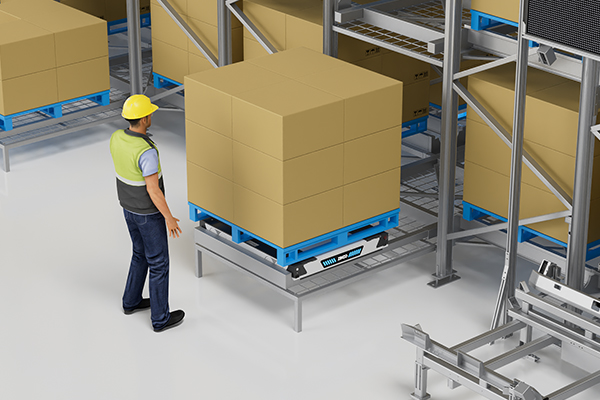
Traditional warehouse picking requires people to walk to products. In a large facility, that walking time adds up to hours per shift—time when workers aren’t actually picking anything. Pallet-to-person robotics flips this model entirely. Products come to people instead of the other way around.
The efficiency gains are substantial. Picking accuracy improves because workers stay focused at their stations rather than navigating aisles while consulting pick lists. Speed increases because the limiting factor shifts from human walking pace to robot travel time—and robots don’t get tired, don’t take breaks, and don’t slow down toward the end of a shift.
Zikoo’s U-bot Omnidirectional Stacker Robots illustrate what’s possible in this space. These units operate in narrow aisles requiring only 2100 mm width, which matters enormously for space utilization. They handle loads up to 1000 kg and reach lifting heights from floor level to 8 meters. The omnidirectional movement allows them to navigate tight spaces that would challenge conventional equipment.
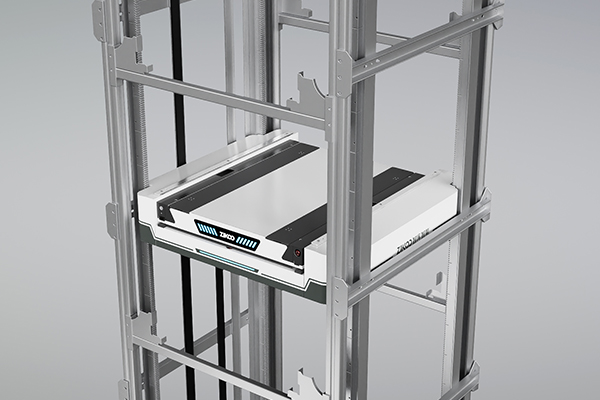
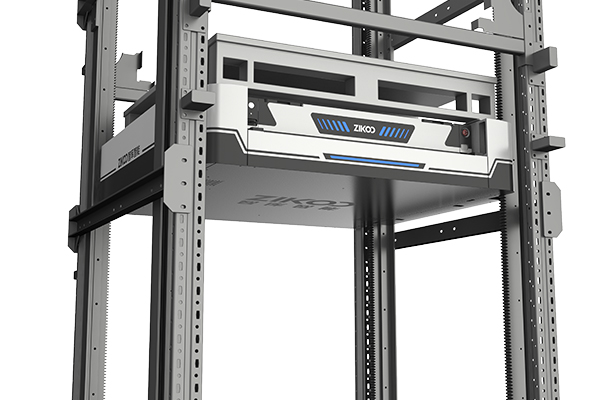
The R-bot Four-Way Shuttle takes a different approach, optimized for dense storage configurations. At just 125 mm in body height with 1.5-ton load capacity, these units move in four directions and handle autonomous routing decisions. Paired with the H-bot Vertical Bidirectional Shuttle, they form what’s called a six-way shuttle system. The H-bot functions as a vertical transport hub, occupying a single storage location while coordinating with R-bots to create a three-dimensional movement network. This integration allows goods to flow through the facility in ways that would be impossible with conventional equipment.
| Model | Load Capacity | Body Dimensions (L×W×H) | Pallet Size | Empty Speed | Loaded Speed |
|---|---|---|---|---|---|
| R-bot (Standard) | 1200 kg | 1000 × 972 × 125 mm | 1200 × 800–1000 mm | 1.6 m/s | 1.2 m/s |
| R-bot (Heavy-duty) | 1500 kg | 1192 × 972 × 125 mm | 1200 mm | 1.6 m/s | 1.2 m/s |
| U-bot (U1080) | 1000 kg | 2198 × 1820 × 3465 mm | N/A | N/A | N/A |
| H-bot (Standard) | 1800 kg | 1300 × 1464 × 288 mm | 1200 × 800–1200 mm | 1 m/s | 0.5 m/s |
The Real Math on Automation and Operating Costs
Labor costs keep rising, and that trend shows no signs of reversing. Automation addresses this directly by handling repetitive, physically demanding tasks that would otherwise require human workers. But the cost picture is more nuanced than simple labor replacement.
When you automate routine tasks, you free human workers for activities that actually require human judgment—exception handling, quality decisions, customer-facing work. This isn’t just about cutting headcount; it’s about deploying your workforce where it creates the most value.
The ROI calculation includes several factors that aren’t immediately obvious. Automated systems maintain consistent accuracy, which reduces the costs associated with picking errors—returns, rework, customer service time. They operate predictably, which makes capacity planning more reliable. Predictive maintenance capabilities catch equipment issues before they cause unplanned downtime, keeping operations running when they need to run.
| ROI Factor | Description | Impact on Costs |
|---|---|---|
| Labor Savings | Reduced need for manual labor in repetitive tasks. | Direct reduction in wages and benefits. |
| Increased Throughput | Faster processing of goods. | Higher revenue potential, lower cost per unit. |
| Space Utilization | Optimized storage density. | Reduced need for additional warehouse space. |
| Error Reduction | Automated precision minimizes picking errors. | Decreased returns, rework, and associated costs. |
| Safety Improvements | Robots handle hazardous tasks. | Lower insurance premiums and fewer workplace accidents. |
Getting More From Every Square Foot
Warehouse space is expensive, and in many markets, it’s getting harder to find. Vertical storage solutions combined with automated retrieval can increase storage density by up to 40%. That’s the equivalent of adding significant capacity without breaking ground on new construction.
Automated storage and retrieval systems (AS/RS) make vertical space usable in ways that manual operations simply can’t match. Human workers can’t efficiently pick from 8-meter heights, but automated stackers handle it routinely. The six-way shuttle system—combining R-bot Four-way Shuttles with H-bot Vertical Bidirectional Shuttles—creates a storage network that uses all three dimensions effectively.
This approach also improves scalability. When demand fluctuates, you need operations that can flex without massive capital investments or lengthy hiring cycles. A well-designed automated system can handle volume swings by running additional shifts or adjusting throughput rates, without the lead time required to recruit and train new staff.
Discover how the six-way shuttle system can redefine storage efficiency in the cold chain era by reading 《Smart Cold Chain Era: Six-Way Shuttle System Redefines Storage Efficiency with Maximum Density》.
What to Think Through Before Implementing Automation
Automation projects that fail usually fail in the planning phase, not the execution phase. A phased implementation approach reduces risk by allowing you to learn and adjust before committing fully. Starting with a pilot area, proving out the technology, and then expanding systematically beats trying to transform everything at once.
Several questions deserve serious attention early in the process. How well does your existing infrastructure support automated equipment? What specific operational goals are you trying to achieve, and how will you measure success? Which technologies actually fit your product mix, order profiles, and facility layout?
Safety protocols need to be designed into the system from the start, not bolted on afterward. Automated equipment and human workers will share space in most implementations, and the interaction points require careful thought. Training matters too—your team needs to understand how to work alongside automated systems and how to respond when something goes wrong.
Integration with existing systems is often more complex than it initially appears. Your WMS, WES, and WCS need to communicate reliably, and data needs to flow accurately between layers. The solutions you choose should also accommodate future growth—what works for today’s volumes needs to scale for tomorrow’s.
What are the benefits of warehouse automation?
The primary benefits fall into three categories: cost reduction, throughput improvement, and accuracy gains. Operating costs drop because automated systems handle work that would otherwise require manual labor. Throughput increases because robots work continuously at consistent speeds. Accuracy improves because automated systems don’t make the kinds of errors that tired or distracted humans make. There’s also a labor reallocation effect—when robots handle the repetitive physical work, human workers can focus on tasks that require judgment and problem-solving.
How do pallet-to-person robots improve warehouse efficiency?
The core improvement comes from eliminating travel time. In traditional picking operations, workers might spend more than half their shift walking between locations. Pallet-to-person robotics brings inventory to stationary workstations, so workers spend their time actually picking rather than walking. Zikoo’s U-bot Omnidirectional Stacker Robots exemplify this approach, delivering pallets directly to operators. The result is faster order fulfillment, lower labor costs per order, and fewer picking errors because workers can focus on the task at hand rather than navigating the facility.
What is the difference between WMS, WES, and WCS in smart warehouses?
These three systems operate at different levels of the warehouse technology stack. WMS (Warehouse Management System) handles the strategic layer—inventory levels, order management, labor planning. WES (Warehouse Execution System) sits in the middle, optimizing workflows and coordinating between management decisions and physical execution. WCS (Warehouse Control System) operates at the tactical level, directly controlling automated equipment like conveyors, sorters, and robots in real time. Zikoo PTP Smart Warehouse Software integrates these functions into a unified platform, which simplifies implementation and ensures the different layers work together smoothly.
Unlock Your Warehouse’s Full Potential with Zikoo Smart Technology
Ready to transform your logistics operations and achieve unparalleled efficiency? Zikoo Smart Technology Co., Ltd. offers cutting-edge pallet-to-person robotics and intelligent PTP Smart Warehouse Software (WMS/WES/WCS/RCS) designed to optimize your entire supply chain. Contact us today for a personalized consultation and discover how our U-bot, R-bot, and H-bot solutions can drive your business forward. Visit our website or reach out via info@zikoo-int.com or (+86)-19941778955 to schedule a demo.


