


A smart warehouse is not simply a building with more technology. It is an operational system that connects storage hardware, material flow, software, and people around real-time information. The defining change is feedback: instead of following fixed waves and manual task lists, the warehouse senses current order demand, storage availability, and equipment status, then adjusts its decisions. That closed-loop behavior—sense, decide, execute, and learn—is the core of what separates smart operations from conventional mechanization [1].
What “Smart” Actually Means in a Modern Warehouse
Smartness is best understood as a performance outcome rather than a product category. A facility may have conveyors, racks, and barcode scanners, but if its daily routing, replenishment, and labor assignment still depend on static plans, it is only automated in parts. A truly smart warehouse uses integrated data to shorten lead time, reduce wasted travel, and make storage decisions that respond to shifting order profiles.
The most useful definition focuses on four capabilities: visibility into inventory and equipment states, decision support from real-time data, automatic execution through robotics, and continuous learning from operational history. Digital twin frameworks describe this as maintaining a synchronized digital representation of physical warehouse operations so that changes can be tested before they reach the floor [1]. Industry surveys consistently frame the same shift around speed, workforce constraints, and the need for scalable fulfillment capacity [2].
The Core Technology Stack Behind a Smart Warehouse
Automated Storage and Retrieval Systems
Automated storage and retrieval systems, commonly shortened to AS/RS, provide the structural backbone for dense, high-discipline storage. They replace broad aisles and manual putaway with machine-guided placement into racks or high-density lanes. The result is a warehouse that can use vertical space more effectively and maintain tighter inventory accuracy than paper-based or basic WMS-guided processes.
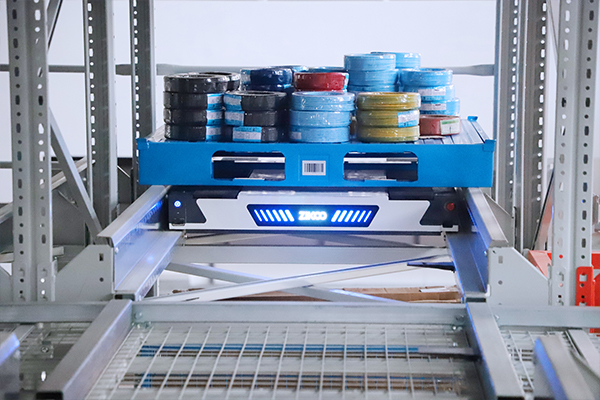
AS/RS is not one technology. Stacker cranes serve tall racking with heavy throughput demands. Shuttle-based systems, including four-way and six-way configurations, move pallets horizontally inside dense lanes and may combine with vertical lifts to form a three-dimensional handling network. The right choice depends on pallet dimensions, load weight, building height, and whether inbound or outbound flows dominate.
| Technology | Best fit | Typical constraint |
|---|---|---|
| Stacker crane AS/RS | Tall high-bay racking, heavy pallets | Fixed rail, aisle geometry |
| Four-way shuttle system | Dense pallet lanes, flexible access | Deep lane planning, software coordination |
| Compact omnidirectional stacker | Narrow-aisle retrofits, lower heights | Lift range, aisle width |
| Mobile robot fleet | Flexible point-to-point transport | Load size, traffic control, floor condition |
Four-Way Shuttles and Pallet-to-Person Robotics
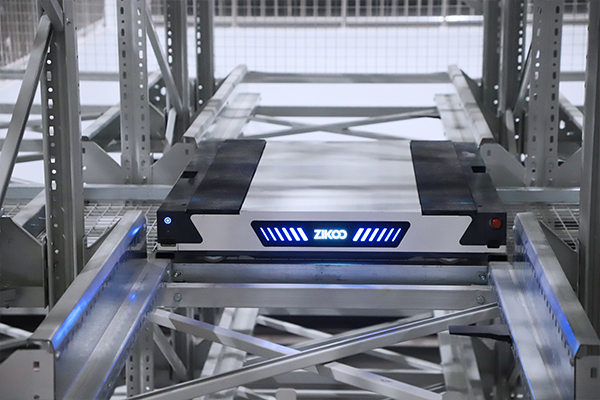
A four-way shuttle is a compact pallet carrier that travels in all four horizontal directions within a rack structure, allowing high-density storage without a dedicated aisle for every picking position. In a pallet-to-person model, the shuttle retrieves a pallet and presents it to an ergonomic workstation, so operators remain in safe zones while machines handle travel. This approach can reduce aisle space, shorten operator walking distance, and support multi-shuttle collaboration across multiple levels.
In dense storage applications, four-way shuttle systems are often compared with stacker cranes. Shuttles typically offer more flexible lane access and can scale by adding units, while stacker cranes can reach greater heights and may simplify very high-bay layouts. Neither is universally better; the decision must follow the facility’s throughput, SKU profile, and expansion plan.
The stacker crane versus four-way shuttle decision depends on height, depth, and throughput balance. <Stacker Crane vs Four-Way Shuttle: Which Fits Your [ASRS Warehouse](https://www.zikooint.com/asrs-automated-storage-and-retrieval-system-solutions) Best> covers how to match rack geometry and order profiles to the right automated storage model.
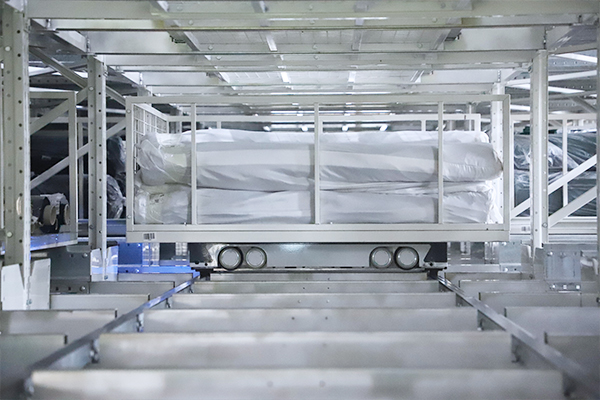
Shuttle-based dense storage also forms the foundation for automatic three-dimensional warehouses. When horizontal shuttle movement is paired with vertical bidirectional shuttles or lifts, the system can serve multiple levels without assigning a fixed crane to every rack row. This creates a more flexible path from any storage location to any workstation, which matters most for high-SKU and multi-temperature operations.
Four-way shuttle systems are now a common reference point in automatic 3D warehouse design. <Smart Storage Revolution: Comprehensive Overview of Four-Way Shuttle Systems for Automatic 3D Warehouses> covers how shuttle-based lanes, racking geometry, and software scheduling fit together in high-density projects.
Warehouse Software: WMS, WES, WCS, and RCS
Hardware only becomes intelligent when the software layer can allocate work across machines in real time. A warehouse management system (WMS) plans inventory and orders. A warehouse execution system (WES) translates business priorities into machine-level workflow decisions. A warehouse control system (WCS) coordinates fixed equipment such as conveyors, lifts, and scanners. A robot control system (RCS) manages robot dispatching, traffic control, and task sequencing across a fleet.
| Software layer | Primary role |
|---|---|
| WMS | Inventory and order planning |
| WES | Workflow prioritization and release |
| WCS | Fixed equipment coordination |
| RCS | Robot fleet dispatch and traffic management |
The smart warehouse depends less on any single module than on the handoffs among these layers. If WMS says a pallet is available, WCS must confirm physical availability. If RCS reports congestion in one aisle, WES should reroute orders before queues build. That kind of closed-loop coordination is the practical expression of a smart system.
Planning an AS/RS or shuttle-based project? Send warehouse dimensions, pallet specifications, and throughput targets to info@zikoo-int.com for technical feedback before writing an RFP.
Data, Safety, and Operational Discipline
Data integration is what allows a warehouse to respond to conditions rather than merely record them. Modern IoT architectures connect sensors, machine controllers, and handheld devices into a shared event stream. The industrial IoT reference architecture treats interoperability and data exchange as first-class requirements, not afterthoughts [3]. In a smart warehouse, this may include battery state, shuttle position, pallet weight, outbound priority, and environmental readings such as temperature and humidity.
The same emphasis belongs to safety. Automation reduces some risks, but it does not remove the need for controlled access, maintenance procedures, and emergency stop protocols. Personnel still enter aisles for inspection, cleaning, and recovery, so material handling safety requirements remain the baseline for design and operation [4]. A smart facility should also define degraded modes: what happens when a shuttle stops mid-aisle, when the network is interrupted, or when an order wave exceeds planned capacity.
From Smart Capability to Business Value
A smart warehouse creates value in four practical ways. It compresses storage footprint by using vertical and deep-lane space more efficiently. It reduces dependence on manual travel by bringing pallets to operators. It improves accuracy by making more transactions machine-verified. It smooths peak demand by allowing more flexible shifts and task prioritization.
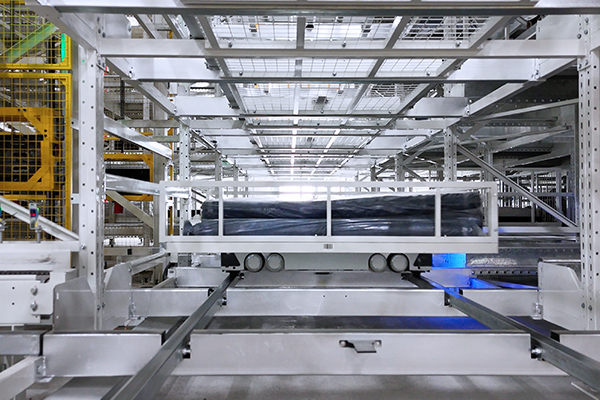
Consider a dense storage lane served by a compact shuttle. The shuttle can operate in spaces where traditional forklift aisles would be impractical, and battery-backed shuttle fleets can support multi-shift operation when charging and duty cycles are planned correctly. In mixed picking environments, a robotics system can combine pallet-level access with split-case picking, so the same facility serves both B2B and B2C order profiles without duplicating inventory.
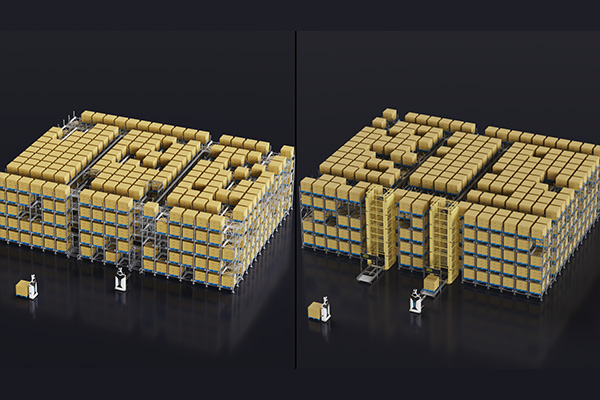
The economic case is strongest when the smart layer is designed into the process, not layered on top of a broken one. A facility with unstable master data, inconsistent pallet quality, or unclear order priorities will carry those problems into the automated system. That is why pre-project data analysis, slotting design, and simulation matter more than the selection of any single robot model.
Efficiency in a smart warehouse is inseparable from software-driven hardware coordination. <Six-Way Shuttle: The Smart Warehousing Tool for Cost Reduction and Efficiency> covers the cost and productivity logic behind dense shuttle-based fulfillment.
Smart Warehouse Readiness Checklist
- Map inbound, storage, picking, and outbound flows before choosing automation.
- Classify pallet sizes, weights, SKU velocity, and order profiles realistically.
- Measure ceiling height, column spacing, floor flatness, and available electrical capacity.
- Define target throughput in pallets per hour and peak-day behavior.
- Plan for system integration: ERP, WMS, machine controllers, and network infrastructure.
- Establish safety procedures, maintenance access, and recovery workflows during design, not after installation.
Plan Your Smart Warehouse Move
A smart warehouse project should begin with an operational analysis, not a product list. The questions that matter most include storage density requirements, peak throughput, temperature conditions, software integration depth, and long-term scalability. Once these are clear, the technology selection becomes measurable.
If you are evaluating four-way shuttle systems, AS/RS, or pallet-to-person robotics for a new build or retrofit, the Zikoo Smart Technology engineering team can support the evaluation with layout review, software integration planning, and project delivery experience. Send your warehouse dimensions, pallet specifications, and target inbound/outbound volumes to info@zikoo-int.com or call (+86)-19941778955 for a technical consultation.
Frequently Asked Questions
What is the difference between a smart warehouse and an automated warehouse?
An automated warehouse replaces manual tasks with machines. A smart warehouse connects those machines, software, and people through real-time data so that workflows are continuously prioritized and adjusted. Automation provides the actuators; smartness comes from the control and feedback loops around them.
What is the most important technology in a smart warehouse?
There is no single most important technology. The critical elements are automated storage and retrieval equipment, material flow robotics, and warehouse software that coordinates WMS, WES, WCS, and RCS. The value is created by their integration, not by any one component in isolation.
Is a four-way shuttle suitable for my warehouse?
Four-way shuttle systems fit dense pallet storage environments with disciplined pallet sizes and enough throughput to justify automated travel. Building height, load weight, temperature, SKU profile, and order mix determine suitability. A site analysis is needed before selecting lane depth, number of shuttles, and workstation count.
How does software make a warehouse truly smart?
Software turns machine availability and order demand into a single decision flow. WMS plans inventory, WES prioritizes work, WCS coordinates fixed equipment, and RCS dispatches mobile robots. The feedback among these systems allows the warehouse to adjust to congestion, order changes, and equipment states in near real time.
What should I verify before investing in smart warehouse automation?
Verify data quality, pallet consistency, building constraints, throughput requirements, integration points, maintenance access, and supplier project references. A reliable partner should walk through the full process from simulation and layout validation to installation, commissioning, and after-sales support.
References
[1] ISO 23247-1:2021, Automation systems and integration — Digital twin framework for manufacturing — Part 1: Overview and general principles, International Organization for Standardization.
[2] MHI, “2025 MHI Annual Industry Report: The Collaborative Supply Chain,” Deloitte, 2025, https://www.mhi.org/publications/report.
[3] ISO/IEC 30141:2018, Internet of Things (IoT) — Reference Architecture, International Organization for Standardization/International Electrotechnical Commission.
[4] Occupational Safety and Health Administration, 29 CFR 1910.176, Materials Handling — General, U.S. Department of Labor.
If you’re interested, check out these related articles:
Six-Way Shuttle: The Dual-Engine Solution for High-D
Six-Way Shuttle: Empowering Industries to Embrace Smart Warehousing
Six-Way Shuttle Unlocks the Era of True 3D Intelligent Warehousing
Six-Way Shuttle: The Smart Warehousing Tool for Cost Reduction and Efficiency 2
Six-Way Shuttle Powers Dense Storage: Breaking Space Limitations


