El almacenamiento automatizado vs pallet racking decision often centers on space savings, but the real differentiators are throughput, flexibility, and total cost per pallet moved. High-density sistema de transbordador automatizados excel in warehouses above 5,000 pallet positions where multi-SKU handling and high throughput are required, delivering a lower cost per pallet moved than standard racking. For low-volume, low-SKU operations, however, standard pallet racking remains the simpler and more capital-efficient choice.
High-Density Automated Storage and Standard Pallet Racking Defined
In pallet storage, two distinct approaches dominate warehouse design. Standard pallet racking, typically selective rack, arranges frames and beams into single-deep lanes with aisles wide enough for forklift access. Every pallet is immediately reachable, and rack structure is entirely passive. Drive-in and push-back racking increase density but still rely on forklifts and reduced selectivity.
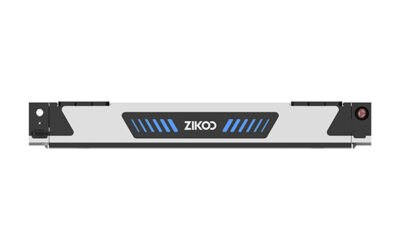
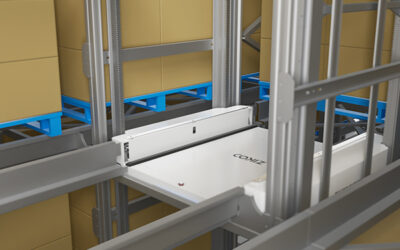
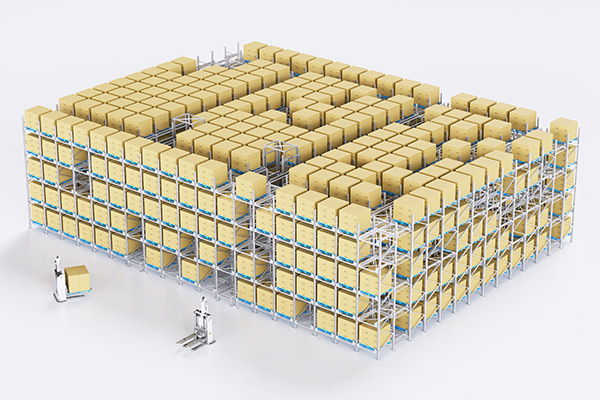
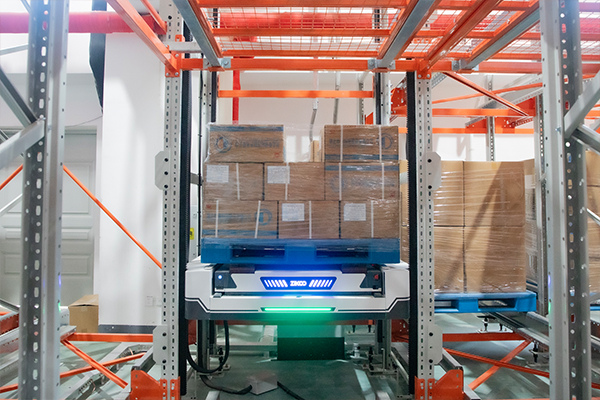
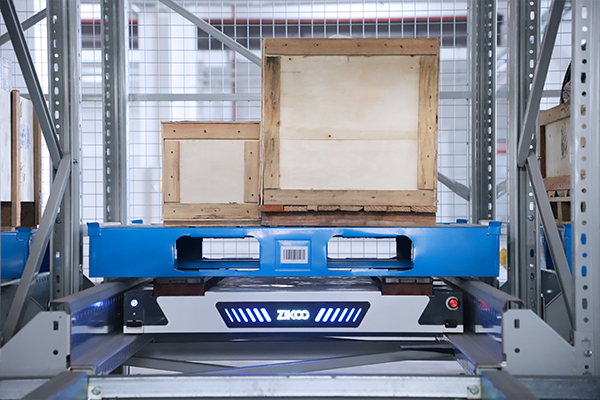
High-density automated storage takes a fundamentally different approach. A sistema de transporte por tranvía de pallets such as a sistema de transbordador de cuatro vías ASRS runs on rails within deep storage lanes, carrying pallets from the front face to any position in the lane. A vertical lift, typically an elevator-type mechanism, brings pallets to a pickup and deposit station at floor level. These systems integrate with warehouse execution software to automate putaway and retrieval sequences. Space savings come from eliminating the wide aisles that forklifts need; lanes can be several pallets deep and separated by only the width of the shuttle body.
Storage Density and Space Savings Compared
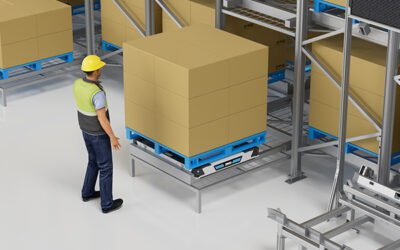
Density differences are stark. Standard selective racking typically uses roughly 40–45% of the building footprint for actual storage once aisle space is accounted for. A sistema de transbordadores de cuatro vías can push that figure above 80% because aisles between lanes are reduced to the minimum clearance required for the shuttle, and vertical space is used more efficiently with higher racking. This translates directly into more pallet positions inside the same building envelope. For facilities with high land or construction costs, doubling the number of storage slots within an existing footprint can reshape the entire business case.
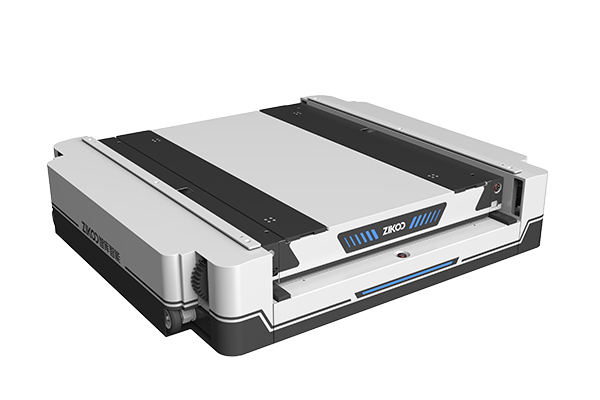
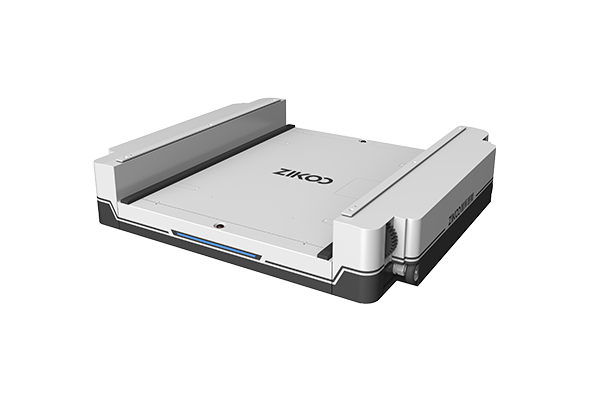
The R-bot four-way shuttle, with a body thickness of 125 mm and a rated load up to 1.5 tons, is designed precisely for this density. Its compact dimensions allow racking lanes to be tightly spaced, while the shuttle’s four-way movement eliminates the need for intermediate cross-aisles. Still, density alone is not the full picture. The cost per pallet stored drops with automated high-density systems, but the cost per pallet moved depends on how the system handles throughput and picks.
Throughput and Flexibility: The Overlooked Differentiators
Standard racking has a genuine advantage in single-pallet retrieval time. A forklift operator can pull any pallet in roughly 30–60 seconds. In a deep-lane shuttle system, the worst-case retrieval requires the shuttle to move pallets behind the target pallet to a buffer position, then extract the target and relocate the buffered pallets. Without careful slotting and WMS logic, deep-lane retrieval can take several minutes per pallet.
In practice, the gap narrows with intelligent software. We have seen properly tuned shuttle systems sustain 80–100 dual-cycle moves per hour per lane in manufacturing and 3PL environments. Batch picking algorithms group retrievals so that multiple pallets from the same lane are extracted together, amortizing the deep-lane repositioning time across an entire wave. The key factor is not the peak retrieval speed of one pallet but the sustained throughput the system can deliver across a shift.
Handling Multi-SKU Warehouses
When an operation stores thousands of SKUs with varying turnover patterns, a shuttle-based ASRS can dynamically slot pallets based on velocity. High-turn items sit close to the lane face; slow movers fill the deep positions. Standard racking, by contrast, tends to suffer from pick-path inefficiencies as SKUs proliferate. The ability to reconfigure slot assignments through software without physically moving rack gives the automated system a flexibility that static racking cannot match.
| Storage Type | Effective Aisle Ratio | Typical Retrieval Time (Single Pallet) | Sustained Throughput (Pallets/Hour per Lane) |
|---|---|---|---|
| Standard Selective Rack | 55–60% aisle space | 30–60 seconds (forklift) | 15–25 |
| Drive-In Rack | 25–35% aisle space | 90–120 seconds (forklift) | 10–15 |
| Four-Way Shuttle ASRS | 10–20% aisle space | 60–180 seconds (deep retrieval); 30 seconds (face) | 40–80 (with batch picking) |
Total Cost of Ownership from Capital to Payback
Standard pallet racking carries the lowest upfront cost per pallet position. However, total cost per pallet moved includes labor, MHE maintenance, energy, and facility costs over the system’s life. A shuttle system eliminates the need for forklifts inside the storage zone and reduces headcount required for putaway and retrieval. In a warehouse processing 500 pallets per shift with 12 operators, moving to automated handling can free 6–8 operators for other tasks. Over five to seven years, the cumulative labor savings alone often surpass the initial hardware investment difference, especially in regions with rising labor costs.
Space savings convert directly to lower cost per pallet stored, but the real leverage point is throughput-per-square-meter. When a facility can double its storage slots without expanding the building, the capital avoided from new construction can offset a significant portion of the automation cost. This is why we frequently see shuttle systems pay back within three to five years in greenfield projects that would otherwise require a much larger footprint.
Warehouse Scenarios Suited to Each System
cURL Too many subrequests by single Worker invocation. To configure this limit, refer to https://developers.cloudflare.com/workers/wrangler/configuration/#limits cURL Too many subrequests by single Worker invocation. To configure this limit, refer to https://developers.cloudflare.com/workers/wrangler/configuration/#limits cURL Too many subrequests by single Worker invocation. To configure this limit, refer to https://developers.cloudflare.com/workers/wrangler/configuration/#limits
cURL Too many subrequests by single Worker invocation. To configure this limit, refer to https://developers.cloudflare.com/workers/wrangler/configuration/#limits
cURL Too many subrequests by single Worker invocation. To configure this limit, refer to https://developers.cloudflare.com/workers/wrangler/configuration/#limits
cURL Too many subrequests by single Worker invocation. To configure this limit, refer to https://developers.cloudflare.com/workers/wrangler/configuration/#limits
cURL Too many subrequests by single Worker invocation. To configure this limit, refer to https://developers.cloudflare.com/workers/wrangler/configuration/#limits
cURL Too many subrequests by single Worker invocation. To configure this limit, refer to https://developers.cloudflare.com/workers/wrangler/configuration/#limits
cURL Too many subrequests by single Worker invocation. To configure this limit, refer to https://developers.cloudflare.com/workers/wrangler/configuration/#limits
cURL Too many subrequests by single Worker invocation. To configure this limit, refer to https://developers.cloudflare.com/workers/wrangler/configuration/#limits
cURL Too many subrequests by single Worker invocation. To configure this limit, refer to https://developers.cloudflare.com/workers/wrangler/configuration/#limits
cURL Too many subrequests by single Worker invocation. To configure this limit, refer to https://developers.cloudflare.com/workers/wrangler/configuration/#limits
cURL Too many subrequests by single Worker invocation. To configure this limit, refer to https://developers.cloudflare.com/workers/wrangler/configuration/#limits
cURL Too many subrequests by single Worker invocation. To configure this limit, refer to https://developers.cloudflare.com/workers/wrangler/configuration/#limits
cURL Too many subrequests by single Worker invocation. To configure this limit, refer to https://developers.cloudflare.com/workers/wrangler/configuration/#limits
cURL Too many subrequests by single Worker invocation. To configure this limit, refer to https://developers.cloudflare.com/workers/wrangler/configuration/#limits
cURL Too many subrequests by single Worker invocation. To configure this limit, refer to https://developers.cloudflare.com/workers/wrangler/configuration/#limits
cURL Too many subrequests by single Worker invocation. To configure this limit, refer to https://developers.cloudflare.com/workers/wrangler/configuration/#limits
cURL Too many subrequests by single Worker invocation. To configure this limit, refer to https://developers.cloudflare.com/workers/wrangler/configuration/#limits
cURL Too many subrequests by single Worker invocation. To configure this limit, refer to https://developers.cloudflare.com/workers/wrangler/configuration/#limits
cURL Too many subrequests by single Worker invocation. To configure this limit, refer to https://developers.cloudflare.com/workers/wrangler/configuration/#limits almacenamiento denso cURL Too many subrequests by single Worker invocation. To configure this limit, refer to https://developers.cloudflare.com/workers/wrangler/configuration/#limits
Si está interesado, eche un vistazo a estos artículos relacionados:
Revolucionando la Logística de Cadena de Frío: La Lanzadera de Seis Vías Zikoo Robotics Potencia Almacenamiento de Alta Densidad y Alta Eficiencia
El transporte de seis vías desbloquea la era del almacenamiento inteligente 3D real
Sistema de transbordadores de seis vías lidera el cambio de máquinas a robots en la automatización de almacenamiento denso