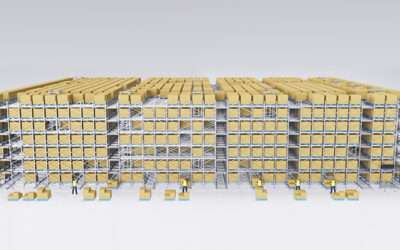
For any logistics manager weighing pallet storage options, the sistema de transbordadores de cuatro vías presents a compelling alternative to the familiar forklift fleet. I’ve been on both sides of this decision—designing and commissioning sistema automatizado de almacenamiento y recuperacións, and also troubleshooting facilities that still run on reach trucks and counterbalance forklifts. The cost difference is not just a line-item comparison of equipment price tags. A sistema de transbordador de cuatro vías system can reduce total pallet-handling costs by roughly one-third in medium- to high-throughput environments because it compresses aisles, eliminates travel waste, and runs without a driver on every move. The real question is what you’re paying per pallet moved over a five-year window—and that’s where a forklift-based warehouse often looks cheaper only on day one.
What Are the Real Costs of a Forklift-Based Warehouse?
A standard forklift warehouse looks inexpensive because the equipment cost per truck is modest compared to an automated shuttle. But the fully loaded picture includes multiple forklifts, battery chargers, spare batteries, racking, a dedicated operator for each truck (often across two or three shifts), plus maintenance contracts. In a 5,000-pallet facility with medium throughput, you might need five reach trucks, five operators per shift, and an aisle width of 3.2 meters to allow safe turning. Labor alone can exceed $180,000 per year per shift in developed markets, and that expense recurs every year. Add energy, pallet damage from manual handling, and productivity loss during shift changes, and the annual operating cost of a forklift fleet can easily surpass the initial equipment investment within two years.
| Cost Driver | Typical Forklift Fleet (5 reach trucks) |
|---|---|
| Equipment (amortized 5 years) | $60,000–$80,000/year |
| Labor (1 shift, 5 operators) | $180,000–$250,000/year |
| Energy & Battery Maintenance | $15,000–$25,000/year |
| Racking & Floor space (wider aisles) | $35,000–$50,000/year |
| Pallet & Rack Damage | $8,000–$15,000/year |
| Total Annual Operating Cost | $298,000–$420,000/year |
These numbers don’t include the hidden cost of limited vertical space usage. Because forklifts can only reach up to about 12 meters safely and require wider aisles, a 10,000-square-meter warehouse may leave 30–40% of its cubic volume unused.
Where Does a Four-Way Shuttle System Save Money?
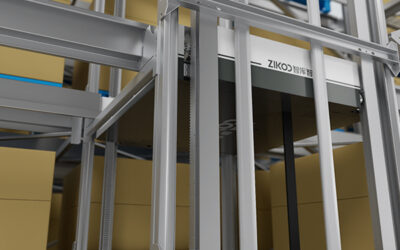
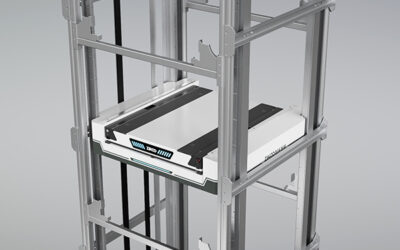
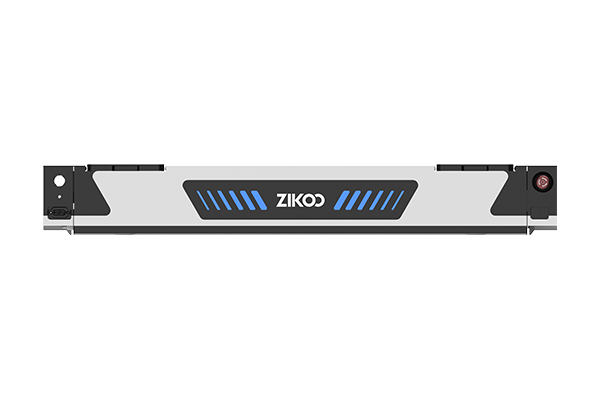
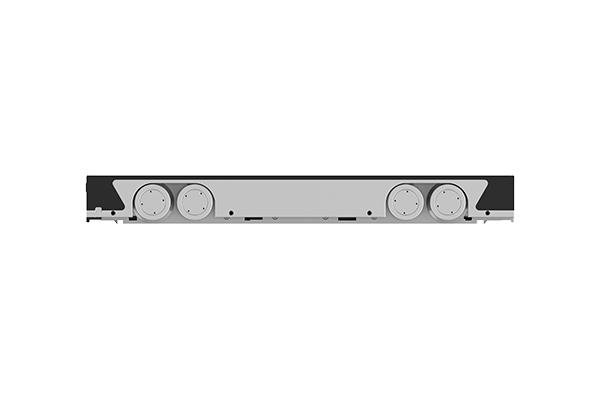
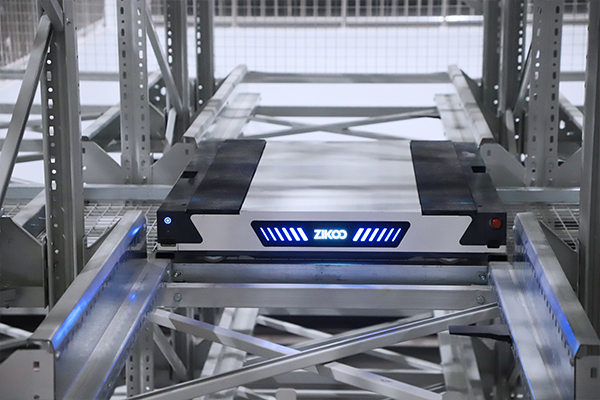
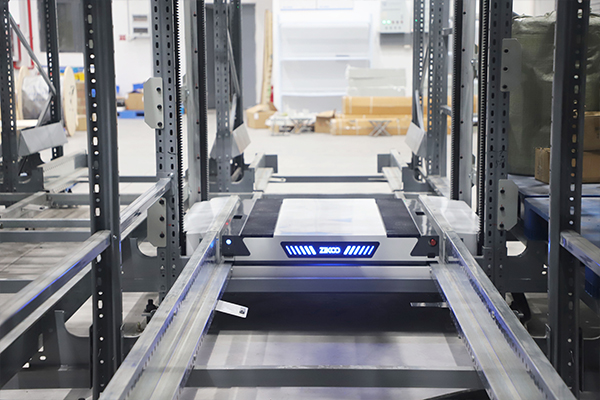
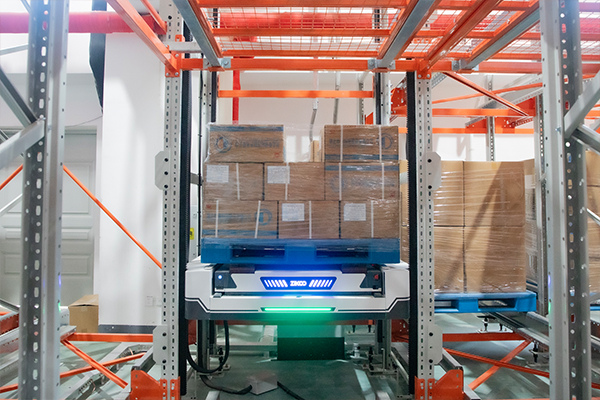
The four-way shuttle shrinks aisle width to roughly 1.5 meters and eliminates travel by operating within the rack lanes. In the same 5,000-pallet facility, a shuttle-based almacenamiento denso system can fit the same inventory into 40%–50% less floor space, often allowing a company to avoid or delay building expansion. The R-bot Four-way Shuttle, for example, has a body thickness of only 125 mm and can handle pallets up to 1,500 kg, moving at 1.6 m/s empty and 1.2 m/s loaded. With multiple shuttles working in coordinated groups, the system achieves throughput that would otherwise require many more forklifts.
Labor cost drops sharply: one operator managing a bank of shuttles via the warehouse control system can oversee what used to need a team of forklift drivers. From our project data in dense storage facilities, the direct labor reduction is typically 50%–70%, depending on shift patterns. And because shuttles use lithium batteries with up to eight hours of continuous operation, energy cost per pallet moved is roughly one-third that of a forklift fleet—the shuttle weighs only 270 kg compared to a reach truck’s several tons, so moving its own mass consumes far less energy.
Capital Investment: Shuttle Systems vs Forklift Fleets
There’s no getting around it: the upfront capital for a four-way shuttle installation is higher. A fork-based system includes the trucks, racking, and perhaps a warehouse management module. A shuttle system adds the shuttles themselves, the vertical lifts (or H-bot elevators), a more sophisticated software stack (WMS/WCS/RCS), and often a raised floor or guide rail installation. For a 5,000-pallet greenfield project, the total capital outlay for a shuttle system can be 2–3 times the equipment cost of a forklift fleet. But this comparison ignores the fact that the shuttle system often allows you to use a smaller building, or to fit 50% more storage into the same footprint, offsetting construction or lease costs substantially.
I’ve seen several projects where the savings in land and building costs alone covered 40% of the automation investment. Once you factor in the reduced headcount and the longer lifespan of an industrial shuttle (12–15 years versus 7–10 years for a forklift), the capital gap narrows significantly over time.
If your project involves mixed pallet sizes, the specific shuttle model can swing the cost. The R-bot comes in variants for 1200×1000 mm, 1100×1100 mm, and even 1400 mm pallets, and choosing the right one avoids expensive rack modifications. Share your pallet dimensions with us, and we’ll validate the most cost-effective configuration before you commit to a design—reach out at [email protected].
Day-to-Day Operating Expenses: Maintenance, Labor, and Energy
Labor Costs: Automation vs Manual Operation
Forklift warehouses require a driver for every vehicle, and skilled operators are increasingly scarce and expensive in many regions. A shuttle system replaces the majority of travel and placement motions with automated moves. One technician can monitor and manage a fleet of 10–15 shuttles, and the control software handles task allocation. In a two-shift operation, this alone saves hundreds of thousands of dollars annually.
Energy and Maintenance: What to Expect
Shuttles run on compact lithium batteries and consume far less peak power than forklifts accelerating with a heavy counterweight. A typical R-bot battery (51.2V/40Ah) provides a full shift of operation, and the shuttle’s light weight reduces wear on racking and floors. Preventive maintenance on shuttles is often simpler: no masts, no hydraulics, fewer moving parts. That said, the software layer requires regular updates and occasional tuning, especially if WMS integration is complex. But overall, from our service data, a shuttle system’s annual maintenance cost runs about 1.5%–2.5% of the initial hardware investment, compared to 5%–8% for a multi-shift forklift fleet.
How Different Warehouse Conditions Shift the Cost Balance
Cold Storage: How Temperature Affects Cost
Cold and freezer warehouses amplify the cost advantage of shuttle systems. Forklift batteries lose capacity in sub-zero environments, and operators need heated cabs, frequent breaks, and premium pay—all driving up labor costs. The R-bot cold chain solution uses a dedicated -25°C lithium battery that still gives 6–8 hours of operation, and the shuttle’s enclosed design protects electronics from frost and condensation. We’ve helped several cold storage operators switch from manual forklifts to automated shuttles, cutting energy for material handling by half and eliminating cold-related downtime.
cURL Too many subrequests by single Worker invocation. To configure this limit, refer to https://developers.cloudflare.com/workers/wrangler/configuration/#limits
cURL Too many subrequests by single Worker invocation. To configure this limit, refer to https://developers.cloudflare.com/workers/wrangler/configuration/#limits
cURL Too many subrequests by single Worker invocation. To configure this limit, refer to https://developers.cloudflare.com/workers/wrangler/configuration/#limits
cURL Too many subrequests by single Worker invocation. To configure this limit, refer to https://developers.cloudflare.com/workers/wrangler/configuration/#limits
cURL Too many subrequests by single Worker invocation. To configure this limit, refer to https://developers.cloudflare.com/workers/wrangler/configuration/#limits
cURL Too many subrequests by single Worker invocation. To configure this limit, refer to https://developers.cloudflare.com/workers/wrangler/configuration/#limits
cURL Too many subrequests by single Worker invocation. To configure this limit, refer to https://developers.cloudflare.com/workers/wrangler/configuration/#limits Sistema de Almacenamiento Automatizado
cURL Too many subrequests by single Worker invocation. To configure this limit, refer to https://developers.cloudflare.com/workers/wrangler/configuration/#limits
cURL Too many subrequests by single Worker invocation. To configure this limit, refer to https://developers.cloudflare.com/workers/wrangler/configuration/#limits
cURL Too many subrequests by single Worker invocation. To configure this limit, refer to https://developers.cloudflare.com/workers/wrangler/configuration/#limits
cURL Too many subrequests by single Worker invocation. To configure this limit, refer to https://developers.cloudflare.com/workers/wrangler/configuration/#limits almacenamiento automatizado cURL Too many subrequests by single Worker invocation. To configure this limit, refer to https://developers.cloudflare.com/workers/wrangler/configuration/#limits
cURL Too many subrequests by single Worker invocation. To configure this limit, refer to https://developers.cloudflare.com/workers/wrangler/configuration/#limits
cURL Too many subrequests by single Worker invocation. To configure this limit, refer to https://developers.cloudflare.com/workers/wrangler/configuration/#limits
cURL Too many subrequests by single Worker invocation. To configure this limit, refer to https://developers.cloudflare.com/workers/wrangler/configuration/#limits
cURL Too many subrequests by single Worker invocation. To configure this limit, refer to https://developers.cloudflare.com/workers/wrangler/configuration/#limits
cURL Too many subrequests by single Worker invocation. To configure this limit, refer to https://developers.cloudflare.com/workers/wrangler/configuration/#limits
cURL Too many subrequests by single Worker invocation. To configure this limit, refer to https://developers.cloudflare.com/workers/wrangler/configuration/#limits
Si está interesado, eche un vistazo a estos artículos relacionados:
La estandarización impulsa la entrega global: Zikoo Robotics Six-Way Shuttle amplía su presencia en el extranjero
Plataforma de Almacenamiento Inteligente PTP: Construyendo un Ecosistema Logístico Flexible e Inteligente