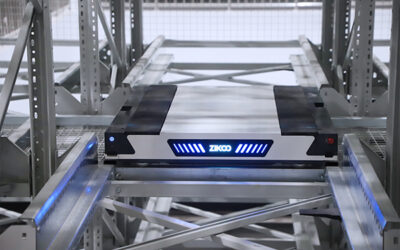
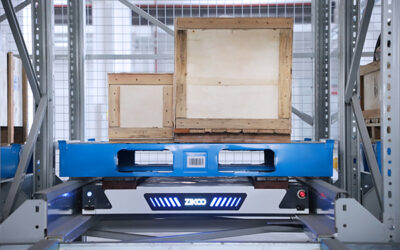
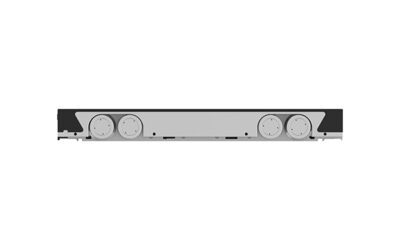
Software is not a supporting layer in a modern warehouse automation project — it is the central nervous system. In my experience integrating pallet-to-person robotics across manufacturing and cold chain facilities, a system’s mechanical hardware can only perform as well as the software directing it. Warehouse automation software determines how inbound pallets are assigned to storage locations, how retrieval sequences are ordered during peak throughput, and how dozens of shuttle robots avoid deadlock in a dense racking environment. Without the software layer that ties warehouse execution logic to real-time equipment control, the hardware is simply a collection of well-engineered machines waiting for instructions.
What the Software Stack Actually Controls in a Pallet Sistema de Almacenamiento Automatizado
In a typical pallet shuttle system, three software tiers work together to turn a physical storage structure into a live, responsive operation. The warehouse management system (WMS) handles the business logic: inventory master data, order wave processing, and putaway rules. Below that, the warehouse execution system (WES) orchestrates task sequencing — balancing inbound and outbound priorities against available shuttle capacity. The lowest layer, the robot control system (RCS), manages device-level commands: path planning, traffic control, and positioning corrections for each individual shuttle.
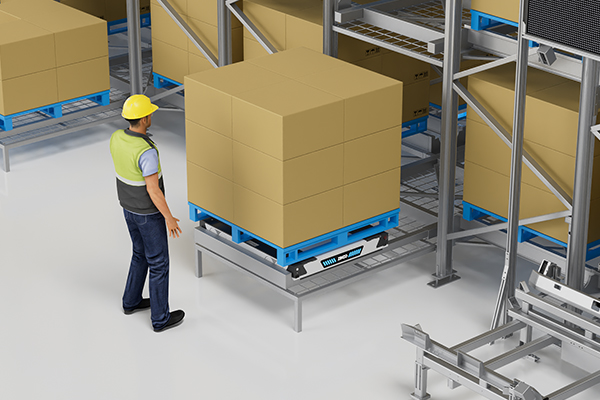
What distinguishes a production-ready implementation from a pilot is how these layers share a single source of truth about inventory location and status. A sistema de transbordador de cuatro vías does not decide which pallet to retrieve next. It receives a command from the RCS, which was informed by the WES, which processed a picking wave from the WMS. If the WMS holds stale inventory data, the entire chain produces a wrong retrieval — and that error propagates faster than any mechanical breakdown. During one project for a cold storage facility requiring -25℃ operation, we found that the most consequential commissioning time went not toward shuttle tuning, but toward verifying that the WES correctly re-sorted task priority when a single shuttle entered a low-battery charge cycle. The hardware worked on day one; the exception-handling logic took another week to harden.
Why Sistema de transporte en cuatro direccioness Depend on Real-Time Traffic Management
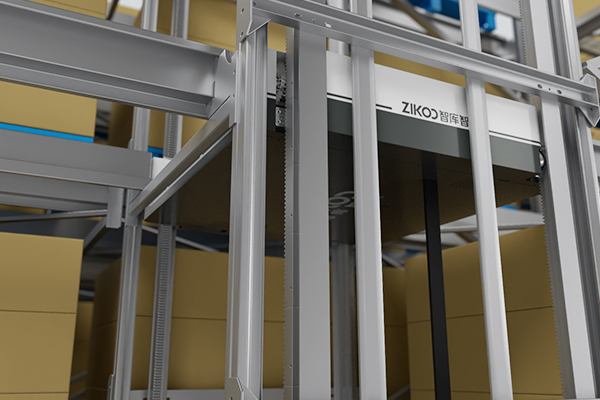
A four-way shuttle fleet operating in a high-density rack with a single vertical lift demands a fundamentally different control model than a fixed-path conveyor. The software must solve a dynamic routing problem: at any moment, each shuttle can move forward, backward, or laterally within its storage plane, while the vertical lift serves as a shared elevator resource. If the control algorithm allows two shuttles to request the lift at the same time, a bottleneck forms that can knock 15–20% off the system’s throughput within a single shift.
The RCS in our Software de almacén inteligente PTP uses a reservation-based traffic model. Each shuttle books a path segment ahead of time, and the lift controller accepts one call at a time based on task urgency and proximity optimization. I’ve seen teams initially underestimate this component because they evaluate the shuttle hardware in isolation. A single R-bot four-way shuttle can travel at 1.6 m/s unloaded and 1.2 m/s loaded. That is a useful number, but fleet-level throughput is not the sum of individual shuttle speeds — it is the output of the scheduling algorithm that prevents them from interfering with each other. In a system with eight shuttles per level across four vertical planes, the software is making hundreds of path-allocation decisions per minute.
If your operation involves mixed inbound and outbound during the same shift, it is worth confirming that the WES supports simultaneous task interleaving before finalizing the equipment specification — send your peak-hour throughput profile to [email protected] and we can model the software’s task-pairing logic against it.
The Cost of a Software Failure: What Happens When the System Goes Down
A mechanical failure usually affects a single shuttle. A software failure can freeze an entire storage plane. In a pallet-to-person system, when the RCS loses positioning reference — either from a floor marker degradation or a communication handshake failure with a shuttle — the safe-stop protocol triggers across the affected zone. All shuttles halt, the vertical lift parks, and the operator is presented with a recovery interface.
How long that recovery takes depends on two software capabilities: offline simulation restore and manual override granularity. The platform I work on stores a digital twin of the rack configuration and shuttle positions updated every 500 milliseconds. When a zone restart is initiated, the system recalibrates each shuttle’s odometry against fixed reference points rather than requiring an operator to manually re-home every unit. That cuts recovery time from potentially 30 minutes of manual intervention to roughly three to five minutes of automated repositioning. Without that software capability, a minor sensor glitch becomes a half-shift of lost productivity.
The larger risk is not a crash but a degraded state that nobody notices. For example, a memory leak in the WES task queue can gradually increase command latency over several hours, and the floor supervisor sees throughput dropping without an obvious root cause. In projects across e-commerce warehouses with 10,000 SKU profiles, we log every task execution timestamp and compare it against a baseline computed from the last seven days of operation, flagging deviations that exceed two standard deviations before they become production delays.
Selecting Software That Scales With Your Operation
A four-way shuttle system is a long-lived asset — the mechanical structure often outlasts the original software version by five to eight years. Selecting a software platform means evaluating not just whether it runs today’s SKU count, but whether its architecture supports expansion without a rewrite.
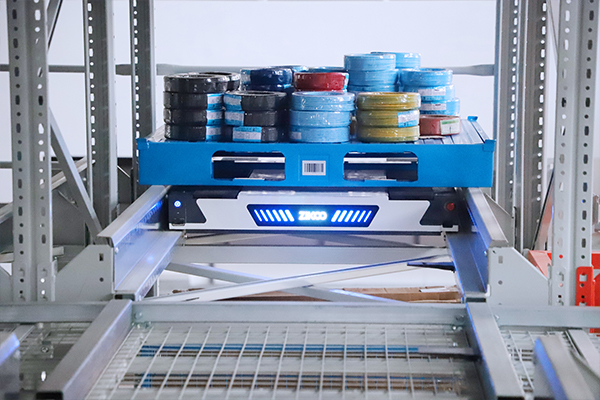
The RCS must handle additional shuttles as lane count increases. If the current system manages 20 shuttles and the future plan adds 12 more, the path reservation algorithm must scale sub-linearly — meaning double the shuttles cannot double the computational load. The control platform we deploy uses a hierarchical decomposition that isolates intra-lane traffic from inter-lane coordination, so adding lanes does not explode the state space.
The WES side must accommodate changes in order profiles. A warehouse that starts with full-pallet outbound for B2B distribution and later adds case-picking for B2C fulfillment needs a task engine that can reprioritize on the fly without a schema change. I have seen organizations buy capable hardware and then, two years later, need to replace the entire control software layer because the original system was designed around a fixed-task-sequence assumption. The hardware was fine; the software was a dead end.
The following table compares operational software characteristics at different organizational stages:
| Operational Stage | Software Requirement | Por qué es importante |
|---|---|---|
| Single-format full-pallet outbound | Basic WMS with static putaway logic | Overhead of dynamic task engine not justified |
| Mixed inbound/outbound, single shift | WES with task interleaving | Prevents forklift staging backlog during peak wave |
| Multi-SKU split-case picking added | WES with dynamic priority injection | Maintains throughput when small orders interleave with pallet moves |
| Multi-site, multi-tenant 3PL | Full WMS/WES/RCS stack with segregated data partitions | Each client’s SLA operates on independent logic without cross-contamination |
Key Questions to Ask Before Commissioning a Software-Heavy Automation System
Before a single shuttle is delivered, the software architecture already sets the upper bound on what the system can achieve. After commissioning multiple pallet-to-person facilities, here are the specific parameters I verify:
- Does the RCS support dynamic re-routing when a shuttle reports a blocked path, or only static route pre-allocation? In a dense grid, a blocked floor section can cascade into fleet-wide waiting if alternate paths are not computed in real time.
- Can the WES accept a partial-order cancellation and roll back the task sequence without deleting the wave? A missing pallet at picking time should not force a wave rebuild.
- Is the inventory reconciliation logic between WMS and WCS event-driven or batch-synced? Batch sync introduces a latency window where the WCS may execute against stale locations.
I’ve seen a pharmaceutical warehouse implement a batch-sync model to save software cost, only to find that discrepancies grew to over 2% of inventory records within three months because cancelled moves were not propagated until the next sync. The correction required a full physical inventory count and a software patch. The hardware never failed once.
cURL Too many subrequests by single Worker invocation. To configure this limit, refer to https://developers.cloudflare.com/workers/wrangler/configuration/#limits
cURL Too many subrequests by single Worker invocation. To configure this limit, refer to https://developers.cloudflare.com/workers/wrangler/configuration/#limits
cURL Too many subrequests by single Worker invocation. To configure this limit, refer to https://developers.cloudflare.com/workers/wrangler/configuration/#limits
cURL Too many subrequests by single Worker invocation. To configure this limit, refer to https://developers.cloudflare.com/workers/wrangler/configuration/#limits
cURL Too many subrequests by single Worker invocation. To configure this limit, refer to https://developers.cloudflare.com/workers/wrangler/configuration/#limits
cURL Too many subrequests by single Worker invocation. To configure this limit, refer to https://developers.cloudflare.com/workers/wrangler/configuration/#limits
cURL Too many subrequests by single Worker invocation. To configure this limit, refer to https://developers.cloudflare.com/workers/wrangler/configuration/#limits sistema de transporte por tranvía de pallets cURL Too many subrequests by single Worker invocation. To configure this limit, refer to https://developers.cloudflare.com/workers/wrangler/configuration/#limits
cURL Too many subrequests by single Worker invocation. To configure this limit, refer to https://developers.cloudflare.com/workers/wrangler/configuration/#limits
cURL Too many subrequests by single Worker invocation. To configure this limit, refer to https://developers.cloudflare.com/workers/wrangler/configuration/#limits
Si está interesado, eche un vistazo a estos artículos relacionados:
Six-Way Shuttle permite a los proveedores 3PL construir centros logísticos inteligentes de próxima generación
Transbordador de Seis Vías: La Herramienta de Almacenamiento Inteligente para la Reducción de Costes y la Eficiencia 2
Transbordador de Seis Vías: La Solución Definitiva para Almacenes para Reducir Costos y Mejorar la Eficiencia