


Four-way shuttle storage is an automated storage and retrieval architecture in which a compact shuttle travels in both horizontal axes inside rack lanes and transfers between levels through vertical lifts or H-bot bidirectional shuttles [1]. Instead of dedicating wide access aisles for cranes or forklifts, the four-way shuttle operates inside the rack itself. The result is a dense, modular, high-throughput pallet storage system that can extend backward and upward while keeping multiple shuttles, lifts, and workstations running under one orchestration layer.
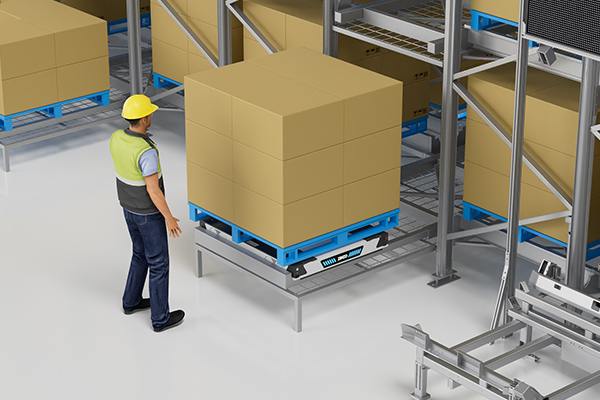
How Four-Way Shuttle Storage Creates Dense Capacity
A conventional stacker crane AS/RS requires an aisle wide enough for the crane mast, its load-handling device, and maintenance access. The four-way shuttle replaces that dedicated aisle with compact vertical transfer positions. Because the shuttle moves in both the X and Y directions within a storage level, rack rows can be placed almost continuously side by side, and lane depth can be extended behind the transfer position.
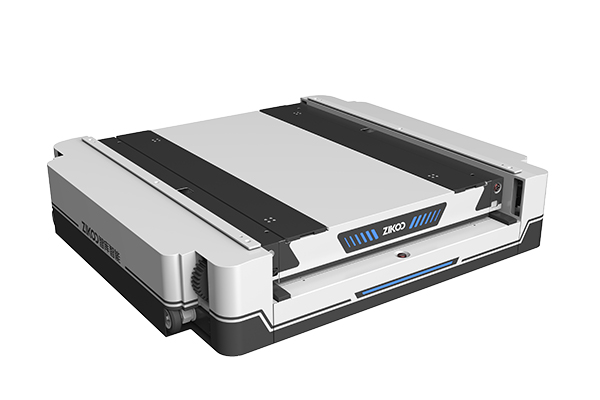
The R-bot Four-Way Shuttle illustrates the compact form factor that makes this possible. The body is only 125 mm thick on most models, while rated loads range from 1,200 kg to 2,000 kg. The thin body reduces vertical pitch between storage levels, which directly increases the number of usable levels in a given building height.
| Model | Rated load | Body dimensions (L×W×H) | Typical pallet size |
|---|---|---|---|
| Standard R1200B | 1,200 kg | 1,000 × 972 × 125 mm | 1,200 × 800–1,000 mm |
| American R1200A | 1,200 kg | 1,192 × 840 × 125 mm | 1,016 × 1,219 mm |
| Japanese R1500J | 1,500 kg | 1,192 × 900 × 125 mm | 1,100 × 1,100 mm |
| Heavy-duty R1500B | 1,500 kg | 1,192 × 972 × 125 mm | 1,200 mm |
| Heavy-duty large-pallet R2000B | 2,000 kg | 1,250 × 1,300 × 150 mm | 1,400 mm |
Lane depth cannot be chosen from the shuttle specification alone. Pallet quality, load distribution, rack deflection, and shuttle positioning must be designed together. EN 15620 [2] sets tolerances, deformations, and clearances for adjustable pallet racking, and those tolerances determine how deep a lane can be built before positioning faults and pallet transfer failures become likely. In a well-engineered dense storage system, the WCS/RCS layer uses rack and pallet position feedback to manage accumulated deviation.
Dense storage layouts succeed only when lane depth, rack tolerance, and shuttle positioning are designed as one system. <Smart Storage Revolution: Comprehensive Overview of Four-Way Shuttle Systems for Automatic 3D Warehouses> covers how shuttle-based automatic 3D warehouse layouts are configured for different pallet formats and throughput classes.
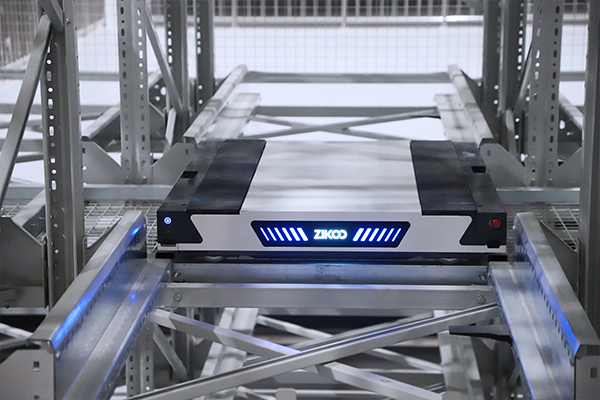
Modular Architecture: Add Capacity Level by Level
Four-way shuttle systems are modular at the physical layer and the software layer. A facility can start with a defined number of storage levels, shuttles, and transfer positions, then add capacity as SKU count or throughput grows. Additional shuttles increase horizontal movement capacity; additional H-bot vertical shuttles create more transfer points between levels and the floor. Because modularity is native to the architecture, a phased brownfield retrofit can be planned around existing rack, building columns, and dock positions.
The R-bot model range supports multiple pallet footprints within one control architecture: 1,200 × 800–1,000 mm, 1,016 × 1,219 mm, 1,100 × 1,100 mm, and 1,400 mm pallet sizes. The H-bot vertical shuttle occupies approximately one storage location, so vertical transfer does not consume a full crane aisle. Its positioning accuracy of ±1 mm supports deterministic handover between shuttle and lift.
Modularity also applies to the software stack. PTP Smart Warehouse Software is structured across WMS, WES, WCS, and RCS domains. An operation can begin with core inbound/outbound execution and add advanced mission optimization, order-wave control, and equipment-level diagnostics as the system matures.
The same four-way shuttle network can be extended into a six-way system with a vertical lift, changing floor-level interaction into multi-level dynamic handling. <Six-Way Shuttle: The Dual-Engine Solution for High-Density and High-Throughput> covers the mechanical and software coordination behind density-plus-throughput layouts.
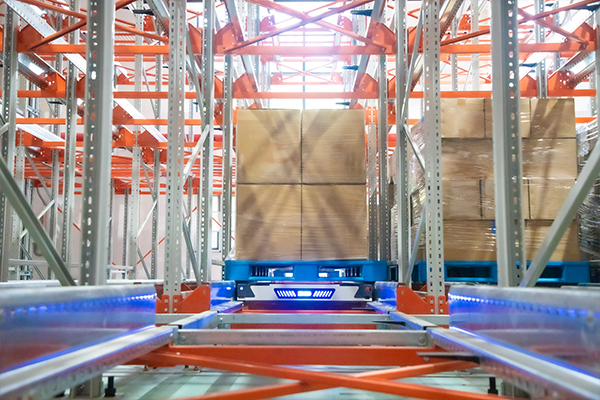
High-Throughput Orchestration: WMS, WES, WCS, and RCS
Throughput in a four-way shuttle system is not determined by one machine speed. It emerges from the interaction among shuttles, lifts, workstations, and the software that schedules them. WMS releases orders and inventory rules, WES balances work across zones, and the WCS/RCS layer performs real-time mission assignment, path planning, deadlock avoidance, and equipment coordination.
A practical throughput estimate must model shuttles, vertical transfer points, dock stations, and order-wave logic together. FEM 9.851 [3] provides a cycle-time framework for storage and retrieval machines, but a four-way shuttle cycle also includes lane transfer and lift handover time. If all pallets queue through one lift or one dock, shuttle speed becomes irrelevant. The system design must treat speed, acceleration, battery duration, lane depth, and lift placement as linked variables.
For reference, standard R-bot models travel at 1.6 m/s empty and 1.2 m/s loaded, while the heavy-duty large-pallet model travels at 1.35 m/s empty and 1.0 m/s loaded. H-bot lifts travel at 1.0 m/s empty and 0.5 m/s loaded. These are equipment specifications, not guaranteed system output; actual throughput should be confirmed through mission-level simulation.
If you are evaluating a four-way shuttle retrofit or greenfield design, request a material-flow simulation before committing capital. The configuration study should show where your bottleneck will appear under peak inbound and outbound workloads. Contact the Zikoo Smart Technology engineering team at info@zikoo-int.com to discuss a simulation based on your pallet profile, rack drawing, and throughput data.
PTP Smart Warehouse Software is the orchestration layer that schedules shuttles, lifts, and workstations under one mission engine. <PTP Intelligent Warehouse Software Empowers Enterprises for Smart Upgrades> covers the WMS/WES/WCS/RCS layer and upgrade paths for existing warehouses.
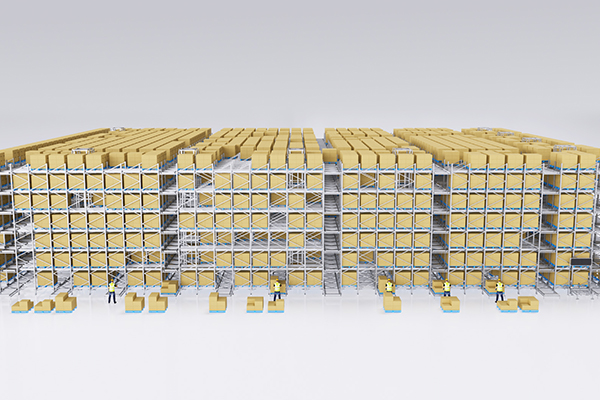
Where Four-Way Shuttle Storage Delivers the Strongest Payback
Four-way shuttle systems fit several high-density pallet storage scenarios:
- E-commerce warehouses and distribution centers with deep reserve storage
- Manufacturing facilities storing raw materials and finished goods
- Cold chain food storage and pharmaceutical constant-temperature warehouses
- Brownfield facilities that cannot add crane aisles but can convert existing pallet rack
- High-SKU operations with mixed pallet dimensions and unsynchronized inbound/outbound flows
In cold storage, the system may be configured with a low-temperature battery supporting -25°C operation and 6–8 hours of continuous duty. Low-temperature charging ports and special PCBA coating help protect electronics in high-humidity environments. Because shuttle automation reduces the number of people entering the frozen cube, cold chain facilities can also reduce heat gain and improve operator safety.
What to Verify Before Choosing a Four-Way Shuttle System
Before selecting a supplier, confirm that the following points are addressed in every proposal:
- Rack tolerance and lane-depth calculations aligned with current pallet quality
- Mission-level throughput simulation showing shuttles, lifts, docks, and order-wave logic
- Separation of WMS, WES, WCS, and RCS functions, including failure handling
- Pallet dimension and load-weight validation against the proposed shuttle model
- Spare-parts availability, local service response, and remote diagnostics capability
- Battery runtime, charging strategy, and cold chain options where relevant
A four-way shuttle proposal built only around maximum shuttle speed or maximum pallet depth should be treated as incomplete. The value of dense, modular, high-throughput storage appears only when lane design, vertical transfer, and software scheduling are engineered as one continuous process.
Talk to a Four-Way Shuttle Engineering Team
If you are assessing whether a four-way shuttle system fits your pallet profile, throughput target, and brownfield constraints, send your layout drawings, SKU mix, and inbound/outbound rates to Zikoo Smart Technology’s automation team. We respond with a configuration review covering lane depth, shuttle fleet size, lift placement, software integration, and expected throughput under your actual mission profiles.
Email: info@zikoo-int.com
Phone: (+86)-19941778955
Frequently Asked Questions
What is the difference between a four-way shuttle and a stacker crane AS/RS?
A four-way shuttle moves inside rack lanes in both horizontal directions and changes levels through vertical lifts. A stacker crane operates from a dedicated aisle and moves vertically and horizontally on rails. Four-way shuttle systems often provide higher storage density because the access aisle is replaced by compact transfer positions, but system throughput depends strongly on software orchestration and the number of vertical transfer points.
How deep can a four-way shuttle lane be?
Lane depth is determined by rack engineering, pallet condition, load distribution, and shuttle control. EN 15620 [2] provides rack tolerance and clearance guidance. Deeper lanes exchange more aisle-free footprint for longer access time, so required throughput must be tested before adding depth.
Is a four-way shuttle system suitable for cold storage?
Yes, when specified correctly. R-bot cold-chain models can operate at -25°C with 6–8 hours of continuous duty. Autonomous shuttle operation reduces the number of people working inside the frozen cube, which lowers heat gain and improves safety.
How is throughput improved in a four-way shuttle system?
Throughput improves through parallel shuttle operation across multiple levels, multiple vertical transfer positions, and real-time mission scheduling from the WMS/WES/WCS/RCS layer. System output should be validated with simulation rather than relying on single-machine speed.
Can I retrofit a four-way shuttle system into an existing warehouse?
In many cases, yes. Four-way shuttle systems suit existing pallet rack retrofits because shuttles operate inside the lanes and H-bot lifts can be added at transfer positions. A brownfield audit must check floor flatness, rack tolerances, electrical supply, and vertical transport positions.
What should I request in a four-way shuttle project proposal?
Request pallet profile confirmation, lane-depth calculation, rack tolerance assessment, throughput simulation, software architecture description, equipment list, acceptance criteria, service plan, and spare-parts coverage. These items allow you to compare proposals on engineering completeness rather than on headline speed alone.
References
[1] MHI, “Automated Storage and Retrieval Systems,” Material Handling Industry, Charlotte, NC, USA. [Online]. Available: https://www.mhi.org/fundamentals/as-rs
[2] EN 15620:2021, “Steel static storage systems — Adjustable pallet racking — Tolerances, deformations and clearances,” European Committee for Standardization, Brussels, Belgium, 2021.
[3] FEM 9.851, “Performance Data of S/R Machines — Cycle Times,” European Materials Handling Federation, Frankfurt, Germany, 2003.
[4] ISO 23247-1:2021, “Automation systems and integration — Digital twin framework for manufacturing — Part 1: Overview and general principles,” International Organization for Standardization, Geneva, Switzerland, 2021.
If you’re interested, check out these related articles:
Smart Storage Revolution: Comprehensive Overview of Four-Way Shuttle Systems for Automatic 3D Warehouses
Reshaping Warehouse Value: Six-Way Shuttle Leads the Digital Transformation
Standardization Empowers Global Delivery: Zikoo Robotics Six-Way Shuttle Expands Overseas
Six-Way Shuttle Drives Warehouse Upgrades: Building an Intelligent Automatic 3D Warehouse
PTP Intelligent Warehousing Platform: Building a Flexible and Smart Logistics Ecosystem


