


Choosing between a four-way shuttle system and a stacker crane AS/RS is not a simple spec comparison. In our projects across manufacturing, cold chain, and e-commerce, the break-even point depends less on published throughput numbers and more on pallet mix, building constraints, and daily operating variability. This article examines the engineering trade-offs behind each technology so you can make a decision grounded in your actual warehouse profile, not a vendor’s datasheet.
How Do Four-Way Shuttles and Stacker Cranes Move Pallets?
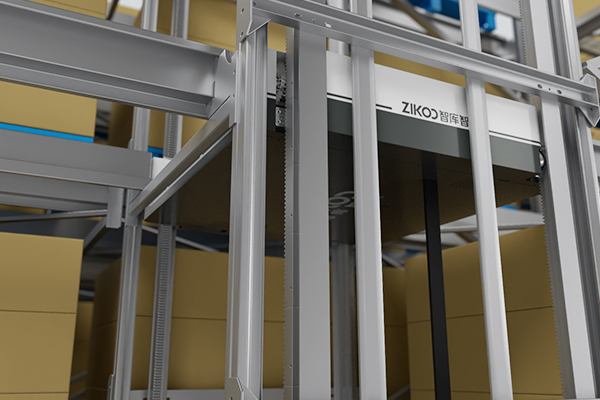
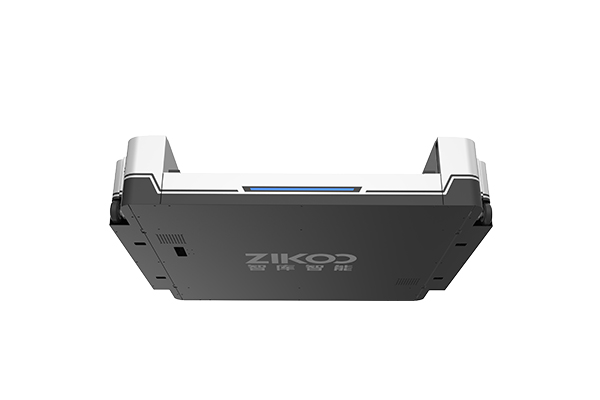
A four-way shuttle travels on parallel rails within a racking lane and can transfer between lanes via perpendicular rails at aisle ends. It carries pallets horizontally in four directions, and vertical movement is handled by separate elevators positioned at rack faces. A stacker crane moves on a single floor rail inside an aisle, using a mast to lift and retrieve pallets from both sides.
This mechanical difference shapes nearly every operational decision. The shuttle’s decoupled design means horizontal transport and vertical lift are independent. You can add more shuttles or elevators separately to match your throughput. The stacker crane integrates both motions into one machine, so an aisle cardinally depends on a single device.
The shuttle also handles a wider range of pallet sizes without mechanical reconfiguration. Our R-bot series supports standard 1200×1000 mm pallets, American 1016×1219 mm pallets, and Japanese 1100×1100 mm pallets within the same system, with load capacities from 1200 kg up to 2000 kg. A stacker crane’s telescopic forks typically adapt to one or two pallet footprints, and changing pallet type often means swapping the load handling device.
| Feature | Four-Way Shuttle (R-bot example) | Stacker Crane |
|---|---|---|
| Horizontal motion | Every aisle via perpendicular transfer rails | Single aisle on floor rail |
| Vertical motion | Separate H-bot elevator, operates independently | Integrated mast, one machine per aisle |
| Load capacity | 1200–2000 kg depending on model | Typically 1500–3000 kg |
| Pallet size flexibility | Handles multiple pallet footprints without hardware change | Limited to one or two sizes without fork replacement |
| Aisle width requirement | Narrow: shuttle body 125 mm height, minimal gap | Wider: depends on mast and fork width |
Which System Delivers Better Storage Density?
A stacker crane can reach building heights above 30 meters, creating very tall racks with single-deep or double-deep lanes. If you have a greenfield building with high ceilings and uniform pallets, the crane often wins on raw cubic volume utilization.
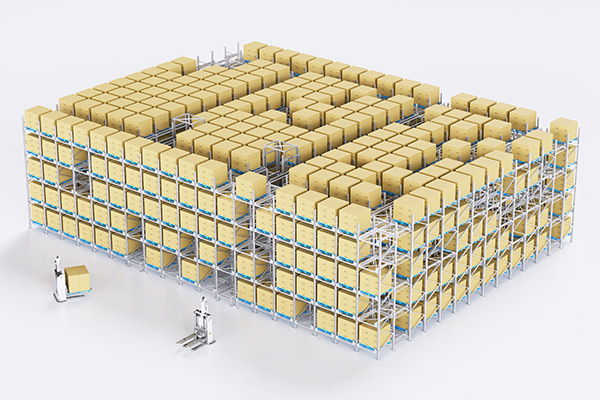
But density is not just about height. In facilities with constrained floor space or multiple temperature zones, a shuttle system with H-bot elevators constructs dense storage arrays that can exceed the practical density of a stacker crane when the building height is under 15 meters. The R-bot’s 125 mm body height allows rack beam spacing as tight as 150 mm, recovering vertical inches that a crane’s mast clearance would sacrifice.
We have deployed six-way shuttle systems in urban distribution centers where the building footprint was fixed and the ceiling was only 10 meters. By using shuttle lanes on every level and elevators at each row end, the storage density per square meter exceeded what a stacker crane design could achieve in the same envelope. The key variable is whether your building height gives the crane an advantage or whether floor coverage and rack depth make the shuttle more space-efficient.
What Are the Throughput and Peak-Handling Differences?
A stacker crane serves one pallet at a time per aisle. Put five cranes in five aisles, and you get five simultaneous moves. A four-way shuttle system with multiple shuttles and elevators can handle moves in parallel across aisles. During peak inbound waves, the WCS software can reroute shuttles to high-demand lanes without physical reconfiguration.
Our PTP Smart Warehouse Software stack, including WES and RCS, assigns tasks to shuttles dynamically. When an e-commerce client experiences a 3× throughput surge during evening order cut-off, the system distributes moves across all available shuttles rather than queueing behind one aisle’s crane. In a stacker crane system, that surge hits a single machine per aisle, and the only remedy is to run cranes faster, which eventually hits a ceiling.
If your operation deals with predictable, steady flow and a limited number of SKUs, a stacker crane may keep up without complex software. But if variability is built into your business, the multi-shuttle architecture absorbs peaks with less capital per aisle.
If your operation faces frequent peak surges or unpredictable mix changes, it is worth running a simulation against your real order data before finalizing the system architecture. Share a week of order logs with us at info@zikoo-int.com, and we will model the throughput of a shuttle configuration versus a crane layout for your specific scenario.
What Is the Total Cost of Each AS/RS Solution?
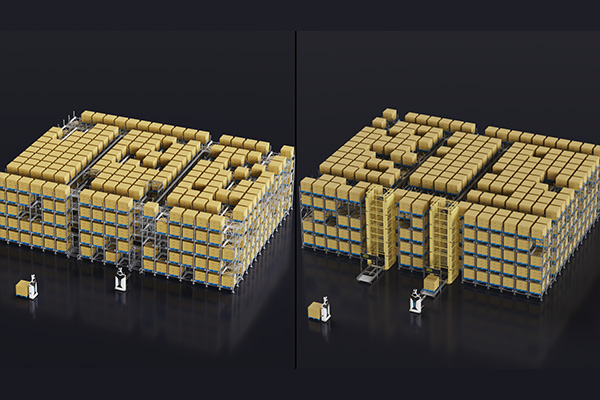
The upfront price of a stacker crane for a single aisle is often lower than the equivalent shuttle-plus-elevator set. But that comparison misses the relationship between aisle count and cost scaling. In a shuttle system, one elevator can serve multiple shuttles across several aisles, so the cost per pallet position drops as storage depth increases. A crane’s cost remains roughly linear with aisle count.
Operational costs also diverge. Shuttles run on lithium batteries with 8-hour continuous operation and can be swapped or charged without stopping the warehouse. A stacker crane draws continuous power and requires more cooling in cold storage. Battery replacements for shuttles add a maintenance line item, but the redundancy means no single component failure stops operations. The business impact of an hour of downtime in a crane-served aisle often outweighs the multi-year battery replacement cost.
Installation in an existing building is another cost layer. Shuttles ride on rails that can be mounted on existing rack structures, and elevators install at rack faces without deep floor pits. Stacker cranes require ground rails and upper guide rails that demand tighter floor tolerances, sometimes necessitating concrete regrading. Those civil works can erase any upfront equipment savings.
How to Match the Right System to Your Warehouse Profile
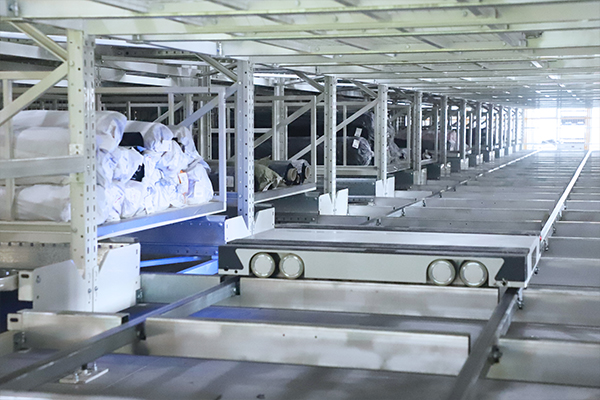
The choice becomes clear when you list your non-negotiable constraints. If you handle multiple pallet types in the same facility, a shuttle system avoids the fork-change process required on most cranes. In the pharmaceutical sector, where batch traceability and segregation matter, multi-shuttle layouts can create dedicated lanes for different product classes without physical barriers. For cold chain applications down to -25 °C, our R-bot uses low-temperature lithium batteries and coated PCBA boards that keep running while a crane’s exposed mechanical elements risk frost accumulation.
When retrofitting an existing warehouse, check column spacing and floor load. Shuttle rails add approximately 1500 kg per rack row, which most industrial floors accommodate. Crane rails impose concentrated rolling loads that may exceed floor capacity without reinforcement. In buildings with low headroom, the elevator can be placed at the end of the row, keeping the shuttle as the only moving part in the aisle, whereas a crane mast must fit under the ceiling height with clearance for the top pallet position.
If your business plans a phased deployment, shuttle systems scale in smaller steps. You can add lanes, shuttles, and elevators incrementally without disrupting operations. A crane aisle, once built, is difficult to extend or reconfigure without halting half the warehouse. For long-term flexibility, the shuttle architecture has consistently proven less restrictive.
Finding the Best Fit for Your Warehouse
Deciding between a four-way shuttle and a stacker crane requires aligning system capabilities with your operational reality. The best choice often emerges after a detailed throughput simulation and pallet-flow analysis. Our engineering team at Zikoo Smart Technology provides these assessments at no initial cost. Send your facility dimensions and throughput targets to info@zikoo-int.com or call (+86)-19941778955, and we will recommend a configuration specific to your warehouse.
Common Questions About Shuttle vs Crane AS/RS
What is the maximum height for a four-way shuttle system?
With an H-bot elevator integrated into the rack structure, a six-way shuttle configuration can reach 20 meters or more. The shuttle itself operates within the rack lanes, and the elevator transfers pallets between levels. We have deployed systems at 15 meters in cold storage and 18 meters in ambient. The practical limit is usually the rack engineering and local building codes, not the shuttle technology.
Can a four-way shuttle be installed in an existing warehouse?
It depends on floor load capacity and column spacing. We have retrofitted shuttle systems into standard pallet rack buildings by bolting rails directly to the existing rack uprights, with the elevator mounted at the row end. Floor reinforcement is rarely needed because shuttle rails distribute weight across multiple rack columns. The main constraint is clear horizontal space at aisle ends for elevator service, typically about 3 meters.
How many shuttles does my warehouse need?
In our system designs, shuttle count is determined by the required throughput per hour and the number of storage aisles. A typical facility with 10,000 pallet positions and a target of 50 dual cycles per hour might operate with four to five shuttles and two elevators. The PTP software dynamically reassigns shuttles based on lane congestion, so the fleet operates collectively rather than as dedicated aisle servants. We size the fleet using throughput simulations before procurement.
Is a stacker crane more reliable than a four-way shuttle?
The assumption that a single crane per aisle is easier to maintain often overlooks failure consequences. When a stacker crane goes down, that entire aisle is offline until repair. In a multi-shuttle system, if one shuttle fails, the remaining shuttles continue working, and the WCS re-routes tasks. The failure mode is graceful rather than catastrophic. Planned maintenance can also be scheduled per shuttle without stopping aisle operations.
Which system is easier to expand in the future?
Expansion means adding capacity: both systems handle adding racks, but shuttle systems scale throughput more easily. You can add shuttles and elevators without disturbing existing lanes. To increase throughput in a stacker crane system, you typically need a new aisle with a new crane. If your growth forecast includes substantial throughput increases over time, factor that into the initial architecture. Share your long-term growth targets with us at info@zikoo-int.com, and we will include scalable expansion options in the initial design.
If you’re interested, check out these related articles:
Six-Way Shuttle Drives Warehouse Upgrades: Building an Intelligent Automatic 3D Warehouse
Reshaping Warehouse Value: Six-Way Shuttle Leads the Digital Transformation
Six-Way Shuttle System Leads the Shift from Machines to Robots in Dense Storage Automation
Six-Way Shuttle: Empowering Industries to Embrace Smart Warehousing
Standardization Empowers Global Delivery: Zikoo Robotics Six-Way Shuttle Expands Overseas


