


A heavy-duty ASRS usually fails at the load path long before it reaches its rated payload. Ton-class pallet automation, meaning systems that move pallets of 1,000 kg and above, is not a standard automated storage system with a larger number printed on the datasheet. The load handler, the mast or chassis, the rail, the rack tolerances and the pallet itself all carry the load, and each of them adds deflection to the same stack. Teams that specify the chain and its tolerance budget get a system that holds cycle time at the top level for a decade. Teams that compare payload figures alone tend to find the gap during commissioning, when a two-tonne pallet refuses to seat in a bay that a one-tonne pallet entered without complaint.
What Makes a Pallet ASRS Ton-Class
Payload stops being a specification and starts being a design driver at the point where the load governs the machine’s geometry, its drive sizing and the building it sits in. Suppliers quote a rated load, which is a single number attached to defined conditions: a centred load, a stated pallet size, a stated lift height and a stated speed. Engineering a ton-class system means asking what happens outside those conditions, because real pallets are rarely centred and rarely undamaged.
Three different load numbers matter, and they are not interchangeable.
The first is the declared rated load, which is a condition rather than a capability. The second is the dynamic load during acceleration, braking and an emergency stop, which is higher than the static load and is the number the chassis, the rail fixings and the rack beams actually see. The third is the worst-case load: an offset centre of gravity, a pallet overhanging the deck, a load that has shifted in transit, or frozen moisture adding mass in a cold store.
Mass also changes the energy picture faster than many specifications assume. Doubling the payload at the same travel speed doubles the kinetic energy that the braking system must absorb, and raising speed as well multiplies it. Braking distance, structural shock, drive current and heat all move together, which is why a heavy-duty vehicle is not simply a standard vehicle with a reinforced deck.
For planning purposes, four rough classes help. Under 1,000 kg sits the light and standard pallet class. Between 1,000 and 2,000 kg sits the heavy-duty vehicle class, where four-way shuttles and narrow-aisle stacker robots compete. Between 3,000 and 5,000 kg the rail-mounted stacker crane class takes over, and above that the project moves into heavy industry handling equipment rather than warehouse automation in the ordinary sense. The boundaries are practical rather than formal, but they predict which architecture will be on the shortlist before any layout work begins.
The Load Path From Pallet to Floor
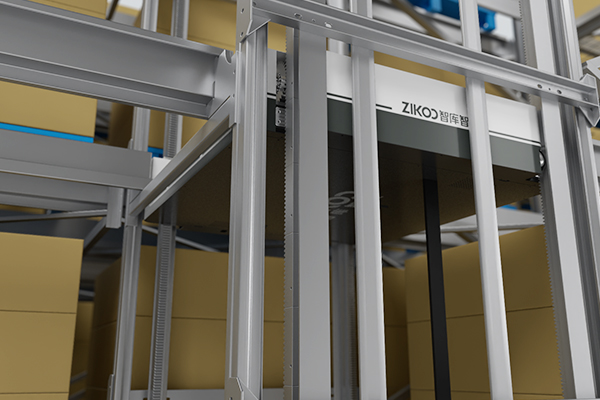
Follow the load and the engineering becomes visible. It passes from the pallet deck into the load handler, from the load handler into the carriage, from the carriage into the mast or the vehicle chassis, from the chassis into the wheel or the rail, and from there into the rail beam, the rack upright and the floor slab. Every one of those links deflects, and the deflections add up at the point where the pallet has to enter a bay.
The most underrated link is the extended load handler. Telescopic forks, a satellite carriage or a shuttle deck push the load outside the machine’s footprint, so the centre of gravity moves outward and the moment on the chassis or mast grows with that distance. A load that is well within the static rating can still be the governing case for the rail, the wheel bearings or the mast section, because the governing case is the extended position, not the centred one.
Vertical deflection behaves in a way that surprises people who are used to fork trucks. A mast acting as a cantilever deflects roughly in proportion to the load and in proportion to the cube of the extended height. At six metres a small change in load produces a deflection nobody notices. At twenty metres the same percentage change moves the fork tip enough to consume the bay clearance. This is why high-bay heavy systems separate two numbers that sound similar: the positioning accuracy of the machine, and the bay tolerance it must tolerate.
The rail and floor complete the path. Rail-mounted storage and retrieval machines are covered by EN 528, which sets safety requirements for this equipment class [1]. Compliance with that standard tells you about the machine. It does not tell you whether your slab, your rail alignment or your rack is built to the tolerance the machine needs, and those three items cause more commissioning delay than the machine itself.
The practical rule is short. The usable capacity of a system is the lowest-rated link in the chain, never the highest number in the brochure.

Pallet and Unit Load Quality Above One Tonne
A wooden pallet that behaved perfectly at 800 kg can behave badly at 2,000 kg, and the difference is not visible from the driver’s seat. Pallets bend between their supports, and the support condition changes with the equipment. On a shuttle deck the pallet is carried across a broad surface. In a rack it spans between beams. The same pallet therefore deflects differently in the two positions, which changes the fork entry clearance and the risk of a fork tip catching a deck board.
ISO 8611-1 defines test methods for flat pallets, so a declared pallet rating should trace to a test and a stated support condition rather than to a supplier’s habit [2]. When ton-class loads are involved, that traceability is worth asking for in writing.
Damage thresholds deserve the same treatment as any other specification. A missing deck board, a protruding nail, a cracked stringer block, warp or delamination all reduce the load a pallet can carry, and the reduction is not linear. The right control is a written inspection standard plus a rejection point in the inbound flow, not an instruction to operators to use their judgement.
Three further details decide whether a ton-class load travels safely. Overhang shifts the centre of gravity outward and loads the machine asymmetrically. Wrapping and corner boards protect the load but can extend the effective footprint beyond the nominal pallet dimensions. Load height changes the sway and the clearance at the top level, which matters most in a high bay where the margin is smallest. In a freezer, frozen moisture, ice on the deck and the changed behaviour of plastic at low temperature all sit on top of the ordinary checks.
| Record | Method context | Responsible use | Do not infer |
|---|---|---|---|
| Declared pallet rating traced to ISO 8611-1 test methods | Flat pallet tested under a stated support and load condition | A starting point for matching pallet type to the load | That the same rating holds for a wet, repaired or edge-damaged pallet in the same rack |
| Vehicle rated load from a datasheet | Centred load, stated pallet size, stated speed and stated lift height | Defining the machine envelope for a first layout | That the rated load applies with an offset centre of gravity or a fully extended load handler |
| EN 528 conformity for a rail dependent storage and retrieval machine | Machine-level safety requirements and verification | Basis for the machine safety file and the guarding strategy | That the building layout, the rack or the site traffic rules satisfy the same standard |
| As-built rack survey | Measured bay width, level pitch and upright plumb on the survey date | Setting the entry window the machine must tolerate | That the survey remains valid after a year of forklift impact |
| Site acceptance test at rated load | Agreed pallet, agreed cycle, agreed duration | Proving the tested cycle under the tested condition | That performance holds for a different SKU, a longer lane or a colder store |
Each row answers one question and refuses to answer the next. A specification that blurs them produces arguments at commissioning instead of decisions at design.
Matching Heavy-Duty ASRS Architecture to the Job
Architecture selection follows four inputs in order: load band, height, density and throughput pattern. Choose in that order and the shortlist usually contains two options rather than six.
| Architecture | Practical load band | Height and footprint | Throughput pattern | Choose it when | Avoid it when |
|---|---|---|---|---|---|
| Four-way shuttle with vertical transfer | 1,200 to 2,000 kg per vehicle | Dense multi-level grid, slim vehicle body, works from low bay to high bay | High, and it scales with vehicle count | You need density and phased growth in the same footprint | Loads exceed the heaviest shuttle model, or bay geometry cannot hold tolerance |
| Unit-load stacker crane ASRS | 1,500 kg upward, well past 5,000 kg with a heavier mast | Tallest option, commonly 10 to 30 m, one aisle per crane | Moderate per aisle, high single-machine availability | Loads are very heavy and bays are very high | You need multi-vehicle redundancy in a low building |
| Omnidirectional stacker robot in narrow aisle | Around 1,000 kg | Lift to roughly 8 m in aisles near 2.1 m | Flexible, well suited to retrofit | The building already exists and aisles are narrow | Loads sit well above one tonne, or each aisle needs very high moves per hour |
| Satellite or pallet shuttle racking | Limited by rail and beam design | Deep lane, very high density per SKU | Low to moderate, one vehicle per level | Few SKUs, deep buffer, tight capital budget | SKU count is high or access must be selective |
| Pallet AGV or AMR | Ground-level heavy loads, typically 1,000 to 2,000 kg | No fixed storage infrastructure | Flexible routing, lower peak rate | The layout changes often and storage height is low | The job needs dense high-bay storage or very high moves per hour |
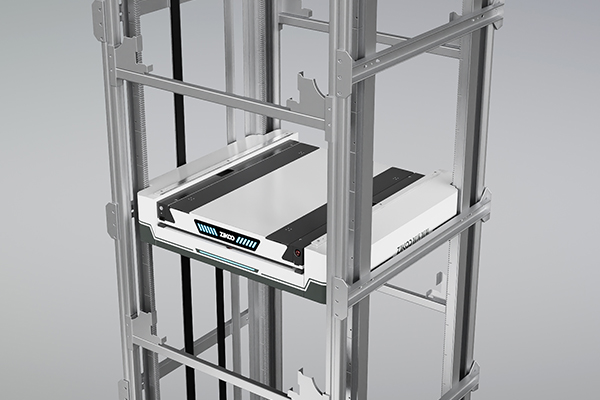
One component decides more than the table suggests. In a network where horizontal shuttles hand loads to a vertical transfer unit, the vertical unit is a shared resource, and its cycle time caps the whole network. Sizing it for the average hour rather than the peak hour is one of the most common design errors in ton-class projects, because the horizontal fleet can be expanded later and the elevator position in the rack usually cannot.
Zikoo’s own range illustrates how the pairing sets the real limit. The R-bot heavy-duty large pallet type carries a rated load of 2,000 kg on a 1,400 mm pallet with a 150 mm body, while the H-bot vertical bidirectional shuttle used for the vertical leg is rated at 1,800 kg with a stated positioning accuracy of plus or minus 1 mm. Unless the transfer is engineered otherwise, the usable payload for the pair is 1,800 kg. That gap between two adjacent datasheet numbers is exactly what a payload comparison misses.
Vertical transfer is where a dense layout gains its height, and it deserves the same engineering attention as the horizontal fleet. <Six-Way Shuttle System Leads the Shift from Machines to Robots in Dense Storage Automation> covers how shuttle-based dense storage has moved from machine-level automation toward coordinated robot networks.
Floor, Rack and Building Interfaces That Decide Feasibility
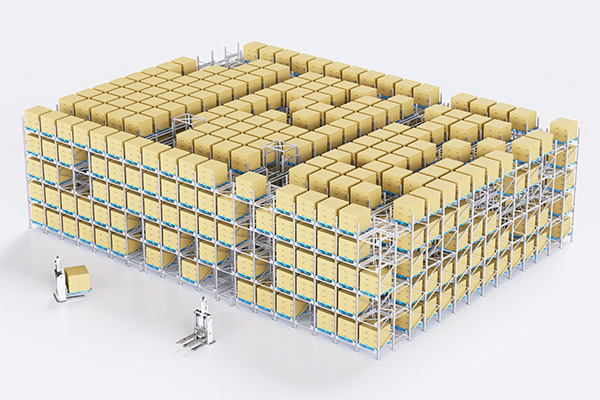
Most heavy-duty ASRS projects are constrained by the building before they are constrained by the machine. The floor carries the rail and the rack, and its bearing capacity, flatness and joint positions all enter the design. A rail that follows a slab joint will not hold alignment, and a point load from a loaded crane leg or a shuttle rail is a different structural question from a uniformly loaded slab.
The rack is the second interface. EN 15635 covers the application and maintenance of steel static storage systems, and it is the reference most sites use for inspection and damage classification [3]. The point that matters at specification stage is that the machine’s entry window must be agreed against the as-built rack, not the catalogue rack. A survey before the layout is frozen costs a fraction of a retrofit after it.
Height is the third interface, and it is rarely a simple number. Clear building height has to accommodate the top bay, the lift height, the sprinkler installation, smoke clearance and maintenance access. In-rack sprinklers consume bay space, and a heavy pallet layout that ignores them loses a level. Insulated panels in a cold store consume further space and add door interlocks and airlock sequencing to the throughput calculation.
Temperature changes the equipment, not just the building. At minus 25 degrees Celsius, lithium battery capacity falls, lubricant viscosity rises, steel behaviour changes and condensation becomes a maintenance issue. A cold-store project needs a battery and charging strategy agreed at design, not discovered in the first winter.
Height is often the cheapest capacity a site already owns, and the engineering question is how to use it without losing tolerance. <Six-Way Shuttle Unlocks the Era of True 3D Intelligent Warehousing> covers how three-dimensional shuttle layouts use vertical space in intelligent warehousing.
Positioning, Controls and Load Security Under Load
Positioning accuracy, repeatability and tolerance stack-up are three different things, and mixing them causes more specification disputes than any other control topic. A vertical transfer unit docking with a horizontal shuttle needs a tight positional accuracy because two machines must meet. A mobile aisle robot navigating to a bay needs a looser navigation accuracy because it senses the bay and corrects. Quoting plus or minus 10 mm and plus or minus 1 mm in the same comparison table tells the reader nothing useful unless the function is stated alongside the number.
The tolerance stack-up is what the machine actually has to survive. Rack position error, rail alignment, vehicle positioning error and pallet condition combine into a single entry window, and the window is usually set by the rack and the pallet rather than by the machine. Good systems measure the bay before entering it and refuse the entry rather than forcing it.
Safety follows the same logic. ISO 12100 sets the general framework for risk assessment and risk reduction [4]. Driverless industrial trucks and their systems fall under ISO 3691-4, which covers safety requirements and verification for that equipment class [5]. Safety-related control functions are designed under ISO 13849-1, which sets the principles for the safety-related parts of control systems [6]. Between them, these standards define what the machine must do, and they leave the site responsible for the layout, the traffic rules, the pedestrian interfaces and the maintenance regime.
Load security deserves its own list. Load presence sensing confirms that a pallet is actually on the deck. Over-height and over-width detection prevents a load entering a bay it cannot clear. Off-centre detection catches the shifted pallet before the machine lifts. Anti-drop devices, brake monitoring and slack rope or chain detection protect the vertical axis. None of these are optional in a ton-class system, because the consequences of a dropped two-tonne pallet are not recoverable with a broom.
The software layer is where these protections become a system. A warehouse control system assigns missions, locks zones so that two vehicles cannot enter the same bay, schedules charging and handles degraded operation. The test that separates a mature control layer from a basic one is the recovery scenario: a loaded vehicle stops at height, and the site needs a documented procedure, a manual release method and a safe way to bring the load down. Design that procedure before go-live, not during the first fault.
As vehicle counts rise, the constraint moves from the machine to the coordination layer that decides which machine goes where. <Software-Driven Hardware: Six-Way Shuttle Maximizes Warehouse Efficiency> covers how software orchestration affects the efficiency of shuttle-based storage systems.
Cycle Time and Throughput for Heavier Pallets
Heavy pallets change cycle time in two places: the machine moves more slowly under load, and the transfer at each end takes longer because the load handler has more mass to position and settle. A throughput figure calculated from a standard pallet cycle will overstate a ton-class system, sometimes by a wide margin.
For a single horizontal leg where the vehicle reaches its commanded speed, motion time is approximately d divided by v, plus v divided by a, where d is distance, v is loaded speed and a is loaded acceleration. The second term is the acceleration and deceleration penalty, and it stops growing once the distance exceeds v squared divided by a. Short legs are dominated by acceleration, long legs by speed.
An illustrative cycle shows the method. Take a loaded horizontal run of 40 m at 1.5 m/s and 0.4 m/s squared. The motion time is 40 divided by 1.5, plus 1.5 divided by 0.4, which is about 30 seconds. Take a vertical lift of 12 m at 0.5 m/s and 0.3 m/s squared, which gives about 26 seconds. Add 20 seconds for the transfer at each end and 8 seconds for position confirmation and the handshake between machines, and one leg is roughly 84 seconds. A dual cycle that stores one pallet and retrieves another on the same trip runs near 130 seconds. At a demand of 60 dual-cycle moves per hour, one vehicle covers 3600 divided by 130, about 27 moves per hour at full availability. At 85 percent availability and utilization that falls to roughly 23, so the fleet requirement is 60 divided by 23, which rounds up to three vehicles.
Those inputs are illustrative and chosen to demonstrate the method rather than to describe any product. Replace them with measured values for the vehicle you are considering, and treat the 85 percent figure as a planning assumption to be agreed in the contract, not a guaranteed availability number.
Two further constraints shape the answer. Peak demand, not average demand, sets the fleet size, because the cost of missing a peak is a service failure and the cost of an extra vehicle is capital. And battery strategy belongs in the same calculation: a heavy pallet vehicle drawing more current per move will not achieve the same continuous operating hours as a standard vehicle, so opportunity charging windows, charger placement and spare battery policy all need to be part of the throughput model.
What to Put in a Heavy-Duty ASRS Specification
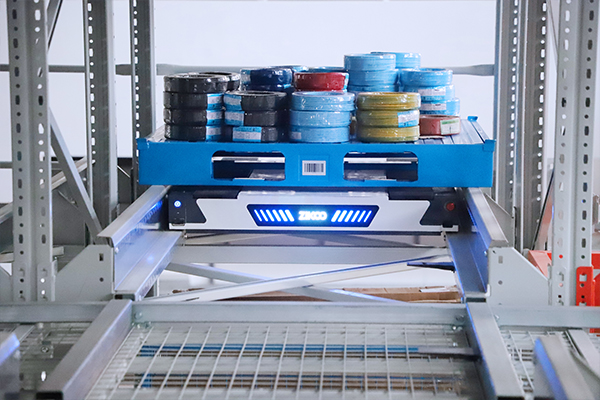
A ton-class specification earns its value by closing the questions that commissioning would otherwise reopen. These are the fields worth writing down before a supplier prices the job.
| RFQ field | What to specify | Why it matters |
|---|---|---|
| Load definition | Maximum mass, centre of gravity offset, pallet type and condition, load height | A rated load quoted for a centred load does not cover an offset or shifted load |
| Duty cycle | Moves per hour at peak and at average, shifts per day, seasonality | Sizing for the average fails at peak, sizing for a single peak day inflates the fleet |
| Geometry | Bay width, level pitch, top level height, rack tolerance as built | The entry window is set by the as-built rack, not by the catalogue |
| Transfer interfaces | Docking accuracy at each handshake, signal sequence, fault behaviour | An unwritten docking tolerance becomes a site dispute rather than a design input |
| Safety basis | Risk assessment owner, applicable machine standards, guarding and access strategy | Responsibility for the risk assessment is a contractual gap before it is a technical one |
| Acceptance | Test load, test pallet condition, cycle count, availability measurement window | Without a defined test, acceptance becomes opinion |
The acceptance test that actually proves the system
Acceptance should reproduce the conditions the machine will meet in service, at the load it will carry. That means a test pallet at maximum mass, with the centre of gravity offset the specification permits, cycled through the real bay geometry at the real lift height, for a duration long enough to expose thermal and battery behaviour. Availability should be measured over an agreed window with agreed downtime exclusions, and the recovery procedure for a loaded vehicle at height should be demonstrated, not described.
Questions to ask before the layout is frozen
Ask what happens at maximum load with the worst permitted pallet. Ask which component in the chain is the lowest-rated, and by how much. Ask what the vertical transfer’s cycle time is at peak, and what the plan is if it becomes the bottleneck. Ask who signs the risk assessment and who owns the as-built rack survey. Ask how a loaded vehicle is recovered from the top level. A supplier who answers these with numbers and procedures is a different proposition from one who answers with reassurance.
Send the Heaviest Pallet First
Most ton-class projects are specified from an average pallet and then tested with a real one. Reverse the order. Send the heaviest pallet you handle, its measured mass, its centre of gravity offset, its condition standard, the rack tolerance you can actually hold, the peak moves per hour and the lift height, and the layout can be engineered against the real governing case instead of an optimistic one. That single change removes more commissioning risk than any clause in the commercial terms.
Zikoo Smart Technology engineers pallet-to-person heavy-duty storage systems and reviews these inputs against the load path before a layout is fixed. Email info@zikoo-int.com or call (+86)-19941778955 with your heaviest pallet data and the operating profile, and the first answer you get back should be about the weakest link in the chain.
FAQ
What payload counts as heavy-duty for an ASRS?
There is no single threshold, but the practical dividing line sits at 1,000 kg. Below that, standard pallet vehicles and racking handle the load without the structure becoming the design driver. Between 1,000 and 2,000 kg the machine geometry, the rail and the pallet condition start to govern the design, which is what most people mean by heavy-duty. Above roughly 3,000 kg the rail-mounted stacker crane class usually becomes the better fit.
Can a four-way shuttle system handle 2,000 kg pallets?
Heavy-duty four-way shuttle models are offered in the 1,500 to 2,000 kg band, so the vehicle itself can be specified for that load. The question to ask is what the rest of the system is rated for. If a vertical transfer unit rated at 1,800 kg sits in the chain, the usable system payload is 1,800 kg. Check every transfer in the path, not just the shuttle.
Does a heavier ASRS cost proportionally more?
It does not scale linearly, and the increases appear in places buyers do not expect. The structural items grow faster than the vehicle price: rail, rack, floor preparation, mast section, brake rating and drive sizing. The building work often grows as well, because a heavier machine needs a flatter, stronger slab and tighter rack tolerance. Energy and maintenance costs rise more slowly, but battery replacement intervals shorten under heavier duty cycles.
What should happen if a loaded vehicle stops at height?
There should be a documented recovery procedure agreed before go-live, covering how the machine is isolated, how the load is secured, what manual release method is used and who is authorised to perform it. A ton-class load cannot be handled with improvised equipment, and the recovery method affects both the safety file and the service contract. Ask for the procedure as a written deliverable during the project, not as a service call afterwards.
References
[1] EN 528:2021, “Rail dependent storage and retrieval equipment. Safety requirements,” CEN, 2021.
[2] ISO 8611-1:2021, “Pallets for materials handling. Flat pallets. Part 1: Test methods,” ISO, 2021.
[3] EN 15635:2009, “Steel static storage systems. Application and maintenance of storage equipment,” CEN, 2009.
[4] ISO 12100:2010, “Safety of machinery. General principles for design. Risk assessment and risk reduction,” ISO, 2010.
[5] ISO 3691-4:2023, “Industrial trucks. Safety requirements and verification. Part 4: Driverless industrial trucks and their systems,” ISO, 2023.
[6] ISO 13849-1:2023, “Safety of machinery. Safety-related parts of control systems. Part 1: General principles for design,” ISO, 2023.
If you’re interested, check out these related articles:
Six-Way Shuttle: The Ultimate Warehousing Solution for Cost Reduction and Efficiency
Standardization Empowers Global Delivery: Zikoo Robotics Six-Way Shuttle Expands Overseas
Six-Way Shuttle Unlocks the Era of True 3D Intelligent Warehousing
Six-Way Shuttle Drives Warehouse Upgrades: Building an Intelligent Automatic 3D Warehouse


