


Deep-lane pallet shuttle storage replaces a crane aisle with shuttle lanes that place pallets one behind another in the rack. A shuttle travels inside the lane, lifts a pallet, carries it to the assigned depth, and returns to the lane face. This creates high pallet density because the rack does not need an aisle for every pallet position. The method works best when pallets are standardized, SKU depth is manageable, and the operation can accept batch flow more than instant random access. The following sections explain the mechanism, the conditions that decide suitability, and the checks to run before comparing configurations.
How Deep-Lane Pallet Shuttle Storage Works
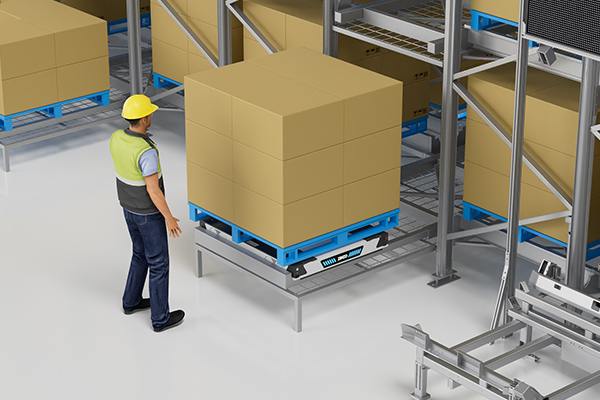
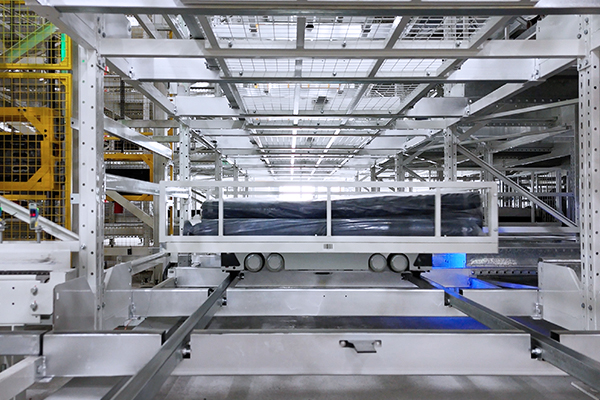
In a deep-lane pallet shuttle system, racking is built as horizontal storage channels. Each channel has rails or guide surfaces, and a motorized shuttle enters the channel under the pallet. The shuttle uses its lift to pick the pallet from the inbound position and drives it to the first free position in the lane. Retrieval reverses the sequence: the shuttle drives to the target pallet, lifts it, and carries it back to the lane opening. A vertical lift or transfer conveyor at the aisle front moves pallets between floor level and upper levels. No unit-load crane is required because the shuttle carries the pallet, while the lift handles the vertical transfer.
Compared with a crane, the system splits horizontal transport from vertical transport. The shuttle works inside dense lanes, and the lift works at the front. That separation lets the rack depth expand without a crane mast traveling along the aisle. It also means retrieval time increases with lane depth: the first pallet in a lane may have to sit behind several others if the lane is deep. That is why lane depth is a decision variable, not an automatic maximum.
Where Deep-Lane Shuttle Storage Fits
Deep-lane shuttle storage is not the best answer for every high-density warehouse. It fits operations that have enough pallets per SKU or batch to fill a lane, stable pallet dimensions and weights, and inbound and outbound patterns that can be grouped. It is especially useful for raw material buffering, finished goods staging, cold storage, and distribution centers with a moderate number of SKUs per aisle. The density benefit comes from removing aisles, but the operational cost is lane-level access: if every pallet must be available in any order at any moment, a crane may provide simpler access.
High-SKU operations can still work, but they need narrower lane depths and more front positions. A high-SKU warehouse with many products per aisle may spend more time moving pallets within lanes than retrieving them. In that case, shallow deep-lane storage or a different system may be better. The comparison with a crane should therefore be based on SKU depth, pallet quality, and required cycle time rather than storage density alone.
A crane-based AS/RS gives each storage location direct access, while a shuttle system buys density by storing pallets one behind another. <Stacker Crane vs Four-Way Shuttle: Which Fits Your ASRS Warehouse Best> covers the trade-off between direct access and dense lane storage.
Key Engineering Parameters for Deep-Lane Pallet Systems
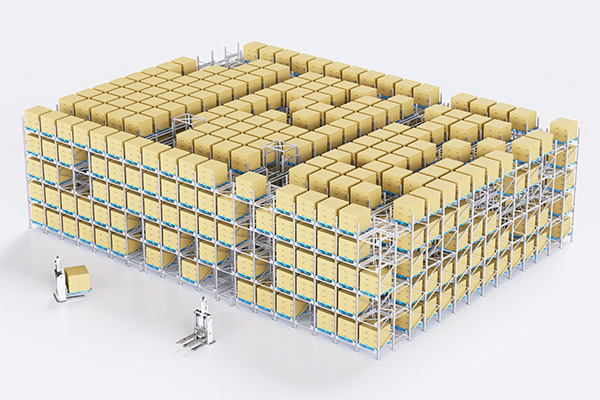
The first engineering decisions are pallet size, pallet weight, and lane depth. Pallet size determines the shuttle body and guide dimensions. Pallet weight determines the rated load. Lane depth then tunes the density and response time. A deeper lane stores more pallets per front position but creates longer travel and more pallet shuffling for mixed SKUs. A shallower lane increases access speed and flexibility but requires more front equipment.
The table below shows how shuttle models differ by pallet load and pallet size. These are the base parameters that decide whether a shuttle can enter the lane safely and handle the actual pallet population.
| Model | Rated load | Body dimensions | Supported pallet size | Loaded speed |
|---|---|---|---|---|
| R1200B Standard | 1200 kg | 1000 x 972 x 125 mm | 1200 x 800 to 1000 mm | 1.2 m/s |
| R1200A American | 1200 kg | 1192 x 840 x 125 mm | 1016 x 1219 mm | 1.2 m/s |
| R1500J Japanese | 1500 kg | 1192 x 900 x 125 mm | 1100 x 1100 mm | 1.2 m/s |
| R1500B Heavy-duty | 1500 kg | 1192 x 972 x 125 mm | 1200 mm | 1.2 m/s |
| R2000B Heavy-duty large pallet | 2000 kg | 1250 x 1300 x 150 mm | 1400 mm | 1.0 m/s |
These specifications matter because a 1200 kg European pallet and a 1400 mm industrial pallet require different shuttle bodies and wheel-track interfaces. If the pallet has overhang, poor bottom boards, or split dimensions, the shuttle may not lift cleanly. Before quoting, confirm that the racking and shuttle supplier have reviewed the actual pallet population, not only the nominal size.
The density advantage depends on lane depth and rack layout. <Six-Way Shuttle Powers Dense Storage: Breaking Space Limitations> covers how the shuttle and lift network expands storage capacity without multiplying aisle space.
Power, Temperature, and Software Integration
Cold storage requires more than a standard battery. At low temperature, lithium battery capacity falls and charging behavior changes if the system is not designed for it. A deep-lane shuttle for a freezer should specify the operating temperature, battery chemistry, charging location, and condensation protection. R-bot, for example, uses -25°C low-temperature lithium batteries for cold-chain applications, with a low-temperature charging port and a PCBA coating for high-humidity protection. Standard R-bot models operate down to -15°C, while heavy-duty large pallet versions are rated for 7 hours of continuous operation per charge. These conditions should be matched to the warehouse environment before the shuttle count is fixed.
Energy-sensitive applications may need material restrictions. In some new-energy battery material operations, copper, zinc, nickel, and lead contamination is not acceptable. A shuttle configured for those sites can use stainless steel structural components with blackening treatment and all-rubber buffer wheels to avoid exposing product to metal particles. That is a custom specification, not an automatic feature.
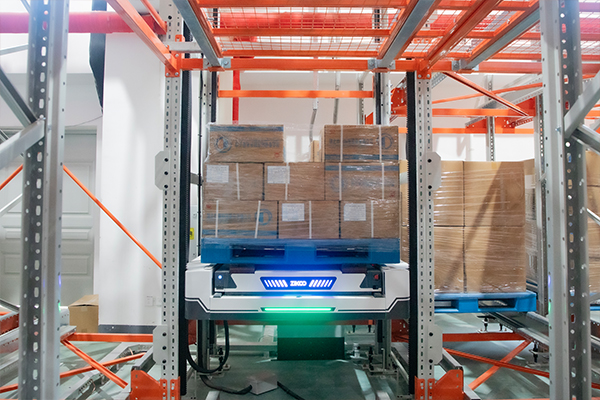
The shuttle and lift are only part of the system. Deep-lane storage depends on software to decide which lane receives each pallet, which shuttle handles a mission, and when to reshuffle lane positions. The WMS holds inventory and order priorities, WES can coordinate inbound and outbound pools, WCS issues equipment commands, and RCS manages robot movements. A stable handoff among these layers is more important than individual robot speed because a poor lane assignment can create extra pallet moves. The acceptance test should include end-to-end missions, not just shuttle cycle time.
Lane assignment and mission orchestration determine whether a dense shuttle system stays productive. <PTP Intelligent Warehousing Platform: Building a Flexible and Smart Logistics Ecosystem> covers how warehouse management, execution, and robot control systems work together in automated storage.
What to Check Before Selecting a Supplier
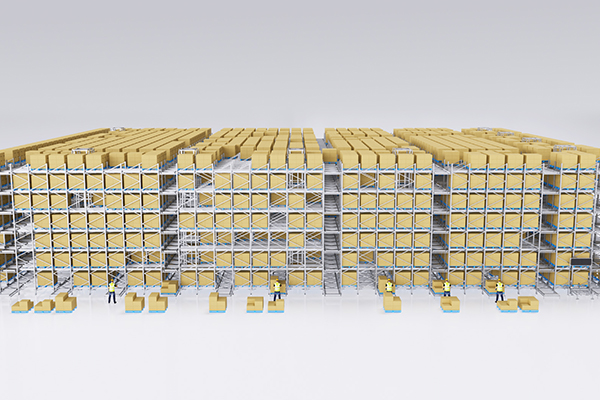
Before comparing quotes, make the supplier prove that the proposed system can handle your pallet population and daily mission profile. Ask for the lane depth calculation, the number of shuttles and lifts, and the expected cycle time for your worst case, not the manufacturer’s best case. If the site is an existing building, request a floor flatness and rack alignment survey because deep-lane travel depends on consistent rail elevation. Check whether the shuttle battery swap or charging strategy supports the operating shifts, and confirm whether the software can import your WMS master data without a separate manual interface.
Project references should be used as evidence of relevant experience, not as a guarantee of your outcome. A useful reference uses the same pallet size, similar load, similar lane depth, and the same temperature range. Ask what happened during commissioning and what recurring faults appeared. That tells you more than a portfolio photo. If the reference is from a different industry, ask which failure modes would transfer.
Contract terms should define acceptance around actual missions: inbound pallets per hour, outbound pallets per hour, first pallet retrieval time, and system availability during a defined test window. Avoid accepting a warehouse system based only on installation completion. The acceptance criteria should include degraded-mode behavior, such as what happens when one shuttle is removed for maintenance.
Cost and ROI Drivers in Deep-Lane Storage
Cost depends less on the word automation and more on the number of moving assets, the rack depth, and the integration workload. A system with fewer shuttles may need longer lanes or more lifts, while a system with more shuttles may raise cost and maintenance but shorten response time. Quotes vary because each supplier allocates racks, shuttles, lifts, software, installation, and commissioning differently. A buyer should compare those line items using the same lane depth and mission profile rather than a single total price.
The strongest return usually comes from space recovery and reduced forklift travel, but the result is not automatic. It is strongest when the saved floor area would otherwise force a new building expansion, when pallet movements are repetitive, and when labor availability is constrained. If the warehouse has shallow inventory, low flow, or constantly changing pallet types, the case is weaker. The same happens when multiple SKUs per lane and strict FIFO across them create additional moves and offset the density benefit.
Plan Your Deep-Lane Pallet Storage System
Send your pallet dimensions, maximum pallet weight, target storage positions, daily inbound and outbound pallets per SKU, and any temperature range. Those inputs are enough to calculate lane depth, shuttle count, and lift requirement. Contact Zikoo Smart Technology Co., Ltd at info@zikoo-int.com or call (+86)-19941778955 to run that configuration review.
FAQ
What is the main difference between deep-lane pallet shuttle storage and a crane AS/RS?
A crane positions forks at a specific rack location, so each pallet can be reached independently. A deep-lane shuttle travels inside the storage lane and stores pallets one behind another, which increases density but can require moving the pallets ahead of the target. Choose based on SKU depth, access pattern, pallet quality, and building shape.
Which operations should avoid deep-lane pallet shuttle storage?
Operations with many mixed SKUs per lane, strict FIFO across mixed products, very low throughput, unstable pallet condition, or frequent size changes will struggle. If most lanes must hold a single SKU but inventory depth is too shallow to fill lanes, fixed aisle equipment may be simpler. Deep-lane storage works best when pallets can be grouped and lane depth matches inventory depth.
How many shuttles and lifts does a deep-lane system need?
There is no standard number. It depends on inbound and outbound rates, lane depth, travel distances, lift cycles, and peak windows. If daily missions are known, a supplier can estimate wave arrival, lane assignments, and cycle times. Ask for the model and calculation, and confirm that the plan includes a spare shuttle for maintenance.
Can deep-lane shuttle systems operate in cold storage?
Yes, when the components are specified for it. Cold storage shuttles usually need low-temperature lithium batteries, suitable charging points, and coatings against condensation. Some systems operate at -25°C and run 6 to 8 hours per charge, but runtime decreases with lower temperature and heavier loads. Confirm the temperature rating and battery strategy for the actual freezer.
If you’re interested, check out these related articles:
Standardization Empowers Global Delivery: Zikoo Robotics Six-Way Shuttle Expands Overseas
Six-Way Shuttle: The Smart Warehousing Tool for Cost Reduction and Efficiency
Looking for Reliable Four-Way Shuttle Manufacturers? Choose Zikoo Robotics
Six-Way Shuttle Powers Dense Storage: Breaking Space Limitations
Six-Way Shuttle: Pioneering the Future of Smart Warehousing


