Managing a warehouse with a few hundred SKUs is a solved problem. Managing one with several thousand, where retrieval patterns shift weekly and no two pallets move at the same frequency, is where most sistema automatizado de almacenamiento y recuperacións come apart. The AS/RS that works on a static product line often fails under the velocity skew of a high-SKU environment — and the failure shows up as idle machinery waiting on the wrong pallet. In my work designing pallet-to-person robotics systems, I have seen sistema de transbordador de cuatro vías architectures repeatedly outperform fixed-aisle solutions in these conditions, not because the hardware is inherently faster, but because the system design matches the uncertainty of high-SKU operations instead of fighting it. This article examines what that match looks like, where the trade-offs live, and what procurement teams should verify before committing to an AS/RS for a high-SKU warehouse.
What Makes High-SKU Warehouses Break Standard AS/RS Designs
A warehouse with thousands of active SKUs does not simply store more varieties. It stores them with wildly uneven retrieval frequencies, often following a Pareto distribution where the top 20% of SKUs generate 80% of the movement, while a long tail of slow movers gets picked once a week or less. A traditional stacker crane AS/RS dedicates one machine per aisle. In a static inventory, that machine’s capacity is sized to the lane. In a high-SKU inventory, the aisle that happens to hold a concentration of fast-moving SKUs becomes the bottleneck, while the crane two aisles over sits idle. You cannot fix that by adding more cranes to the hot aisle because the rack structure does not permit it — and you cannot redistribute the SKUs without a degree of software orchestration that most WCS platforms treat as an afterthought.
The same goes for reach truck or narrow-aisle VNA setups with automated guided vehicles. They are built on the assumption that every pallet is equally likely to be retrieved next, an assumption that fails as soon as the SKU count climbs past a few hundred. In practice, facilities running high-SKU operations on fixed-path automation end up padding cycle times with deadhead moves and manual interventions that erase the cost justification for automation in the first place.
Cómo Sistema de transporte en cuatro direccioness Absorb SKU Volatility
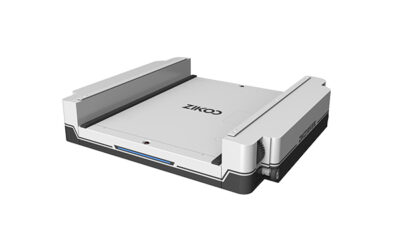
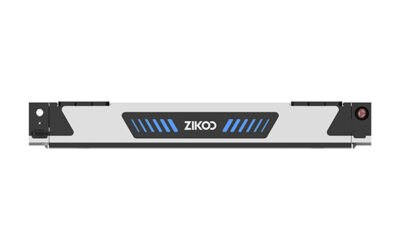
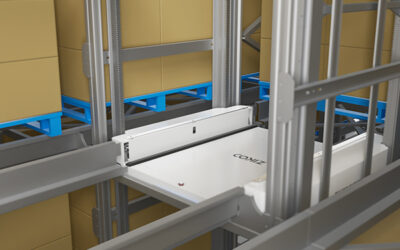
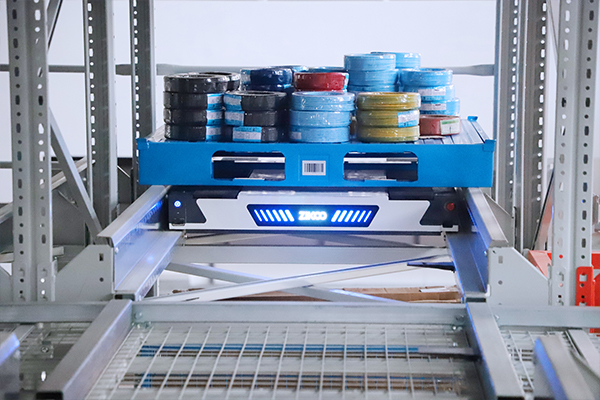
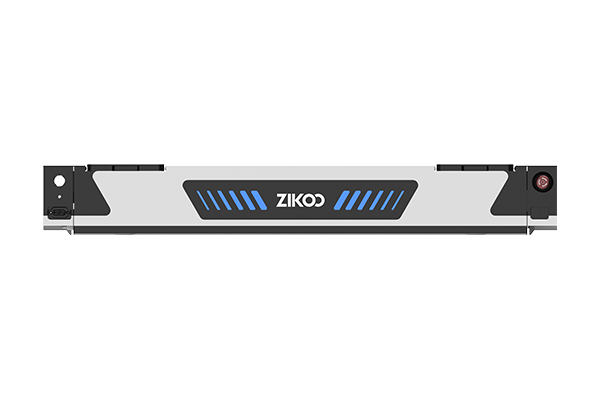
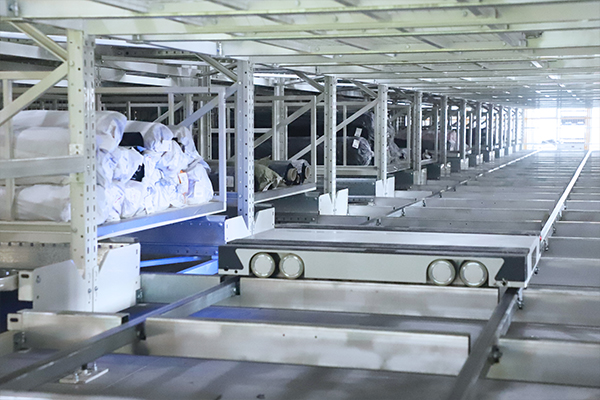
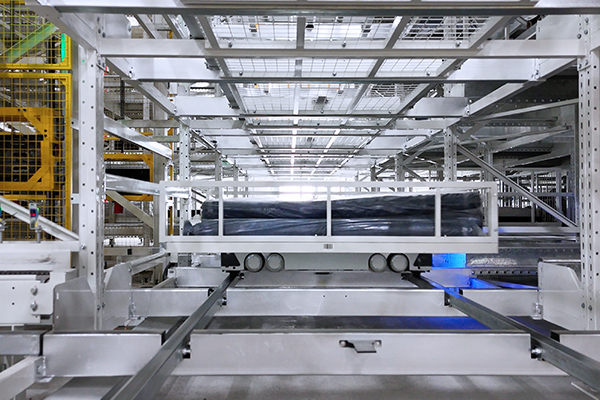
A four-way shuttle like Zikoo’s R-bot does not belong to a single aisle. It rides on rails within a storage layer and can reposition laterally and longitudinally to any pallet location within that layer. Multiple shuttles run in the same layer, and the fleet can be dynamically assigned to the locations that are generating demand at that moment. If a particular zone suddenly spikes, more shuttles can pool there without mechanical reconfiguration. That changes the bottleneck equation: throughput becomes a function of the number of shuttles assigned to the layer, not the number of aisles in the warehouse.
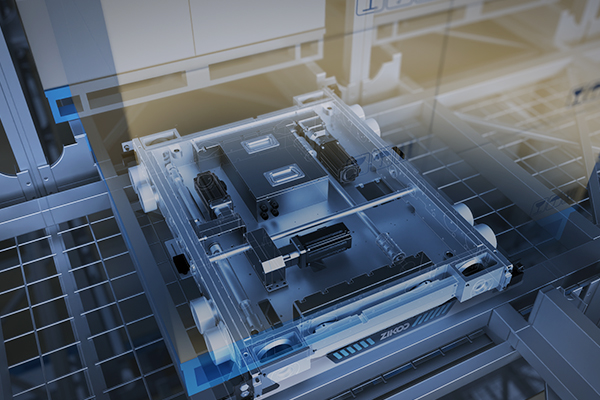
The compact form factor — the R-bot’s body is only 125 mm thick while carrying up to 1,500 kg — means you pile more storage layers into the same building height without sacrificing pallet positions. In a high-SKU operation, that vertical density matters because each incremental layer adds buffer positions for the long-tail SKUs that are critical for service level but ruin space utilization in a wide-aisle layout. When combined with a vertical bidirectional shuttle like the H-bot, the system becomes a sistema de transporte en seis vías network: horizontal movement within the layer, vertical lift between layers, and lateral transfer across lanes. Once a pallet is in the system, it can reach any workstation without passing through a fixed sequence of conveyors or elevators.
The R-bot family also covers multiple pallet footprints — standard 1200 mm, US 1016×1219 mm, Japanese 1100×1100 mm, and a heavy-duty 2000 kg variant for oversized loads. For a high-SKU warehouse handling mixed inbound pallet types, that flexibility eliminates the need to segregate inventory by physical lane, which is one of the silent complexity multipliers in almacenamiento automatizado escalables y de alta eficiencia.
If your SKU profile includes heavy variability in pallet size and weight class across the same inventory pool, it is worth confirming the shuttle model mix before locking in the rack design — mismatching pallet dimensions to shuttle specifications early on creates system-wide throughput penalties that are expensive to correct. Reach out at [email protected] to review your pallet data.
Throughput and Storage Density: Where Four-Way Shuttles Change the Trade-off
Conventional wisdom says you choose between storage density and throughput: almacenamiento denso means fewer access points; high throughput means wider aisles and more machines. A sistema de shuttle de seis vías changes the terms of that trade-off because the access point is not the aisle — it is the layer. Each layer can have its own shuttle population, and the system software can decide in real time how many shuttles to assign to picking versus replenishment moves. I have seen configurations where three shuttles in a single layer sustain higher throughput than a stacker crane serving three aisles, simply because the shuttles do not spend time traveling empty down a corridor to reach their next pallet.
The table below illustrates the key differences that matter when SKU count is the primary variable driving complexity.
| Criterion | cURL Too many subrequests by single Worker invocation. To configure this limit, refer to https://developers.cloudflare.com/workers/wrangler/configuration/#limits | Four-Way Shuttle AS/RS |
|---|---|---|
| Aisle dependency | One crane per fixed aisle | Shuttles can cross entire layer |
| Throughput elasticity | Fixed per aisle | Scales with shuttle count per layer |
| SKU adaptability | Requires slotting re-optimization to handle changes | Dynamic assignment recalibrates on demand |
| Storage density | High, but access points are limited | High, with more access points per layer |
| Pallet type flexibility | Limited to pallet design of aisle | Multi-pallet models within same layer |
This is not a theoretical distinction. I have worked on projects where a high-SKU pharmaceutical warehouse initially specified stacker cranes but found that after six months of live data, the velocity skew made two out of five aisles responsible for 70% of labor cost variance. The retrofit to a shuttle-based design cost more upfront but eliminated the systemic bottleneck. In high-SKU contexts, the bottleneck you cannot predict is worse than the one you can budget for.
Real-World Design Decisions for High-SKU AS/RS Projects
cURL Too many subrequests by single Worker invocation. To configure this limit, refer to https://developers.cloudflare.com/workers/wrangler/configuration/#limits
cURL Too many subrequests by single Worker invocation. To configure this limit, refer to https://developers.cloudflare.com/workers/wrangler/configuration/#limits cURL Too many subrequests by single Worker invocation. To configure this limit, refer to https://developers.cloudflare.com/workers/wrangler/configuration/#limits
cURL Too many subrequests by single Worker invocation. To configure this limit, refer to https://developers.cloudflare.com/workers/wrangler/configuration/#limits cURL Too many subrequests by single Worker invocation. To configure this limit, refer to https://developers.cloudflare.com/workers/wrangler/configuration/#limits
cURL Too many subrequests by single Worker invocation. To configure this limit, refer to https://developers.cloudflare.com/workers/wrangler/configuration/#limits cURL Too many subrequests by single Worker invocation. To configure this limit, refer to https://developers.cloudflare.com/workers/wrangler/configuration/#limits Software de almacén inteligente PTP cURL Too many subrequests by single Worker invocation. To configure this limit, refer to https://developers.cloudflare.com/workers/wrangler/configuration/#limits
cURL Too many subrequests by single Worker invocation. To configure this limit, refer to https://developers.cloudflare.com/workers/wrangler/configuration/#limits
cURL Too many subrequests by single Worker invocation. To configure this limit, refer to https://developers.cloudflare.com/workers/wrangler/configuration/#limits
cURL Too many subrequests by single Worker invocation. To configure this limit, refer to https://developers.cloudflare.com/workers/wrangler/configuration/#limits
cURL Too many subrequests by single Worker invocation. To configure this limit, refer to https://developers.cloudflare.com/workers/wrangler/configuration/#limits
cURL Too many subrequests by single Worker invocation. To configure this limit, refer to https://developers.cloudflare.com/workers/wrangler/configuration/#limits
cURL Too many subrequests by single Worker invocation. To configure this limit, refer to https://developers.cloudflare.com/workers/wrangler/configuration/#limits
cURL Too many subrequests by single Worker invocation. To configure this limit, refer to https://developers.cloudflare.com/workers/wrangler/configuration/#limits
cURL Too many subrequests by single Worker invocation. To configure this limit, refer to https://developers.cloudflare.com/workers/wrangler/configuration/#limits
cURL Too many subrequests by single Worker invocation. To configure this limit, refer to https://developers.cloudflare.com/workers/wrangler/configuration/#limits
cURL Too many subrequests by single Worker invocation. To configure this limit, refer to https://developers.cloudflare.com/workers/wrangler/configuration/#limits
cURL Too many subrequests by single Worker invocation. To configure this limit, refer to https://developers.cloudflare.com/workers/wrangler/configuration/#limits
cURL Too many subrequests by single Worker invocation. To configure this limit, refer to https://developers.cloudflare.com/workers/wrangler/configuration/#limits
cURL Too many subrequests by single Worker invocation. To configure this limit, refer to https://developers.cloudflare.com/workers/wrangler/configuration/#limits
cURL Too many subrequests by single Worker invocation. To configure this limit, refer to https://developers.cloudflare.com/workers/wrangler/configuration/#limits
cURL Too many subrequests by single Worker invocation. To configure this limit, refer to https://developers.cloudflare.com/workers/wrangler/configuration/#limits
cURL Too many subrequests by single Worker invocation. To configure this limit, refer to https://developers.cloudflare.com/workers/wrangler/configuration/#limits
Si está interesado, eche un vistazo a estos artículos relacionados:
El transporte de seis vías desbloquea la era del almacenamiento inteligente 3D real
Transbordador de Seis Vías: Empoderando a las Industrias para Adoptar el Almacenamiento Inteligente
Transbordador de Seis Vías: La Herramienta de Almacenamiento Inteligente para la Reducción de Costes y la Eficiencia 2