Operating a cold storage warehouse means solving problems that do not exist in ambient facilities. Temperatures that preserve product also punish equipment and people. Energy costs scale with every cubic meter of conditioned air, so unused space is not just idle—it is actively expensive. 四方シャトルシステムs address these realities by automating storage and retrieval in environments where human labor is slow, costly, and risky.
Why Cold Storage Demands a Different Automation Approach
Cold chain operations run under constraints that compound each other. Regulatory requirements dictate temperature bands. Perishable inventory cannot wait for slow retrieval. Workers in freezers fatigue faster, take longer breaks, and face genuine health risks during extended shifts. Manual handling in a -20°C environment is not just uncomfortable; it is a productivity ceiling that no training program can raise.
The energy math makes this worse. Refrigeration systems consume power continuously, and that consumption scales with the volume being cooled. A half-empty freezer costs nearly as much to run as a full one. Every pallet position that sits empty represents energy spent cooling air instead of product. Effective cold chain management requires systems that maximize density while minimizing the door openings, foot traffic, and dwell time that let warm air in.
どうやって 四方向シャトルs Work in Temperature-Controlled Warehouses
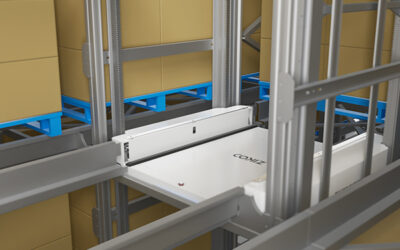
Four-way shuttle systems move in all cardinal directions within a storage aisle, which changes what is possible in rack design. Traditional two-way shuttles travel forward and backward only, requiring dedicated aisles for each storage lane. Four-way units can traverse between lanes, enabling deep-lane configurations that would otherwise require multiple shuttle deployments or manual intervention.
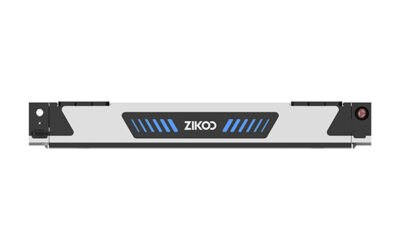
The R-bot Four-way Shuttle illustrates what this looks like in practice. At 125 mm body thickness and load capacities reaching 1500 kg for the Japanese Type (R1500J), it fits into rack structures that would reject bulkier equipment. The multi-directional capability means pallets can be stored and retrieved from any position in the rack, not just the positions nearest an aisle. Storage allocation becomes dynamic rather than fixed.
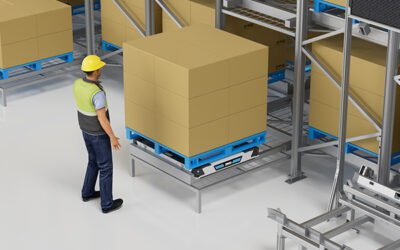
During a project for a frozen food distributor, we deployed a multi-level R-bot system in an existing freezer building. The facility gained 40% more storage density without expanding the footprint. Energy consumption per pallet stored dropped 25% because the same refrigeration system now served more product. Manual handling fell by 80%, which improved safety metrics and reduced the labor hours spent in freezer gear.
Engineering Challenges for Automation in Sub-Zero Environments
Cold does not just slow down equipment; it changes material behavior. Lubricants thicken. Batteries lose capacity. Seals contract and leak. Condensation forms ice on surfaces that were dry an hour earlier. Designing automation for freezers means solving these problems before they become failures.
Battery performance is the most visible constraint. Standard lithium cells lose efficiency below 0°C and can be damaged by charging in extreme cold. The R-bot cold chain configuration uses low-temperature lithium batteries rated for continuous operation down to -25°C, delivering 6 to 8 hours of runtime. Charging ports are designed for low-temperature conditions, so robots can recharge in place without relocating to a warm zone.
Material selection matters throughout the system. Metals contract at different rates, so joints and bearings must tolerate thermal cycling without binding or loosening. Lubricants formulated for freezer conditions maintain viscosity where standard greases would solidify. PCBA coatings protect electronics from the moisture that condenses when warm air enters during door cycles or maintenance windows.
Integrating Four-Way Shuttles with Existing Cold Storage Operations
Automation projects fail when the equipment works but the integration does not. A shuttle system that cannot communicate with inventory management creates islands of efficiency surrounded by manual workarounds. Successful deployment requires treating hardware and software as a single system.
Assessment comes first. Inventory profiles, throughput peaks, and facility geometry determine what configuration makes sense. A facility with high SKU variety needs different lane depths than one storing bulk pallets of a single product. Bottlenecks in current operations often point to where automation delivers the most value.
System architecture follows assessment. Vertical transport elements like the H-bot Vertical Bidirectional Shuttle can extend four-way shuttle networks into multi-level configurations, creating what functions as a six-way system. The layout must balance density against retrieval speed; deeper lanes store more but take longer to access.
Software integration connects the physical system to operational intelligence. The PTPスマート倉庫ソフトウェア suite includes WMS, WES, WCS, and RCS modules that manage inventory records, allocate tasks, and coordinate robot movements in real time. Without this layer, the shuttles move pallets but the warehouse still runs on spreadsheets.
Phased rollout reduces risk. Testing in a controlled section before full deployment catches integration issues while the stakes are low. Scaling gradually lets operators learn the system before it handles peak volumes.
Optimization continues after go-live. Performance data reveals where algorithms can improve, where workflows create unnecessary movements, and where capacity remains underutilized.
Calculating Return on Investment for Cold Storage Automation
Four-way shuttle systems require substantial capital. The ROI case rests on operational savings that accumulate over years, not months.
Labor cost reduction is the most direct benefit. Freezer work commands premium wages, requires specialized PPE, and generates higher injury rates than ambient warehouse roles. Automation shifts labor from cold zones to supervisory and maintenance functions in conditioned spaces.
Storage density gains delay or eliminate expansion costs. A facility that doubles its pallet positions in the same footprint avoids the capital and energy costs of building new freezer space. In markets where cold storage capacity is constrained, density improvements can also support revenue growth that would otherwise require waiting for construction.
Energy savings compound over time. Better space utilization means refrigeration systems cool product rather than empty air. Fewer door openings and reduced foot traffic lower the warm air infiltration that drives compressor loads.
Product integrity improvements reduce spoilage and quality claims. Automated systems maintain consistent handling and minimize the temperature excursions that occur when pallets sit on docks waiting for manual retrieval.
Throughput gains support faster order fulfillment. Automated systems operate at consistent speeds regardless of shift or season, and they do not slow down as a freezer shift progresses.
| メリットカテゴリー | Manual Cold Storage | Automated Cold Storage with Four-Way Shuttles |
|---|---|---|
| 保管密度 | 中程度 | High, often 2x or more |
| 労働コスト | High, with premium wages and PPE | 通路スペースによる制限 |
| エネルギー効率 | Lower, due to underutilized space | Higher, from density and reduced air exchange |
| スループット | Variable, limited by human endurance | High, consistent, scalable |
| Worker Safety | Elevated risk | Minimal exposure |
| cURL Too many subrequests by single Worker invocation. To configure this limit, refer to https://developers.cloudflare.com/workers/wrangler/configuration/#limits | 中程度 | 低い |
よくある質問
cURL Too many subrequests by single Worker invocation. To configure this limit, refer to https://developers.cloudflare.com/workers/wrangler/configuration/#limits
cURL Too many subrequests by single Worker invocation. To configure this limit, refer to https://developers.cloudflare.com/workers/wrangler/configuration/#limits
cURL Too many subrequests by single Worker invocation. To configure this limit, refer to https://developers.cloudflare.com/workers/wrangler/configuration/#limits
cURL Too many subrequests by single Worker invocation. To configure this limit, refer to https://developers.cloudflare.com/workers/wrangler/configuration/#limits
cURL Too many subrequests by single Worker invocation. To configure this limit, refer to https://developers.cloudflare.com/workers/wrangler/configuration/#limits
cURL Too many subrequests by single Worker invocation. To configure this limit, refer to https://developers.cloudflare.com/workers/wrangler/configuration/#limits
cURL Too many subrequests by single Worker invocation. To configure this limit, refer to https://developers.cloudflare.com/workers/wrangler/configuration/#limits
興味があれば、これらの関連記事もご覧ください:
PTPインテリジェント倉庫ソフトウェアは、企業のスマートアップグレードを支援します
スマート倉庫の始まり:コスト効果の高いフォーウェイシャトルシステム》をお読みください。
標準化がグローバル配送を強化:Zikoo Roboticsの6方向シャトルが海外展開
倉庫価値の再構築:六方シャトルがデジタルトランスフォーメーションを牽引
スマートコールドチェーン時代:六方向シャトルシステムが最大密度で収納効率を再定義