High-capacity sorting centers are not simply larger versions of a standard warehouse. They combine dense pallet buffering, rapid inbound and outbound movement, order consolidation, and a control layer that can reschedule tasks in real time. The planning phase determines whether the system will hit target throughput without creating a new bottleneck at receiving, picking, or dispatch. Industry surveys consistently show that automation investment concentrates where labor availability, throughput variability, and space constraints intersect [1].
Most successful sorting-center projects begin with a fixed performance brief: expected pallets per hour, peak-day surge, SKU mix, pallet type, building height, and the required buffer between receiving and shipping. From that brief, engineers choose the storage and transport model, the number of shuttles and lifts, the picking strategy, and the software architecture. The goal is not maximum automation for its own sake, but a balanced system that clears peak workloads without excessive idle capacity during normal periods.
What High-Capacity Sorting Actually Demands
A high-capacity sorting center usually serves one of three missions: e-commerce order consolidation, retail distribution, or production-adjacent buffer and dispatch. Each mission puts stress on a different part of the system. E-commerce peaks are highly variable and SKU-intensive, retail distribution demands wave-based outbound sorting, and manufacturing supply often requires stable, repeatable pallet movement with tight production windows.
The planning team should quantify three constraints before selecting equipment. The first is peak throughput, not average throughput. The second is storage depth and density, because sorting centers need enough queue space to decouple inbound variability from outbound schedule. The third is building geometry, especially column spacing, floor flatness, usable height, and expansion space. When any of these constraints is ignored, the result is usually a system that meets design throughput in simulation but degrades under real operating conditions.
Safety and compliance must also be locked in during planning. Automated sorting systems that combine driverless vehicles, shuttles, and fixed conveying equipment should be verified against applicable machinery-safety requirements for driverless industrial trucks [2] and rail-dependent storage and retrieval equipment [3]. Early alignment with these standards prevents late-stage design rework.
Core Automation Architecture for High-Capacity Sorting
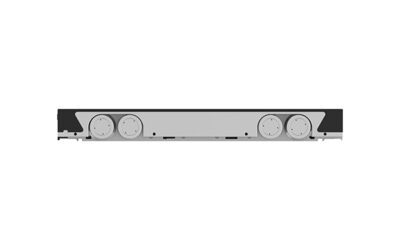
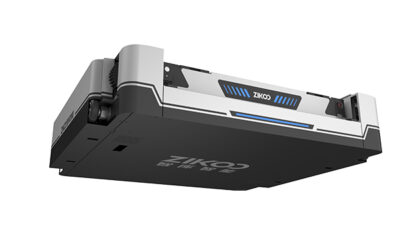
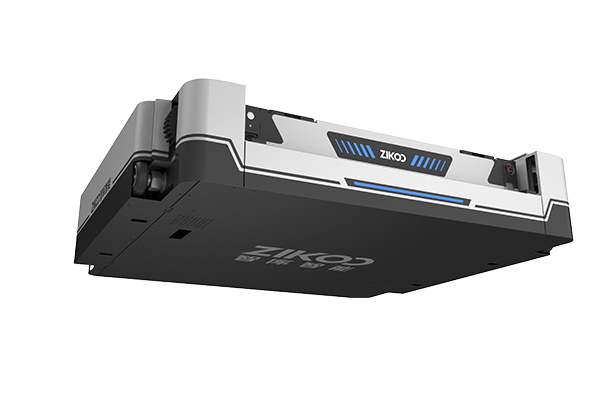
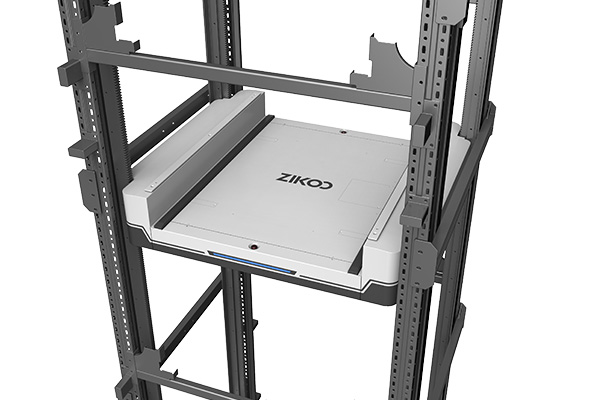
High-capacity sorting centers typically use a layered architecture: dense shuttle storage, vertical lift equipment, picking or sorting workstations, and a software control stack. In pallet-based operations, the R-bot 四方向シャトル operates inside rack lanes and handles horizontal movement within the storage structure. It moves in four directions, supports pallets from 1200 × 800 mm to 1400 mm formats depending on model, and carries up to 1.5 tons in standard configurations, with heavy-duty models reaching 2 tons. Its compact 125 mm body height allows dense pallet positioning without wasting vertical space.
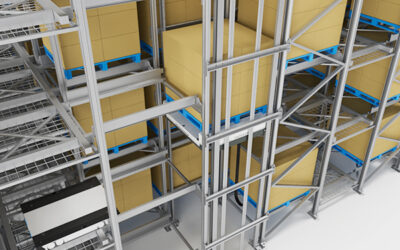
Vertical transfer is handled by equipment such as the H-bot Vertical Bidirectional Shuttle. Rather than moving along a central aisle like a stacker crane, the H-bot occupies a single storage location and transports pallets between the shuttle level and the picking or conveyor level. Combined with multiple R-bot shuttles, this forms a six-way movement network across the rack structure. The advantage in a sorting center is that each shuttle and lift can be assigned independently, so a slow inbound task does not block an urgent outbound task.
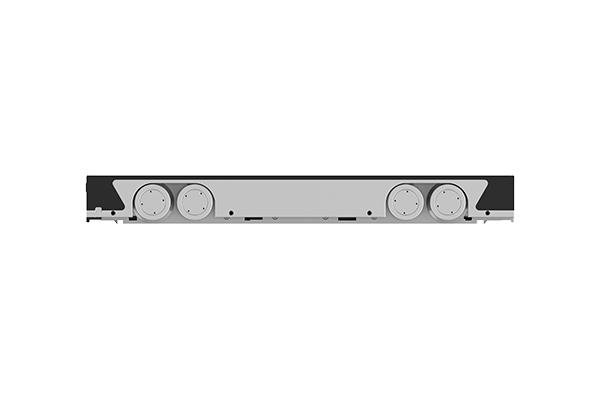
The sizing logic is not simply “more shuttles equals more throughput.” Shuttle count must match the vertical transfer capacity, workstation capacity, and software dispatch logic. If the shuttle layer produces more pallets than the lifts can move, the workflow stalls. If the lifts are oversized, capital is wasted. A capacity model should run several demand profiles: normal day, peak shift, new-SKU ramp, and seasonal surge.
密なストレージ and sorting capacity are connected through shuttle count, lane depth, and vertical transfer design. <スマートストレージ革命:[自動3D倉庫](https://www.zikooint.com/asrs-automated-storage-and-retrieval-system-solutions)向けの[4方向シャトルシステム](https://www.zikooint.com/6-way-pallet-shuttle)の包括的概要> covers the storage-density and pallet-handling logic behind automatic 3D warehouse designs.
Designing the Sortation Layout
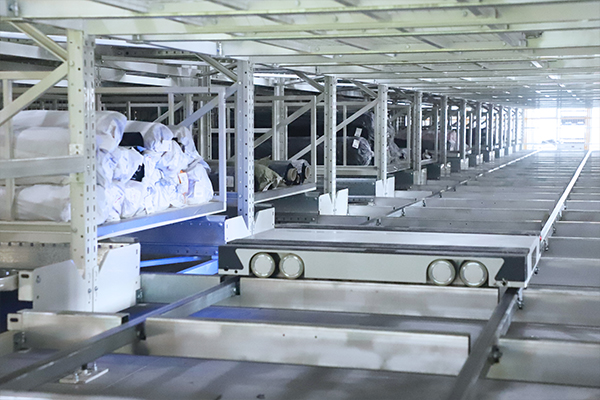
Once the storage-and-retrieval layer is defined, the next decision is how pallets interact with sorting operations. In many high-capacity centers, pallet-to-person stations are intentionally separated from case-level sortation. Full pallets are delivered by shuttle and lift to a decoupling buffer near the pick face, while split-case picking or robotic sortation happens downstream. This prevents dense storage equipment from being dragged into piece-level variability.
The layout should preserve at least three buffer zones: receiving-to-storage, storage-to-picking, and picking-to-dispatch. The middle buffer is the most important in high-capacity sorting because it absorbs the difference between shuttle delivery rhythm and picking labor rhythm. Without it, short pauses at a workstation cascade backward and reduce effective shuttle utilization.
Rack structure also affects layout quality. Pallet racks and shuttle rails should be specified and installed according to recognized rack design and testing guidance [4]. Column alignment, lane straightness, and floor tolerance directly influence shuttle positioning accuracy and long-term maintenance cost. In retrofit projects, the planning team must verify existing floor flatness and rack condition before committing to shuttle deployment.
Lift-assisted 六方向シャトル layouts are a practical response when a sorting center must handle both dense pallet buffering and rapid vertical movement. <六方向シャトルが倉庫のアップグレードを推進し、インテリジェントな自動3D倉庫を構築> covers the upgrade logic behind six-way shuttle deployments in existing and new facilities.
Planning a high-capacity sorting center should include a throughput simulation and a failure-mode exercise. The capacity model is only useful if it represents blockages, battery charging windows, maintenance intervals, and software task retries. A design that looks strong on paper often needs a small increase in buffer capacity or shuttle redundancy to remain stable during peak operations.
The Software Control Stack
Software is the least visible part of a high-capacity sorting center and often the largest source of operational friction. A complete stack covers warehouse management, warehouse execution, warehouse control, and robot control: WMS, WES, WCS, and RCS. Each layer has a distinct role. The WMS defines what to move and when based on orders, the WES sequences work and manages exceptions, the WCS coordinates equipment-level tasks, and the RCS dispatches individual robots and shuttles.
In sorting centers, the software must handle dynamic task allocation. Many operations run smoother with a rule-based WES that can pre-stage pallets for upcoming outbound waves while continuing to process current orders. The RCS should support mixed fleets—shuttles, lifts, AMRs, and automated picking robots—so that expansion does not require a separate control system.
System-level planning includes WMS, WES, WCS, and RCS integration, not only mechanical throughput. <PTPインテリジェント倉庫ソフトウェアは、企業のスマートアップグレードを支援します> covers how PTP software coordinates pallet movement, task dispatch, and reporting across automated equipment.
The software decision should be made during planning, not after equipment selection. A later software change can invalidate throughput assumptions because task release rules, wave logic, and equipment interfaces differ between platforms. Planners should require a clear interface specification, a defined handover between WES and RCS, and a test plan for peak-hour simulation before accepting a proposal.
If you are mapping a high-capacity sorting center and need early system-level sizing, contact Zikoo Smart Technology at [email protected] with your target pallets per hour, SKU count, pallet dimensions, and building height. Engineering teams can run a capacity check before you commit to a full design.
Implementation, Scalability, and Risk Control
High-capacity sorting centers are typically implemented in stages. Rack installation and floor preparation come first, followed by shuttle and lift commissioning, software integration, and finally volume ramp-up. This sequence reduces operational disruption, but only if the site team understands the dependencies between each layer.
Expansion planning is equally important. Four-way shuttle systems are attractive because they can be scaled by adding shuttles and lifts within an existing rack structure, provided the original design reserves lane access and electrical infrastructure. A plan that does not reserve future charging positions or software licenses may force a costly redesign when volume grows.
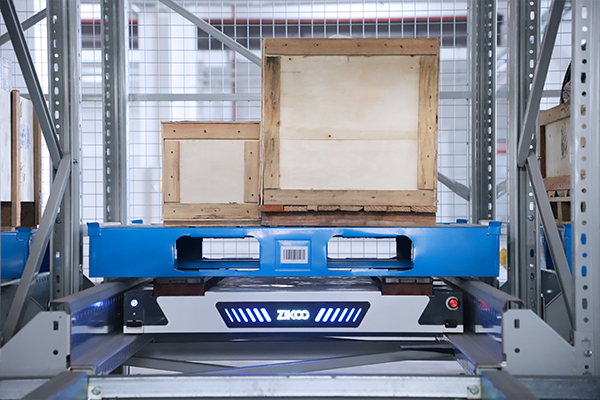
Maintenance and battery strategy should be built into the layout. Shuttle batteries, charging stations, lift service access, and spare-part storage need physical space. The planning team should also define how the system behaves when a shuttle fails or a lane is taken offline. In well-designed centers, a single shuttle failure reduces throughput temporarily but does not stop the entire sorting operation.
Special environments such as pharmaceutical and temperature-controlled sorting require additional planning. Sealing, humidity control, battery selection, and material compatibility must be reviewed before the automation layer is fixed. The product platform used in such environments should support the required temperature range and safe charging behavior.
End CTA
High-capacity sorting automation is a system integration challenge, not a standalone equipment purchase. The strongest plans combine dense shuttle storage, independent vertical transfer, a clear buffer strategy, and software that can reschedule work in real time.
Zikoo Smart Technology Co., Ltd provides pallet-to-person robotics, four-way shuttle systems, vertical bidirectional shuttles, and PTPスマート倉庫ソフトウェア for sorting-center projects across e-commerce, cold chain, pharmaceutical, manufacturing, and third-party logistics.
For a technical consultation or a capacity review, contact:
メール:[email protected]
電話:(+86)-19941778955
住所:中国南京市雨花台区软件大道170-1号ビル4棟4階
よくある質問
How many shuttles does a high-capacity sorting center need?
The number depends on peak pallet throughput, lift capacity, lane depth, and workstation demand. A simulation-based capacity model is the most reliable way to determine shuttle count; generic ratios should not replace site-specific analysis.
Can a four-way shuttle system handle both storage and sorting?
cURL Too many subrequests by single Worker invocation. To configure this limit, refer to https://developers.cloudflare.com/workers/wrangler/configuration/#limits
cURL Too many subrequests by single Worker invocation. To configure this limit, refer to https://developers.cloudflare.com/workers/wrangler/configuration/#limits
cURL Too many subrequests by single Worker invocation. To configure this limit, refer to https://developers.cloudflare.com/workers/wrangler/configuration/#limits
cURL Too many subrequests by single Worker invocation. To configure this limit, refer to https://developers.cloudflare.com/workers/wrangler/configuration/#limits
cURL Too many subrequests by single Worker invocation. To configure this limit, refer to https://developers.cloudflare.com/workers/wrangler/configuration/#limits
cURL Too many subrequests by single Worker invocation. To configure this limit, refer to https://developers.cloudflare.com/workers/wrangler/configuration/#limits
cURL Too many subrequests by single Worker invocation. To configure this limit, refer to https://developers.cloudflare.com/workers/wrangler/configuration/#limits
参考文献
cURL Too many subrequests by single Worker invocation. To configure this limit, refer to https://developers.cloudflare.com/workers/wrangler/configuration/#limits
[2] 国際標準化機構。ISO 3691-4:2023, 産業用トラック — 安全要件と検証 — パート4:自動運転産業用トラックとそのシステム。ジュネーブ:ISO;2023。
cURL Too many subrequests by single Worker invocation. To configure this limit, refer to https://developers.cloudflare.com/workers/wrangler/configuration/#limits
cURL Too many subrequests by single Worker invocation. To configure this limit, refer to https://developers.cloudflare.com/workers/wrangler/configuration/#limits
興味があれば、これらの関連記事もご覧ください:
倉庫価値の再構築:六方シャトルがデジタルトランスフォーメーションを牽引
PTPインテリジェント倉庫ソフトウェアは、企業のスマートアップグレードを支援します
マルチシナリオスマート適応:Zikooの六方向シャトルが倉庫のデジタル変革を推進》