Cold storage warehouses face constraints that ambient distribution centers never see. Every cubic meter of refrigerated space costs more to build, more to power, and more to staff. Operators pay for cooling whether a rack position is full or empty, and every open door leaks cold air into the aisle while pulling warm, humid air inside. When labor scarcity collides with food-safety compliance and rising energy tariffs, the traditional response — more racking, more forklifts, more manual picking — stops closing the gap.
4방향 셔틀 시스템s approach cold storage from a different direction. Instead of adding forklift aisles, a thin pallet shuttle travels inside the rack beneath the pallet, moving forward, backward, left, and right. The warehouse stores more pallets in the same frozen cube while shrinking the conditioned air volume. This guide walks through how cold-chain 4방향 셔틀 automation actually works: system architecture, battery engineering, condensation control, software integration, common selection mistakes, and ROI planning.
Why Cold Storage Changes the Automation Equation
Refrigerated warehouses are not warm warehouses turned down. The differences start with thermodynamics and end with maintenance economics.
Cold storage spans three main temperature bands: chilled rooms typically run from 0°C to +4°C, frozen rooms from -18°C to -25°C, and deep-freeze environments below -25°C [1]. These conditions drive three problems that automation must solve directly.
First is energy. Refrigeration regularly dominates cold-store electricity demand, and industry energy surveys consistently show refrigeration accounting for half or more of total consumption [2]. Every aisle added to a cold room increases the air volume that must be conditioned and the door-opening losses that accompany forklift traffic. Equipment that reduces aisle count therefore attacks the dominant operating cost.
Second is labor. Shifts shorten in sub-zero conditions, breaks increase, and turnover runs higher than in ambient facilities. Manual pallet handling in insulated clothing is slower and more error-prone, which ripples into receiving, putaway, and order assembly accuracy.
Third is moisture. Warm air entering a freezer condenses and freezes. Ice accumulates on floors, rails, sensors, and racking, creating slip hazards, positioning errors, and corrosion. A machine designed for cold storage must accept condensation as a permanent design input, not an edge case.
The practical consequence is that cold storage automation earns its return on three fronts at once: density, throughput, and predictability. 집약 저장 reduces conditioned cubic meters per pallet. Faster, robot-driven pallet moves shorten door-open windows. Consistent machine pacing removes the variability of a fatigued night shift.
System Architecture: Four-Way Shuttle Plus Vertical Lift
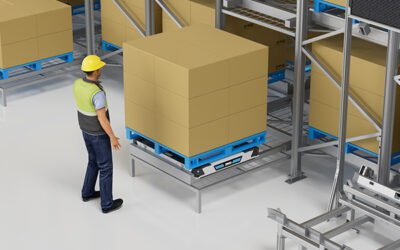
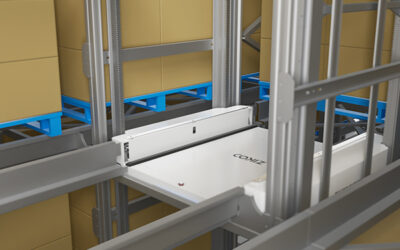
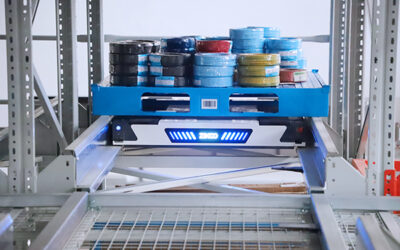
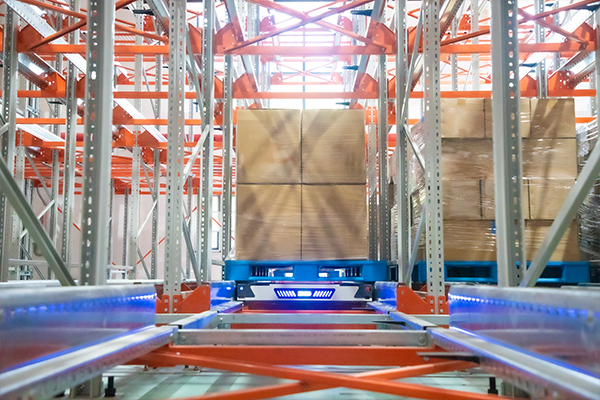
A four-way shuttle runs on rails inside the storage lanes. It positions itself beneath a pallet, lifts slightly, carries the pallet along the lane, and changes direction across the rack face to reach different aisle positions. Because the shuttle stays inside the rack, the warehouse no longer needs wide forklift aisles between every row.
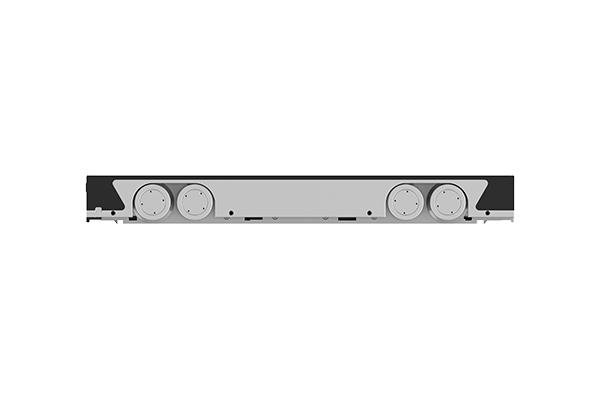
The core machine in this design is the R-bot four-way shuttle. Its body measures 125 mm in height with rated loads from 1,200 kg to 2,000 kg across standard, American, Japanese, and heavy-duty model variants. Travel speed reaches 1.6 m/s empty and 1.2 m/s loaded. For cold-chain applications, the shuttle operates down to -25°C with a dedicated low-temperature lithium battery providing 6–8 hours of continuous operation per charge.
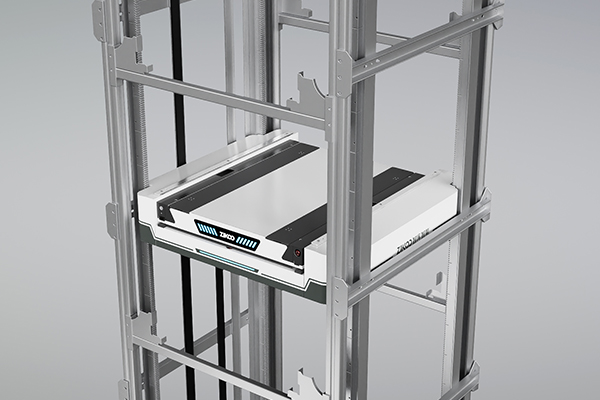
Four-way movement solves horizontal transport, but vertical transfer still requires a lift. That role falls to the H-bot vertical bidirectional shuttle, which occupies a single storage location and raises or lowers pallets between rack levels. The H-bot achieves ±1 mm positioning accuracy, carries rated loads up to 1,800 kg, and operates across a -25°C to 45°C range.
Together, the horizontal shuttle and vertical lift form a six-directional network: forward, backward, left, right, up, and down. Pallet storage becomes fully three-dimensional, with the system able to retrieve any stored pallet while other shuttles continue working elsewhere.
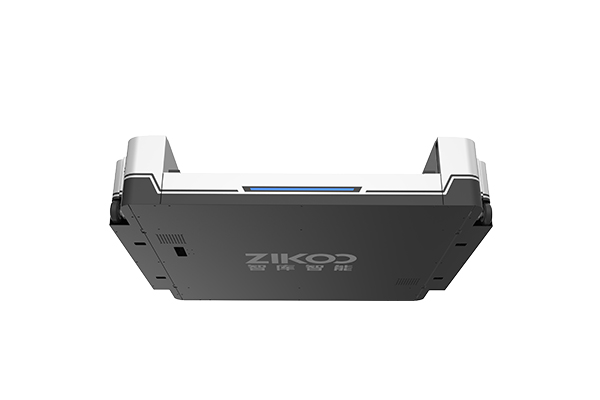
Cold chain logistics depends on exactly this combination of horizontal shuttle flexibility and vertical lift speed. <Smart Cold Chain Era: 6방향 셔틀 시스템 Redefines Storage Efficiency with Maximum Density> covers how the six-way layout raises storage density while keeping order access fast.
Sub-Zero Battery and Charging Design
Battery performance is the most fragile link in cold automation. Standard lithium cells lose usable capacity as temperature drops, and charging a cell below freezing can cause permanent damage. A shuttle fleet selected without attention to battery chemistry will degrade quickly in a frozen warehouse.
The governing engineering reference for industrial lithium cells is IEC 62619, which sets safety requirements for secondary lithium batteries used in industrial applications, including short-circuit, thermal-abuse, and mechanical-stress tests [3]. This standard matters because a shuttle battery sits inside the conditioned space, subject to the same low-temperature cycles as the pallets themselves.
Cold-chain shuttle design therefore differs from ambient design in three ways. The battery uses low-temperature-dedicated lithium chemistry rated to -25°C rather than a room-temperature pack. The shuttle carries a low-temperature charging port, allowing automatic charging without removing the battery from the working zone. The electronics receive a special PCBA coating that protects against high humidity and condensation.
Charging strategy is a core design decision. Some systems pull shuttles into a conditioned charging alcove outside the deep-freeze zone; others charge in place using controlled low-temperature profiles. The correct choice depends on duty cycle and fleet size — both approaches work, but mixing them without planning creates availability gaps during peak putaway windows.
Condensation, Ice, and Material Selection
Moisture is the silent killer in cold storage automation. Warm, humid air penetrates through doorways and loading docks, and every intersection of warm machinery with cold structure becomes a condensation point.
Good cold-chain automation engineering treats humidity as a permanent condition. Control electronics receive conformal PCBA coating and sealed, moisture-resistant enclosures. Connectors are sealed and oriented to shed condensation. Structural components use corrosion-resistant materials; in demanding applications this can extend to stainless steel frames with blackening treatment and non-metallic buffer wheels that eliminate metal contamination risk.
Racking systems in freeze-thaw environments need periodic inspection aligned to EN 15635, covering beam deflection, anchor condition, corrosion, and load-sign integrity [4]. Ice formation on rails must be managed through floor flatness, defrost water drainage, and rail heating where needed, because shuttle positioning accuracy depends on clean, true-running rails.
Lubricants, cables, and plastic components must also be rated for low temperature. A material that performs well at 20°C can become brittle or viscous at -25°C, so component selection happens against the cold-chain specification, not the ambient one.
Throughput, Density, and Space Utilization
The economic justification for four-way shuttles in cold storage begins with the footprint. Forklift-aisle layouts sacrifice a large share of floor area to travel lanes and turning radii. Dense shuttle lanes recover that area, and because the shuttle body is only 125 mm high, each rack level carries more productive storage height — more pallets in the same building shell.
The exact gain depends on the starting layout and throughput profile. A facility converting from wide-aisle selective racking to dense shuttle lanes can typically reduce aisle count substantially, which translates into more pallet positions per square meter and fewer conditioned cubic meters per pallet stored. Deeper lanes store more pallets per shuttle position but require more movement to reach the far end, so the design trade-off is storage density versus access time.
Throughput comes from fleet coordination rather than single-unit speed. A warehouse control system dispatches multiple shuttles to handle inbound and outbound flows simultaneously, overlaying storage moves, replenishment, and picking requests so that lift capacity and shuttle capacity stay balanced.
Packing more pallets into each rack block is how cold storage projects hit their ROI targets. <육방 셔틀이 밀집 저장을 가능하게 하며 공간 제한을 깨뜨리다> covers the space-breakthrough mechanics in dense storage layouts.
cURL Too many subrequests by single Worker invocation. To configure this limit, refer to https://developers.cloudflare.com/workers/wrangler/configuration/#limits
cURL Too many subrequests by single Worker invocation. To configure this limit, refer to https://developers.cloudflare.com/workers/wrangler/configuration/#limits
cURL Too many subrequests by single Worker invocation. To configure this limit, refer to https://developers.cloudflare.com/workers/wrangler/configuration/#limits PTP 스마트 웨어하우스 소프트웨어 cURL Too many subrequests by single Worker invocation. To configure this limit, refer to https://developers.cloudflare.com/workers/wrangler/configuration/#limits
cURL Too many subrequests by single Worker invocation. To configure this limit, refer to https://developers.cloudflare.com/workers/wrangler/configuration/#limits
cURL Too many subrequests by single Worker invocation. To configure this limit, refer to https://developers.cloudflare.com/workers/wrangler/configuration/#limits
cURL Too many subrequests by single Worker invocation. To configure this limit, refer to https://developers.cloudflare.com/workers/wrangler/configuration/#limits [email protected] cURL Too many subrequests by single Worker invocation. To configure this limit, refer to https://developers.cloudflare.com/workers/wrangler/configuration/#limits (+86)-19941778955cURL Too many subrequests by single Worker invocation. To configure this limit, refer to https://developers.cloudflare.com/workers/wrangler/configuration/#limits
cURL Too many subrequests by single Worker invocation. To configure this limit, refer to https://developers.cloudflare.com/workers/wrangler/configuration/#limits
cURL Too many subrequests by single Worker invocation. To configure this limit, refer to https://developers.cloudflare.com/workers/wrangler/configuration/#limits
cURL Too many subrequests by single Worker invocation. To configure this limit, refer to https://developers.cloudflare.com/workers/wrangler/configuration/#limits cURL Too many subrequests by single Worker invocation. To configure this limit, refer to https://developers.cloudflare.com/workers/wrangler/configuration/#limits
cURL Too many subrequests by single Worker invocation. To configure this limit, refer to https://developers.cloudflare.com/workers/wrangler/configuration/#limits cURL Too many subrequests by single Worker invocation. To configure this limit, refer to https://developers.cloudflare.com/workers/wrangler/configuration/#limits
cURL Too many subrequests by single Worker invocation. To configure this limit, refer to https://developers.cloudflare.com/workers/wrangler/configuration/#limits cURL Too many subrequests by single Worker invocation. To configure this limit, refer to https://developers.cloudflare.com/workers/wrangler/configuration/#limits
cURL Too many subrequests by single Worker invocation. To configure this limit, refer to https://developers.cloudflare.com/workers/wrangler/configuration/#limits cURL Too many subrequests by single Worker invocation. To configure this limit, refer to https://developers.cloudflare.com/workers/wrangler/configuration/#limits
cURL Too many subrequests by single Worker invocation. To configure this limit, refer to https://developers.cloudflare.com/workers/wrangler/configuration/#limits cURL Too many subrequests by single Worker invocation. To configure this limit, refer to https://developers.cloudflare.com/workers/wrangler/configuration/#limits
cURL Too many subrequests by single Worker invocation. To configure this limit, refer to https://developers.cloudflare.com/workers/wrangler/configuration/#limits cURL Too many subrequests by single Worker invocation. To configure this limit, refer to https://developers.cloudflare.com/workers/wrangler/configuration/#limits
cURL Too many subrequests by single Worker invocation. To configure this limit, refer to https://developers.cloudflare.com/workers/wrangler/configuration/#limits
cURL Too many subrequests by single Worker invocation. To configure this limit, refer to https://developers.cloudflare.com/workers/wrangler/configuration/#limits
cURL Too many subrequests by single Worker invocation. To configure this limit, refer to https://developers.cloudflare.com/workers/wrangler/configuration/#limits
cURL Too many subrequests by single Worker invocation. To configure this limit, refer to https://developers.cloudflare.com/workers/wrangler/configuration/#limits
cURL Too many subrequests by single Worker invocation. To configure this limit, refer to https://developers.cloudflare.com/workers/wrangler/configuration/#limits
cURL Too many subrequests by single Worker invocation. To configure this limit, refer to https://developers.cloudflare.com/workers/wrangler/configuration/#limits육방 셔틀은 진정한 3D 지능형 창고 시대를 열다cURL Too many subrequests by single Worker invocation. To configure this limit, refer to https://developers.cloudflare.com/workers/wrangler/configuration/#limits
cURL Too many subrequests by single Worker invocation. To configure this limit, refer to https://developers.cloudflare.com/workers/wrangler/configuration/#limits
cURL Too many subrequests by single Worker invocation. To configure this limit, refer to https://developers.cloudflare.com/workers/wrangler/configuration/#limits
- cURL Too many subrequests by single Worker invocation. To configure this limit, refer to https://developers.cloudflare.com/workers/wrangler/configuration/#limits
- cURL Too many subrequests by single Worker invocation. To configure this limit, refer to https://developers.cloudflare.com/workers/wrangler/configuration/#limits
- cURL Too many subrequests by single Worker invocation. To configure this limit, refer to https://developers.cloudflare.com/workers/wrangler/configuration/#limits
- cURL Too many subrequests by single Worker invocation. To configure this limit, refer to https://developers.cloudflare.com/workers/wrangler/configuration/#limits
- cURL Too many subrequests by single Worker invocation. To configure this limit, refer to https://developers.cloudflare.com/workers/wrangler/configuration/#limits
cURL Too many subrequests by single Worker invocation. To configure this limit, refer to https://developers.cloudflare.com/workers/wrangler/configuration/#limits
cURL Too many subrequests by single Worker invocation. To configure this limit, refer to https://developers.cloudflare.com/workers/wrangler/configuration/#limits [email protected]
cURL Too many subrequests by single Worker invocation. To configure this limit, refer to https://developers.cloudflare.com/workers/wrangler/configuration/#limits (+86)-19941778955
주소: 중국 난징시 위화타이구 소프트웨어 애비뉴 170-1, 빌딩 4, 4층
자주 묻는 질문
cURL Too many subrequests by single Worker invocation. To configure this limit, refer to https://developers.cloudflare.com/workers/wrangler/configuration/#limits
cURL Too many subrequests by single Worker invocation. To configure this limit, refer to https://developers.cloudflare.com/workers/wrangler/configuration/#limits
cURL Too many subrequests by single Worker invocation. To configure this limit, refer to https://developers.cloudflare.com/workers/wrangler/configuration/#limits
cURL Too many subrequests by single Worker invocation. To configure this limit, refer to https://developers.cloudflare.com/workers/wrangler/configuration/#limits
cURL Too many subrequests by single Worker invocation. To configure this limit, refer to https://developers.cloudflare.com/workers/wrangler/configuration/#limits
Standard cells lose capacity in cold conditions and cannot be charged safely below freezing. Cold-chain variants use low-temperature-dedicated lithium cells with controlled charging profiles, delivering 6–8 hours of continuous operation per charge and supporting automatic in-system charging.
Can existing cold storage facilities be retrofitted?
Yes, typically in staged phases. Shuttle rails install into existing rack blocks, and lanes convert aisle by aisle while the cold store remains operational. Floor flatness and defrost water drainage are the main pre-installation checks.
How much space can cold storage automation save?
Dense shuttle layout eliminates forklift aisles and wide turning radii. Gains depend on the starting layout and throughput profile, but shuttle projects commonly target double-digit percentage increases in pallet positions within the same building envelope.
What is the typical ROI for cold storage shuttle systems?
ROI is driven by labor reduction, energy per pallet stored, recovered floor space, and reduced error-related product loss. Cold stores often reach payback faster than ambient warehouses because labor and energy costs per cubic meter are higher.
How do automated cold storage systems resist condensation damage?
Control electronics receive conformal PCBA coating and sealed enclosures, connectors are sealed and oriented to shed moisture, and structural components use corrosion-resistant materials. Charging and control cabinets are positioned to avoid frost zones.
Do shuttle systems require special maintenance in freezing environments?
Yes. Scheduled inspection of rails, batteries, drives, and racking should run on low-temperature service intervals, with alignment to rack safety inspection standards and use of low-temperature-rated lubricants throughout.
참고 문헌
[1] ASHRAE, ASHRAE Handbook—Refrigeration, Atlanta, GA, USA: American Society of Heating, Refrigerating and Air-Conditioning Engineers.
[2] International Association of Refrigerated Warehouses, IARW Global Cold Storage Capacity Report, Alexandria, VA, USA: IARW.
[3] IEC 62619, Secondary cells and batteries containing alkaline or other non-acid electrolytes — Safety requirements for secondary lithium cells and batteries for use in industrial applications, Geneva, Switzerland: International Electrotechnical Commission.
[4] EN 15635, Steel static storage systems — Application and maintenance of storage equipment, Brussels, Belgium: European Committee for Standardization.
[5] ISO 22000, Food safety management systems — Requirements for any organization in the food chain, Geneva, Switzerland: International Organization for Standardization.
관심이 있다면, 관련 기사들을 확인하세요:
육방 셔틀이 3PL 제공업체들이 차세대 스마트 물류 허브를 구축할 수 있도록 지원합니다
육방 셔틀: 비용 절감과 효율성을 위한 궁극의 창고 솔루션