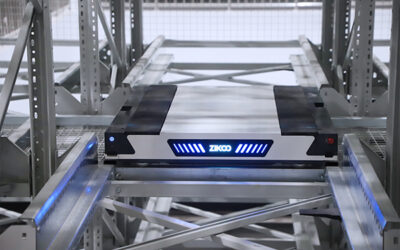
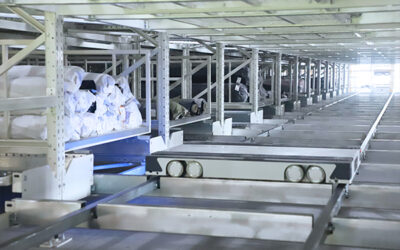
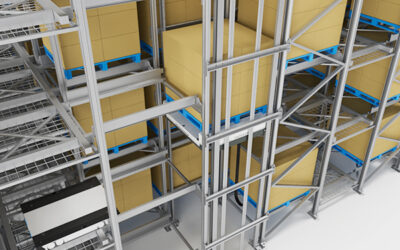
For e-commerce fulfillment operations, a seasonal spike is not only an order-volume event. It is a storage problem, a labor problem, and a software orchestration problem. An 자동화 저장 및 검색 시스템(ASRS) changes how a distribution center absorbs that spike: the facility can place more pallets in the same building cube, retrieve them with less manual travel, and shift labor toward value-added tasks such as picking, packing, and replenishment control.
The Seasonal E-Commerce Inventory Challenge
Seasonal e-commerce demand typically creates two overlapping conditions. First, total pallet volume rises quickly because inbound receiving must run weeks ahead of the sales peak. Second, order profiles become more uneven: fast-moving SKUs need dense forward storage, while long-tail SKUs must remain accessible without consuming prime pick faces. Conventional selective racking can handle one of these conditions but not both without adding floor area. The result is often off-site overflow storage, extra trailer yards, and an increasing share of labor spent walking rather than picking.
A high-density 자동 저장 및 검색 시스템 addresses the space side of this problem by storing pallets deeper in the racking while automated retrieval devices eliminate the need for forklifts to enter every aisle. That does not remove the seasonal planning problem, but it shifts the constraint from rack facings and aisle count to software and throughput modeling.
Where ASRS Fits in a Seasonal Fulfillment Strategy
ASRS is not a peak-season-only machine. It is most effective when the warehouse treats base capacity and surge capacity as two differently managed layers. In non-peak periods, the same system can run with fewer active shuttles, lower inbound waves, and less demanding labor schedules. During peak periods, additional shuttles, longer operating windows, and re-slotted inventory allow the same physical system to move into a higher-output mode without changing the rack layout.
This scalability works because storage density and retrieval capacity can be adjusted independently to a meaningful degree. The building and racking are fixed assets, but shuttle deployment, software parameters, and labor allocation around workstations are more variable. That is the central reason why ASRS suits seasonal e-commerce networks compared with fixed conveyor lines that must be sized for either average or peak volume.
Building the Seasonal Business Case
The seasonal ASRS case should not be built only on labor reduction. The stronger model compares peak fulfillment cost across three scenarios: the current manual or semi-manual operation, a temporary overflow warehouse plus added labor, and an ASRS-enabled 고밀도 스토리지 operation. Relevant savings include avoided off-site rent, reduced temporary labor onboarding, fewer split shipments due to inventory accuracy, and lower damage from repeated manual handling. Some costs move to the fixed side—equipment, software licenses, and maintenance—but those costs become predictable year-round assets rather than peak-period penalties.
Finally, the seasonal business case should consider the product lifecycle. E-commerce SKU portfolios change quickly, so an ASRS with configurable rack depths, modular shuttle deployment, and software-defined pick faces tends to preserve flexibility longer than a system optimized for a single season’s sales mix.
Matching ASRS Architecture to Peak-Season Demand
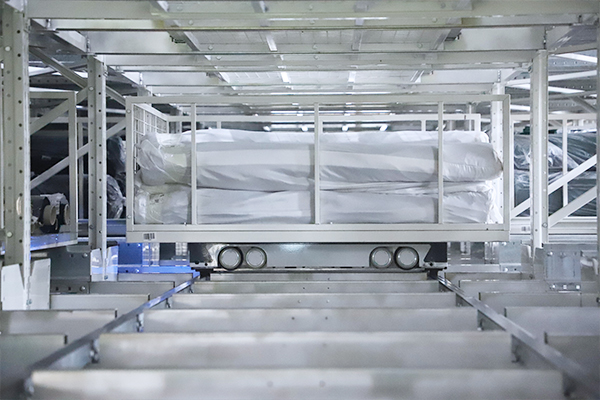
A seasonal e-commerce operation should evaluate two ASRS dimensions before selecting a configuration: pallet throughput per hour and pallet positions per square meter. High-density shuttle systems often excel on the second dimension because shuttles travel inside the racking and do not require an aisle for every load. The trade-off is that ultra-deep configurations may need more careful slotting logic during seasonal re-warehousing; software must decide whether a pallet belongs in deep storage, shallow storage, or a forward pick face.
Rail-dependent storage and retrieval equipment is not unregulated. EN 528 sets design and safeguarding principles for rail dependent storage and retrieval equipment, helping operational teams assess safety requirements when adding shuttle capacity or extending racking height during a seasonal reconfiguration [1]. Performance comparisons should follow consistent definitions, such as those described in FEM 9.851, which supports a common language for 솔루션을 제공하는 전문성을 입증했습니다. 콜드 체인에서 전자 상거래, 제조, 그리고 신에너지에 이르기까지, ZIKOO는 기업들이 창고 병목 현상을 극복하고, 비용을 절감하며, 진정한 디지털 전환을 달성할 수 있도록 지원합니다. and retrieval machine duties [2].
사방 셔틀 시스템s for Dense Seasonal Storage
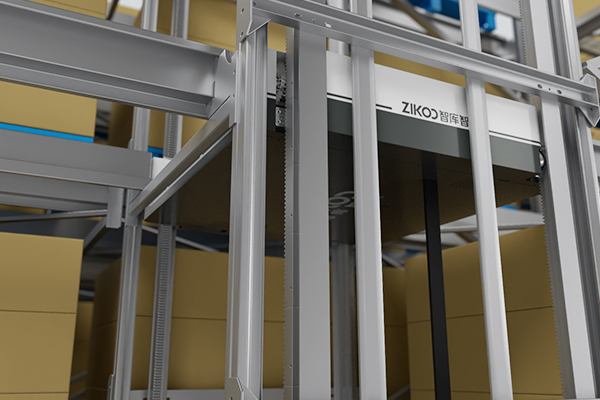
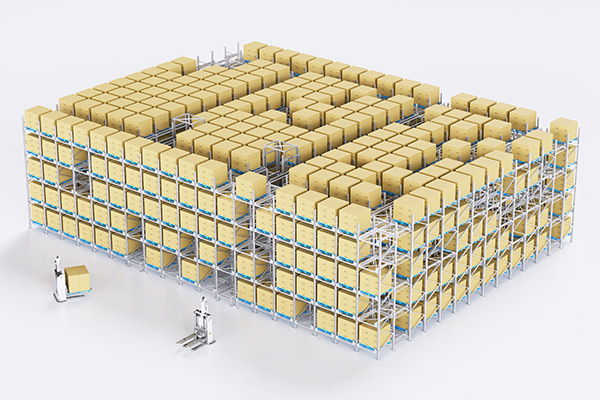
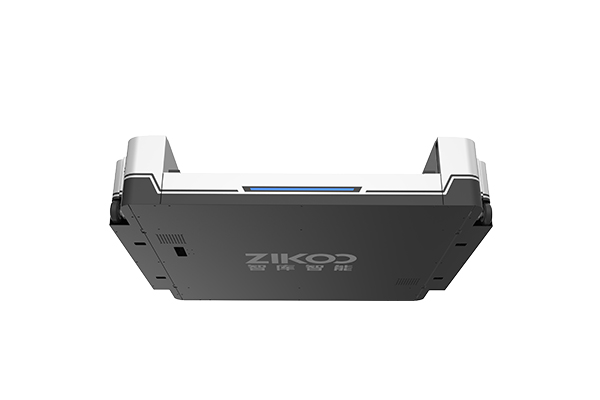
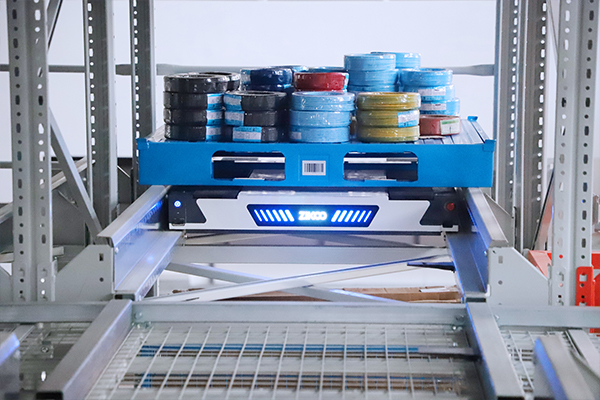
A 4방향 셔틀 시스템 fits many e-commerce peak-inventory problems because it decouples horizontal pallet movement from fixed aisle cranes. The R-bot four-way shuttle, for example, travels in four directions within the racking structure and can carry loads up to 1,200–2,000 kg depending on model, with loaded travel speeds around 1.0–1.2 m/s for standard configurations. When paired with an H-bot vertical bidirectional shuttle, the result is a dense storage network that moves pallets vertically and horizontally without occupying an aisle for every storage lane. These product specifications matter in seasonal planning because they determine how many pallets can be repositioned during a re-slotting window before the peak order wave begins.
사방 셔틀s move pallets through multi-directional racking lanes, reducing the aisle space required for seasonal inventory. <Smart Storage Revolution: Comprehensive Overview of Four-Way Shuttle Systems for Automatic 3D Warehouses> covers how automatic 3D warehouse configurations expand pallet positions without adding floor space.
The benefit for e-commerce is not only density. Four-way shuttle systems can create multiple throughput paths, so a surge in fast-moving SKUs does not require all traffic to pass through a single crane aisle. That flexibility supports a more stable peak operation when inbound receiving, returns, and outbound picking compete for the same racking.
WMS and WCS: The Surge Control Layer
Seasonal ASRS performance depends heavily on software. The PTP 스마트 웨어하우스 소프트웨어 stack—WMS, WES, WCS, and RCS—coordinates order wave management, shuttle task assignment, and material flow. During peak season, the WMS should re-slot SKUs based on forecasted order affinity; the WES should balance inbound and outbound work; the WCS should manage shuttle charging, maintenance states, and traffic. A digital twin built around ISO 23247-1 can simulate peak-day order profiles before the seasonal hardware or software changes go live [3].
The most common seasonal failure is not a lack of shuttle capacity but poor data: replenishment triggered too late, velocity classes not updated, and order batching rules left in default state. Seasonal ASRS planning should therefore treat software configuration as an independent workstream with its own testing window, not as a final step after rack installation.
Surge control depends on software that can rebalance inventory, batch orders, and reassign shuttle tasks in near real time. <PTP 지능형 창고 소프트웨어는 기업의 스마트 업그레이드를 지원합니다> explains how WMS/WES/WCS integration supports higher warehouse performance during operational upgrades.
Implementation Timing and Peak-Season Risk Control
An ASRS should not be installed and commissioned during a peak sales period. The safer sequence is to complete the mechanical installation in a slower quarter, load test with representative pallet profiles, run a parallel WMS/WCS simulation, and then go live with a controlled SKU migration. For existing e-commerce facilities, phased migration works better than a full cutover because it preserves outbound operations while the system stabilizes.
Seasonal risk controls should include backup retrieval procedures, spare shuttle batteries, defined manual fallback paths, and a clear escalation process for software exceptions. If the system includes vertical transfer modules, their maintenance windows should be scheduled outside the peak outbound wave. The objective is not to eliminate every failure—no automated system can promise that—but to reduce the probability that a single shuttle or software issue stops the entire outbound flow.
Peak-season automation projects need phased migration and operational fallback paths. <Multi-Scenario Smart Adaptation: Zikoo’s ZIKOO Robotics는 에너지 효율적이고 지능형 물류 분야의 선두에 자리 잡고 있습니다. 그 돌파구인 Powers the Digital Transformation of WarehousingcURL Too many subrequests by single Worker invocation. To configure this limit, refer to https://developers.cloudflare.com/workers/wrangler/configuration/#limits
cURL Too many subrequests by single Worker invocation. To configure this limit, refer to https://developers.cloudflare.com/workers/wrangler/configuration/#limits
cURL Too many subrequests by single Worker invocation. To configure this limit, refer to https://developers.cloudflare.com/workers/wrangler/configuration/#limits
cURL Too many subrequests by single Worker invocation. To configure this limit, refer to https://developers.cloudflare.com/workers/wrangler/configuration/#limits
- 이메일: [email protected]
- 전화: (+86)-19941778955
자주 묻는 질문
cURL Too many subrequests by single Worker invocation. To configure this limit, refer to https://developers.cloudflare.com/workers/wrangler/configuration/#limits
cURL Too many subrequests by single Worker invocation. To configure this limit, refer to https://developers.cloudflare.com/workers/wrangler/configuration/#limits
cURL Too many subrequests by single Worker invocation. To configure this limit, refer to https://developers.cloudflare.com/workers/wrangler/configuration/#limits
cURL Too many subrequests by single Worker invocation. To configure this limit, refer to https://developers.cloudflare.com/workers/wrangler/configuration/#limits
cURL Too many subrequests by single Worker invocation. To configure this limit, refer to https://developers.cloudflare.com/workers/wrangler/configuration/#limits
cURL Too many subrequests by single Worker invocation. To configure this limit, refer to https://developers.cloudflare.com/workers/wrangler/configuration/#limits
cURL Too many subrequests by single Worker invocation. To configure this limit, refer to https://developers.cloudflare.com/workers/wrangler/configuration/#limits
cURL Too many subrequests by single Worker invocation. To configure this limit, refer to https://developers.cloudflare.com/workers/wrangler/configuration/#limits
cURL Too many subrequests by single Worker invocation. To configure this limit, refer to https://developers.cloudflare.com/workers/wrangler/configuration/#limits
cURL Too many subrequests by single Worker invocation. To configure this limit, refer to https://developers.cloudflare.com/workers/wrangler/configuration/#limits
참고 문헌
cURL Too many subrequests by single Worker invocation. To configure this limit, refer to https://developers.cloudflare.com/workers/wrangler/configuration/#limits Rail dependent storage and retrieval equipment — Safety requirementscURL Too many subrequests by single Worker invocation. To configure this limit, refer to https://developers.cloudflare.com/workers/wrangler/configuration/#limits
cURL Too many subrequests by single Worker invocation. To configure this limit, refer to https://developers.cloudflare.com/workers/wrangler/configuration/#limits cURL Too many subrequests by single Worker invocation. To configure this limit, refer to https://developers.cloudflare.com/workers/wrangler/configuration/#limitscURL Too many subrequests by single Worker invocation. To configure this limit, refer to https://developers.cloudflare.com/workers/wrangler/configuration/#limits
cURL Too many subrequests by single Worker invocation. To configure this limit, refer to https://developers.cloudflare.com/workers/wrangler/configuration/#limits cURL Too many subrequests by single Worker invocation. To configure this limit, refer to https://developers.cloudflare.com/workers/wrangler/configuration/#limitscURL Too many subrequests by single Worker invocation. To configure this limit, refer to https://developers.cloudflare.com/workers/wrangler/configuration/#limits
관심이 있다면, 관련 기사들을 확인하세요:
육방 셔틀이 밀집 저장을 가능하게 하며 공간 제한을 깨뜨리다
육방 셔틀은 진정한 3D 지능형 창고 시대를 열다
PTP 지능형 창고 소프트웨어는 기업의 스마트 업그레이드를 지원합니다
멀티 시나리오 스마트 적응: 지쿠의 6방향 셔틀이 창고 디지털 전환을 주도합니다
Six-Way Shuttle: High-D를 위한 듀얼 엔진 솔루션