Choosing between a pallet 四方向シャトルシステム and a conveyor system shapes your entire warehouse operation — not just throughput, but how you adapt to changing demands over the next decade. While many comparisons stop at headline density and speed, we’ve encountered projects where the real differentiator was the software layer and the ability to reconfigure without structural changes. This article breaks down the practical factors that determine which pallet storage method fits your facility, grounded in real-world system integration experience.
Pallet Handling Mechanics of Shuttles vs Conveyors
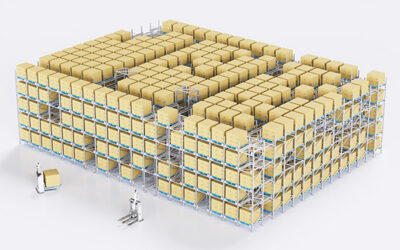
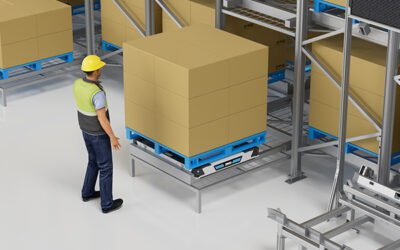
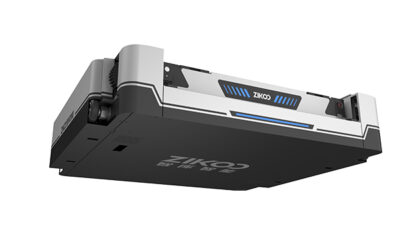
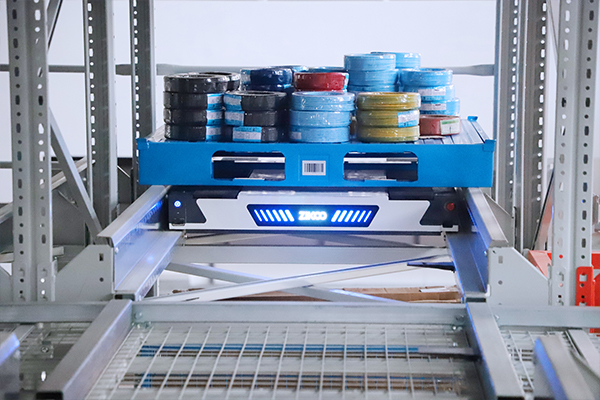
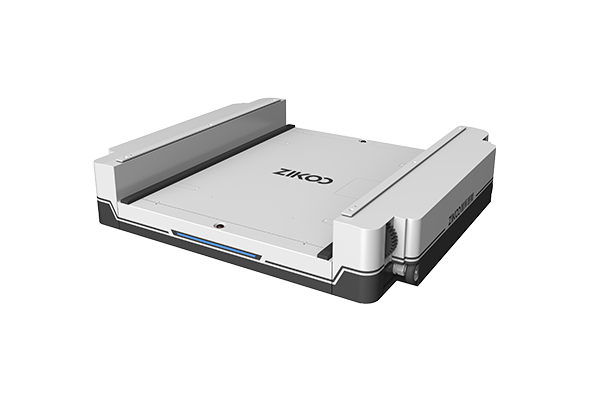
A 四方向シャトル is an autonomous mobile robot that travels on rails within high-density racking, carrying pallets horizontally in four directions and interfacing with vertical lifts to serve multiple levels. The R-bot four-way shuttle from our product line, for instance, moves at up to 1.6 m/s empty and handles 1.2 tons on a body only 125 mm thick, which lets it slot into exceptionally compact rack depths. A conveyor system, by contrast, relies on fixed roller or belt sections that move pallets along predetermined paths. Conveyors excel at steady, dedicated flow — moving pallets from receiving to shipping without deviation — but they lack the ability to change lanes or routes without physical rework.
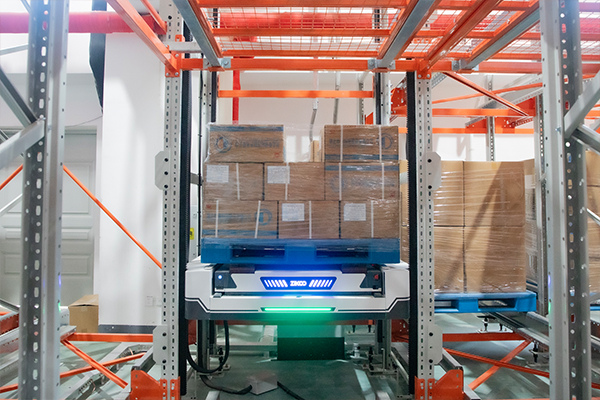
In a shuttle-based layout, pallets are stored deep in multi-level racking and retrieved by a fleet of shuttles working in parallel with lifts. This creates a “random access” capability: any pallet can be reached at any time without disturbing others. A conveyor line, on the other hand, typically sequences pallets in a first-in-first-out (FIFO) stream; accessing a pallet mid-sequence requires complex bypass logic. For operations with variable demand or mixed SKU profiles, that distinction matters more than raw throughput numbers.
Throughput and Peak Demand Performance
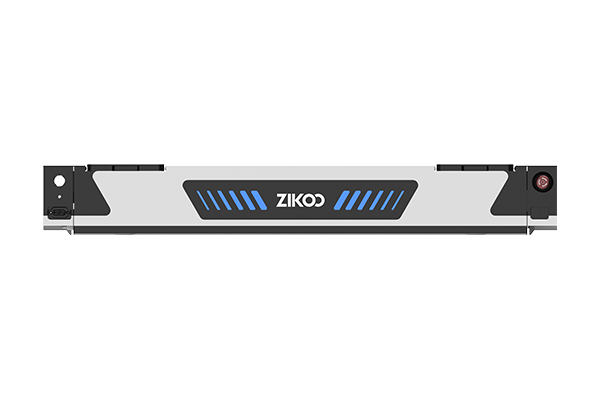
When evaluating peak throughput, conveyors can look stronger on paper for point-to-point moves. A high-speed roller conveyor pushes 60 to 100 pallets per hour on a dedicated lane, and multiple lanes can be combined to scale linearly. However, that linear scaling also means the entire line’s performance caps if one section is delayed or a single pick station backs up. Shuttle systems achieve throughput through parallelism: a fleet of shuttles service multiple rack faces and levels simultaneously, so the system’s capacity scales with the number of shuttles, not just the length of a line. In a typical 密な収納 rack, we’ve seen a cluster of four to six R-bot shuttles deliver combined throughput of 80 to 120 pallets per hour, and adding shuttles raises that ceiling without altering the building footprint.
For peak demand spikes — say end-of-month shipping surges in a retail DC — a conveyor system’s fixed capacity becomes a bottleneck unless you planned for excess capacity during design. Shuttle systems, with pallet buffers at each level and dynamic dispatch software, can absorb peaks by pre-positioning high-demand SKUs at lift faces and dispatching additional shuttles to hot zones. The key is the warehouse control software; without intelligent task allocation, even a shuttle fleet underperforms.
If your operation faces large, predictable day-to-day volume swings, the flexibility of parallel shuttle operations often saves capital that would otherwise go into oversized conveyor lines.
Space Utilization and Storage Density
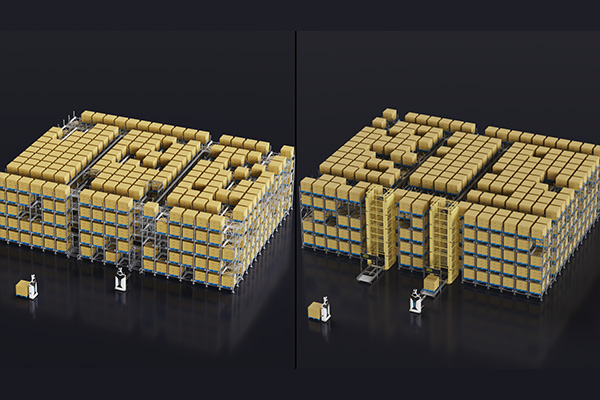
Storage density is where shuttles pull well ahead. A conveyor-fed pallet rack typically needs 2.5 to 3.5 meter aisles for forklift or truck access, and conveyors themselves consume floor area with returns, transfers, and accumulation zones. A four-way shuttle system collapses those aisles to the width of the shuttle itself — often less than a meter — and stacks pallets in multi-depth lanes without intermediate aisles. Using the R-bot’s 125 mm body height, racks can achieve ten or more levels within a building, pushing storage density past 2.5 pallet positions per square meter. For a 5,000‑square‑meter warehouse, that can mean 50% to 70% more pallet positions compared to a traditional conveyor-fed layout.
Conveyors still have a density argument in very narrow, single-purpose applications such as a high-bay to shipping dock spine, where the entire building volume is not needed for storage. But in any multi-SKU environment where pallets need to be both stored and accessed in any order, the shuttle’s high-density rack integrates storage and retrieval without separate buffer space.
Total Cost of Ownership and ROI Considerations
Upfront cost comparisons can be misleading. A conveyor system for a 2,000‑pallet warehouse might quote lower on paper because roller sections and drives are commodity items, while a shuttle system requires robots, lifts, and a more sophisticated control system. However, cost per pallet position — including building, racking, and equipment — often favors shuttles once the building footprint shrinks. Building cost, racking steel, and climate control (especially in cold storage) scale with square footage, and the shuttle saves all three.
Maintenance cost profiles differ, too. Conveyors have hundreds of moving parts — rollers, belts, bearings, motors — and require regular mechanical upkeep across the entire length. Shuttles concentrate maintenance on the robots themselves, and in a multi-shuttle fleet, one shuttle taken offline for service does not stop the whole warehouse. Battery replacement intervals for lithium-powered shuttles like our R-bot are typically three to five years, and energy consumption per pallet move is lower because the robot only energizes when moving, unlike a conveyor line that runs continuously during operating hours.
When factoring in labor savings (one shuttle system operator monitoring via WCS versus a team of forklift drivers for conveyor-fed operations) and space-related building costs, many facilities see a four-way shuttle system pay back within 3 to 5 years against a comparable conveyor installation.
Software Integration and System Control
This is the factor most comparisons overlook. A conveyor system’s control logic is relatively simple: start a motor, stop a motor, divert a pallet. A shuttle system, especially one that operates across multiple rack levels with a fleet of robots, needs a tightly coupled warehouse control system (WCS) that handles task allocation, traffic management, and energy optimization in real time. The software must also integrate with the host WMS to direct pallet storage and retrieval based on inventory rules.
From our projects, the single biggest predictor of shuttle system success is the quality of the WCS layer. We build our PTPスマート倉庫ソフトウェア platform to manage R-bot shuttles, H-bot vertical lifts, and U-bot stackers under one dispatching engine, which avoids the handshake delays that happen when controls come from different vendors. If your operation already runs a mature WMS and you plan to add shuttles, verify that the shuttle supplier’s WCS can operate at the sub-second response times required for dense storage — not all can.
Conveyor systems, despite their mechanical simplicity, also need PLC and WCS coordination, but the integration scope is narrower. For a warehouse expecting to expand in phases, a shuttle system’s software flexibility makes incremental addition far less disruptive than reengineering a fixed conveyor layout.
Scalability and Long-Term Flexibility
A conveyor system is essentially a custom installation: once the line is bolted in, changing the flow pattern means dismantling and reintegrating sections, which requires downtime and engineering. A shuttle system, by contrast, is a modular architecture. Adding more storage depth means extending racking and rails; increasing throughput means adding shuttles; adding vertical capacity means another lift. These changes can happen in phases without interrupting active operations — we’ve executed projects where an initial shuttle zone was expanded to double the pallet positions over a weekend shutdown.
For businesses with uncertain growth or evolving SKU profiles, that flexibility is worth a premium. One energy sector client running a dedicated conveyor system for raw material feeding found that when their product mix shifted, the fixed conveyor layout became a constraint, forcing manual staging workarounds. The same company later adopted a 六方向シャトルシステム for finished goods storage that could be reconfigured in software as SKU counts changed.
When a warehouse must serve multiple industries or handle seasonal peaks with unpredictable mix, the shuttle’s ability to repurpose storage on demand provides an operational buffer that a conveyor line simply cannot offer.
Making the Right Pallet Storage Decision for Your Site
No single technology fits every site. A conveyor system is the right tool when you have a steady, high-volume linear flow — for example, feeding a production line or moving full pallets from receiving straight to a shipping sorter. In that scenario, the conveyor’s simplicity and low per-move cost justify the fixed layout.
A four-way shuttle system becomes the stronger investment when floor space is expensive, storage density is a priority, and the operation requires random access to a wide range of SKUs. The ability to store deep, retrieve any pallet at any time, and scale incrementally changes the economics of the entire building. And as we’ve seen across projects in cold chain, manufacturing, and e‑commerce, the software layer — not just the robot — decides whether that advantage materializes.
Selecting between pallet storage technologies is a system-level decision that benefits from a detailed site evaluation. Whether you are upgrading an existing facility or planning a greenfield project, share your storage requirements and throughput targets with our engineering team at [email protected] or call (+86)-19941778955 for a configuration analysis that weighs both shuttle and conveyor options against your real data.
Common Questions When Choosing Shuttle vs Conveyor
Which system is easier to install in an existing building?
It depends on the building structure, not just the equipment. A conveyor system needs continuous floor space and ceiling-mounted supports for overhead lines; existing columns often get in the way. Four-way shuttle racking uses the cube more efficiently and can be designed around columns, but it requires a flat slab floor with tolerances of a few millimeters. In one brownfield project we supported, a shuttle installation fit into a building with 5.5‑meter clear height — too low for a conveyor-fed high-bay — by using seven rack levels. Conveyors often demand more structural modifications up front, but the shuttle requires a floor flatness survey and possibly resurfacing before rack installation.
Can a four-way shuttle replace all conveyors in my warehouse?
In most warehouses, shuttles and conveyors serve different roles. The shuttle is a storage and retrieval robot; it is not designed to move pallets over hundreds of meters across a site. We often see hybrid layouts where shuttles handle dense storage and retrieval, and short conveyor spurs connect the lift drop-off points to pick stations or shipping docks. Pure shuttle-to-truck arrangements work when the storage rack is adjacent to the dock, but for large-footprint facilities, some backbone conveyor reduces travel distance. The best design usually pairs the shuttle’s dense storage with minimal targeted conveyance.
How do I decide when budgets are tight?
Start by modeling the cost per pallet position, not just equipment cost. For a given storage capacity, a shuttle layout typically uses 30% to 50% less building area, which translates directly into lower construction, lighting, and climate control costs. If the budget cannot cover a full shuttle deployment, a hybrid approach works: build the rack structure for future shuttles, install conveyors in the high-flow zones, and add shuttles in phases as volumes grow. In several phased projects we’ve designed, early-stage conveyor handling of inbound pallets paid for the later shuttle expansion by cutting labor hours first. Share your current layout and a 3‑year volume projection; we can outline a staged rollout that avoids overbuilding.
興味があれば、これらの関連記事もご覧ください:
六方向シャトルが倉庫のアップグレードを推進し、インテリジェントな自動3D倉庫を構築
倉庫価値の再構築:六方シャトルがデジタルトランスフォーメーションを牽引