Choosing between a 四方向シャトルシステム and a stacker crane AS/RS is not a simple spec comparison. In our projects across manufacturing, cold chain, and e-commerce, the break-even point depends less on published throughput numbers and more on pallet mix, building constraints, and daily operating variability. This article examines the engineering trade-offs behind each technology so you can make a decision grounded in your actual warehouse profile, not a vendor’s datasheet.
How Do 四方向シャトルs and Stacker Cranes Move Pallets?
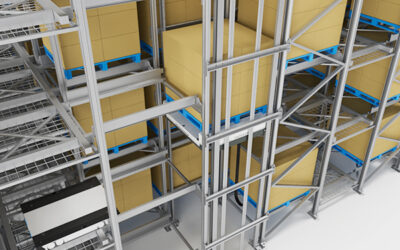
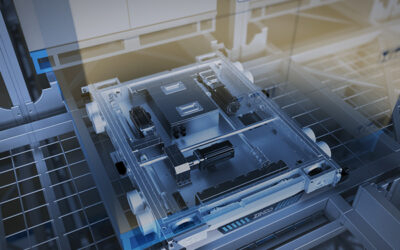
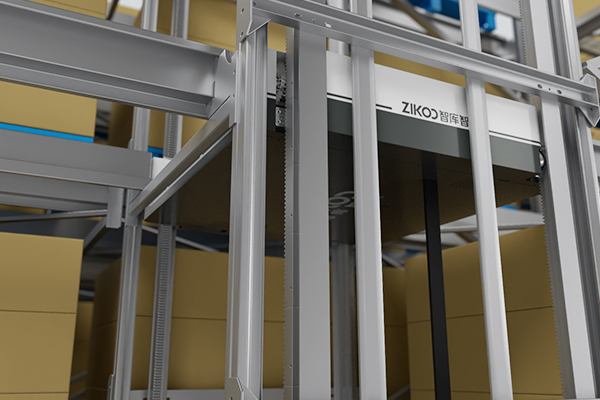
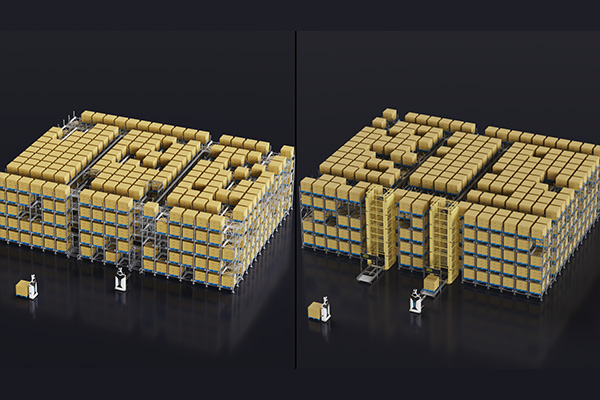
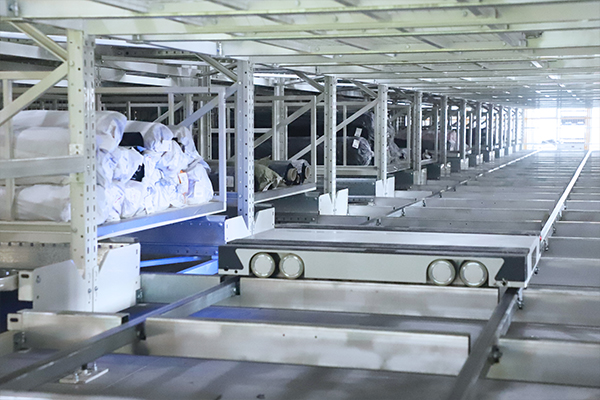
A four-way shuttle travels on parallel rails within a racking lane and can transfer between lanes via perpendicular rails at aisle ends. It carries pallets horizontally in four directions, and vertical movement is handled by separate elevators positioned at rack faces. A stacker crane moves on a single floor rail inside an aisle, using a mast to lift and retrieve pallets from both sides.
This mechanical difference shapes nearly every operational decision. The shuttle’s decoupled design means horizontal transport and vertical lift are independent. You can add more shuttles or elevators separately to match your throughput. The stacker crane integrates both motions into one machine, so an aisle cardinally depends on a single device.
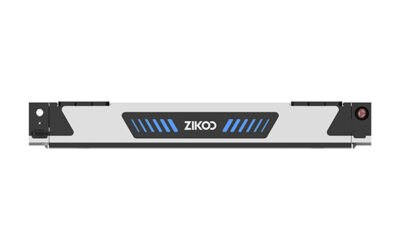
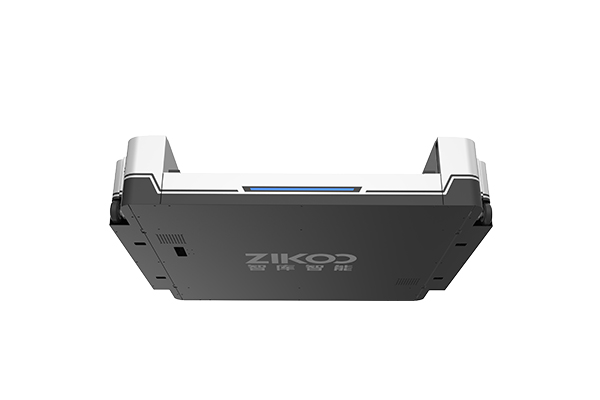
The shuttle also handles a wider range of pallet sizes without mechanical reconfiguration. Our R-bot series supports standard 1200×1000 mm pallets, American 1016×1219 mm pallets, and Japanese 1100×1100 mm pallets within the same system, with load capacities from 1200 kg up to 2000 kg. A stacker crane’s telescopic forks typically adapt to one or two pallet footprints, and changing pallet type often means swapping the load handling device.
| 特徴 | Four-Way Shuttle (R-bot example) | Stacker Crane |
|---|---|---|
| Horizontal motion | Every aisle via perpendicular transfer rails | Single aisle on floor rail |
| Vertical motion | Separate H-bot elevator, operates independently | Integrated mast, one machine per aisle |
| Load capacity | 1200–2000 kg depending on model | Typically 1500–3000 kg |
| Pallet size flexibility | Handles multiple pallet footprints without hardware change | Limited to one or two sizes without fork replacement |
| Aisle width requirement | Narrow: shuttle body 125 mm height, minimal gap | Wider: depends on mast and fork width |
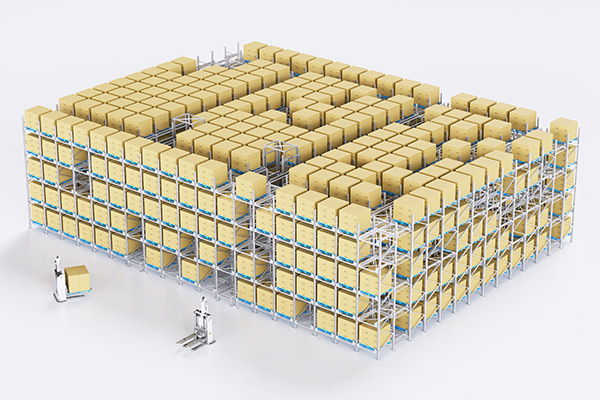
Which System Delivers Better Storage Density?
A stacker crane can reach building heights above 30 meters, creating very tall racks with single-deep or double-deep lanes. If you have a greenfield building with high ceilings and uniform pallets, the crane often wins on raw cubic volume utilization.
But density is not just about height. In facilities with constrained floor space or multiple temperature zones, a shuttle system with H-bot elevators constructs 密な収納 arrays that can exceed the practical density of a stacker crane when the building height is under 15 meters. The R-bot’s 125 mm body height allows rack beam spacing as tight as 150 mm, recovering vertical inches that a crane’s mast clearance would sacrifice.
We have deployed 六方向シャトルシステムs in urban distribution centers where the building footprint was fixed and the ceiling was only 10 meters. By using shuttle lanes on every level and elevators at each row end, the storage density per square meter exceeded what a stacker crane design could achieve in the same envelope. The key variable is whether your building height gives the crane an advantage or whether floor coverage and rack depth make the shuttle more space-efficient.
What Are the Throughput and Peak-Handling Differences?
A stacker crane serves one pallet at a time per aisle. Put five cranes in five aisles, and you get five simultaneous moves. A four-way shuttle system with multiple shuttles and elevators can handle moves in parallel across aisles. During peak inbound waves, the WCS software can reroute shuttles to high-demand lanes without physical reconfiguration.
私たちの PTPスマート倉庫ソフトウェア stack, including WES and RCS, assigns tasks to shuttles dynamically. When an e-commerce client experiences a 3× throughput surge during evening order cut-off, the system distributes moves across all available shuttles rather than queueing behind one aisle’s crane. In a stacker crane system, that surge hits a single machine per aisle, and the only remedy is to run cranes faster, which eventually hits a ceiling.
If your operation deals with predictable, steady flow and a limited number of SKUs, a stacker crane may keep up without complex software. But if variability is built into your business, the multi-shuttle architecture absorbs peaks with less capital per aisle.
If your operation faces frequent peak surges or unpredictable mix changes, it is worth running a simulation against your real order data before finalizing the system architecture. Share a week of order logs with us at [email protected], and we will model the throughput of a shuttle configuration versus a crane layout for your specific scenario.
What Is the Total Cost of Each AS/RS Solution?
The upfront price of a stacker crane for a single aisle is often lower than the equivalent shuttle-plus-elevator set. But that comparison misses the relationship between aisle count and cost scaling. In a shuttle system, one elevator can serve multiple shuttles across several aisles, so the cost per pallet position drops as storage depth increases. A crane’s cost remains roughly linear with aisle count.
cURL Too many subrequests by single Worker invocation. To configure this limit, refer to https://developers.cloudflare.com/workers/wrangler/configuration/#limits
cURL Too many subrequests by single Worker invocation. To configure this limit, refer to https://developers.cloudflare.com/workers/wrangler/configuration/#limits
cURL Too many subrequests by single Worker invocation. To configure this limit, refer to https://developers.cloudflare.com/workers/wrangler/configuration/#limits
cURL Too many subrequests by single Worker invocation. To configure this limit, refer to https://developers.cloudflare.com/workers/wrangler/configuration/#limits
cURL Too many subrequests by single Worker invocation. To configure this limit, refer to https://developers.cloudflare.com/workers/wrangler/configuration/#limits
cURL Too many subrequests by single Worker invocation. To configure this limit, refer to https://developers.cloudflare.com/workers/wrangler/configuration/#limits
cURL Too many subrequests by single Worker invocation. To configure this limit, refer to https://developers.cloudflare.com/workers/wrangler/configuration/#limits
cURL Too many subrequests by single Worker invocation. To configure this limit, refer to https://developers.cloudflare.com/workers/wrangler/configuration/#limits
cURL Too many subrequests by single Worker invocation. To configure this limit, refer to https://developers.cloudflare.com/workers/wrangler/configuration/#limits
cURL Too many subrequests by single Worker invocation. To configure this limit, refer to https://developers.cloudflare.com/workers/wrangler/configuration/#limits
cURL Too many subrequests by single Worker invocation. To configure this limit, refer to https://developers.cloudflare.com/workers/wrangler/configuration/#limits 六方向シャトル cURL Too many subrequests by single Worker invocation. To configure this limit, refer to https://developers.cloudflare.com/workers/wrangler/configuration/#limits
cURL Too many subrequests by single Worker invocation. To configure this limit, refer to https://developers.cloudflare.com/workers/wrangler/configuration/#limits
cURL Too many subrequests by single Worker invocation. To configure this limit, refer to https://developers.cloudflare.com/workers/wrangler/configuration/#limits
cURL Too many subrequests by single Worker invocation. To configure this limit, refer to https://developers.cloudflare.com/workers/wrangler/configuration/#limits
cURL Too many subrequests by single Worker invocation. To configure this limit, refer to https://developers.cloudflare.com/workers/wrangler/configuration/#limits
cURL Too many subrequests by single Worker invocation. To configure this limit, refer to https://developers.cloudflare.com/workers/wrangler/configuration/#limits
cURL Too many subrequests by single Worker invocation. To configure this limit, refer to https://developers.cloudflare.com/workers/wrangler/configuration/#limits
cURL Too many subrequests by single Worker invocation. To configure this limit, refer to https://developers.cloudflare.com/workers/wrangler/configuration/#limits
cURL Too many subrequests by single Worker invocation. To configure this limit, refer to https://developers.cloudflare.com/workers/wrangler/configuration/#limits
興味があれば、これらの関連記事もご覧ください:
六方向シャトルが倉庫のアップグレードを推進し、インテリジェントな自動3D倉庫を構築
倉庫価値の再構築:六方シャトルがデジタルトランスフォーメーションを牽引
6方向シャトルシステムが、高密度ストレージ自動化における機械からロボットへの移行を主導
六方向シャトルが産業を支え、スマート倉庫の導入を促進
標準化がグローバル配送を強化:Zikoo Roboticsの6方向シャトルが海外展開