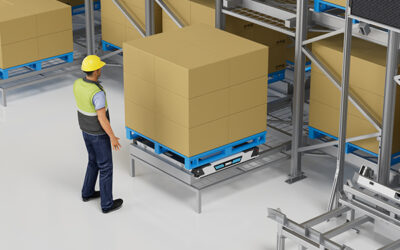
Autonomous pallet handling has moved from material-handling experiment to systems-engineering discipline. An intelligent pallet robot is not a motorized cart that happens to carry a load. It is a controlled vehicle that combines motion control, positioning, energy storage, load engagement, and warehouse-software integration inside a rack structure, under a mission plan, and in coordination with other robots and the warehouse management layer. The safety envelope for these systems often follows the requirements for driverless industrial trucks and their systems [1].
The Hardware Architecture of Intelligent Pallet Handling
In a pallet-to-person or pallet-to-machine warehouse, the robot fleet is normally split by movement direction. A four-way shuttle handles horizontal travel inside rack lanes. A vertical bidirectional shuttle moves pallets between levels. An omnidirectional stacker robot serves narrow aisles and retrieval points. That division of movement is what makes autonomous pallet handling scalable: no single vehicle has to be good at everything.
The intelligence of a pallet robot comes from three layers. The first is local control, such as maintaining speed, acceleration, and stopping accuracy. The second is navigation, which may combine barcode grids, laser SLAM, encoders, and 3D vision. The third is mission logic, where the robot receives a task from warehouse control software, selects a route, confirms the correct pallet, and reports completion state.
Four-Way Shuttles: The Dense-Storage Workhorse
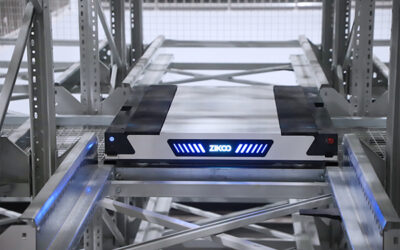
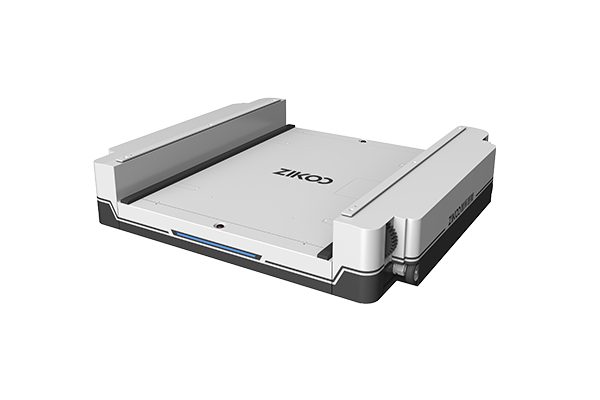
The R-bot four-way shuttle is designed for high-density pallet storage and picking. It is 125 mm high in most models, which allows it to travel underneath pallets inside rack lanes, lift the load slightly, and carry it in four directions. Rated loads range from 1,200 kg to 2,000 kg depending on the model. Standard configurations move at 1.6 m/s empty and 1.2 m/s loaded, while heavy-duty large-pallet versions operate at 1.35 m/s empty and 1.0 m/s loaded.
The low body height is important because pallet handling is ultimately about vertical clearance. If the robot is thin enough, more storage levels can be placed in the same building height. That engineering trade-off, vehicle height versus load capacity, determines how many pallets a dense-storage system can hold.
Pallet footprint still matters. Intercontinental pallet dimensions and tolerances are specified in standards such as ISO 6780 [2]. A four-way shuttle must match the actual pallet width, depth, underside clearance, and board condition, not a theoretical pallet size. That is why shuttle models are often separated by pallet type: 1,200 mm, 1,016 × 1,219 mm, 1,100 mm, and larger 1,400 mm formats each require a different body-width configuration.
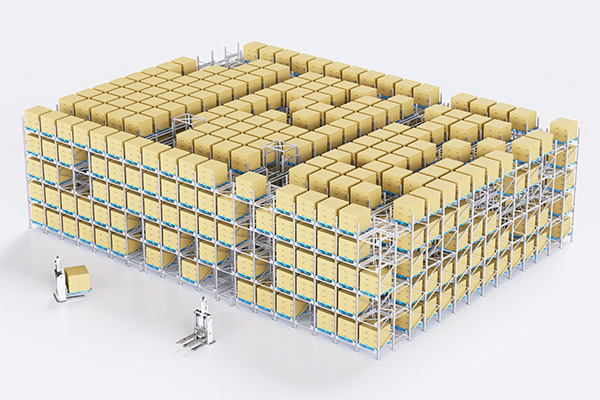
Four-way shuttles are at the center of high-density pallet-to-person warehousing. <Smart Storage Revolution: Comprehensive Overview of Four-Way Shuttle Systems for Automatic 3D Warehouses> covers how a four-way shuttle system turns an automatic 3D warehouse from a layout concept into a working storage architecture.
Six-Way Coordination: Adding the Vertical Dimension
A four-way shuttle moves horizontally. To create a full three-dimensional storage network, the system needs a vertical lift. The H-bot vertical bidirectional shuttle performs that function while occupying a single storage position in the rack. It has a rated load of 1,800 kg in standard configurations and positions loads with ±1 mm accuracy. Typical travel speed is 1 m/s empty and 0.5 m/s loaded, with acceleration of 1 m/s² empty and 0.3 m/s² loaded.
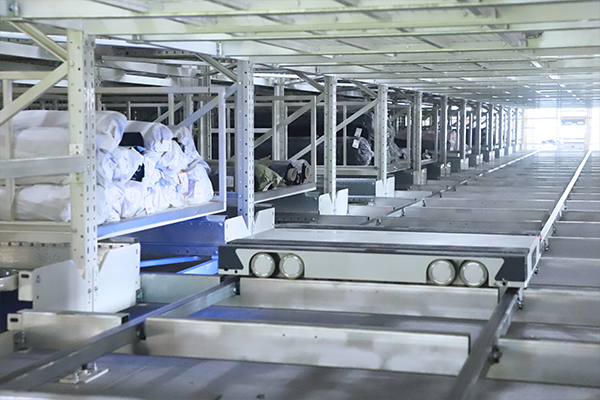
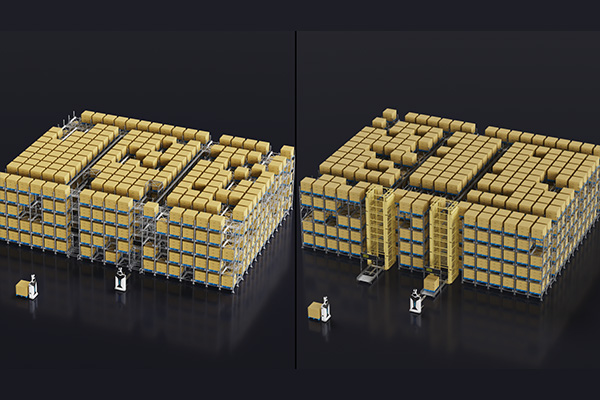
When an H-bot is integrated with R-bot four-way shuttles, the result is a six-way shuttle system: four horizontal directions plus vertical up and down. That changes how buffer zones, picking faces, and retrieval paths are designed. Instead of moving every pallet to a fixed conveyor, the system can bring the pallet to a lift, transfer it to a picking floor, and return the empty pallet to storage without blocking the lane.
Adding a vertical bidirectional shuttle turns a four-way shuttle network into a three-dimensional material system. <Six-Way Shuttle: Empowering Industries to Embrace Smart Warehousing> covers how six-way shuttle systems support dense storage, vertical movement, and multi-level warehouse workflows across different industries.
Software Orchestration with WMS, WES, WCS, and RCS
The shuttle is only the actuator. The system that makes it intelligent is the software stack. In automated pallet handling, management functions are usually separated into WMS, WES, WCS, and RCS. The WMS decides what should move. The WES batches, prioritizes, and sequences orders. The WCS assigns work to equipment. The RCS manages robot-level execution: path selection, traffic control, charging, and error recovery.
That separation is practical for pallet robots because high-density storage creates conflicts. Several shuttles may need the same aisle, the same lift, or the same picking face. A mission orchestrator must reserve paths, prevent deadlock, and recover from a blocked lane without human intervention.
A pallet robot that works only in isolation is not enough for high-SKU, high-throughput operations. The robot must accept a task, coordinate with lifts and conveyors, and return a completion message that updates inventory in near real time. That is why the control system is evaluated together with the vehicle, not as a separate add-on.
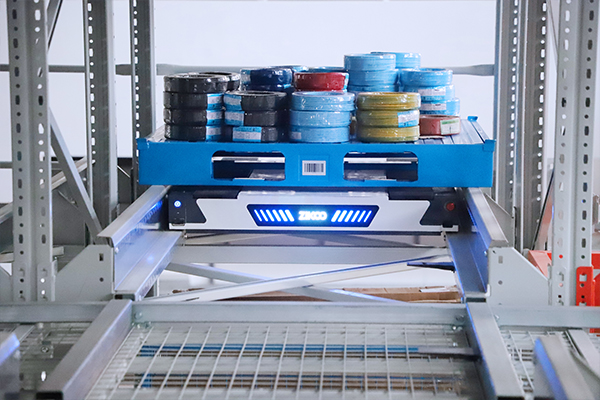
The shuttle itself is only half of the system; the missing layer is orchestration. <PTP Intelligent Warehouse Software Empowers Enterprises for Smart Upgrades> covers how WMS, WES, WCS, and RCS work together to turn robotic hardware into adaptive warehouse intelligence.
Engineering review: send the pallet footprint, storage height, rack depth, target pallet moves per hour, and cold storage requirement if any to [email protected]. The response should map shuttle count, lift points, and software integration to the actual load spectrum, not a generic equipment list.
Narrow-Aisle Access with U-bot Omnidirectional Stacker Robots
Not every pallet position sits inside a dense shuttle lane. Some warehouses have narrow aisles, irregular pallet types, or low-volume picking areas. The U-bot omnidirectional stacker robot is built for those access tasks. It requires a minimum aisle width of 2,100 mm in its U1045 model and 2,140 mm in the U1060 and U1080 models. Lifting heights cover 4,500 mm, 6,000 mm, and 8,000 mm, with a rated load of 1,000 kg.
The U-bot uses dual laser SLAM hybrid navigation and a 3D depth camera that builds a model of the pallet position. The camera compensates for butting board offset of up to ±50 mm, which is important when pallets are not perfectly square or have shifted boards. Driving positioning accuracy is ±10 mm.
In a combined U-bot and AMR narrow-aisle picking system, picking efficiency can reach 300 or more pieces per hour, with inbound and outbound capacity of 80 or more pallets per hour. Such a system can support up to 10,000 SKUs in multi-SKU, split-case operations.
Throughput, Density, and Safety Engineering
Throughput is not a single robot specification. It is the result of vehicle count, cycle time, lift capacity, lane depth, and mission scheduling. A fast shuttle with poor traffic control can deliver lower real throughput than a slower shuttle with better sequencing. That is why automated pallet systems are evaluated by system throughput, not just vehicle speed.
Density is easier to compare. A four-way shuttle system removes the need for many wide aisles because the shuttle travels inside the rack lane. The saved aisle space can increase the number of storage locations in the same building footprint. Dense storage is particularly useful for low- to medium-turnover pallets, raw materials, finished goods, and cold-chain inventory.
For rail-guided pallet robots and storage and retrieval machines operating inside rack structures, safety is governed by standards such as EN 528 [3]. That standard addresses rail-dependent storage and retrieval equipment and sets requirements for safe movement, access, and control. When autonomous vehicles move outside the rack, such as AMRs, the safety framework for driverless industrial trucks becomes relevant [1].
Cold storage adds another layer. In -25 °C environments, shuttle batteries, PCBA coatings, charging ports, and wheel materials must be specified for condensation, low-temperature discharge, and repeated thermal cycling. A cold-chain shuttle can operate for six to eight hours on a dedicated low-temperature lithium battery, but the charging strategy must account for low-temperature charging windows.
From Concept to Configuration
An intelligent pallet robot project should start with data, not with an equipment list. The following information is normally enough to produce a first engineering configuration: pallet length, width, height, and weight; number of SKUs; inbound and outbound pallets per day; peak-hour throughput; storage temperature; building height; column spacing; and dock positions.
From that input, the system design can determine whether a four-way shuttle is appropriate, whether an H-bot vertical lift is required, and whether a U-bot should cover narrow-aisle access. The pallet profile often decides the shuttle model. The throughput profile decides shuttle count and lift count. The temperature profile decides battery and coating configuration. The building height decides how many levels can be engineered into the rack.
Special-environment projects may require additional constraints. New-energy production environments, for example, may require vehicles that avoid copper, zinc, nickel, and lead in exposed components, use stainless steel structural frames, and apply all-rubber buffer wheels to reduce metal contamination risk.
Talk to the Engineering Team
If you are evaluating autonomous pallet handling for a new build, an expansion, or a brownfield retrofit, contact Zikoo Smart Technology Co., Ltd at [email protected] or (+86)-19941778955. Include pallet dimensions, storage height, temperature range, and target inbound and outbound throughput. The engineering team can map the appropriate robot family, vertical lift plan, rack interface, and software integration points.
Frequently Asked Questions
What is the difference between a four-way shuttle and a two-way pallet shuttle?
A two-way shuttle generally moves forward and backward within a single lane. A four-way shuttle can also move laterally across lanes, which allows it to change lanes without a transfer car and gives the warehouse more routing flexibility.
Can intelligent pallet robots work in cold storage?
Yes. Cold storage requires low-temperature lithium batteries, condensation-resistant electronics, and charging strategies designed for low-temperature operation. Dedicated cold-chain configurations can operate in environments down to -25 °C for six to eight hours per charge.
How does a six-way shuttle system improve storage density?
A six-way shuttle system combines the horizontal movement of a four-way shuttle with a vertical bidirectional shuttle. The vertical lift occupies a single storage position and transfers pallets between levels, which allows the rack to extend upward while the shuttle handles horizontal movement inside the lanes.
What data is needed before configuring a pallet robot system?
At minimum, the pallet footprint, weight, storage height, temperature range, SKU count, daily inbound and outbound volume, peak-hour throughput, and building constraints such as column spacing should be provided. These inputs determine shuttle model, fleet size, lift count, and rack layout.
How are pallet robots integrated with WMS and WCS?
The robot communicates with the warehouse control layer through task interfaces. WMS releases the order or inventory movement, WES sequences and prioritizes work, WCS assigns tasks to equipment, and RCS manages robot navigation, traffic, charging, and exception recovery.
References
[1] ISO 3691-4:2023, Industrial trucks — Safety requirements and verification — Part 4: Driverless industrial trucks and their systems.
[2] ISO 6780:2003, Flat pallets for intercontinental materials handling — Principal dimensions and tolerances.
[3] EN 528:2008, Rail dependent storage and retrieval equipment — Safety requirements.
If you’re interested, check out these related articles:
Six-Way Shuttle: The Dual-Engine Solution for High-D
Stacker Crane vs Four-Way Shuttle: Which Fits Your ASRS Warehouse Best
Looking for Reliable Four-Way Shuttle Manufacturers? Choose Zikoo Robotics