When a logistics director evaluates warehouse automation, the question is never “does this technology work?” but “what will it actually do for my throughput and space utilization?” A four-way shuttle system consistently delivers between 40% and 60% storage density increase and 50% or greater labor reduction, but those numbers depend far more on how the shuttles, rack structure, and software are integrated than on the shuttle hardware alone. This article breaks down the efficiency metrics that matter, the architecture decisions that drive them, and the operational realities that prevent a high-spec shuttle from translating into a high-performance warehouse.
What Drives the Efficiency of a Four-Way Shuttle System?
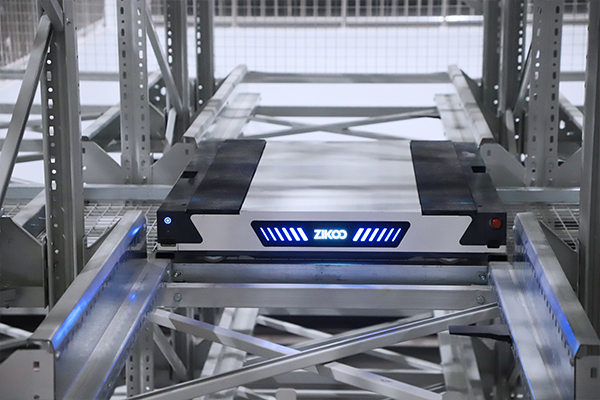
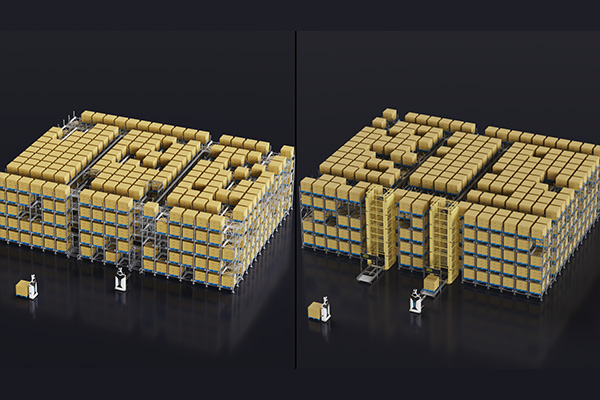
A four-way shuttle’s ability to move in four directions inside a rack eliminates every aisle in a conventional VNA layout, which is why dense storage gains hit 40% to 60% in most designs. The shuttle itself accelerates at 1.0 m/s² empty and reaches 1.6 m/s travel speed on a standard R-bot, but those numbers only become high throughput when the rack is deep enough and the picking logic avoids empty travel. The real efficiency driver is not the shuttle’s speed—it’s the removal of forklift travel paths. A 10,000-pallet warehouse that once needed 8 to 10 aisles for reach trucks might operate with 2 to 3 aisles after installing four-way shuttles, simply because the racks can be 30 to 50 meters deep and still accessible. When we specify rack depth, we look at SKU velocity first. Slow-moving SKUs in deep lanes increase density, fast-movers in shallower lanes keep cycle times low, and mixing both in the same block with software-controlled slotting is where the system earns its keep. Without that logical segregation, the shuttle moves more but retrieves less, and the efficiency numbers flatten.
Storage density is the most discussed metric in automated storage projects, yet it is meaningless without throughput targets attached. <Six-Way Shuttle: The Dual-Engine Solution for High-Density and High-Throughput> covers the floorplan logic we use when a client needs 30,000 pallets stored but also 80 forklift movements per hour—conditions where density and throughput become competing design variables.
How Much Space Can You Actually Recover?
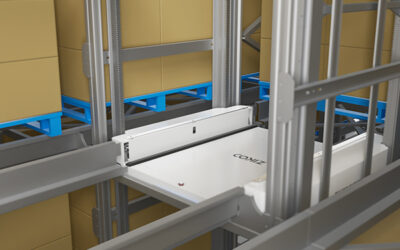
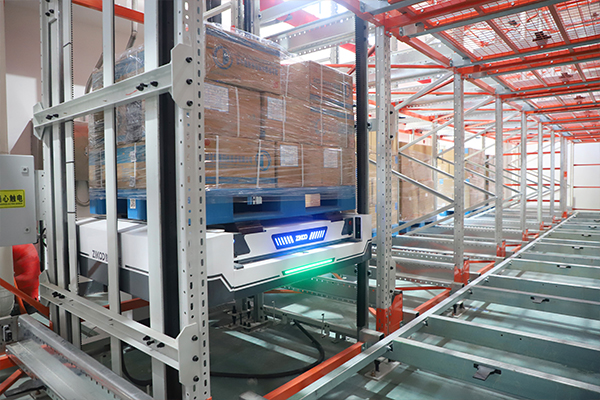
The headline number in any sales deck is “up to 60% space reduction,” and it is achievable, but only when the existing warehouse has wide aisles, low racking, or excessive staging areas. In a brownfield facility with a 10-meter clear height, switching to pallet shuttle racking often lifts the storage height to within 1.5 meters of the ceiling. That alone can double the pallet positions without expanding the building footprint, because most manual warehouses leave 3 to 4 meters unused above the top beam. When we measure a site for the R-bot, the 125 mm body thickness means the rack beam can sit low, and the shuttle still passes under a loaded pallet. That vertical compaction, combined with 2.1-meter aisle reductions, is why a 2,000-square-meter floor that once held 1,200 pallets can jump to over 2,000 pallets after the conversion. The variable is always the building column grid. A column every 10 meters is ideal; a column every 6 meters forces awkward rack stub lanes and eats into that gain. We have seen a 50% density target drop to 35% just because the building structure dictated rack depth cuts.
What Throughput Increase Is Realistic for a Single Shift?
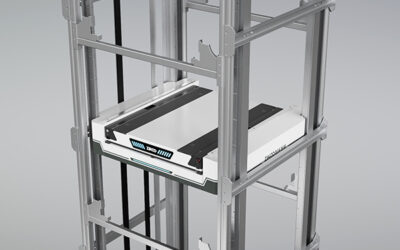
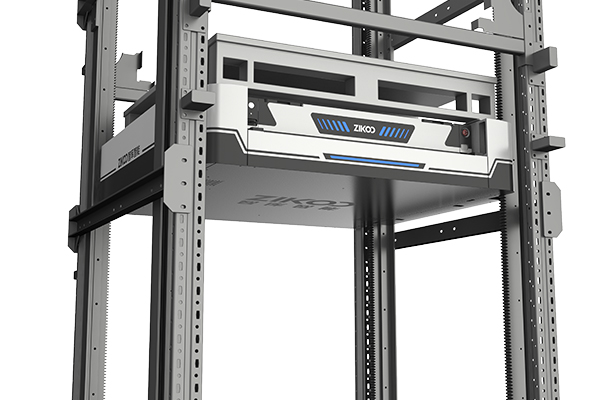
Throughput improvement is the metric where hardware specs and software scheduling intersect hardest. The R-bot can travel at 1.2 m/s with a 1,200 kg load, which means a single shuttle can complete a retrieval from a 40-meter-deep lane in under 40 seconds if the WCS dispatches it without queuing. But in a multi-shuttle fleet, that cycle time widens when the task is “retrieve 15 pallets from 12 different lanes” because the path-optimization layer has to decide which shuttle takes which lane and in what sequence to avoid blocking. We target an average of 25 to 30 pallet moves per shuttle per hour in a dense storage block. For a fleet of 8 shuttles, that translates to 200 to 240 pallets per hour, which is roughly three times what a team of reach trucks could handle in the same footprint. Adding an H-bot vertical bidirectional shuttle turns the system into a six-way configuration, so the shuttle never leaves its level, and vertical transfers happen at 0.5 m/s loaded. That separation of horizontal and vertical movement is what pushes the system from “better than manual” to “three shifts of 24/7 operation with no fatigue loss.” Without it, the same R-bot shuttles would also handle vertical lifts, and a 12-meter rack would add 24 seconds per cycle, cutting fleet throughput by almost half.
The vertical transfer decision is what separates a four-way system from a six-way shuttle architecture, and it has a direct impact on the number of shuttles you buy. <Six-Way Shuttle: The Ultimate Warehousing Solution for Cost Reduction and Efficiency> explains the shuttle count calculation we use when the lift bottleneck appears—often the difference between needing 6 shuttles versus 10 for the same throughput target.
Where Does the Labor Saving Come From?
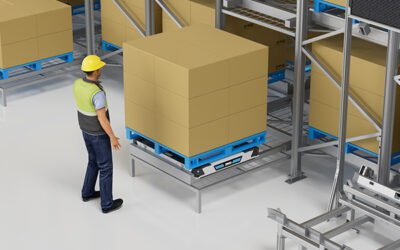
Walkie-rider and reach-truck operators spend less than half their shift actually moving pallets; the rest is travel, documentation, and searching. A four-way shuttle system removes the travel completely and assigns one operator to an inbound/outbound station where the pallet appears on a conveyor. In a facility we supported that handled 400 pallets per day, the system replaced six forklift shifts with two conveyor operators per shift, and outbound accuracy moved from 97% to over 99.5% because the WMS confirmed every pick at the shuttle’s sensor point. That 50% labor reduction is typical, but the larger gain is in consistency. A shuttle does not take breaks, does not slow down at hour 7, and does not place pallets in the wrong lane. The operational cost shift is from variable labor to a known maintenance schedule—roughly 2% to 3% of capital cost annually for shuttle battery replacements and rail wear.
Why the Full Efficiency Gain Requires the Software Stack
The shuttle is a dumb vehicle until the WCS gives it a task. The R-bot itself has no awareness of inventory age, FIFO rotation, or dock scheduling, so the real efficiency multiplier lives in the PTP Smart Warehouse Software that manages slotting algorithms, wave planning, and real-time task assignment. When a warehouse operates with 5,000 SKUs and heavy seasonality, the difference between “everything stored in the first available lane” and “ABC velocity slotting with dynamic relocation” is a 20% to 30% drop in shuttle travel distance per pallet moved. We configure the WCS to re-slot during idle time, moving slow SKUs deeper and pulling fast-movers forward, which the shuttle executes without human intervention. Without that layer, the shuttle system still moves pallets and fills space, but it never reaches the advertised efficiency numbers because it spends too much time retrieving pallets from deep lanes that should have been staged near the aisles. The efficiency improvement is a system outcome, not a shuttle specification, and the buyer who evaluates hardware without a software demo is measuring half the equation.
Common Questions About Four-Way Shuttle System Performance
Can I achieve 60% space savings even in a warehouse with low ceilings?
That top-end figure assumes you have vertical room to exploit. In a facility with a 7-meter clear height, dense storage racking will still increase pallet positions by 30% to 40% simply by eliminating aisles, but the ceiling is the hard cap. The R-bot’s 125 mm body height helps because it reduces the lost height per beam level, but the pallet height plus the rack beam profile still determines how many levels fit. Share your warehouse dimensions and pallet type with us, and we can model the exact density gain before you commit to a layout.
Is the throughput number affected if my pallets vary widely in weight?
Yes, and the impact is on acceleration and battery life, not top speed. The R-bot adjusts its acceleration curve based on load weight, so a 200 kg pallet accelerates faster than a 1,200 kg one, and that saves seconds per cycle on short travel distances. Over a day, mixed-weight pallets will average slightly lower throughput than a uniform fleet of max-weight loads, because the scheduler cannot predict every cycle time equally. If your mix is extreme, we plan the shuttle count for the heaviest sustained load to avoid a bottleneck.
Do efficiency gains hold up in a freezer environment?
Cold chain operation adds battery conditioning and entry/exit thermal loss, so the same shuttle that runs 8 hours at ambient might run 6 to 7 hours at -25°C with the low-temperature lithium battery option. The mechanical movement is unaffected, but the duty cycle shortens. We offset that with opportunity charging during shift changes, so the daily throughput lands within 10% of ambient spec. The dense storage benefit in a freezer is actually greater because the energy cost per pallet stored falls sharply with the reduced air volume.
Can the system be expanded without a full redesign?
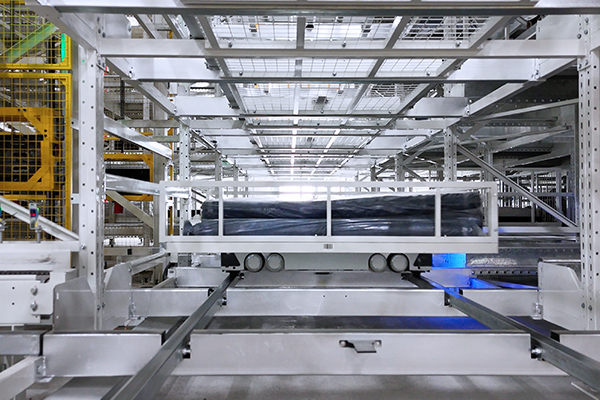
The rack structure is modular, so adding bays and shuttles is a mechanical expansion, but the software must be planned for it from the start. We configure the WCS with expansion lanes pre-mapped so the pathing algorithm does not require re-tuning when the rack grows. If you know your 5-year growth in pallet positions, we build the software capacity to match, even if the physical hardware rolls out in phases. A well-planned software foundation is what keeps expansion from degrading throughput.
Does the system maintain efficiency when order profiles shift from full pallet to split-case?
A four-way shuttle system is optimized for full-pallet moves, but when your outbound shifts to mixed-case picking, you either add a goods-to-person station or pair the shuttle system with an AMR layer for split-case operations. In our design, the shuttle can deliver pallets to a picking mezzanine where AMRs handle the piece-level tasks, and the WMS orchestrates both. That hybrid setup can handle 10,000 SKUs without losing the density advantage. If your business model is trending toward e-commerce fulfillment, plan the mezzanine space now; share your order profile and we will confirm the exact throughput intersection.
If you’re interested, check out these related articles:
Six-Way Shuttle Empowers 3PL Providers to Build Next-Generation Smart Logistics Hubs
Standardization Empowers Global Delivery: Zikoo Robotics Six-Way Shuttle Expands Overseas