Returns processing in retail warehouses is usually the last flow to get designed and the first to break when volume rises. The cause is structural rather than a matter of effort. An outbound warehouse is built to move known goods in one direction, while a returned unit arrives without a destination, in an unknown condition, and often in a unit type nobody planned for. Streamlining returns therefore starts with a decision model and a defined buffer, not with a faster conveyor. This guide sets out the flow, the disposition rules, and the measurements that show which parts are worth automating and which will stay manual for good reason.
Why Returns Break a Warehouse Built for Outbound Flow
Every outbound design decision assumes a known destination. The pallet is built for a store or an order, the location is chosen by velocity, the pick face holds the ten or twenty units that move fastest, and the conveyor runs in one direction. Returns violate all four assumptions at once. The unit arrives without a customer order behind it, its condition is unverified, its SKU may already be discontinued, and the volume is decided by the shopper rather than by the planner.
The practical consequences show up in three places. First, dock contention: returns arrive at receiving doors that are already scheduled for inbound purchase orders, so either the trailer waits or new stock gets delayed. Second, storage contention: an undecided unit occupies a location but is not sellable, so it quietly reduces the capacity available for stock that could ship. Third, data contention: the unit exists physically but has no clean inventory state, so planners cannot tell whether it is available, quarantined, or already promised to a resale channel.
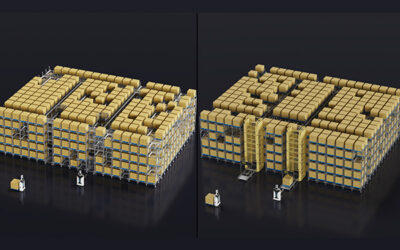
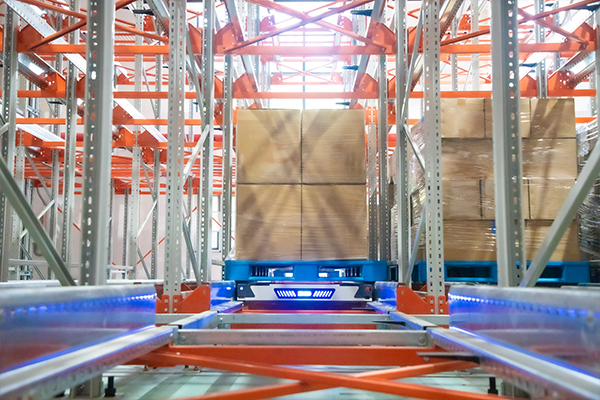
A high-bay installation designed around production output, such as the manufacturing smart warehouse case shown below, makes the point visible. Every location and every travel path in that building assumes goods enter in a predictable form and leave in one direction.
Returns also peak differently from outbound. Holiday and promotion cycles produce a wave that arrives two to six weeks after the outbound peak, which means the returns area is stressed exactly when the warehouse is trying to reset its racks. Sizing that area on an annual average guarantees a queue.
Where the Handling Time Actually Goes
Most returns improvement projects start by trying to move goods faster. In practice, movement is rarely the constraint. A returned unit goes through four stages: receipt and identification, inspection and grading, the disposition decision, and execution of that decision. Only the last stage is a transport problem.
The stage that consumes the most calendar time is usually the decision wait. A unit that has been graded but not assigned a path sits in a buffer, and that wait is invisible in labour reporting because nobody is working on it. The cost still appears, as consumed locations, as double handling when the unit is finally moved, and as value lost while the resale window closes.
There is a second, less obvious cost in the number of touches. A unit that is received, put away undecided, retrieved for inspection, put away again, then picked for repacking has been handled five times. A unit inspected at the dock and routed straight to a disposition lane has been handled twice. The difference is not speed of travel; it is whether the decision happens before or after storage.
This is why pre-sorting at receipt is worth the effort when the data supports it. If the return authorization record already identifies the SKU, the order, and the reason code, the warehouse can route by category at the dock and skip an intermediate put-away. If that data is missing or wrong, pre-sorting creates misroutes that cost more than the touch it saved.
Four Disposition Paths and the Checks Each One Needs
A returns process is only as good as its path definitions. Each path has a release condition, and skipping that condition is where recovery value leaks out.
| Disposition path | What must be true before the unit is released | What goes wrong when it is skipped |
|---|---|---|
| Resell as new | Condition grade, accessories and packaging meet the listing standard, and order and warranty status are clean | The buyer receives a unit that fails the listing promise, and the return repeats |
| Repack or refurbish | Work content, parts list and a functional check are defined before relabelling | Labour is charged to the wrong SKU and recovery value is overstated |
| Return to vendor | Contract terms, claim window and freight cost are confirmed before the unit is set aside | Goods sit past the claim window and become scrap |
| Liquidate or bulk sell | Grade, quantity and lot composition are agreed with the buyer | The buyer re-sorts the lot and discounts the price accordingly |
| Recycle or destroy | Serial or data removal is complete and the disposal record is filed | Serialised stock reappears in inventory or on the secondary market |
Two rules make this table work in daily operation. The grade code used at inspection must be the same code the sales channel reads, otherwise a unit graded for resale arrives at a listing process that cannot interpret the grade. And each path needs a named owner, because a path without an owner becomes the place where difficult units are parked.
Apparel returns show why the paths cannot be merged. A garment returned for fit is a resale candidate after inspection, a garment returned damaged is a liquidation candidate, and a garment returned after a season is a vendor claim or a markdown. Treating all three as one returns pile forces the sorter to make a commercial decision that should have been written into a rule.
Designing the Returns Flow Step by Step
The sequence below is the minimum for a retail warehouse that handles more than a few pallets of returns a day. Each step produces something the next step depends on.
- Separate returns receipt from purchase order receipt. Use a different dock window, a different door, or at minimum a different time slot. This protects inbound service levels and gives returns a queue that can be measured.
- Identify at unit level at the dock. Scan the return label, confirm the order and SKU, and capture the customer reason code. Anything that cannot be identified goes to a research queue with a timer, not into general storage.
- Grade at a fixed inspection point with a fixed code set. Inspection benches need light, a surface, a terminal and a camera for damage evidence. Grading anywhere else produces inconsistent codes.
- Decide by rule, not by person. The rule reads grade, value band, demand signal and warranty status and returns a path. A person should handle exceptions, not the routine case.
- Move to a disposition buffer segmented by path. Buffer lanes are organised by destination (resale, repack, vendor, liquidation, scrap) rather than by arrival date, so consolidation and outbound loading stay simple.
- Post the disposition to inventory immediately. Resale stock should become available the moment the grade is posted, not when someone finishes a shift report.
Step five is where storage design begins to matter. Graded stock waiting for a resale or liquidation cycle behaves like normal palletised inventory except that its dwell time is uncertain, so it is a poor fit for the pick face.
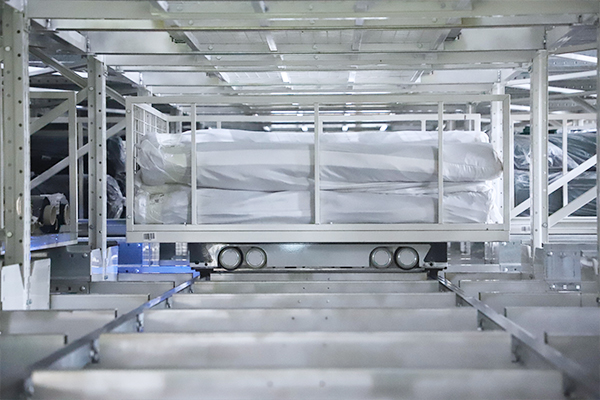
A graded pallet still needs a location, and dense storage is often the cheapest way to hold that stock without consuming the pick face. <Six-Way Shuttle Powers Dense Storage: Breaking Space Limitations> covers dense pallet storage as a way to work around space limits.
Which Returns Tasks Automation Can Carry and Which It Cannot
Automation pays where the handling unit is standardised and the decision has already been made. It rarely pays where the task is judgement on an irregular unit. The distinction matters because returns projects fail when a transport solution is asked to solve a grading problem.
| Task | Fit for automation | Condition that decides it |
|---|---|---|
| Receiving scan and identification | Partial | Unit-level labels and a working order lookup at the dock |
| Transport from dock to buffer | High | Load is standardised on a tote or pallet |
| Dense storage of graded stock | High | Grade is assigned and the unit has a system state |
| Sortation to disposition lanes | Medium | Lanes built around a fixed code set, not ad hoc categories |
| Condition grading of single items | Low | Damage, wear and fraud calls need a person and a photograph |
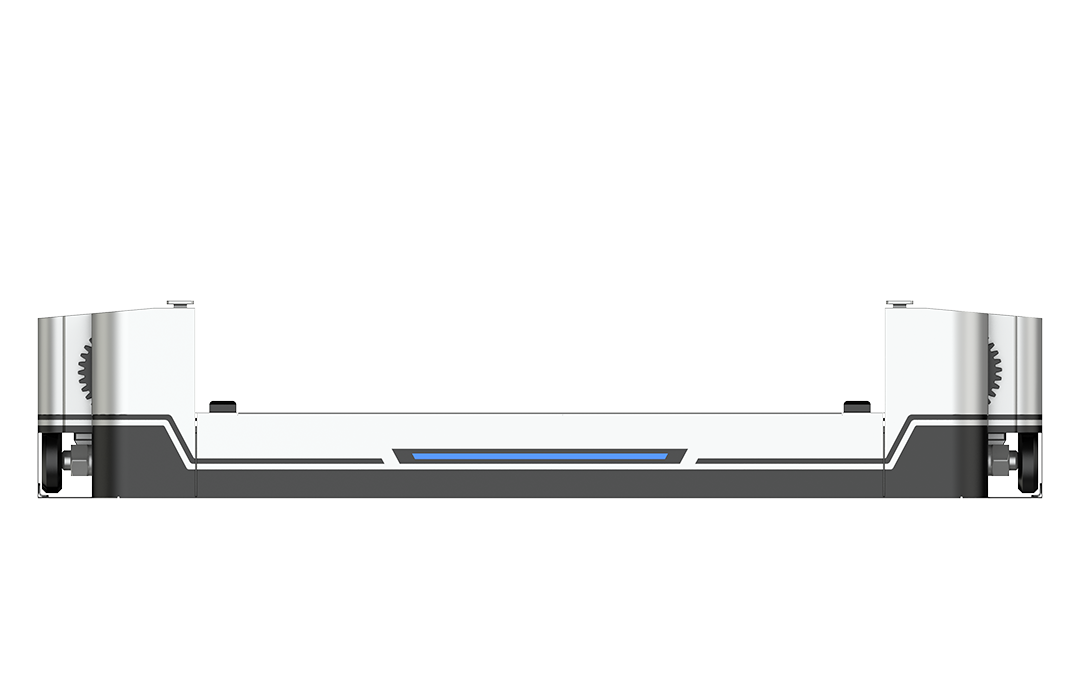
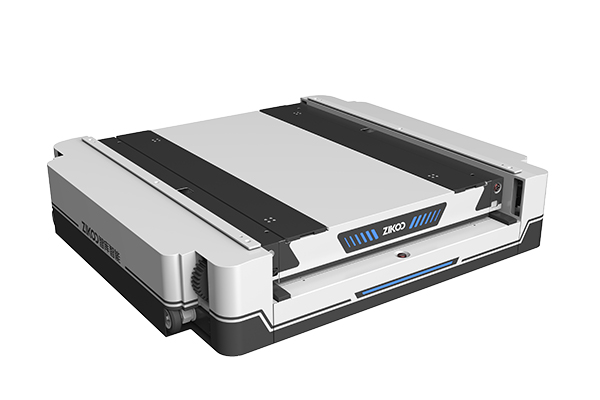
For graded stock that is palletised, dense pallet automation is the part of returns that most clearly benefits. A four-way shuttle moves pallets in two horizontal axes inside the rack, so the aisle is replaced by racking and the storage density rises without adding building area. The Zikoo R-bot Four-way Shuttle, for example, has a 125 mm body height and a rated load of up to 1.5 t on its heavy-duty models, and can be paired with the H-bot vertical shuttle to add a vertical transport axis. That combination produces a retrieval path in three dimensions and is the reason dense buffers can serve both resale picking and liquidation consolidation from the same block.
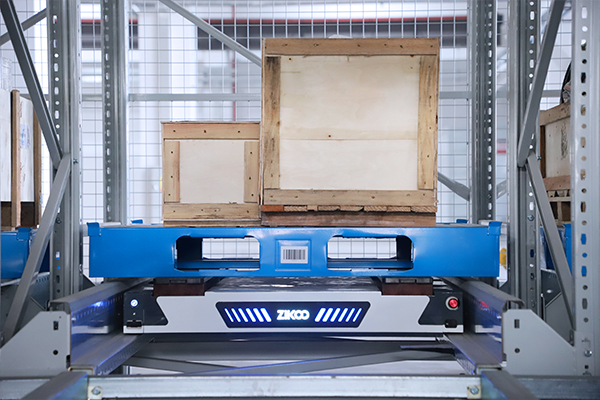
The limit is worth stating plainly. A shuttle system moves a load; it does not decide whether a returned item is sellable. If returns arrive as loose single units, the automation belongs downstream of inspection, at the tote or pallet level, after a person has graded the item and the system has assigned a path.
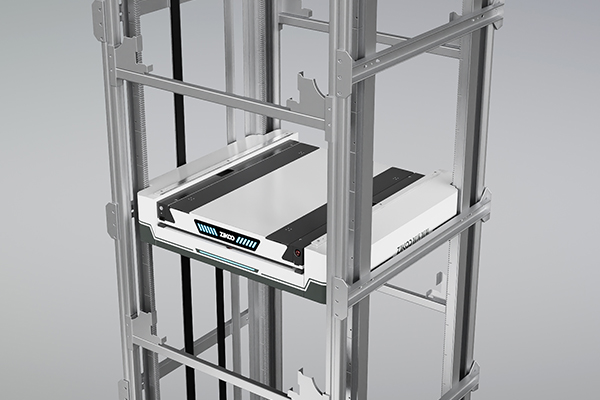
Shuttle clusters also change the buffer economics. Because retrieval is on demand, the buffer does not need to be arranged by arrival sequence, and a liquidation lot can be built over several days without occupying floor space in the outbound zone.
Buffer sizing is really a density question, since every location given to an undecided unit is a location unavailable for sellable stock. <Smart Storage Revolution: Comprehensive Overview of Four-Way Shuttle Systems for Automatic 3D Warehouses> covers four-way shuttle systems for automatic 3D warehouses.
How the Software Decides Before Any Robot Moves
Returns expose a gap that outbound flows can hide: a unit that is physically present but not yet sellable. If the warehouse management system only understands “in stock” and “shipped”, the returns team ends up tracking quarantined units on spreadsheets, and the automation layer has nothing to execute.
The working arrangement separates responsibilities. The warehouse management layer owns the identity and state of the unit, including a hold state with a reason code, an owner, and a timestamp. The execution layer turns the disposition rule into tasks for people and equipment. The control layer sequences the equipment, and the robot control layer handles the fleet. Returns need all four to agree on one thing: what the unit is allowed to do next.
Three design details decide whether this works in practice. First, the hold state must have a timer, so a unit that has waited too long raises an exception instead of quietly ageing. Second, the grade code set must be short enough for a person to apply consistently and rich enough for the sales channel to list against. Five to eight grades is usually workable; thirty is not. Third, relabelling at repack must trigger a new label and a new inventory identity where the original serial or barcode no longer applies, otherwise the same unit can be counted twice.
Disposition rules only pay back when the system can hold a unit in an in-between state and then act on it. <PTP Intelligent Warehouse Software Empowers Enterprises for Smart Upgrades> covers the software layer used to upgrade warehouse operations.
What to Measure Before You Buy Anything
Automation decisions for returns should follow measurement, not the other way round. Four weeks of ordinary data usually settles the argument about where the constraint sits.
Five numbers to record for four weeks
- Dock-to-disposition time, measured as calendar hours from receipt scan to a posted disposition, split by path.
- Touches per returned unit, counted as any pick, place or scan event that moves the unit.
- First-touch resolution rate, the share of units that receive a final path at the inspection bench.
- Buffer occupancy, the number of storage locations held by units with no disposition.
- Recovery rate by grade, the realised value per grade band compared with the original sale price.
If dock-to-disposition time is long while inspection labour is low, the constraint is the decision, and buying equipment will not fix it. If buffer occupancy keeps rising while inspection output is steady, the constraint is space or retrieval, and storage density becomes the useful investment.
Mistakes that survive automation
Sizing the returns area on average volume rather than peak week is the most common. Using the outbound pick face for undecided stock is the most expensive, because it corrupts pick accuracy as well as capacity. Grading after put-away instead of before doubles handling. Leaving liquidation without an owner turns it into a scrap bin with extra steps. And automating before the disposition rule set is stable locks a temporary process into steel.
A buffer estimate can be built without any vendor input. Take units received per day, multiply by the target days to disposition, and divide by the units that fit in one location. Run the same calculation for a peak week. The gap between the two numbers is the buffer you actually need to design for.
Sizing Your Returns Buffer With Real Numbers
If you are sizing a returns buffer or deciding whether graded stock belongs in dense storage, send the monthly return volume in units and in pallets, the unit types you handle (single item, carton, pallet), your target days from receipt to disposition, and the space currently occupied by undecided stock. Zikoo can review those figures against the pallet handling and software options and identify which part of the flow is the real constraint. Email info@zikoo-int.com or call (+86)-19941778955.
FAQ
Should returns be processed in the same building as outbound?
Usually yes, but not in the same flow. The same stock, systems and people are involved, so a separate building adds a transport leg and a second inventory record. What returns need is their own receipt window and their own buffer, not their own site. At low volume, a walled-off returns cell with a dedicated door and inspection bench is normally enough. Higher volume justifies a separate dock window and a defined lane structure, because dock contention is often the first visible symptom of a returns flow that was never designed.
How much space should a retail warehouse reserve for returns?
Size on peak week plus decision latency, not on an annual average. A workable estimate is units received per day multiplied by target days to disposition, divided by the units that fit in one location. Repeat the calculation for your busiest week and design the buffer for that figure. Then check whether the buffer is actually the constraint: if units leave the buffer quickly but the queue at inspection is long, more locations will not help, and the investment belongs in inspection capacity or in a faster disposition rule.
Can a four-way shuttle system handle returned goods?
Yes, when the returns are palletised or toted and already graded. A shuttle system moves a standard load between rack positions and cannot assess condition, so it belongs downstream of inspection. The gain is a dense buffer that does not consume the pick face, with retrieval on demand for resale, vendor claim or liquidation. If returns arrive as loose single items, the shuttle is the wrong end of the process; an inspection bench and a tote conveyor come first, and palletisation follows once grading is complete.
What is the first step to streamline returns processing?
Define the disposition code set and the rule that maps a grade to a path, before buying any equipment. Most slow returns are waiting for a decision rather than for transport, and a shuttle or conveyor installed ahead of that rule simply moves the queue to a more expensive location. Once the rule exists, record dock-to-disposition time for four weeks. Those figures show whether the constraint is space, labour or the decision itself, and they give any automation proposal a baseline to be judged against.
Why do returns block outbound orders?
Because they compete for the same dock doors, the same labour and often the same storage locations. When an undecided unit is placed in the pick face, a picker either works around it or picks it by mistake, and both outcomes damage service level. Separating the returns buffer and scheduling a returns dock window protects outbound flow without requiring a separate facility. The measurement that proves the problem is buffer occupancy in sellable locations, which is easy to count and hard to argue with.
If you’re interested, check out these related articles:
PTP Intelligent Warehousing Platform: Building a Flexible and Smart Logistics Ecosystem
Six-Way Shuttle: The Dual-Engine Solution for High-D