Smart warehouse automation for manufacturing plants rarely fails because the robots are slow. It fails because the storage system was designed around a distribution centre’s order profile while the plant runs on a production schedule. A factory warehouse has three jobs with three different rhythms: deliver raw material to the line when the schedule calls for it, hold work in progress between processes, and ship finished goods against customer dates that move. Automation that serves one rhythm while leaving the other two manual tends to relocate the bottleneck rather than remove it. The equipment decision is the last one to make, not the first.
Why a Plant Warehouse Is Not a Distribution Center
A distribution centre and a factory warehouse both hold pallets, and that is close to where the similarity ends. In a distribution centre the dominant cost is order fulfilment labour and the dominant risk is a late dispatch. In a plant the dominant cost is a stopped line and the dominant risk is a component sitting somewhere in the building when the schedule reaches it.
That asymmetry should drive the design. A line that stops because one pallet of raw material is on the wrong side of the building loses more value than the space that pallet occupies. Storage density matters, but it is a secondary objective next to replenishment latency and system availability.
The two operations also differ in what arrives. A distribution centre receives unpredictable inbound and picks against order profiles that shift week to week. A plant receives against a production plan, holds work in progress that no distribution centre would recognise, and dispatches finished goods against customer dates. Automating only the finished goods warehouse leaves raw material and line-side flows manual, and those are usually where the stoppages originate.
A useful first test takes two weeks. Record every occasion the line waited for material, with the duration and the stated cause. If the waits cluster at shift start and at changeover, the governing problem is replenishment timing rather than storage capacity, and a larger automated store will not fix it.
Mapping Material Flow Before Choosing Equipment
Equipment selection is the point where many projects stop being about the plant. Work through five steps first.
- List every material state and who owns it. Raw material, purchased components, work in progress, packaging, consumables, spare parts, returns and rejects behave differently and rarely belong in the same storage zone.
- Measure flow rather than volume. Pallets per hour by shift, with the daily and seasonal variation, describe the load far better than annual tonnage. The peak to average ratio usually shapes fleet size more than total throughput.
- Write down the timing constraints. The replenishment window the line can tolerate, the frequency of changeovers, and the dispatch cut-off all become requirements the design must meet.
- Walk the route and count the transfers. Every transfer between vehicle types is a delay and a place where pallets wait.
- Identify the constraint before the equipment class. If the constraint is vertical movement or line-side delivery, storage density alone is unlikely to solve it.
Transport and storage are usually mixed together in a project brief and should not be. Moving a pallet from the dock to a buffer, and holding that pallet in dense storage for a week, are different problems with different equipment. Projects that automate the second and leave the first manual often find the bottleneck has simply moved to the aisle outside the store.
Which Storage Architecture Fits Each Material Profile
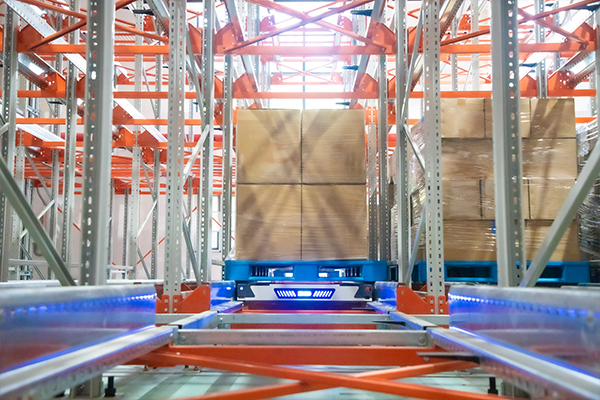
A manufacturing site rarely needs one architecture. It needs a decision for each material profile, made on access frequency, load type and environment. The table below is a starting point, not a specification.
| Material profile | Storage approach to evaluate | What it solves | What it does not establish |
|---|---|---|---|
| High-volume, low-variety raw material | Dense four-way shuttle racking or high-bay AS/RS | Removes pick aisles from the footprint and decouples inbound from consumption | Does not shorten line-side replenishment on its own |
| High-SKU, small-batch components | Narrow-aisle omnidirectional stacker robot or pallet-to-person picking | Access to many pallet positions in aisles around 2 m wide | Does not replace slotting and pick logic |
| Heavy or oversized loads | Heavy-duty shuttle models sized to the actual load | Handles pallet weights beyond the standard 1.2 t class | A rated load does not confirm rack, floor or building suitability |
| Temperature-controlled or special environment | Cold-rated vehicles, batteries and charging | Keeps storage at the required temperature with less manual entry | A cold rating does not prove throughput at your duty cycle |
| Finished goods with fixed dispatch windows | Shuttle storage plus a staging buffer before the dock | Separates dispatch peaks from production peaks | Does not correct production scheduling |
Two equipment classes dominate dense pallet storage in plants, and the choice between them usually turns on building height and how throughput has to scale rather than on purchase price. A stacker crane AS/RS dedicates a crane to an aisle and reaches high with a stable structure; a four-way shuttle shares vehicles across a storage field and adds capacity in increments as the plant grows.
The trade-off between a crane and a shared-vehicle system turns on building height, throughput scaling and how much redundancy the plant needs. <Stacker Crane vs Four-Way Shuttle: Which Fits Your AS/RS Warehouse Best> covers how the two architectures compare for an AS/RS warehouse.
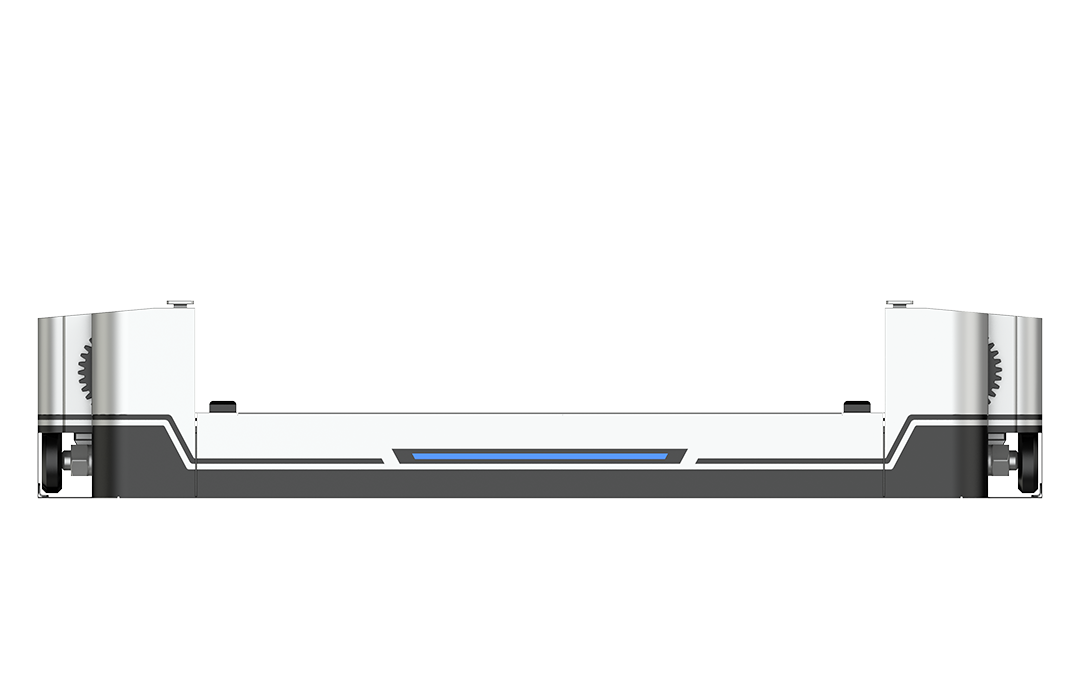
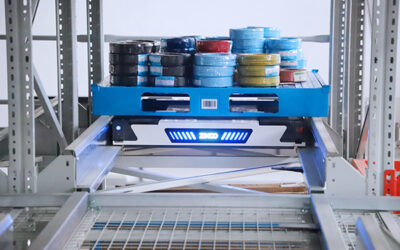
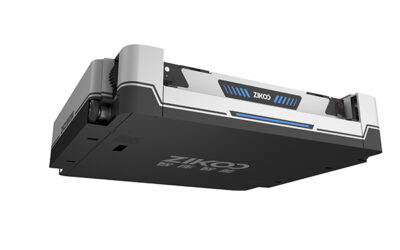
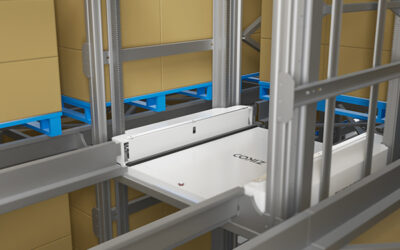
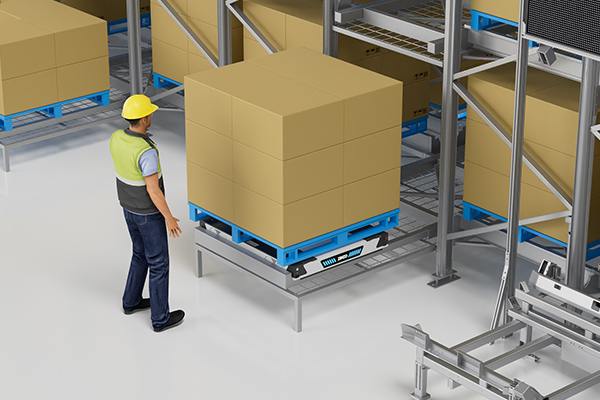
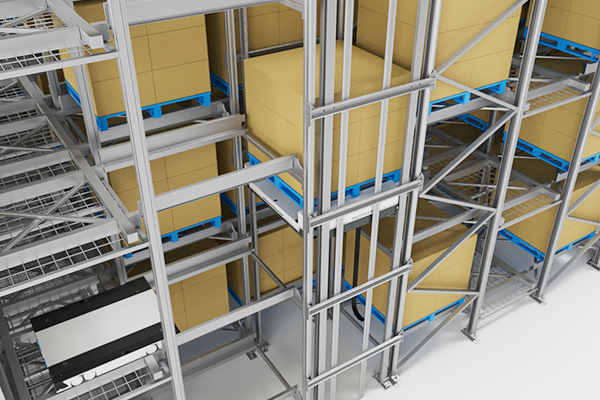
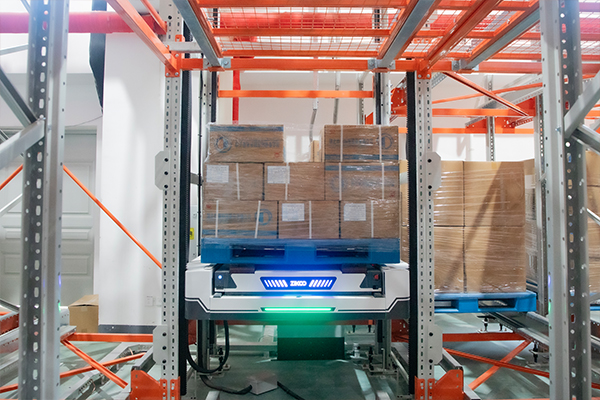
A four-way shuttle works within a storage level. Vertical movement needs a separate lift, which is why a dense system is better described as two resources than as one machine. In Zikoo’s pallet-to-person configuration, the R-bot four-way shuttle covers 1.2 t to 2 t depending on model and travels at 1.2 m/s loaded, while the H-bot vertical shuttle moves pallets between levels at 0.5 m/s loaded with ±1 mm positioning accuracy. Treat those as component specifications. The throughput of a plant system comes from how many vehicles and lifts serve how many positions, not from the top speed of either.
Sizing Throughput to Production Rhythm, Not to the Peak
A plant system is sized on consumption, not on annual tonnage. Convert the line schedule into pallet movements per hour for each flow: inbound to the raw material store, raw material to line side, work in progress between processes, and finished goods to dispatch. Those four numbers rarely look alike, and averaging them hides the flow that actually constrains the design.
The buffer between production and storage has to cover variation during replenishment lead time, not average demand. A first-order estimate is the difference between peak consumption rate and replenishment rate, multiplied by the replenishment lead time. That estimate ignores discrete pallet quantities, so check it against the task list the control system will generate on a normal shift.
Rated vehicle speed is a single-pallet terminal speed on a straight run. System throughput depends on vehicle count, travel distance distribution, lift availability, transfer time and task sequencing. A specification sheet that lists only speed has not answered the question the plant is asking.
Availability usually decides whether the design works on its worst day. Vertical lift count is a common single point of failure, and the charging strategy determines how many vehicles are genuinely available during the third shift. A fleet sized on full availability across all three shifts will fall short when batteries are charging and pallets are not where the plan expected them.
Agree the measurement basis before signing: shift pattern, material mix, replenishment latency and the test window. A throughput figure without those conditions cannot be compared with another supplier’s figure, because the two numbers describe different systems.
How WMS, WES, WCS and RCS Keep Production and Storage in Step
Hardware executes; software decides what is worth executing. In a plant the software chain has to connect a production order to a replenishment task and confirm the result back to the plan, or the automated zone and the manual zone will drift apart within a month.
Any discussion of shuttle speed or lift capacity assumes a control layer that keeps both busy. Hardware performance in a plant is largely an orchestration outcome, since the same fleet produces different hourly rates depending on task batching, priority rules and how well travel is sequenced.
The same vehicles produce different results depending on how work is sequenced across them. <Software-Driven Hardware: Six-Way Shuttle Maximizes Warehouse Efficiency> covers how control logic changes what shuttle hardware delivers in a warehouse.
| Layer | Question it answers | Data it usually owns |
|---|---|---|
| WMS | Where is the stock and what does it belong to | Location, batch, ownership, inventory status |
| WES | What work should happen next | Task priority, call-off sequence, workload balance |
| WCS | Which equipment executes the movement and how | Routes, lift and transfer commands, interlocks, equipment state |
| RCS | Which robot goes where | Fleet traffic, charging, deadlock avoidance, vehicle allocation |
The loop that matters in a plant runs from the ERP or MES production order to a material call-off at the line, into a replenishment task, through equipment execution, and back as a confirmation that closes the order. Where that loop breaks, operators compensate with phone calls and manual staging, and measured system performance drops without any equipment fault being logged.
Upgrade projects often depend on the software layer as much as on the vehicles underneath it. <PTP Intelligent Warehouse Software Empowers Enterprises for Smart Upgrades> covers the platform side of a smart warehouse upgrade.
Ask any supplier to describe the message path from production order to replenishment confirmation, including what happens when the line changes the schedule mid-shift. A supplier who can walk through that path, with the exception handling, has built the interface before.
Retrofitting an Operating Plant Without Stopping the Line
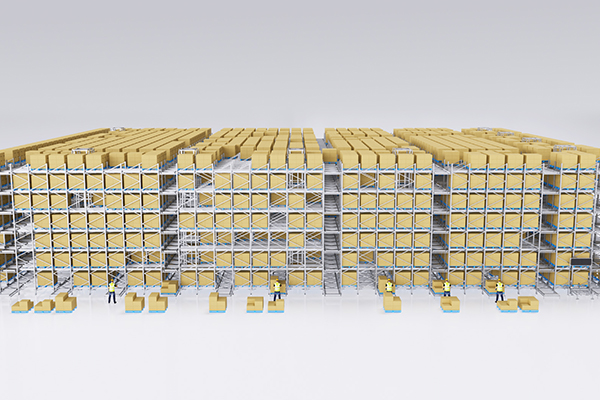
Most plants automate an existing building rather than a new one, and the real constraint is the production calendar rather than the technology.
A retrofit starts with measurement: clear height under the lowest obstruction, floor flatness and slab capacity, column grid, sprinkler and fire protection coverage, power availability, and network coverage where vehicles will roam. Changes to rack height usually trigger a review of fire protection, and narrowed aisles change egress routes.
Work is then staged by zone so that each zone is commissioned while the others keep running. Racking, vehicles and network can be installed and tested beside an operating line. The cutover of material flow cannot, so schedule it into a planned shutdown with a parallel run on the old route and a rollback plan.
The riskiest period is not installation. It is the fortnight after cutover, when buffers are at their thinnest and operators are still learning the call-off process. Keep a manual staging area available for that period and agree in advance when it will be used.
Define the acceptance test before installation: a defined shift pattern, a material mix, a replenishment latency and a measurement window. Then measure availability, task completion and error rate against those conditions rather than against a promise.
What to Collect Before Requesting a Design
A design response is only as good as the data behind it. Six fields are enough to start a serious conversation, and their absence explains most of the gap between two quotations for the same plant.
| Field | What to record | Why it changes the design |
|---|---|---|
| Pallet and load specification | Dimensions, weight, overhang, load stability, damage rate | Drives vehicle model, rack beam and lift capacity |
| Material states and SKU count | Velocity classes, batch sizes, number of pallet positions per state | Sets the storage architecture and slotting rules |
| Flow rate and variance | Pallets in and out per hour by shift, peak factor | Sizes fleet, buffer and vertical transport count |
| Timing constraints | Replenishment window, changeover frequency, dispatch cut-off | Defines task priority rules and buffer depth |
| Building constraints | Clear height, floor loading, column grid, temperature | Limits rack height, aisle width and equipment class |
| Systems and data | ERP and MES interfaces, barcode or RFID, network coverage | Determines interface scope and the acceptance test |
A layout, a fleet count, an interface list and the calculation behind the throughput figure are the parts of a proposal worth reading first. A price without those four elements cannot be compared with another price.
Send the Flow Data and Get a Layout Built Around It
A plant design that starts from material flow looks different from one that starts from a catalogue, and the difference shows up in the first week of operation. If you are planning a manufacturing warehouse project, send the pallet and load specification, the material states and their flow rates by shift, the replenishment window the line can tolerate, the building constraints including clear height and floor loading, and the ERP or MES interfaces the system has to talk to. Zikoo’s engineering team reviews those inputs against the R-bot, H-bot and U-bot equipment set and the PTP software stack, and returns a layout with its assumptions stated rather than buried.
Email info@zikoo-int.com or call (+86)-19941778955 to start that review.
FAQ
Does a manufacturing plant need a full AS/RS or can it start with one area?
Most plants are better served by starting with the area that carries the current constraint. If line-side waits dominate the log, begin with the raw material store and its replenishment cycle. If late dispatch is the problem, begin with dispatch staging and finished goods. Phasing works when each phase closes a loop, including the software loop to the production plan; a partial system without that interface tends to run as an island and operators route around it.
How do you automate a plant warehouse without stopping production?
Separate installation from cutover. Racking, vehicles, charging and network can be installed and commissioned beside a running line over weeks. Switching the material flow is a different activity, scheduled into a planned shutdown with a parallel run on the old route and a documented rollback. Plan a manual staging area for the first weeks after cutover, when buffers are thinnest and the new call-off habits are still forming.
What is the difference between line-side replenishment and warehouse picking?
Picking fulfils an order drawn from a mix of stock, and its efficiency depends on batching and travel. Line-side replenishment delivers a defined material to a defined station inside a time window the line can tolerate, and its efficiency depends on hitting the window. Treating replenishment as a small picking order is a common reason material arrives late, because the control system optimises the wrong objective.
Can four-way shuttle systems work in cold or special environments?
Cold storage needs components rated for the temperature, including batteries and the charging interface, and duty cycles shorten because charging and travel are affected by the environment. Some plants also need contamination control, which in battery or electronics production can mean metal-free vehicle design and non-metallic structural components. Ask for the tested temperature range and the duty cycle behind it, not only a rating on a data sheet.
How long does payback take on plant warehouse automation?
There is no general figure, and any single number offered for your plant should be treated as a hypothesis. Build the case from your own measurements: avoided stoppage minutes, labour hours in transport and staging, space released or avoided, inventory carried in buffers, and the ramp period before the system reaches design performance. Suppliers can price equipment and installation. Only the plant can price a stopped line, and that term usually dominates the result.
If you’re interested, check out these related articles:
Six-Way Shuttle: Pioneering the Future of Smart Warehousing
Smart Warehousing Starts Here: Cost-Effective Four-Way Shuttle Systems
Six-Way Shuttle Unlocks the Era of True 3D Intelligent Warehousing
Reshaping Warehouse Value: Six-Way Shuttle Leads the Digital Transformation