An automated storage and retrieval system (ASRS or AS/RS) is a computer-controlled material handling architecture that stores, retrieves, and moves inventory between storage locations and operator-facing stations without requiring full-aisle walking or manual putaway. In most modern warehouses, the ASRS works as the physical execution layer beneath a warehouse management system (WMS) and warehouse control system (WCS), receiving mission commands, assigning storage locations, and reporting inventory movement back to the execution software.
The system is not a single machine. It is a coordinated arrangement of racks, automated load-handling equipment, transfer devices, safety systems, and control software. Depending on the load type — pallet, tote, carton, or tray — ASRS configurations vary significantly in how they use height, aisle space, and labor.

What Makes an ASRS Different from Conventional Storage?
A conventional pallet rack warehouse depends on forklifts or reach trucks traveling into aisles. Operators locate, lift, and carry each load to a staging lane. This works well in low-throughput operations, but the warehouse must assign wide aisles for truck turning, maintain lift access at every pick face, and continuously coordinate people and equipment.
An ASRS removes the person from the storage aisle. Loads are placed by automated equipment into high-density rack positions, often using fewer access aisles because the equipment operates on rails or within guided channels. Retrieval becomes deterministic rather than search-based: the control system knows the exact storage coordinate, the load condition, and the retrieval sequence before the machine moves.
This shift changes the economics in four ways:
- More cubic meters become productive because aisle width no longer follows forklift turning geometry.
- Labor is redeployed from travel and search to value-added stations.
- Inventory accuracy improves because physical moves are recorded by exception, not by manual data entry.
- Throughput becomes more predictable because retrieval missions follow defined cycle paths.
Safety and equipment requirements for rail-dependent storage equipment are covered by EN 528 [1]. Performance comparisons between systems should use consistent terminology such as travel speed, cycle time, and throughput as defined in FEM 9.851 [2].
Core Components of an ASRS
An ASRS usually includes five layers that must be engineered together. Each layer can be supplied by one integrator or assembled from multiple vendors, but the interfaces must be specified early.
| Component | Primary Function |
|---|---|
| Storage rack structure | Defines load positions, load-bearing design, and seismic or environmental requirements |
| Automated load-handling machine | Moves loads horizontally and vertically to storage and retrieval coordinates |
| Transfer equipment | Links the automated machine to inbound, outbound, and picking stations |
| Control software | Decides which machine serves which mission and in what sequence |
| Safety and access system | Protects people, prevents collisions, and isolates automated zones |
The rack structure is not a commodity. It must be designed for the pallet dimensions, load weight, beam deflection limits, and building tolerances. In North America, rack design and testing guidance follows ANSI MH16.1 [4]. A four-way shuttle system with a 1,200 kg pallet imposes different rack face requirements than a miniload system handling 25 kg totes.
Main Types of ASRS
ASRS architectures differ mainly by load unit and movement logic. The right choice depends on whether the operation is pallet-in/pallet-out, case-picking-intensive, or a mixture of both.
Unit-Load Stacker Crane ASRS
A stacker crane travels along a fixed aisle rail and carries pallets between rack openings and end-of-aisle stations. It is the classic high-bay architecture and works well for medium-to-high throughput with stable pallet profiles. The crane moves vertically and horizontally in coordinated motion, which allows good throughput in tall buildings.
Four-Way and Six-Way Shuttle ASRS
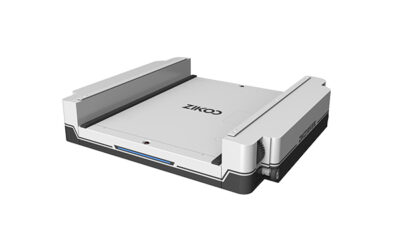
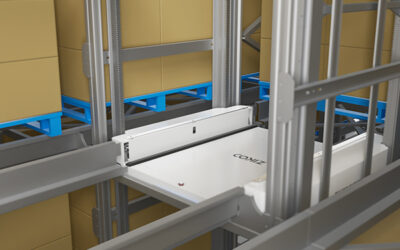
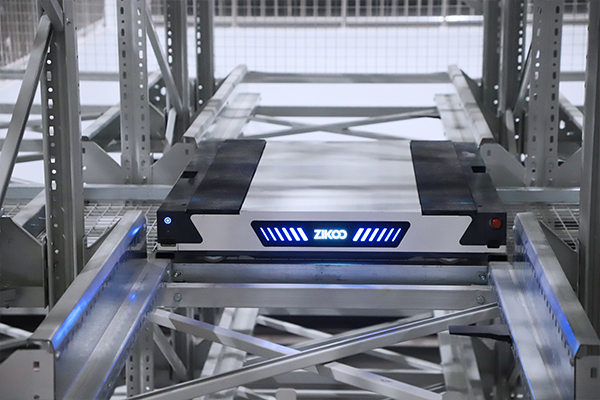
A four-way shuttle moves horizontally in two directions across the rack face, transferring between levels through vertical lifts or elevators. This architecture reduces the number of shuttle vehicles required per aisle and creates flexible paths across deep storage lanes. When a four-way shuttle is combined with a vertical bidirectional shuttle, the system gains movement in the vertical direction, forming a six-way shuttle network.
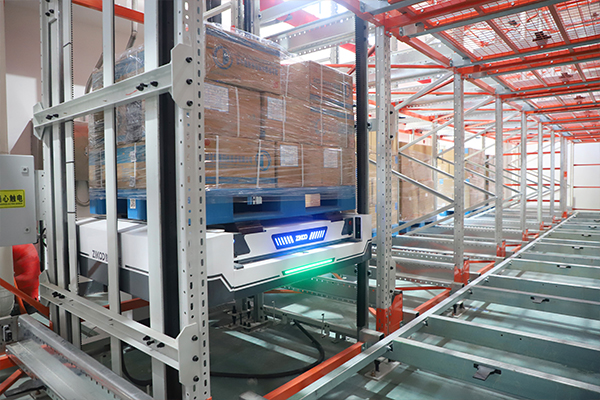
As a product example, the R-bot Four-way Shuttle has a 125 mm body height and a rated load of up to 1.5 tons, depending on model. It supports pallet sizes from 1200 × 800 mm to 1400 mm across standard, American, Japanese, and heavy-duty variants. Combined with an H-bot vertical bidirectional shuttle, it creates a pallet-to-person dense storage grid that uses vertical transfer positions to connect levels.
Miniload ASRS
A miniload system moves small loads, such as totes, cartons, and trays, between compact storage lanes and operator stations. It is common in parts distribution, pharmaceutical distribution, and slow-moving e-commerce inventory where case-sized storage units dominate.
Vertical Lift Module
A vertical lift module delivers trays to an operator opening using a central lift. It is space-efficient for slow-to-medium velocity items and is often installed inside existing facilities where the ceiling height is too low for large rack systems.
Each architecture has a different service profile and should be validated against required pallet moves per hour, order lines per day, and SKU depth, not simply against “automation level.”
How an ASRS Works
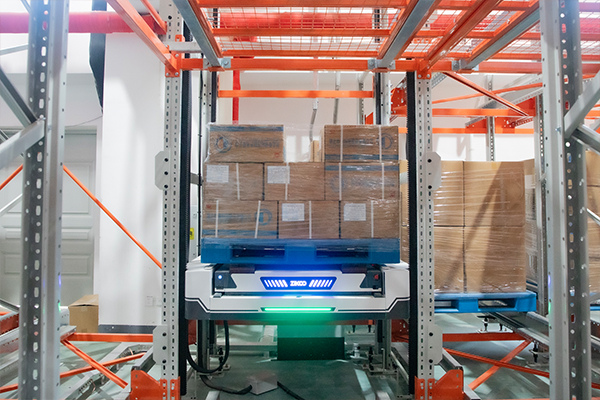
A typical pallet-to-person flow follows this sequence:
- Inbound pallets are registered at a receiving station. The system captures dimensions, weight, and barcode or RFID identifiers.
- The WMS or WES assigns a storage mission. The WCS translates the mission into a machine path.
- The load-handling equipment carries the pallet to a rack coordinate or to a buffer position.
- On retrieval, the system sequences missions based on order priorities, workstation capacity, and equipment location.
- The pallet is delivered to a person-to-station front-end where operators pick, replenish, or build mixed pallets.
- Completed outbound pallets move to staging, wrapping, and dock assignment.
The software layer determines most of the daily performance. Mission order, dwell-point positioning, and shuttle scheduling matter more than raw machine speed once the rack layout is fixed. This is why the warehouse control layer is often the highest-risk integration point.
This software becomes the deciding factor after the hardware layout and cycle path are fixed. <PTP Intelligent Warehousing Platform: Building a Flexible and Smart Logistics Ecosystem> covers how WMS, WES, WCS, and RCS fit into a single execution stack.
Where ASRS Fits: Warehouse Profiles and Applications
ASRS is not limited to huge e-commerce fulfillment centers. It is used wherever storage density, temperature control, traceability, or labor stability creates operating pressure.
Common applications include:
- Cold storage and frozen food distribution
- Pharmaceutical and healthcare distribution
- Automotive and industrial component storage
- Textile and garment raw material buffering
- New energy and battery component storage
- High-SKU service parts distribution
- 3PL multi-client fulfillment
- Food and beverage dense pallet storage
A cold storage operation at −25°C has different battery, lubrication, and sensor requirements than an ambient distribution center. The rack structure may require low-temperature steel selection, and lithium batteries must tolerate low-temperature charging. Some shuttle systems address this with dedicated low-temperature batteries and sealed electronics.
Shuttle-Based ASRS and the Move to Pallet-to-Person
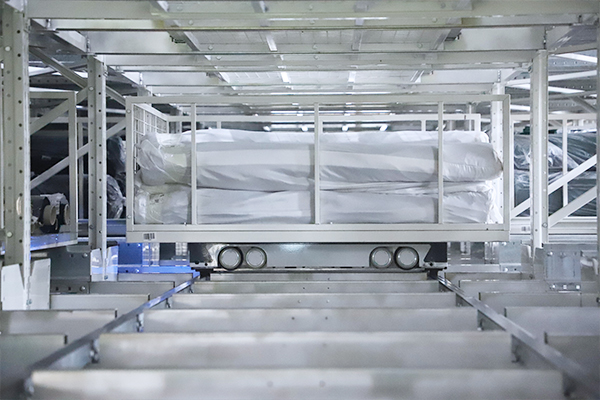
Pallet-to-person means that an operator stays at a station while the automated system delivers pallets from storage. In a shuttle-based ASRS, four-way shuttles travel across lanes, enter lift positions, and transfer between levels. This creates a flexible routing grid that can absorb changes in SKU velocity better than a fixed stacker-crane aisle.
The architecture has three important consequences:
- More storage density because deep lanes replace dedicated crane aisles.
- More flexible throughput because multiple shuttles can share a level.
- More fault tolerance because a shuttle can bypass a blocked lane through alternate travel paths.
However, software complexity increases. The system must schedule vehicle conflicts, lift queues, and workstation delivery windows in real time. Shuttle systems therefore require a more tightly integrated WCS than conventional single-crane systems.
The shift from fixed aisles to shared shuttle paths changes how warehouses think about peak capacity. <Smart Storage Revolution: Comprehensive Overview of Four-Way Shuttle Systems for Automatic 3D Warehouses> covers the system-level logic behind four-way shuttle selection for automatic 3D warehouses.
Key Evaluation Criteria for an ASRS Purchase
Evaluating an ASRS requires more than comparing technical brochures. Buyers should structure the evaluation around operational data and failure behavior.
Data to Prepare Before Requesting a Quote
- Pallet dimensions and load weight distribution
- Number of SKUs and pallets per SKU
- Daily inbound pallets and outbound pallets
- Peak-hour pallet moves, not just daily averages
- Clear ceiling height and column grid
- Floor flatness and floor load capacity
- Temperature and humidity range
- Operating shifts and peak season duration
- Integration targets: WMS, ERP, MES, or warehouse execution software
- Expansion requirements over the next five years
Supplier Evidence to Review
- Reference projects with similar pallet dimensions, not just similar industry names
- Factory audit requirements for lift mechanisms, drives, cradles, and battery modules
- Commissioning records and acceptance test protocols
- Safety compliance documentation, including rail-dependent equipment requirements under EN 528 [1]
- Maintenance plans, spare-part lead times, and remote diagnostic capability
- Ownership of control software, not only mechanical assembly
One common procurement error is comparing machine speed without comparing mission timing. A system quoting 1.6 m/s travel speed may still underperform a slower shuttle if the latter uses better dwell-point logic and lift scheduling. Performance statements should be reviewed using the definitions in FEM 9.851 [2].
If you are comparing architecturally different systems, send daily pallet moves, pallet dimensions, clear ceiling height, and operating hours to [email protected]. The engineering team can map storage locations and cycle times before any proposal is prepared, not after.
Cost and ROI Structure
ASRS cost is not limited to the automated machines. The prepared budget should include:
- Rack structure and platform engineering
- Automated load-handling equipment
- Transfer conveyors, vertical lifts, or elevators
- WMS, WCS, and system integration engineering
- Safety fencing, light curtains, and access control
- Installation, commissioning, and testing
- Operator and maintenance training
- Facility modifications such as slab repair, fire protection, and power distribution
- Spare parts and post-go-live support
Costs are custom-quoted because the rack geometry, ceiling height, fire protection requirements, and integration scope change from site to site. Any price given before collecting operational data is a budget indication, not a firm system proposal.
Return on investment usually comes from three areas: reduced labor travel, increased storage density, and lower damage or accuracy losses. Operators often target a storage density gain of 40% or more compared with conventional pallet racking, though the actual figure depends on the building envelope, clear height, and SKU profile [3]. A system that recovers floor space in an expensive temperature-controlled building can justify automation faster than one in a low-cost ambient warehouse.
The economics change when the same footprint can hold more pallets and move them with fewer vehicle assets. <Smart Warehousing Starts Here: Cost-Effective Four-Way Shuttle Systems> covers the cost-control logic behind four-way shuttle deployment.
When an ASRS Is Not Recommended
ASRS is not automatically better than a conventional warehouse. It may be the wrong investment when:
- Daily throughput is too low to amortize the control and equipment cost.
- The building has irregular columns, low ceilings, or weak floor slabs that require disproportionate retrofit work.
- Pallet dimensions or load weights vary widely without a dominant pallet profile.
- The operation depends on very short delivery windows and highly variable order profiles.
- The company does not have the maintenance or IT capability to support automated systems.
- The expected payback period is longer than the lease or business planning horizon.
In those cases, a phased retrofit, narrow-aisle equipment, or a lower-automation pallet shuttle lane may be a better fit. The right outcome is not “most automation possible” but “lowest reliable cost per pallet moved at target accuracy.”
Next Step: Get an ASRS Feasibility Check
A useful ASRS evaluation starts from a layout, not a brochure. Before committing to a supplier or architecture, test the operational logic against your actual pallet profile, peak-day demand, and order structure.
To start a feasibility evaluation, send the following to [email protected] or call (+86)-19941778955:
- Warehouse drawings or clear dimensions
- Pallet size, weight, and load height
- SKU count and pallets per SKU
- Daily inbound and outbound pallet volume
- Peak-hour pallet moves
- Temperature and humidity conditions
- Operating shifts and expansion plan
Zikoo Smart Technology Co., Ltd. engineers review the data against R-bot Four-way Shuttle, H-bot vertical shuttle, U-bot narrow-aisle, and PTP Smart Warehouse Software configurations, then recommend the smallest system that meets the throughput target and provides a clear expansion path.
Frequently Asked Questions
How much does an ASRS cost?
There is no fixed ASRS price. Total cost depends on rack geometry, building height, load weight, throughput, temperature range, software integration, and safety scope. A high-level budget should include machines, racks, conveyors or lifts, controls, installation, commissioning, and support. Request cost only after the supplier has reviewed operational data and site constraints.
Is an ASRS suitable for existing warehouses?
Yes, in many cases. Existing buildings can be retrofitted when ceiling height is sufficient, floor flatness meets equipment limits, and the column grid allows efficient rack placement. A four-way shuttle system can often fit into lower buildings than a traditional high-bay stacker crane ASRS.
What is the difference between ASRS and a pallet shuttle system?
A pallet shuttle system is one form of ASRS. The broader ASRS category also includes unit-load stacker cranes, miniload systems, vertical lift modules, and shuttle-based pallet-to-person systems. The main difference is movement logic: some ASRS machines travel in fixed aisles, while shuttle-based systems move across levels and lanes.
How long does an ASRS project take?
Project duration depends on scope, building readiness, and integration depth. A simple retrofit may take several months from design to go-live. A large greenfield system with racks, fire protection, building interfaces, software integration, and phased cutover can take longer. The commissioning phase should include dry-run missions, failure drills, and operator training before full cutover.
Which industries gain the fastest ASRS ROI?
Industries with expensive space, high labor movement, cold-chain costs, or high accuracy requirements often see faster returns. These include frozen food, pharmaceuticals, electronics distribution, cold storage, and multi-client 3PL operations.
Does an ASRS require a WMS?
A basic ASRS can operate with a WCS alone for simple storage and retrieval. However, most high-performance installations require WMS or WES integration to sequence orders, manage inventory rules, and prioritize workstations. The integration quality between WMS, WCS, and the mechanical system usually determines daily throughput more than machine speed.
References
[1] European Committee for Standardization (CEN), EN 528: Rail Dependent Storage and Retrieval Equipment — Safety Requirements, CEN, Brussels, Belgium.
[2] European Materials Handling Federation (FEM), FEM 9.851: Performance Terminology for Automated Storage and Retrieval Systems, FEM, Frankfurt, Germany.
[3] Material Handling Institute (MHI), “ASRS Solutions Group: Automated Storage and Retrieval Systems,” MHI, Charlotte, NC, USA. [Online]. Available: https://www.mhi.org/as-rs
[4] Rack Manufacturers Institute (RMI), ANSI MH16.1: Specification for the Design, Testing and Utilization of Industrial Steel Storage Racks, RMI, Charlotte, NC, USA.
If you’re interested, check out these related articles:
Six-Way Shuttle: The Dual-Engine Solution for High-D
PTP Intelligent Warehousing Platform: Building a Flexible and Smart Logistics Ecosystem
Six-Way Shuttle Empowers 3PL Providers to Build Next-Generation Smart Logistics Hubs
Six-Way Shuttle Drives Warehouse Upgrades: Building an Intelligent Automatic 3D Warehouse