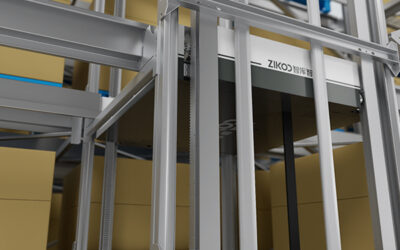
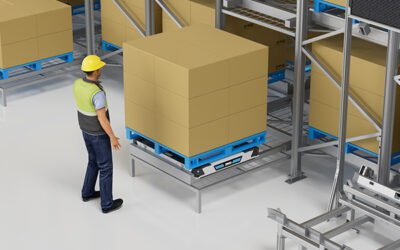
Warehouse automation does not build competitiveness through labor savings alone. The companies that gain an edge are the ones that recover storage density, shorten order cycle time, and make inventory movements visible to planning systems. In my work on pallet storage and shuttle systems, I look at three levers before cost: how many pallet positions fit in the building footprint, how fast the right pallet reaches the picking station, and whether the control software can reprioritize work when demand shifts. This article explains those levers with the system-level detail buyers need before committing capital.
What Does Warehouse Automation Actually Change in Competitive Positioning?
Most buyers begin with the labor cost calculation. That is a real benefit, but it is not the source of durable competitive advantage. A manual warehouse can still miss orders, hold too much buffer stock, or use floor space poorly. Warehouse automation changes the operating model: pallets move on command, locations are tracked, and exceptions appear before they become customer claims.
When I review a warehouse, I separate the work into two groups. Capacity-led operations run out of storage positions or dock throughput. Service-led operations can store enough stock but cannot pick and ship fast enough. Automation changes each group differently, and the buyer needs to know which group is driving the project before selecting equipment.
| Competitive factor | Manual operation | Automated warehouse system |
|---|---|---|
| Storage density | Aisle width and reach limits cap pallet positions | Narrow aisles or dense shuttle racking increase positions in same footprint |
| Order cycle time | Picking depends on operator availability and walking distance | Shuttles and lifts deliver pallets to workstations on command |
| Accuracy | Manual scanning misses create returns and recounts | System-directed moves track every location change |
| Peak capacity | Adding shifts adds labor cost and training | Additional shuttles or extended runtime handle peak demand |
| Visibility | Inventory status lags physical movement | WMS and WCS update location and status as moves happen |
| Scalability | Reconfiguration disrupts operations | Modular shuttles and software can scale in phases |
Why Do Storage Density and Throughput Matter More Than Headcount Reduction?
Headcount reduction shows up quickly on a spreadsheet, but it disappears as a competitive advantage once competitors match the same labor rates. Storage density and throughput are harder to copy because they are built into the rack structure, shuttle fleet, and lift placement.
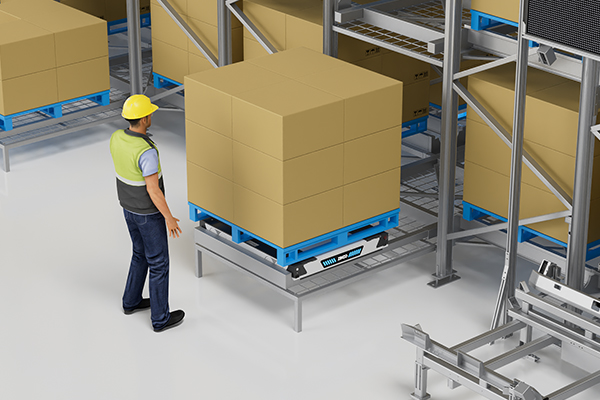
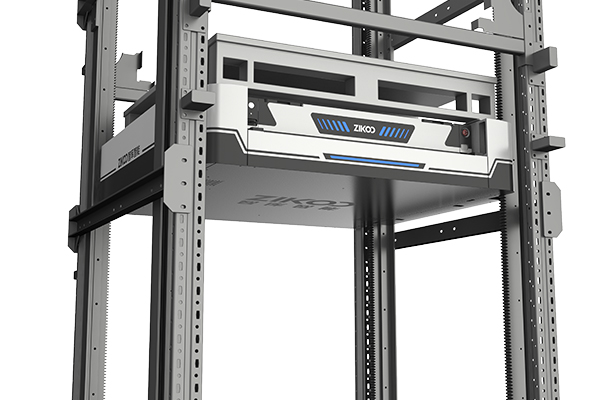
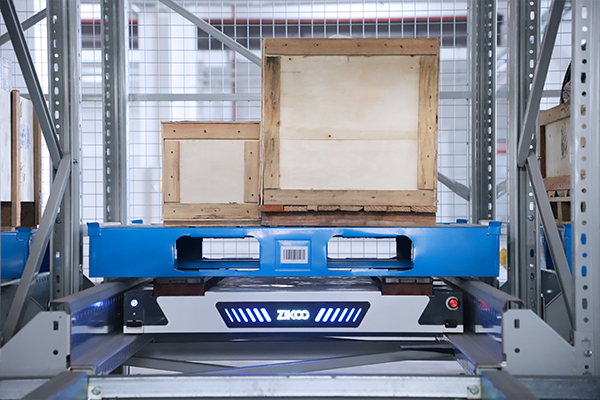
A four-way shuttle with a 125 mm body thickness lets a warehouse add more storage levels in the same clear height. The R-bot carries up to 1.5 tons and moves at 1.6 m/s empty or 1.2 m/s loaded. The H-bot vertical shuttle positions pallets with plus or minus 1 mm accuracy and runs in temperatures from 25 degrees Celsius below zero to 45 degrees Celsius. Those specifications matter because they determine how tightly racking can be planned and how predictable the pallet flow becomes.
Dense storage gains only hold up when the shuttle and lift work as one system. <Six-Way Shuttle Powers Dense Storage: Breaking Space Limitations> covers how six-way shuttle networks turn vertical and horizontal movement into a continuous pallet flow instead of a collection of isolated handling steps.
What makes dense storage a competitive advantage?
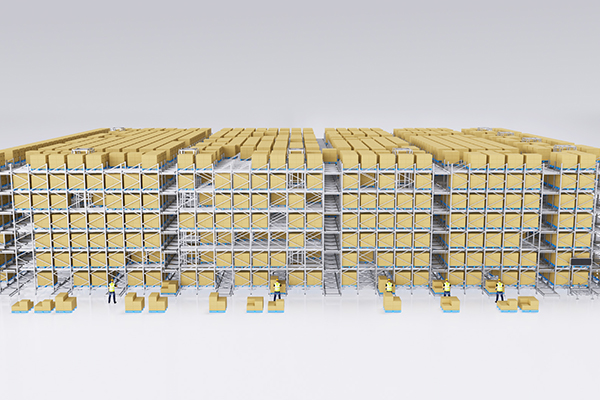
Dense storage changes the math on building cost by adding more pallet positions in the same footprint. That capital avoidance often outweighs the direct labor savings. The competitive advantage is the ability to hold more product closer to the customer without adding real estate.
How Does Warehouse Automation Turn Accuracy and Software Control into a Competitive Asset?
Order accuracy is where automation shows up in customer retention. An automated system records every move, so a missing pallet becomes a system exception instead of a manual search. That changes how quickly a team can respond to a short shipment.
Software is the part buyers underweight. A shuttle fleet without coordinated control still leaves idle time between horizontal movement, vertical transfer, and picking station arrival. The PTP Smart Warehouse Software combines WMS, WES, WCS, and RCS so order priority, equipment dispatch, and location updates stay connected. In system design, I treat software response as a throughput constraint equal to shuttle speed.
Hardware speed only becomes competitive when the software layer schedules the right sequence. <PTP [Intelligent Warehousing](https://www.zikooint.com/asrs-automated-storage-and-retrieval-system-solutions) Platform: Building a Flexible and Smart Logistics Ecosystem> covers how WMS/WES/WCS/RCS coordination changes the way order priority and shuttle dispatching are handled in multi-zone systems.
Why does WCS matter as much as hardware?
WCS is the layer that decides which shuttle takes which pallet to which lift and in what order. Without it, a faster shuttle only waits faster. The R-bot fleet needs the RCS to coordinate path planning and avoid collisions, while WMS holds order priority and inventory status. When these layers are designed together, the system can rearrange work when a hot order arrives instead of forcing every pallet through a fixed sequence.
If your operation runs mixed pallet sizes or sub-zero temperatures, confirm the shuttle model and battery configuration before comparing system quotes. Send your pallet dimensions, storage temperature, and daily throughput target to [email protected] and our team can check the correct R-bot model and H-bot speed profile.
Where Does Warehouse Automation Generate the Fastest Payback and Lasting Flexibility?
Fast payback comes from two conditions: the building is expensive or constrained, and the operation runs more than one shift. Cold storage and urban distribution centers fall into that category because every cubic meter carries energy cost and every extra shift multiplies the same fixed equipment.
The R-bot cold chain solution uses a dedicated low-temperature lithium battery and a charging port design for automatic charging in cold environments. Continuous operation runs six to eight hours. That matters because battery capacity decline at low temperatures is not a warranty issue alone; it becomes a throughput limit if the design ignores it.
Cost reduction claims need to be tied to specific operating conditions to be useful. <Six-Way Shuttle: The Smart Warehousing Tool for Cost Reduction and Efficiency> covers how dense shuttle storage reduces facility, labor, and energy cost per pallet when the system matches pallet size and throughput.
What makes an automated warehouse flexible enough for growth?
Flexibility comes from modularity. A six-way shuttle system combines R-bot horizontal movement with H-bot vertical transfer, so additional storage lanes or lifts can extend capacity without changing the overall control architecture. The U-bot omnidirectional stacker robot operates in aisles as narrow as 2100 mm, which works for existing warehouses where column spacing limits rack placement. Buyers should ask whether the supplier sells a fixed product or a phased system design.
How Do You Turn a Competitiveness Gap into a Concrete Warehouse Automation Plan?
Many operations wait until labor shortages or order errors force a rushed decision. By then the project becomes a reaction to pain instead of a competitive plan.
A better starting point is a system-level review of the existing warehouse. That means collecting clear height, pallet size, SKU count, daily inbound and outbound volume, and temperature range. Those inputs determine storage density, shuttle model, lift count, and software sequencing. Without them, two suppliers can quote very different systems that both look valid on price.
Send those warehouse details to [email protected] or call (+86)-19941778955. Ask for a throughput simulation that compares current operations with a phased shuttle or stacker robot design. That step turns the competitiveness question from a concept into a modeled decision with defined pallet flow, storage capacity, and expansion path.
What Questions Do Buyers Ask About Warehouse Automation and Competitiveness?
Does warehouse automation pay off only for large enterprises?
No. The return depends more on pallet profile, throughput, and building constraints than on company size. A small operation with high storage cost or multi-shift order volume can recover investment faster than a large operation with low-density, single-shift handling. The relevant test is whether storage density, labor dependency, or order errors create enough recurring cost to justify the system. I have reviewed warehouses under 5,000 square meters where a single shuttle and lift configuration made sense because the existing racking could not hold the required SKU count.
Will a four-way shuttle system work in an existing warehouse?
It depends on clear height, floor flatness, column spacing, and pallet size. Buildings with clear height below about 8 meters often suit dense shuttle racking more than tall stacker cranes. Floor flatness must match the shuttle guidance tolerance, and column grids determine how many storage lanes fit. Existing warehouses with standard pallets and stable floor conditions can usually operate a phased shuttle system without major structural changes. The question to ask first is not whether the technology works, but how many pallet positions the existing grid can deliver after the rack layout changes.
How long does it take to see a competitive improvement?
Many buyers assume warehouse automation takes two years to produce results. That is not accurate for a phased design. Installation timing depends on rack volume, software integration, and whether the building remains operational during the project. A single zone with R-bot shuttles and an H-bot lift may go live within months, while a full multi-zone system takes longer. Competitive improvement begins when the first automated zone handles real orders, not when the entire project finishes. That phased effect means the investment can start contributing before the last storage lane is installed.
What data should I collect before evaluating warehouse automation suppliers?
In system reviews I ask for warehouse dimensions, pallet size, SKU count, daily inbound and outbound volume, and temperature range. Those five inputs shape shuttle model, lift count, and rack layout more than any brochure. If the pallet mix includes non-standard sizes or low-temperature storage, those conditions change battery configuration and safety protection. Share those specifications with [email protected] and we will confirm the appropriate R-bot model and battery setup for your pallet profile.
If you’re interested, check out these related articles:
Six-Way Shuttle: Pioneering the Future of Smart Warehousing
Six-Way Shuttle: The Dual-Engine Solution for High-D
Six-Way Shuttle Unlocks the Era of True 3D Intelligent Warehousing
Six-Way Shuttle: The Smart Warehousing Tool for Cost Reduction and Efficiency 2
Revolutionizing Cold Chain Logistics: Zikoo Robotics Six-Way Shuttle Powers High-Density, High-Efficiency Warehousing