Warehouse automation increases profitability only when the system removes a specific constraint: too much travel, too little storage density, too many picking errors, or too few pallet moves per shift. In more than ten years designing four-way shuttle and omnidirectional stacker systems, I have seen projects that generated payback quickly and projects that should never have been automated. The difference is rarely the hardware. It is whether the customer’s pallet sizes, order profile, and peak throughput were modeled honestly before design. This article explains the four places pallet automation creates profit, the conditions where it does not, and the calculation to run before you compare quotations.
Where Does Warehouse Automation Profitability Actually Come From?
Most buyers see labor savings first. That is real, but it is only one part. In a pallet-to-person dense storage system, profit comes from four places at once: lower direct labor, higher pallet capacity per square meter, fewer order errors, and more stable throughput during seasonal peaks. The first two show up on the income statement. The last two do not always appear in a basic ROI spreadsheet, but they are often where a project protects margin because they stop revenue leakage instead of just cutting cost.
Pallet automation changes the cost base when it increases pallet moves without adding aisles. <Six-Way Shuttle: The Ultimate Warehousing Solution for Cost Reduction and Efficiency> covers how multi-shuttle scheduling and vertical transfer keep high-density storage productive during continuous operation.
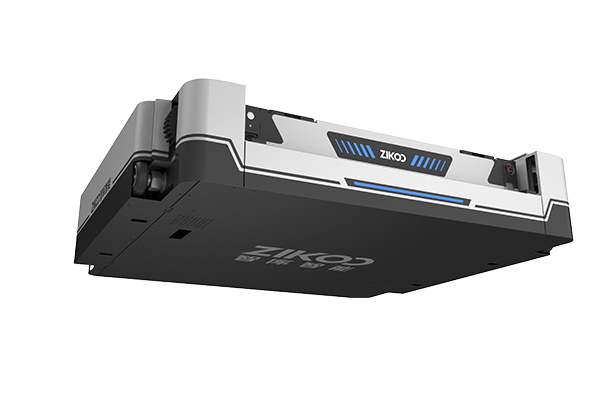
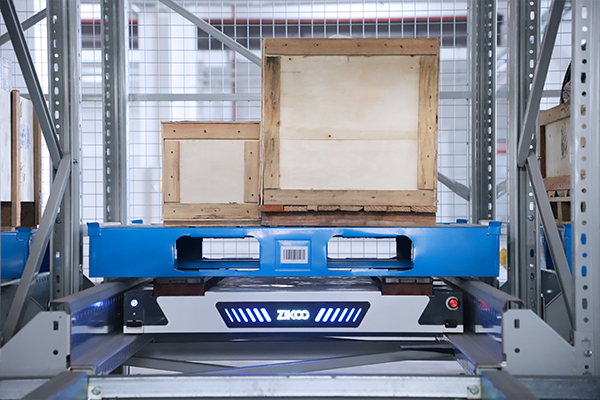
The R-bot Four-way Shuttle has a body thickness of 125 mm and can carry up to 1.5 tons, so rack levels can sit closer together in a dense storage lane. That geometry matters: more pallet positions fit in the same cube without requiring a wider aisle.
How Does Pallet Automation Cut Labor Costs Without Losing Peak Capacity?
Warehouse labor cost is not a flat headcount number. In many sites, the largest cost is the swing capacity added for the last week of each month or the peak season. A manual warehouse staffs for the worst two hours of the day; an automated system handles peak pallet moves with the same shuttles and elevators that run the rest of the shift.
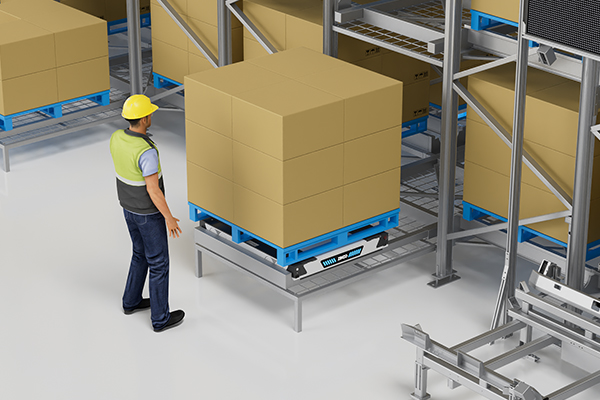
With the R-bot moving 1.2 m/s loaded and the H-bot positioning to ±1 mm, pallets travel without a forklift operator for most of the cycle. Workers move to autonomous pickup stations, which cuts walking and lift-truck time. In projects we have reviewed, the labor saving usually comes from eliminating double handling, not from removing every operator.
Why Does Higher Storage Density Become a Rent Advantage?
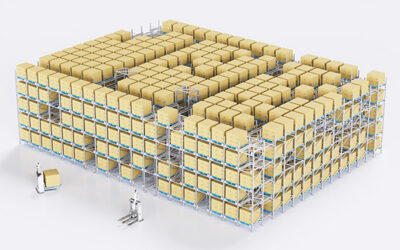
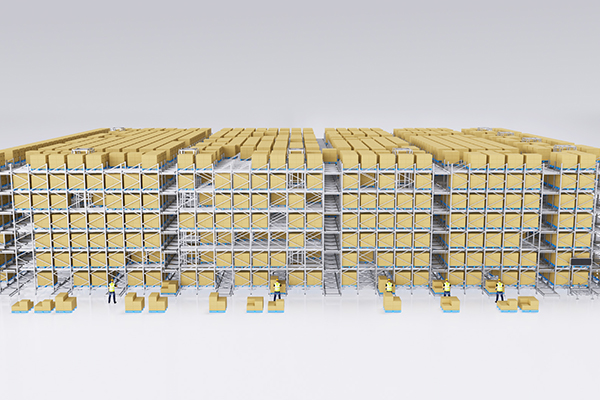
Every pallet stored above floor level in a dense lane reduces the number of cubic meters you rent, heat or cool, and light. That is why density matters in profitability. A manual wide-aisle layout needs far more square meters for the same pallet count, because each aisle exists for forklift travel. A dense pallet system removes most of that travel lane from the equation.
| Cost driver | Manual wide-aisle racking | Four-way shuttle dense storage |
|---|---|---|
| Aisle width | Usually 2.8 to 3.5 m for reach trucks | U-bot operates at 2100 mm; R-bot works inside rack lanes |
| Pallet depth | Usually 1 to 2 pallets deep | Multiple pallets deep in a single lane |
| Peak throughput | Forklift-dependent | Multi-shuttle collaboration |
| Error source | Manual scan and putaway | System-directed location from WMS/WCS |
| Footprint | Larger for same pallet count | Smaller for same pallet count |
Cold storage makes this advantage clearer because every square meter carries a refrigeration cost. A high-density system that shrinks the freezer cube can reduce monthly energy and building expense depending on the layout. If the location is already leased, density may delay the next expansion.
What Do Throughput and Accuracy Do to the Cost of Errors?
An order picked from the wrong pallet has a cascading cost: returned freight, customer service time, warehouse labor to receive and put back, and lost trust. Pallet automation reduces this not because robots are inherently smarter, but because the WMS and WCS assign each pallet to a known location and record movements without manual scan gaps.
PTP Smart Warehouse Software connects WMS, WES, WCS, and RCS layers, so the same order queue triggers shuttle movements and station work instructions. The system keeps the inventory record aligned with the physical pallet. That makes cycle counting less disruptive and cuts the number of reverse logistics events caused by internal errors.
Error cost is often the fastest payback lever. <Smart Warehousing Starts Here: Cost-Effective [Four-Way Shuttle System](https://www.zikooint.com/6-way-pallet-shuttle)s> covers how system-directed putaway with four-way shuttle equipment keeps physical pallet positions aligned with the inventory database, reducing the need for manual location checks.
If your operation mixes fast-moving pallet SKUs with long-tail slow movers, it is worth confirming shuttle count, rack lane depth, and software integration before you finalize a layout. Send your monthly pallet movement data and SKU split to [email protected] and we will check whether the density gain leads to a real labor or space reduction.
When Does Warehouse Automation Fail to Improve Profitability?
Pallet automation is not automatically profitable. If a warehouse ships low pallet volumes, holds irregular or very light pallets, or operates in a building with clear height too low for multi-level racking, the equipment may add cost without removing enough labor or floor space. The same logic applies when SKU profiles change every season and the rack depths cannot be reconfigured quickly.
One common failure pattern is a proposal built on ideal pallet dimensions. The system must handle the pallets the site actually receives, including European 1200 x 800 mm, American 1016 x 1219 mm, and Japanese 1100 x 1100 mm. If the shuttle model is selected for the wrong pallet variant, the rack lane measurements and load transfers become the source of delay instead of profit.
If throughput is too low, the equipment cost can outweigh the savings. <Reshaping Warehouse Value: [Six-Way Shuttle](https://www.zikooint.com/solution/r-bot-h-bot-six-way-shuttle-dense-storage-system) Leads the Digital Transformation> covers how simulation work separates realistic pallet movement profits from optimistic assumptions, which is exactly the analysis that should happen before a purchase decision.
How Should You Model ROI Before Signing a Pallet Automation Contract?
Every credible profitability model starts with the same inputs: monthly inbound and outbound pallets, peak shift throughput, pallet size mix, SKU velocity, building clear height, labor rates, and expected years in the building. Without those inputs, a supplier cannot tell you how many shuttles, elevators, and workstations are required, or when the system pays back.
From the supplier side, I want to see a customer’s actual order lines, not annual averages. A monthly average hides the peak day. If the system is too small, the peak fails. If the system is too large, the equipment sits idle and the payback stretches. The best models run both the average day and the worst day.
Many automation projects miss profitability because the baseline data is too coarse. Before you compare quotations, collect actual order lines, pallet dimensions, shift schedules, and rental or energy costs. If your program involves mixed pallet sizes, cold storage, or peak-driven throughput, it is worth confirming the shuttle model and battery configuration before finalizing the budget. Send your monthly pallet movement data and order profile to [email protected] or call (+86)-19941778955, and we will run a structured calculation that shows where the system pays back first.
Common Questions About Warehouse Automation Profitability
How quickly can a four-way shuttle system pay back?
In most pallet-dense operations running two or more shifts, the payback period lands between three and five years, but the calculation depends on labor cost, building cost, and order volume. A high-rent cold storage site with stable pallet flow often pays back faster than a low-rent location with light movement. The honest test is not the headline number. It is whether the assumptions behind the number match your actual pallet sizes, shift profile, and order lines.
Is pallet automation only profitable for large warehouses?
No. The better question is whether pallet movement is high enough to replace manual travel and handling. A compact facility with a narrow aisle layout can use the U-bot at a 2100 mm minimum aisle width to add storage capacity without a larger footprint. But a small warehouse with low throughput and stable headcount may not recover the capital. The trigger is flow and density pressure, not square meters.
What ongoing costs should I include in the profitability model?
It depends on the system design, but the main items are service, spare parts, energy, and software updates. For example, the R-bot runs on a 51.2V lithium battery and operates about eight hours on a full charge. The cost of a replacement battery or a shuttle service visit should be part of the long-term calculation, not an afterthought. Ignoring these costs makes any automation project look more profitable than it will be.
How do I know whether a supplier’s ROI model is credible?
Ask for the assumptions behind the payback calculation. If the supplier cannot show the pallet size mix, shift schedule, labor rates, and expected order lines behind the model, the projection is not ready for a capital decision. Compare the same baseline across two or three suppliers. If your program has mixed pallet dimensions or peak-driven throughput, share your monthly movement data with us at [email protected] and we will confirm the model logic before you take it to your finance team.
If you’re interested, check out these related articles:
Reshaping Warehouse Value: Six-Way Shuttle Leads the Digital Transformation
Six-Way Shuttle: Pioneering the Future of Smart Warehousing