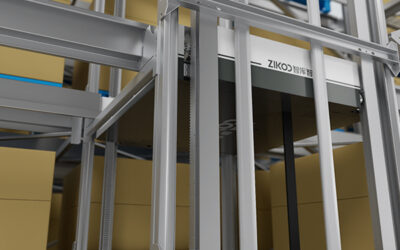
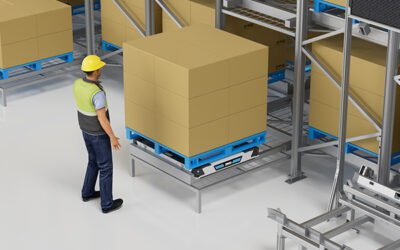
High-SKU warehouses face a structural conflict: they need dense pallet storage, but they also need frequent access to a large number of different pallet positions. Conventional wide-aisle rack and forklift operations solve access but consume floor space; deep-lane and drive-in systems gain density but reduce order flexibility. Pallet-to-person shuttle systems change the equation by combining dense lane storage with on-demand retrieval of full pallets to picking stations.
For operations managing thousands of SKUs across e-commerce, 3PL, manufacturing, and cold chain, the effective question is no longer whether to automate, but which pallet automation logic will not collapse as SKU breadth grows. This guide explains the architecture, software layer, and configuration decisions behind smart warehouse pallet solutions for high-SKU operations.
A practical first step is to map your current SKU profile to storage and throughput targets. If you need a preliminary capacity check, send pallet dimensions, SKU count, and order lines per day to [email protected] or call (+86)-19941778955.
Why High-SKU Warehouses Need a Different Pallet Automation Logic
High-SKU does not simply mean more inventory; it means more unique pallet positions to manage, more mixed picks, and more order lines that involve low and medium movers rather than only full-pallet movers. In a manual or conventional truck-based operation, that profile increases travel, cuts picking accuracy, and consumes docks and staging areas. Research on warehouse order picking consistently identifies travel time as the dominant variable in picker productivity [1].
In a pallet-to-person system, travel is shifted from operators to autonomous shuttles. Four-way shuttles travel across the rack in both horizontal directions, while vertical transfer units connect storage levels. The system can retrieve a pallet from a deep lane without requiring a forklift to enter the rack. That access model is a central advantage for high-SKU environments where slow movers must remain reachable without disturbing fast-moving pallets.
This does not mean every shuttle system fits every high-SKU operation. The decisive factors are the order profile, pallet mix, SKU velocity distribution, and the degree to which the warehouse control system can re-slot and sequence work in near real time.
Pallet-to-Person Architecture for High-SKU Storage and Retrieval
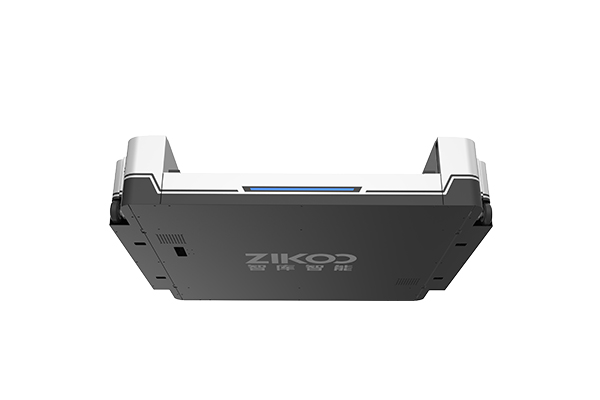
A practical high-SKU pallet solution often combines low-profile four-way shuttles with vertical transfer hubs. The R-bot Four-way Shuttle travels within rack lanes at speeds of up to 1.6 m/s empty and 1.2 m/s loaded on standard models, with a body height of 125 mm. That thin profile allows high beam-level density because the shuttle fits into the same storage layer as the pallet. The H-bot Vertical Bidirectional Shuttle transfers pallets between levels with positioning accuracy of ±1 mm, forming a six-way shuttle network with horizontal and vertical movement.
For high-SKU operations, the value is not speed alone but combination: the shuttle handles dense horizontal retrieval, and the H-bot creates a vertical transportation spine. A pallet for a slow-moving SKU can remain in a deep lane without compromising access to a fast-moving pallet in another lane. The system can also operate with mixed pallet types, which matters when high-SKU catalogs span standard, American, Japanese, and large pallet footprints.
| Model | Rated load | Body height | Supported pallet | Loaded speed |
|---|---|---|---|---|
| R1200B Standard | 1,200 kg | 125 mm | 1200×800–1000 mm | 1.2 m/s |
| R1200A American | 1,200 kg | 125 mm | 1016×1219 mm | 1.2 m/s |
| R1500J Japanese | 1,500 kg | 125 mm | 1100×1100 mm | 1.2 m/s |
| R1500B Heavy-duty | 1,500 kg | 125 mm | 1200 mm | 1.2 m/s |
| R2000B Large pallet | 2,000 kg | 150 mm | 1400 mm | 1.0 m/s |
As with automated storage and retrieval machines, shuttle robot safety loops should be validated against applicable safety standards [3]. The table is not a feature checklist; it is a pallet-profile filter. The right model set follows the actual pallet dimensions in your order data.
Software Orchestration: The Control Layer That Makes Thousands of SKUs Manageable
Hardware density is necessary but not sufficient. High-SKU operations live or die on the ability of the warehouse control system to decide what to retrieve, when, and in what sequence. The PTP Smart Warehouse Software platform spans WMS, WES, WCS, and RCS functions. In practice, that means four layers of control: inventory and order management, order release and wave planning, equipment-level orchestration, and robot mission execution.
Without that separation, a shuttle fleet can generate retrievals faster than the picking workstations can process them, or it can flood the vertical transfers with poorly sequenced moves. In high-SKU environments, the control layer should support dynamic slotting, waveless order release, and task interleaving. These methods let the system combine inbound putaway and outbound retrieval missions, instead of executing every movement as an isolated cycle [2].
This is the area where a pallet shuttle project becomes a software project. The shuttle hardware may be reliable, but if the mission logic cannot regroup orders by velocity class, sequence mixed pallets by workstation, or re-slot SKUs after seasonal shifts, the operation will still pay an efficiency penalty.
The control layer often determines whether shuttle hardware reaches its rated capacity. <Software-Driven Hardware: Six-Way Shuttle Maximizes Warehouse Efficiency> covers how mission orchestration and shuttle motion interact in high-density pallet systems.
If you are evaluating a high-SKU pallet automation project, do not separate hardware and software procurement. A preliminary software-functionality review — mission orchestration, waveless order release, and re-slotting rules — will tell you more about long-term scalability than a shuttle speed sheet. Send your current WMS/WCS integration scope to [email protected] or call (+86)-19941778955 for a focused technical review.
Slotting, Sequencing, and Retrieval Logic for High-SKU Throughput
High-SKU throughput depends more on slotting logic than on maximum travel speed. Fast-moving SKUs should be placed near pick faces or vertical transfers; slow movers can be stored in deeper lanes; correlated SKUs that frequently appear in the same order can be grouped to reduce retrieval missions. In a pallet-to-person operation, the shuttle system can apply dynamic slotting continuously as velocity data changes, rather than relying on a single annual ABC classification.
The retrieval sequence matters because high-SKU orders often require multiple pallet positions for one order line or multiple order lines grouped into a single workstation visit. Task interleaving allows a shuttle to complete a retrieval and then perform a putaway mission instead of returning empty. In systems with vertical transfer hubs, batching by destination level can remove unnecessary vertical moves. Academic and industry studies of warehouse control commonly treat task interleaving and storage assignment as the two control decisions with the largest practical effect on travel and throughput [1][2].
Dense Storage and Six-Way Shuttle Networks: Scaling Without Extra Aisles
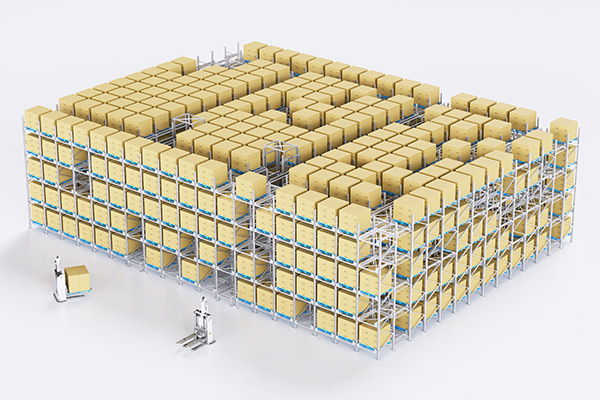
A high-SKU warehouse often runs out of space before it runs out of machines. Four-way shuttle systems can use deep lane storage to raise pallet positions per square meter while retaining access to individual lanes. The link to high-SKU operations is subtle: density does not help if it turns slow movers into inaccessible pallets. A six-way shuttle network mitigates this because horizontal shuttles and vertical H-bot transfers create alternate retrieval paths.
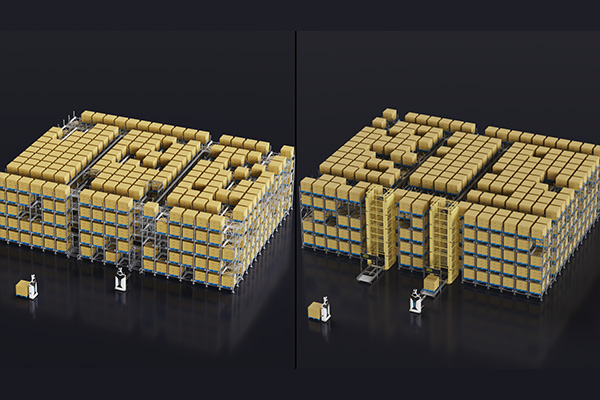
That flexibility is particularly valuable when an operation adds clients, product lines, or seasonality. A facility that starts with a few thousand SKUs may need to absorb several thousand more after adding contract logistics clients. In a lane-restricted system, absorbing new slow-moving SKUs often means disturbing existing storage. In a six-way shuttle layout, new SKUs can be placed in available deep positions and retrieved on demand.
High-SKU buildings rarely have a single storage pattern. <Multi-Scenario Smart Adaptation: Zikoo’s Six-Way Shuttle Powers the Digital Transformation of Warehousing> covers how six-way shuttle networks adapt storage and retrieval behavior across mixed product families and order profiles.
Mixed Pallet Profiles and 3PL High-SKU Fulfillment Patterns
3PL operations are an extreme case of high-SKU complexity because every client brings different pallet standards, order cut-off times, and value-added services. A multi-client warehouse may store 1200×800 mm and 1200×1000 mm pallets for one client while handling 1016×1219 mm or 1100×1100 mm pallets for another. Selecting shuttle models that match the actual pallet footprint prevents rack-level incompatibility and reduces manual pallet repacking.
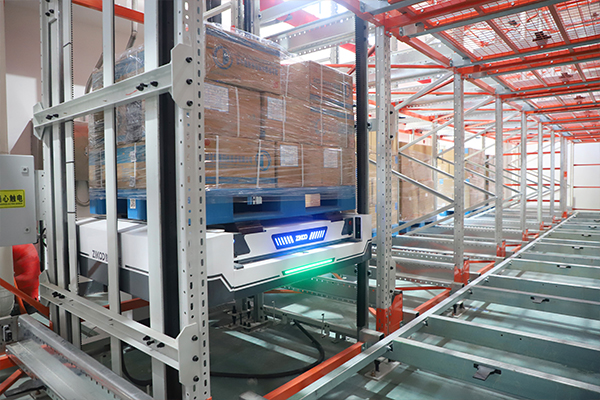
The same logic applies to e-commerce fulfillment, where high SKU counts are paired with unpredictable order tails and peak promotions. A pallet-to-person system can decouple storage from picking, so the same pallet-in/pallet-out system can support case picking, layer picking, and full pallet outbound on different workstations. The U-bot + AMR narrow aisle picking system from Zikoo, for example, targets up to 10,000 SKUs with picking efficiency of at least 300 pieces per hour per workstation and inbound/outbound capacity of at least 80 pallets per hour according to Zikoo’s published system performance benchmarks. These numbers are product-specific, not universal guarantees, but they illustrate the operational envelope a well-scoped system can target.
Multi-client warehouses make pallet profile and retrieval priority harder to predict. <Six-Way Shuttle Empowers 3PL Providers to Build Next-Generation Smart Logistics Hubs> covers how shuttle-based systems support multi-tenant fulfillment and next-generation logistics hubs.
Setting the Performance Baseline: Specs That Matter
When comparing high-SKU pallet solutions, focus on four performance baselines:
- Pallet profile coverage — Can the shuttle handle the full range of pallet footprints without adapters or manual rework?
- Vertical transfer accuracy and speed — H-bot positioning at ±1 mm reduces pallet skew and allows tighter beam clearances.
- Runtime and temperature range — Battery runtime of 7–8 hours and options for -25 °C operation matter in cold storage and multi-shift operations.
- Software mission logic — Dynamic slotting, task interleaving, and waveless order release determine whether rated capacity is achieved.
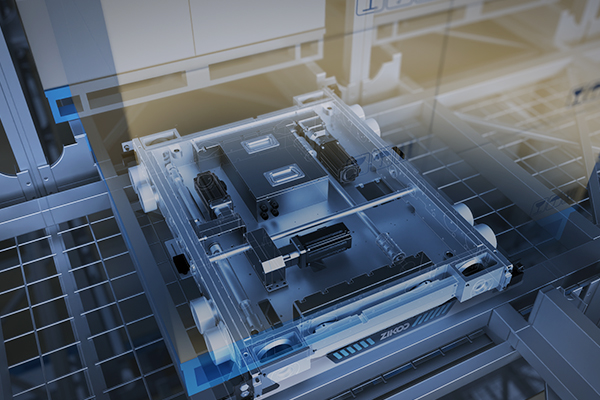
A useful first-pass comparison is not a feature checklist but a capacity simulation using your actual order lines, pallet sizes, and peak day behavior. Systems that look similar on a datasheet can diverge sharply once the software is asked to manage thousands of SKUs across multiple velocity classes.
Move From High-SKU Constraint to Scalable Order Flow
High-SKU operations do not need more hardware first; they need a storage and retrieval logic that keeps every SKU accessible, every pallet profile supported, and every software mission aligned with order demand. Zikoo Smart Technology Co., Ltd supports pallet-to-person robotics for dense storage, narrow-aisle pallet handling, and vertical transfer networks across manufacturing, cold chain, e-commerce, and 3PL operations.
If you are preparing an RFQ or re-evaluating an existing high-SKU warehouse, include these data points for a more useful engineering response:
- Total SKU count and velocity distribution
- Pallet dimensions by SKU family and weight range
- Average and peak order lines per day
- Required pallet moves per hour during peak
- Available building height, aisle constraints, and temperature range
- Existing WMS/WCS integration scope
Send the data to [email protected] or call (+86)-19941778955. Zikoo can provide a preliminary capacity check and phasing plan before you commit to a full simulation.
FAQ
Can a four-way shuttle system handle high-SKU operations without losing throughput?
A four-way shuttle system is well suited to high-SKU operations when dense storage is combined with software-driven retrieval, task interleaving, and dynamic slotting. The shuttle fleet provides horizontal access, and vertical transfer hubs connect rack levels without requiring wide aisles. Throughput depends mainly on order profile, mission sequencing, and workstation balance rather than on shuttle travel speed alone.
What pallet sizes can shuttle-based pallet solutions support?
Many systems support several pallet footprints within one storage environment, including 1200×800–1000 mm, 1016×1219 mm, 1100×1100 mm, 1200 mm, and 1400 mm options. The key is matching shuttle model and rack beam configuration to the actual pallet profile; mixing incompatible pallets without design validation can create skew, reduced density, or handling delays.
What software integration is required for high-SKU warehouses?
High-SKU operations generally require WMS for inventory and orders, WES for order release and wave planning, WCS for equipment coordination, and RCS for robot mission execution. If these functions are not integrated, a shuttle fleet can retrieve pallets faster than workstations can process them, or can create unnecessary vertical moves that degrade throughput.
How does pallet-to-person picking improve accuracy?
Pallet-to-person systems bring complete pallets to a picking or replenishment workstation, so workers no longer spend most of their time driving or searching. Barcode or RFID verification at the workstation can be combined with software sequence checks to confirm the right pallet, quantity, and order line before a pick is completed.
Is high-SKU storage better served by shuttle AS/RS or stacker cranes?
Shuttle AS/RS often fits high-SKU operations that need dense storage, deep lanes, multi-level access, and frequent mixed pallet retrieval. Stacker crane AS/RS may be more appropriate when load weights are higher, building height is substantial, and the operation is dominated by full-pallet moves rather than mixed case and layer picking. The better choice depends on order structure, pallet variety, throughput profile, and the required software behaviour.
References
[1] R. De Koster, T. Le-Duc, and K. J. Roodbergen, “Design and control of warehouse order picking: A literature review,” European Journal of Operational Research, vol. 182, no. 2, pp. 481–501, 2007.
[2] M. Ten Hompel and T. Schmidt, Warehouse Management: Automation and Organisation of Warehouse and Order Picking Systems. Berlin, Germany: Springer, 2007.
[3] ANSI/RIA R15.06-2012, Industrial Robots and Robot Systems — Safety Requirements. Ann Arbor, MI: Robotic Industries Association, 2012.
If you’re interested, check out these related articles:
Six-Way Shuttle: Pioneering the Future of Smart Warehousing
PTP Intelligent Warehousing Platform: Building a Flexible and Smart Logistics Ecosystem
Six-Way Shuttle Drives Warehouse Upgrades: Building an Intelligent Automatic 3D Warehouse
Standardization Empowers Global Delivery: Zikoo Robotics Six-Way Shuttle Expands Overseas