Modern warehouse operations rarely fail because a single machine stops. They fail when information stops moving at the same speed as the work. IoT changes that by connecting sensors, shuttles, elevators, software, and operators into one operational loop. The result is a warehouse that does not wait for a morning report to reveal a bottleneck: it sees the problem while it is forming.
What IoT Actually Means in Warehouse Operations
In an automated storage and retrieval environment, IoT is not a separate product. It is the data infrastructure that sits under daily operations. The ISO/IEC 30141 IoT reference architecture describes this as a layered system: devices, networks, data services, and applications working together [1].
At device level, sensors measure pallet position, shuttle battery state, load weight, temperature, and vibration. At network level, wired backbones and wireless links move that data from the rack structure to the control room. At data level, software cleans, stores, and correlates events. At application level, WMS and WCS platforms turn those events into decisions such as which shuttle should move which pallet next.
One practical difference is identification. UHF RFID tags operating to ISO/IEC 18000-63 [3] allow a pallet to announce itself without a manual scan. That data can then follow the pallet from receiving to storage, picking, staging, and dispatch.
The Data Flow That Makes a Warehouse Connected
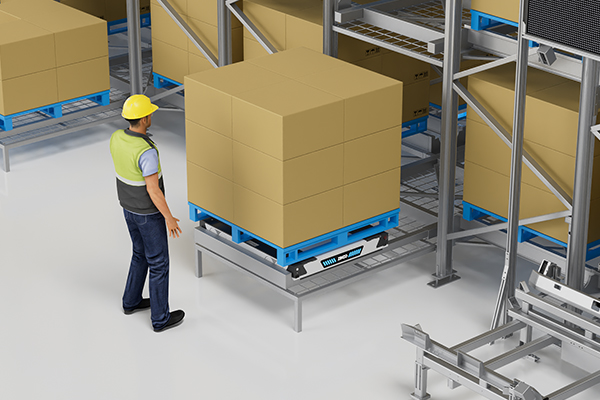
A connected warehouse does not need a human to ask “where is this order?” The answer already exists in the system. A pallet enters receiving, is identified by an RFID reader, and is assigned a storage location. A shuttle reports its position and available charge. An elevator reports whether it is free or transferring another unit. The WCS compares these states and releases the next task at the right moment.
This is a control loop, not a dashboard. Dashboards inform people. Control loops change machine behavior. That is the operational difference IoT introduces.
How IoT Changes Daily Warehouse Execution
Real-Time Pallet and Shuttle Visibility
Without IoT, many warehouses operate with accurate records but delayed visibility. A WMS may know that a pallet is stored in aisle 12, but not whether the assigned shuttle is currently available, blocked, or low on battery. IoT closes that gap by feeding machine state into the same operational picture as inventory state.
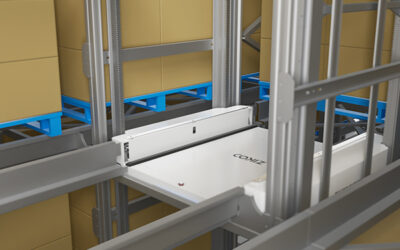
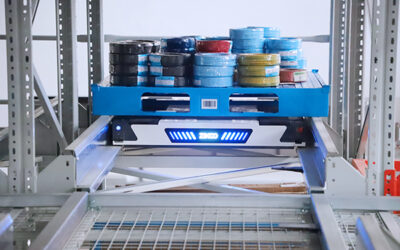
When a four-way shuttle reports its location continuously, the system can choose the shuttle with the shortest travel path and enough remaining charge. That reduces deadhead movement and avoids sending work to a unit that is about to pause for charging.
Dynamic Task Assignment and Exception Handling
In a fixed automation sequence, tasks run in a predetermined order. IoT allows exception-based assignment. If one workstation is backlogged, the system can route the next pallet to a less busy station. If a shuttle reports an obstruction, the WCS can pause that task and release an alternative route.
These decisions are measurable through operational indicators. Throughput, order cycle time, and equipment utilization can follow the definitions in ISO 22400-1 [4]. Tracking them by hour, rather than by shift, shows whether the connected system is actually performing better than the previous manual process.
From Equipment Data to WMS/WCS Decisions
The practical value of IoT appears when WMS, WES, WCS, and RCS share a common event stream. WMS decides what to fulfill. WES balances work across zones. WCS coordinates shuttles, elevators, and conveyors. RCS talks to each robot in its own control language.
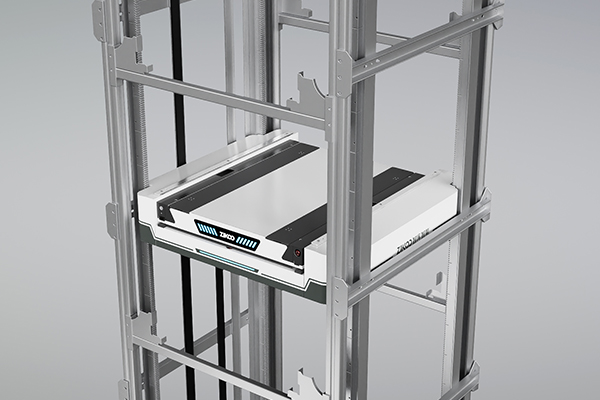
IoT sits between these layers as a translation and timing mechanism. For example, in a pallet-to-person workflow, an R-bot Four-way Shuttle can report position, battery state, and load presence. The software can then choose an available shuttle rather than waiting for a fixed route. That simple change turns a pre-planned sequence into a self-adjusting system.
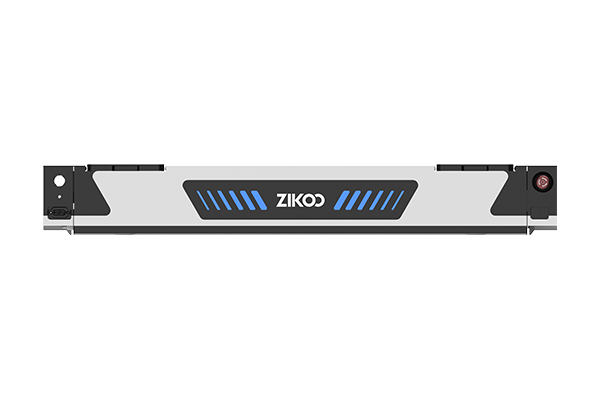
When storage and transport equipment share a common data layer, the warehouse behaves as one system rather than isolated machines. <Smart Storage Revolution: Comprehensive Overview of Four-Way Shuttle Systems for Automatic 3D Warehouses> covers how integrated shuttle systems create automatic 3D warehouses.
Making AS/RS and Shuttle Systems Smarter
A four-way shuttle already has controllers for movement, lifting, and positioning. IoT adds another layer: operational intelligence. Shuttles can operate as a fleet instead of as individual devices. Cluster decisions become possible because the system can see battery levels, cycle counts, and queue loads across the entire fleet.
Industrial wireless networks based on IEEE 802.15.4 are often used for sensor data in rack aisles [2]. These low-rate networks provide the short, frequent messages needed for equipment monitoring without requiring a cable connection to every shuttle position.
In a six-way shuttle configuration, the R-bot handles horizontal movement while the H-bot handles vertical transfer. IoT data lets the system coordinate those two robot types as one storage network rather than as separate machines. The result is smoother pallet flow and fewer manual interventions.
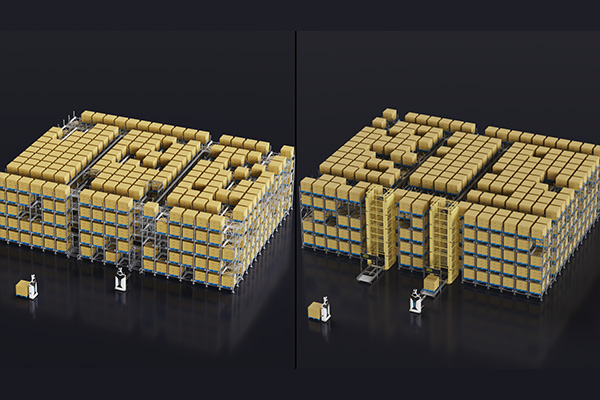
Sensor data only becomes valuable when it changes equipment behavior in real time. <Six-Way Shuttle Unlocks the Era of True 3D Intelligent Warehousing> covers how a six-direction shuttle network turns connected signals into true 3D intelligent warehousing.
Planning an IoT-Enabled Warehouse Upgrade?
IoT adoption is more useful when it starts with a defined operational problem: receiving accuracy, order turnaround, cold-chain compliance, or maintenance response. A site audit can show where data currently stops and where decisions still rely on manual checks.
For a system-level evaluation of your pallet storage and shuttle operations, contact our engineers at [email protected] or call (+86)-19941778955. We can help define an integration path that fits your current WMS and material flow without forcing unnecessary replacement.
Reliability, Safety, and Uptime
A common concern is what happens when the network goes down. In a well-designed IoT warehouse, equipment has local control capability. A shuttle can complete a safe stop if communication drops, and the rack-level controller can retain the last valid command until the connection returns.
Safety systems follow the same layered principle. Driverless industrial truck requirements under ISO 3691-4 [5] guide zone control, obstacle detection, and emergency stop behavior. IoT supports these systems by providing faster awareness of people, equipment, and blocked paths, but it does not replace the local safety controller.
In high-density environments such as pharmaceutical storage, environmental data adds another control layer. Temperature, humidity, and battery state can be monitored continuously, reducing the risk of silent failures that only appear when product quality is already affected.
Scaling IoT Without Ripping Out the Warehouse
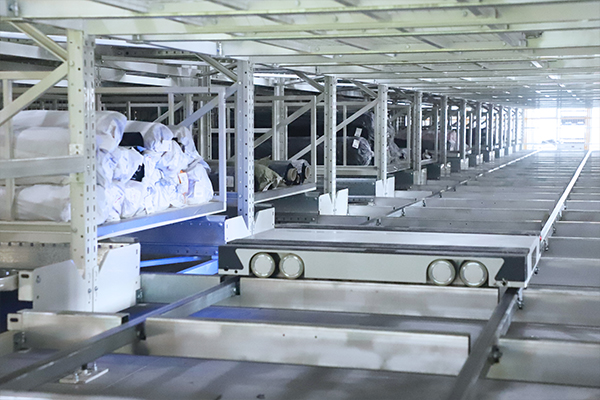
Most warehouses do not transform all at once. A practical path is to start with one storage zone or one material flow, connect the relevant equipment, and let the WCS consume that data before expanding further.
Edge gateways and protocol converters allow older equipment to join the data environment without replacing every motor or controller. Once the first zone is operating, additional shuttles, elevators, and workstations can be added in phases. The system grows from a connected pilot into a connected building.
Warehouses rarely transform all at once. <Six-Way Shuttle Drives Warehouse Upgrades: Building an Intelligent Automatic 3D Warehouse> covers the step-by-step path from conventional storage to an intelligent automatic 3D warehouse.
Talk to Our Warehouse Automation Engineers
Zikoo Smart Technology Co., Ltd. specializes in pallet-to-person robotics, including the U-bot Omnidirectional Stacker Robot, R-bot Four-way Shuttle, and H-bot High-speed Elevator. The PTP Smart Warehouse Software integrates WMS, WES, WCS, and RCS functions so that equipment data becomes an operational asset.
If you are evaluating an IoT-enabled warehouse upgrade, share your warehouse size, SKU profile, temperature requirements, and throughput targets. Our engineers can help you separate necessary integration steps from avoidable complexity.
Address: 4F, Building 4, No. 170-1 Software Avenue, Yuhuatai District, Nanjing, China
Email: [email protected]
Phone: (+86)-19941778955
FAQ
Does IoT require replacing our current WMS?
Not necessarily. Many IoT platforms connect to existing WMS systems through APIs or standard interfaces. The priority is to make equipment data available to the system that already manages orders and inventory.
What happens if the warehouse network goes down?
Local controllers should be able to bring equipment to a safe state and retain the last valid instructions. When the network returns, the system can re-synchronize positions and task states before resuming normal operation.
How does IoT improve pallet shuttle reliability?
It monitors signals such as battery level, cycle count, temperature, and error events. That data supports better charging decisions, earlier maintenance intervention, and faster diagnosis of intermittent faults.
Is IoT only for large automated warehouses?
No. Small and mid-sized operations can start with one zone or one process. A focused pilot often provides better data for the next investment decision than a full-site deployment made without operational evidence.
Where should an IoT-enabled warehouse project start?
Start where information delay causes the most cost: receiving accuracy, picking errors, cold-chain compliance, or equipment downtime. Mapping those data gaps first creates a clear scope and a measurable target.
References
[1] ISO/IEC 30141:2018, Internet of Things (IoT) — Reference Architecture, ISO/IEC, 2018.
[2] IEEE 802.15.4-2020, IEEE Standard for Low-Rate Wireless Networks, IEEE, 2020.
[3] ISO/IEC 18000-63:2021, Information technology — Radio frequency identification for item management — Part 63: Parameters for air interface communications at 860 MHz to 960 MHz Type C, ISO/IEC, 2021.
[4] ISO 22400-1:2014, Automation systems and integration — Key performance indicators (KPIs) for manufacturing operations management — Part 1: Overview, concepts and terminology, ISO, 2014.
[5] ISO 3691-4:2020, Industrial trucks — Safety requirements and verification — Part 4: Driverless industrial trucks and their systems, ISO, 2020.
If you’re interested, check out these related articles:
PTP Intelligent Warehousing Platform: Building a Flexible and Smart Logistics Ecosystem
Multi-Scenario Smart Adaptation: Zikoo’s Six-Way Shuttle Powers the Digital Transformation of Warehousing
Six-Way Shuttle Drives Warehouse Upgrades: Building an Intelligent Automatic 3D Warehouse