Compact pallet storage solutions reduce the aisle space and floor area that conventional selective racking consumes. Deep-lane, push-back, and pallet flow systems each achieve this by storing multiple pallets in one lane, but they differ in access logic, pallet movement, stock rotation, and automation potential. The right choice depends mainly on SKU depth, FIFO or LIFO requirements, pallet condition, throughput, and available building height. This article explains how the three methods actually work, where each one fits, and which layout checks matter before a project is fixed.
The Three Compact Storage Methods at a Glance
Each compact storage method trades access flexibility for density. The table below separates the main technical differences before looking at the system-level constraints.
| System | Access pattern | Stock rotation | Best fit | Key constraint |
|---|---|---|---|---|
| Deep-lane shuttle storage | Shuttle moves pallets inside the lane; lift truck or lift station works at the face | FIFO or LIFO depending on one-face or two-face lane design | Deep lanes, high density, larger SKU batches, medium-to-high throughput | Requires shuttle equipment, lane rails, and WCS coordination |
| Push-back racking | Last pallet loaded is the first pallet retrieved at the picking face | LIFO | Few SKUs with multiple identical pallets, limited depth, lower automation budgets | Lane depth is usually limited; pallet condition and rail maintenance matter |
| Pallet flow racking | Pallets are loaded at the rear and gravity-fed to the front | FIFO | High movers, date-sensitive inventory, order assembly, dock sequencing | Requires lane slope, speed control, and consistent pallet quality |
The phrase compact storage does not mean that every product belongs in the same lane type. It means that the system should be selected so that lane depth, access frequency, and rotation discipline fit the actual inventory profile.
Deep-Lane Shuttle Storage: High Density With Automated Pallet Movement
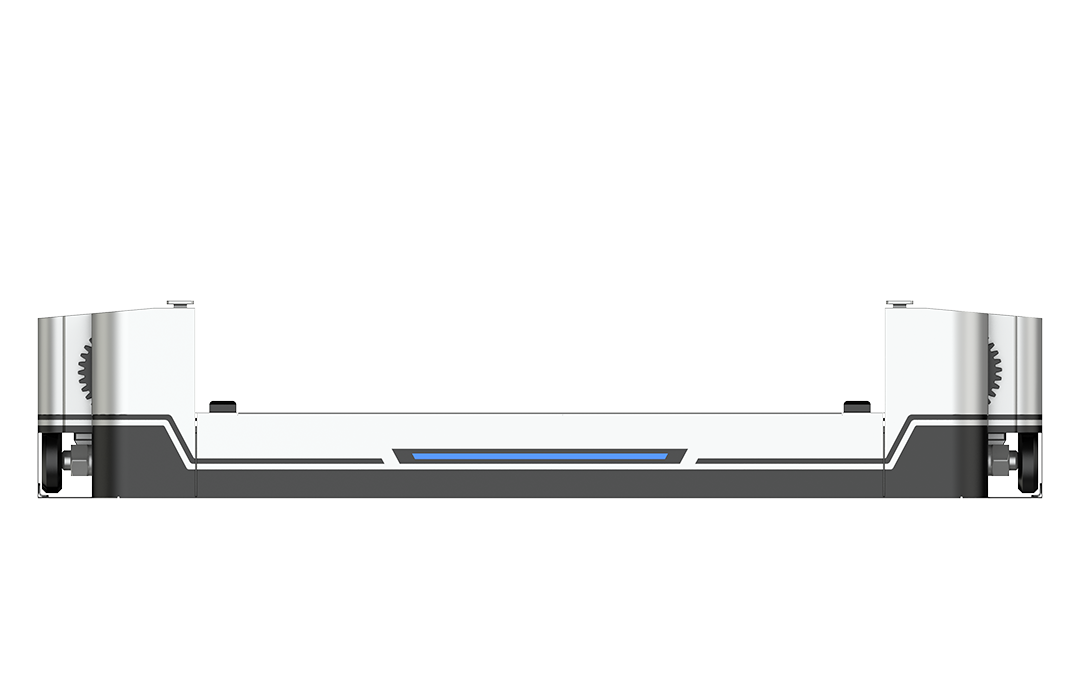
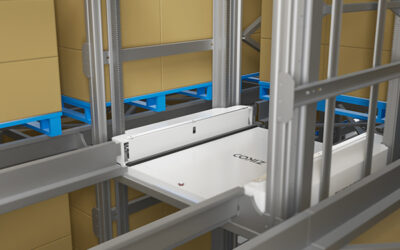
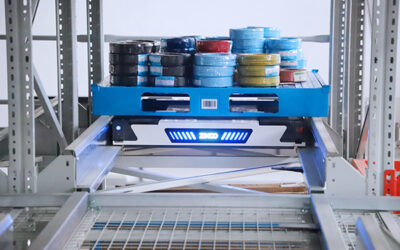
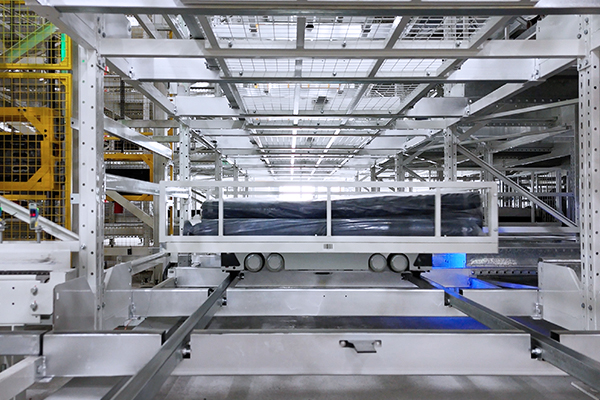
Deep-lane shuttle storage uses a motorized pallet shuttle that travels on rails inside a storage lane. The shuttle lifts a pallet slightly, carries it to the correct depth, sets it down, and returns to the face for the next task. A lift truck, transfer car, or vertical lift places the shuttle into the selected lane when the shuttle is semi-automatic. In fully automatic installations, the shuttle can remain in the rack and receive missions from warehouse control software.
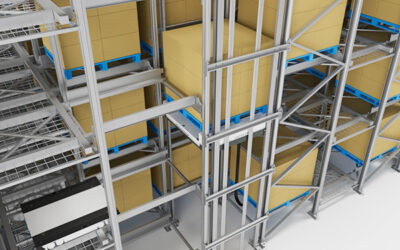
The main advantage is that lane depth can grow without adding aisle width. A shuttle lane can hold far more pallets than a push-back lane, and it can support both FIFO and LIFO layouts. In a single-face lane, pallets enter and leave from the same end, creating LIFO behavior unless the software re-sequences tasks. In a drive-through or two-face layout, pallets enter at one end and leave at the other, producing FIFO flow.
The tradeoff is access time. A longer lane improves space utilization but increases travel time for the shuttle, especially when the required pallet is at the rear. The more pallets in the lane, the more important mission batching becomes. If the system retrieves one pallet at a time from different deep lanes, travel time can reduce pallets per hour even though the building holds more stock.
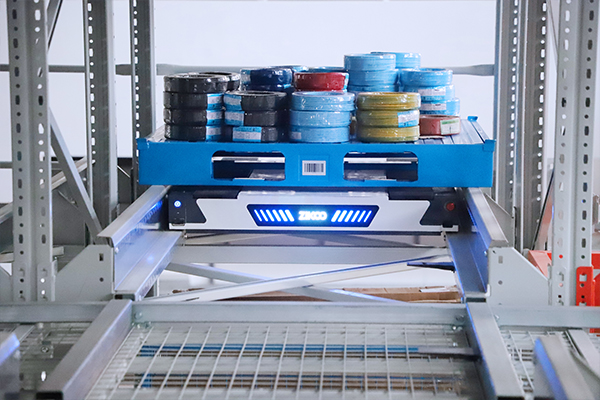
Deep-lane storage only works when the shuttle path, lift position, and lane depth are matched to the retrieval pattern. <Six-Way Shuttle Powers Dense Storage: Breaking Space Limitations> covers how dense shuttle storage increases pallet positions within a fixed building footprint.
Push-Back Racking: LIFO Density for Limited SKU Depth
Push-back racking stores pallets on nested carts or carriages that ride on rails. When a forklift places a new pallet at the face, the pallet pushes the one behind it deeper into the lane. When the operator removes the front pallet, the remaining pallets roll forward to the face. The last pallet loaded is therefore the first pallet retrieved.
This system works best when a limited number of pallets share the same SKU. Depth is commonly limited to a few pallets, often between two and six deep depending on pallet weight, height, and rack configuration. If depth is too great, the forklift must push a large mass backward, and retrieval still exposes only the front pallet.
Push-back racking provides density without shuttle equipment, making it simpler than deep-lane shuttle storage and easier to maintain at a basic level. However, it is a LIFO system. It is not suitable for date-sensitive products, strict FIFO operations, or lanes that mix several SKUs. Mixed SKUs create extra touches because the operator must remove upper pallets to reach a different item.
Pallet condition and floor flatness matter. A broken bottom board or a twisted pallet can cause the carts to bind, skew, or push unevenly. Rail cleanliness, end stops, and regular rack inspection should be included in the maintenance plan.
Pallet Flow Racking: Gravity-Fed FIFO for Date-Sensitive Inventory
Pallet flow racking uses inclined lanes with gravity rollers or wheels. Pallets are loaded at the higher rear end and move by gravity to the lower front face. The first pallet loaded becomes the first pallet picked, which makes pallet flow the simplest compact option for strict FIFO rotation.
The main benefit is high picking speed at the face. As soon as a pallet is removed, the next pallet advances into position, so the operator does not need to enter the lane or wait for handling equipment. This is useful for order assembly, short shelf-life goods, and high-volume SKUs where many pallets move through the warehouse.
The main risk is pallet inconsistency. Flow rails depend on the bottom surface of the pallet moving smoothly across each roller or wheel. Damaged bottom boards, protruding nails, broken slats, or inconsistent pallet dimensions can cause pallets to stop, skew, or ride over one another. Speed brakes or retarders are also needed to prevent pallets from hitting the front stop too fast.
Maintenance requirements are higher than for static racking because rollers, brakes, lane slope, and front stops must be inspected and cleaned. Pallet flow lanes can also have lower storage depth than shuttle lanes, especially when pallet weight or fire protection rules affect the lane slope.
Choosing by SKU Profile, Rotation Rule, and Pallet Quality
The decision should start with the inventory data rather than the equipment preference. A useful first-pass checklist is shown below.
| Requirement | Usually better fit | Reason |
|---|---|---|
| Strict FIFO or expiry-date rotation | Pallet flow racking, or a two-face deep-lane shuttle layout | Gravity flow or drive-through movement preserves first-in, first-out order |
| Multiple identical pallets per SKU and LIFO is acceptable | Push-back racking or a single-face shuttle lane | Dense storage without requiring strict expiration control |
| Deep lanes and automated pallet movement | Deep-lane shuttle storage | Shuttle can reach pallets beyond practical forklift push depth |
| Consistent pallet size and strong bottom condition | Pallet flow racking | Gravity movement depends on predictable pallet contact with rollers |
| Damaged or mixed pallet fleet | Deep-lane shuttle or push-back, with pallet inspection added | Pallet flow lanes tolerate less variation |
A quick layout estimate starts with a simple space calculation: storage positions equal lanes multiplied by pallets per lane multiplied by levels. For example, 8 lanes that are 10 pallets deep and 4 levels high give a nominal capacity of 320 pallet positions. This is only a space calculation. Throughput depends on shuttle speed, lift capacity, lane access, and how the software batches tasks.
Automation, Software, and Facility Checks Before Layout Freeze
Automation changes the design conversation when density alone is not enough. A semi-automatic shuttle system still needs a clear aisle plan and a method for moving the shuttle between lanes. A fully automatic deep-lane system needs WMS inventory records, WCS or WES mission orchestration, and RCS robot control to keep pallets moving without conflicts.
Zikoo’s R-bot four-way shuttle is an example of automated dense-storage hardware for pallet-to-person operations. The shuttle body is only 125 mm high, and the model range supports rated loads from 1,200 kg to 2,000 kg, with pallet widths across standard, American, and Japanese formats. The H-bot vertical bidirectional shuttle adds inter-level movement with a positioning accuracy of plus or minus 1 mm, allowing the four-way shuttle to stay in the rack and exchange pallets through a vertical hub.
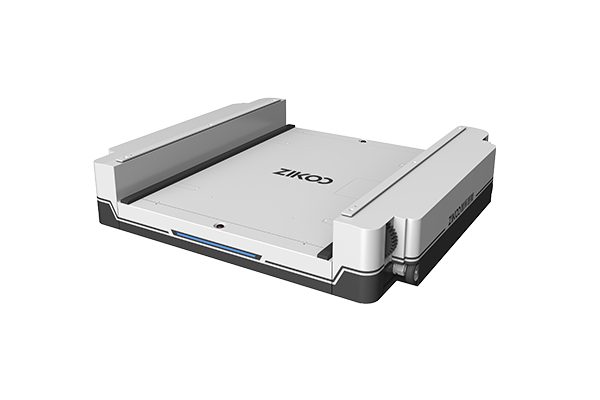
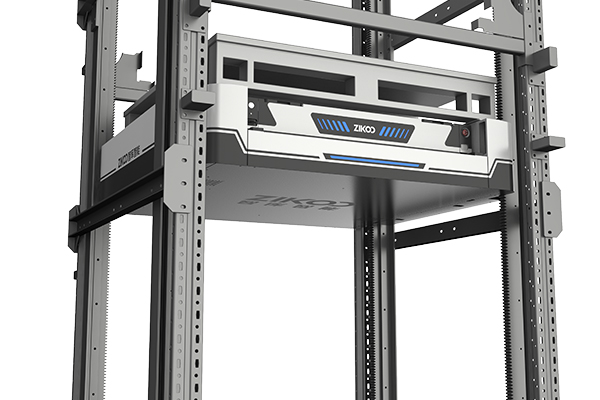
Automation changes layout decisions only when the WMS and WCS can allocate missions at the speed the lanes require. <Software-Driven Hardware: Six-Way Shuttle Maximizes Warehouse Efficiency> covers how software and shuttle motion are designed together to improve warehouse output.
Before the layout is frozen, verify the building conditions that can change all three systems. Floor flatness, column spacing, clear height, rack squareness, sprinkler clearance, and pallet dimensions must be measured against the chosen lane geometry. An aisle that works for push-back may be too narrow for a lift station, while a pallet flow lane that works on paper may fail if the actual pallet fleet has mixed bottom boards.
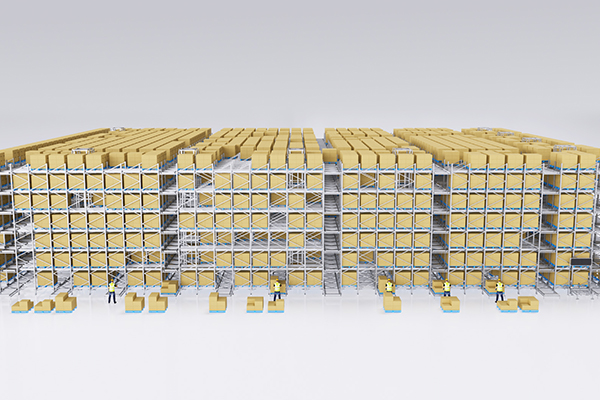
Choosing among high-density systems often leads to the same integration question: how far should the automatic storage network extend? <Smart Storage Revolution: Comprehensive Overview of Four-Way Shuttle Systems for Automatic 3D Warehouses> covers how four-way shuttles are applied in automatic 3D warehouses.
Next Step: Turn Your Lane Profile Into a Feasible Layout
Before selecting a system, assemble the lane profile: number of SKUs, pallets per SKU, pallet size and weight, inbound and outbound pallets per hour, rotation rule, clear height, floor flatness, and column spacing. Send this short profile to info@zikoo-int.com or call (+86)-19941778955 and request a storage-density comparison for your building. The objective is not to force all products into one lane type, but to see where each method saves the most space without creating a throughput bottleneck.
FAQ
Which compact pallet storage method is best for strict FIFO?
Pallet flow racking is normally the simplest FIFO choice because gravity moves the first-loaded pallet to the pick face. Deep-lane shuttle storage can also provide FIFO if it is designed as a drive-through or two-face system, while push-back racking is LIFO and not suitable for strict date rotation.
Can push-back racking store different SKUs in the same lane?
It is not recommended. Because access is LIFO, mixed SKUs in one lane force the operator to move upper pallets to reach a different product, creating extra touches and errors. Push-back works best with several identical pallets per SKU.
Does pallet flow racking require perfect pallet condition?
Yes, pallet consistency matters more than with static racking. Damaged boards, broken bottom slats, or inconsistent pallet dimensions can cause pallets to skew, stop, or ride over each other on the rollers. A pallet quality check and lane trials should be part of the design phase.
Is deep-lane shuttle storage practical in an existing narrow building?
It can be, because depth can be increased in available length while leaving a narrow operating aisle. However, clear height, floor flatness, column spacing, and lift positioning still constrain the design, so a feasibility check is needed before committing.
If you’re interested, check out these related articles:
Six-Way Shuttle: The Dual-Engine Solution for High-D
Six-Way Shuttle Powers Dense Storage: Breaking Space Limitations
Software-Driven Hardware: Six-Way Shuttle Maximizes Warehouse Efficiency
Smart Cold Chain Era: Six-Way Shuttle System Redefines Storage Efficiency with Maximum Density
Six-Way Shuttle Drives Warehouse Upgrades: Building an Intelligent Automatic 3D Warehouse