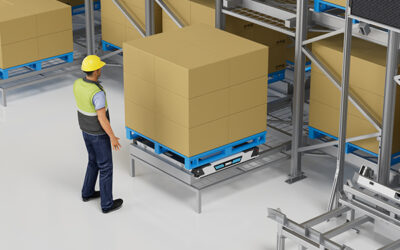
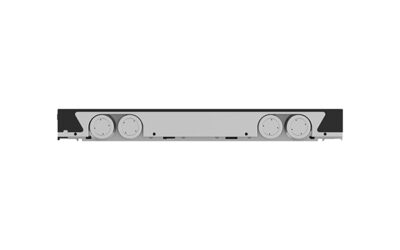
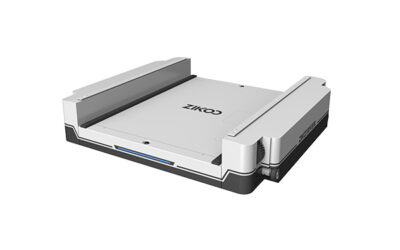
Shuttle storage systems use autonomous pallet carriers inside rack lanes to store and retrieve pallets without assigning a fixed crane aisle to every storage position. For buyers in Germany, Austria, and Switzerland, the main choice is not only between manual storage and automation. It is which shuttle architecture, software layer, and delivery model will operate reliably with their pallet dimensions, building height, temperature, and daily order pattern. The most useful starting point is to define the pallet flow before comparing vehicle specifications. A system that looks flexible on paper can create high integration cost if the rack structure, lift position, fire protection concept, and warehouse control software are not planned as one package.
How Shuttle Storage Systems Change the Warehouse Decision
A four-way shuttle changes the way pallets move inside a dense storage block. It travels along rails within a rack lane, changes direction at intersections, and uses a lift or exchange station to move between levels or aisles. Each shuttle typically carries one pallet per mission, which means the real throughput of the system depends on the number of shuttles, lift locations, mission distance, and how well the warehouse software sequences orders.
This is a different logic from a stacker crane automated storage and retrieval system, where one machine often serves an aisle and carries the pallet through the complete vertical and horizontal movement. It is also different from drive-in racking, where lane depth reduces accessibility and can limit stock rotation.
| Storage approach | Main benefit | Main limitation |
|---|---|---|
| Drive-in or block stacking | Low equipment cost | Deep lanes can restrict FIFO and picking access |
| Stacker crane ASRS | High throughput in tall buildings | Fixed aisles and higher structural investment |
| Two-way pallet shuttle | Dense lane storage with lower vehicle cost | Needs lift trucks or separate equipment to change lanes |
| Four-way shuttle system | Dense storage plus lane-changing flexibility | Performance depends on lifts, rack precision, and software |
The shuttle system therefore does not simply replace the forklift. It transfers part of the operational complexity into rack geometry, lift design, battery management, and control software. Buyers should evaluate the complete system boundary, not the vehicle alone.
Pallet, Building, and Temperature Conditions That Shape the Design
Before asking for a quotation, a DACH buyer should clarify the physical conditions of the warehouse. Shuttle projects fail more often because of a mismatch in site conditions than because the shuttle itself cannot drive.
| Site condition | Design question to resolve |
|---|---|
| Pallet footprint and condition | Which shuttle width and lane pitch fit the actual pallet type consistently? |
| Gross load | Does the rated load cover the heaviest pallet with tolerance? |
| Building height and column grid | Where can lifts, rack blocks, and maintenance zones be placed? |
| Temperature range | Do batteries, charging stations, and electronics handle the working environment? |
| Fire protection concept | Where do detection, sprinkler clearance, and escape routes intersect with lanes? |
| Floor flatness | Can the rack and rails be installed to the required tolerance without major floor repair? |
Textile and manufacturing warehouses often mix several pallet formats and seasonal stock levels, which makes the lane profile and warehouse software reservation logic more important than the shuttle top speed.
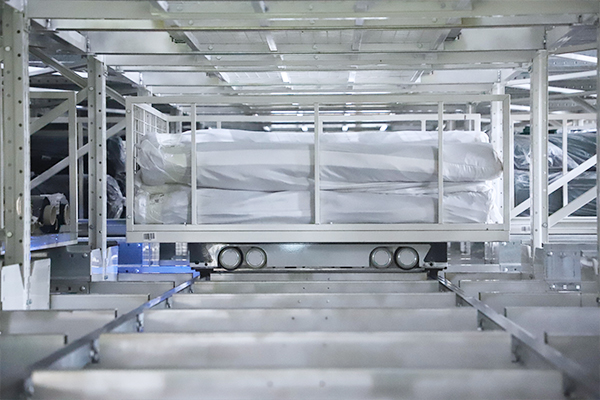
Temperature-controlled storage changes more than the battery specification. In freezer environments, condensation, cable insulation, lubrication, and charging location all affect reliability. The standard R-bot four-way shuttle is specified for operation down to -15°C, while cold chain projects may require a dedicated low-temperature battery and protective treatment for high-humidity or low-temperature use.
Temperature-controlled storage changes battery sizing, charging location, and condensation protection before mechanical speed becomes the main issue. <Revolutionizing Cold Chain Logistics: Zikoo Robotics Six-Way Shuttle Powers High-Density, High-Efficiency Warehousing> covers how shuttle-based automation adapts to high-density cold chain warehouse operation.
Four-Way Shuttle Specifications Buyers Should Verify
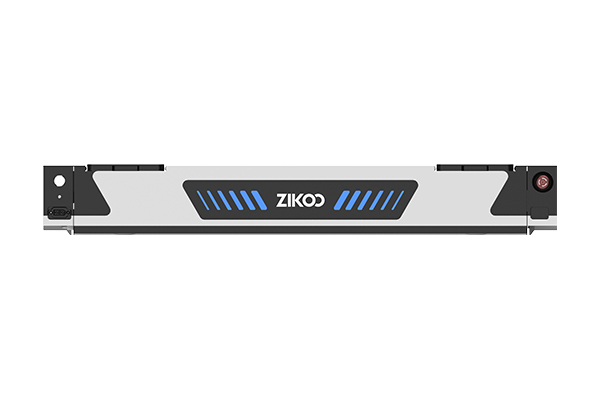
A specification sheet can make similar shuttle systems appear equal. The buyer’s job is to connect the listed values to the planned rack, pallet, and working pattern. As one reference example, the R-bot four-way shuttle from Zikoo shows how much variation exists within a single product family.
| Parameter | R1200B standard example | R2000B heavy-duty large pallet example |
|---|---|---|
| Rated load | 1,200 kg | 2,000 kg |
| Body height | 125 mm | 150 mm |
| Body dimensions | L1000 × W972 × H125 mm | L1250 × W1300 × H150 mm |
| Empty speed | 1.6 m/s | 1.35 m/s |
| Loaded speed | 1.2 m/s | 1.0 m/s |
The range also includes pallet formats for American, Japanese, and European pallet dimensions, as well as a 1,500 kg heavy-duty type. The important point is not that one model is better, but that each model starts from a different pallet and load assumption. A 1,500 kg Japanese pallet specification and a 2,000 kg large-pallet specification do not solve the same warehouse problem.
Battery data also needs operational context. The R-bot uses lithium batteries of 51.2V/40Ah or 51.2V/30Ah, with continuous operation specified at about 8 hours for most models and 7 hours for the heavy-duty large-pallet type. These figures should not be treated as a fixed shift guarantee. A buyer should ask the supplier to calculate the expected runtime using the project’s actual mission mix, lift cycle, idle time, and charging strategy.
Adding Vertical Transport to Build a Six-Way System
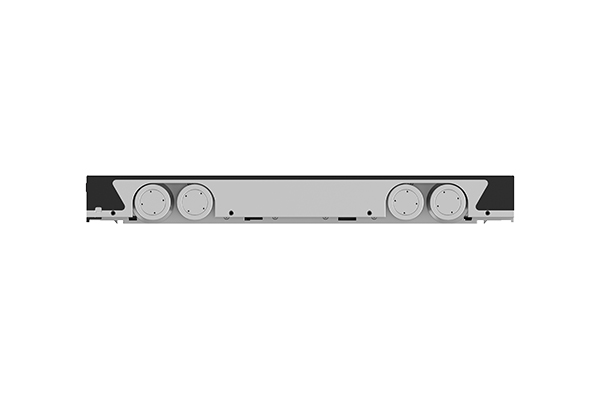
A four-way shuttle moves within a level. To serve a high-rise, multi-level rack, the system must also move pallets vertically. That is where a vertical bidirectional shuttle changes the architecture. The H-bot vertical shuttle is designed to occupy a compact footprint, often around one storage location, while carrying pallets between rack levels.
For the standard H-bot type, the rated load is 1,800 kg, with positioning accuracy specified at ±1 mm. Empty travel speed is 1.0 m/s and loaded speed is 0.5 m/s, with acceleration of 1.0 m/s² empty and 0.3 m/s² loaded. When combined with a four-way shuttle, this vertical transport layer creates six-direction pallet flow: forward, backward, left, right, up, and down.
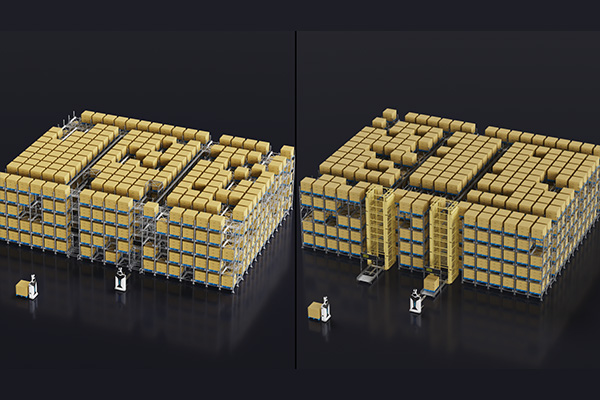
This integrated approach is useful for high-bay dense storage, but it also means the vertical shuttle becomes a critical path. If the lift is unavailable, adjacent rack levels may wait. The design must therefore include the lift’s duty cycle, maintenance access, and fallback operation, not only its speed.
A four-way shuttle alone moves inside the storage aisle, while a vertical shuttle adds the height needed to serve multi-level rack faces. <Six-Way Shuttle: The Dual-Engine Solution for High-Density and High-Throughput> covers how combining lateral and vertical transfer supports the throughput profile of dense pallet storage.
Software Integration Is Part of the Shuttle System
Shuttle hardware cannot be separated from the software that controls it. In most projects, the buyer already has a host system, such as an ERP or WMS, and the shuttle supplier must connect to it through a warehouse control system or robot control system. The relevant question is not only whether the software can exchange data, but which system owns order sequencing, inventory reservation, rerouting, and exception handling.
The PTP Smart Warehouse Software concept covers WMS, WES, WCS, and RCS functions. In practice, this means the system should know which pallet is stored where, decide which shuttle should perform a mission, coordinate lift and shuttle movements, and provide a clear interface to the host system.
For a DACH buyer, software scope should be written into the acceptance test. If the supplier provides only the vehicle and the integrator provides the software, responsibility for communication failures can become difficult to assign. A better contract separates interface ownership, data models, recovery procedures, and performance responsibilities in writing.
Warehouse software choices shape mission orchestration, not just data recording. <PTP Intelligent Warehouse Software Empowers Enterprises for Smart Upgrades> covers how a unified software layer coordinates storage, picking, and equipment control during smart warehouse upgrades.
CE Documentation, Project Delivery, and After-Sales in DACH Markets
Within the European market, shuttle equipment is not simply a collection of components. The supplier or integrator should clarify the conformity route, provide the applicable declaration or incorporation documentation, and define the technical interface between shuttle, lift, rack, and control system. The buyer should not accept a CE mark on the shuttle as evidence that the complete installed system is compliant without checking the contract scope.
| Audit area | What to request | What it confirms |
|---|---|---|
| CE conformity | Declaration of conformity or incorporation and technical file summary | The applicable conformity route for the delivered system |
| Rack interface | Structural calculation summary and installation tolerance | The boundary between rack quality and shuttle performance |
| Software scope | Interface specification and exception-handling matrix | Which party controls WMS, WCS, and RCS behavior |
| Acceptance test | Test plan, cycle counts, and failure recovery scenarios | Whether throughput claims are measurable |
| Spare parts | Recommended spare list and lead times | Whether operational risk can be managed locally |
| Support | Response times, remote access, and escalation path | How after-sales service will work after go-live |
German-speaking markets often place strong weight on documentation, testing, and clear responsibility. A supplier that cannot explain the conformity route, installation tolerances, or software interface before contract signature is likely to create the same ambiguity during commissioning.
How to Compare Offers Without Inflating Risk
Shuttle system offers can differ sharply because they do not always include the same scope. One offer may include rack steel, lifts, fire protection modifications, and installation. Another may appear cheaper because it covers only the shuttle vehicles, leaving the buyer to purchase the other scope separately.
A practical way to compare offers is to define a single operational scenario before sending the request. The buyer should state the pallet footprint, gross weight, inbound and outbound pallets per day or shift, building height, temperature range, SKU count, and host system interface. Each supplier should then return a system concept, a list of exclusions, and an acceptance method based on the same scenario.
When offers differ, do not first compare price. First compare scope, then compare whether the proposed number of shuttles and lifts can reach the required throughput, then compare the technical conditions attached to performance. Price is meaningful only after these elements are normalized.
Plan Your Shuttle Storage Evaluation With a Warehouse Data Brief
Send Zikoo Smart Technology Co., Ltd a short data brief covering pallet footprint and gross weight, inbound and outbound pallet movements, building height and column grid, temperature range, expected SKU count, and the WMS or host system to be connected. That information allows a system review to distinguish between a four-way shuttle, a six-way shuttle with vertical transport, or a staged retrofit concept. Contact info@zikoo-int.com or call (+86)-19941778955.
FAQ
Is a four-way shuttle system suitable for an existing DACH warehouse with low ceiling height?
It depends on the usable rack height and column grid. Four-way shuttles can work in medium-height buildings if lifts and rack blocks can be arranged, but the density advantage may be limited when there are few vertical storage positions. Ask the supplier to calculate lane depth, lift positions, and whether the roof structure or fire concept creates obstacles.
Does a shuttle system for Germany require CE marking beyond the shuttle itself?
Yes in product-scope terms, the shuttle, lift, and rack interface should be evaluated as part of the complete installation or as partly completed machinery. The buyer should receive the applicable declaration of conformity or incorporation, a technical documentation summary, and clear interface conditions for the rack and software.
Why do shuttle system offers for the same number of pallet positions vary so much?
Differences usually come from rack steel scope, the number of lifts, software licenses, installation and cabling, spare parts, and civil or fire protection work. One offer may also assume a different throughput or acceptance method. Compare offers only after the scope sheet and acceptance scenario are normalized.
What happens if the warehouse network or software connection fails?
The system design should define safe states, local recovery, and manual procedures. Ask how the control system saves mission data, how shuttles return to maintenance positions, and whether the WCS can operate at reduced function if the host WMS is offline. These conditions should be part of the acceptance plan, not handled after installation.
Can a shuttle system support future expansion?
Many can, but only if the original rack layout, lift positions, power supply, and software licenses allow additional shuttles or rack depth without a complete rebuild. Request the expansion assumptions in writing, including which equipment can be added and which structural interfaces are already reserved.
If you’re interested, check out these related articles:
Revolutionizing Cold Chain Logistics: Zikoo Robotics Six-Way Shuttle Powers High-Density, High-Efficiency Warehousing
Stacker Crane vs Four-Way Shuttle: Which Fits Your ASRS Warehouse Best
Smart Warehousing Starts Here: Cost-Effective Four-Way Shuttle Systems
PTP Intelligent Warehousing Platform: Building a Flexible and Smart Logistics Ecosystem