The choice between an ASRS and a pallet shuttle system is not the either-or decision that many tenders make it. A fully automated pallet shuttle is an ASRS. Automated storage and retrieval means the machine, not a forklift driver, puts pallets away and brings them back, and a shuttle block does exactly that. The comparison that changes capital cost, throughput and risk is narrower: a unit-load stacker crane ASRS against a shuttle-based dense storage ASRS. Those two architectures put their constraints in different places, and knowing where each one breaks is what makes the selection reliable.
What ASRS Means and What a Pallet Shuttle Actually Is
ASRS is a category, not a machine. It covers any storage block where loads are handled automatically between a station and a storage position. Unit-load stacker cranes, shuttle-based pallet systems, mini-load cranes for totes and vertical lift modules all sit inside that category. A supplier who quotes an ASRS price without naming the machine type has told you very little about density, throughput or cost.
Pallet shuttle is the more confusing label, because three different products are sold under it.
| Configuration | What moves the pallet | Operator involvement | Is it an ASRS |
|---|---|---|---|
| Unit-load stacker crane | One rail-mounted crane per aisle travels, hoists and extends a fork or satellite | None during storage and retrieval | Yes |
| Radio shuttle racking | A battery shuttle runs inside a lane while a forklift lifts to level and serves the aisle face | Forklift driver commands every move | No, it is semi-automatic |
| Automated pallet shuttle | Pallet-carrying vehicles run on rails inside the rack, with a lift for level changes | None during storage and retrieval | Yes, shuttle-based ASRS |
The middle row matters commercially. Radio shuttle racking reduces travel inside the lane but keeps the forklift, the driver and the vertical move. It is a density improvement, not automation of the storage function. When a vendor compares its shuttle product to an ASRS, confirm which of these three it is selling, because the labour model and the control software are not comparable.
How Each Architecture Physically Moves a Pallet
A stacker crane is a serial resource. One machine owns an aisle, and every putaway and retrieval in that aisle queues behind it. The crane travels along the rail, hoists the carriage to the right level, extends the load handler and returns to the station. Throughput per aisle is fixed by that cycle. Add output and you add aisles, each with its own crane, and each consuming floor area at every level of the building.
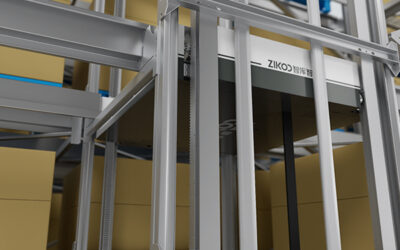
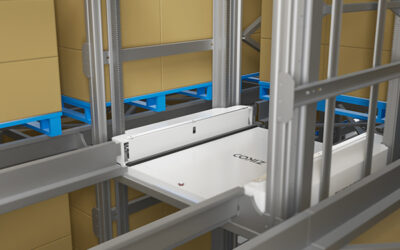
A shuttle system inverts that. Horizontal travel is parallel, because many vehicles share the same rack. Vertical travel is centralised, because level changes happen on a small number of lifts. The rack itself becomes the transport network.
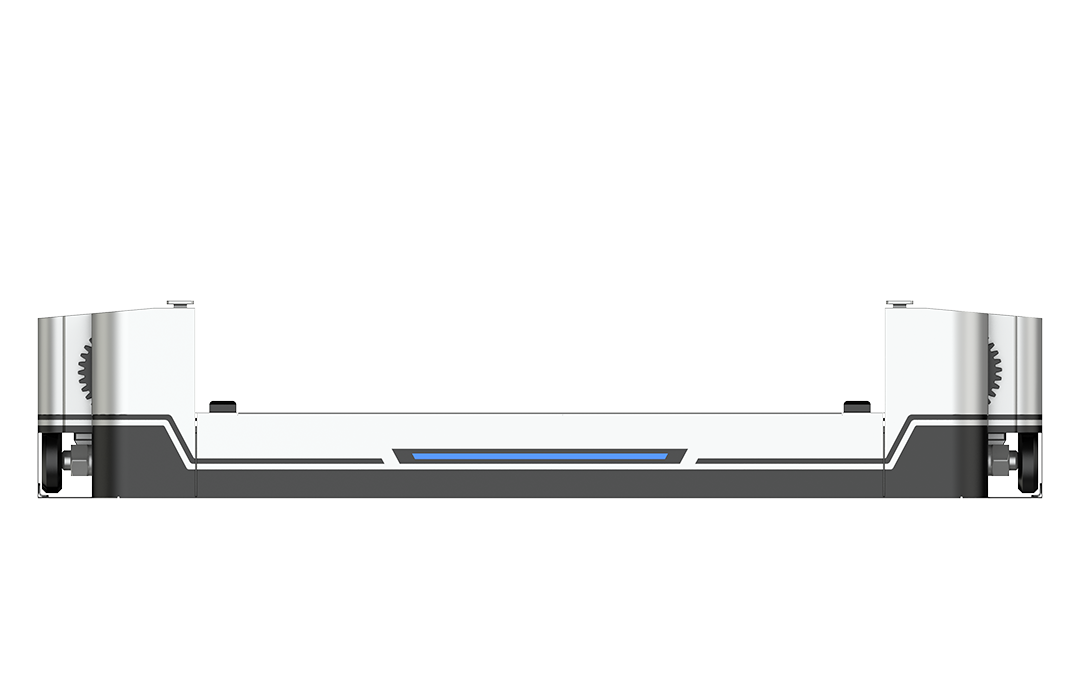
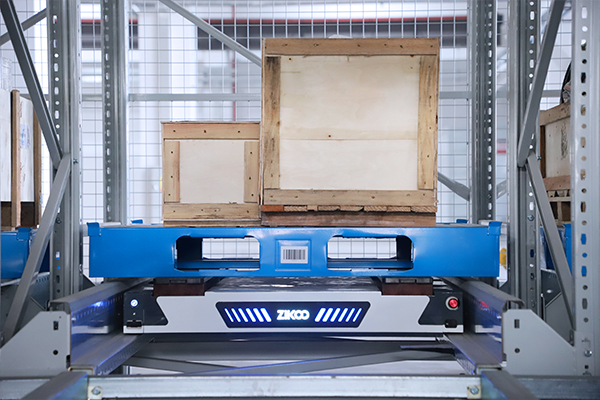
Consider how that ratio behaves. A four-way shuttle such as Zikoo’s R-bot runs on rails through the rack with a 125 mm body height, carries 1.2 t to 2 t depending on model, and travels at 1.6 m/s empty and 1.2 m/s loaded on the standard types. It cannot change level by itself. That job belongs to a vertical lift such as the H-bot, which occupies a single storage position footprint, handles 1,800 kg and positions to within plus or minus 1 mm. Every pallet crossing between levels passes through one of those lifts. A block with 30 vehicles and two lifts has a different ceiling from a block with 20 vehicles and four lifts. The vehicle count on the quotation is not the throughput figure. The vehicle-to-lift ratio is.
Separating horizontal travel from vertical travel is the design idea behind rail-mounted vehicle fleets in dense racking. <Six-Way Shuttle System Leads the Shift from Machines to Robots in Dense Storage Automation> covers how dense storage automation is moving from fixed machines toward coordinated vehicle fleets.
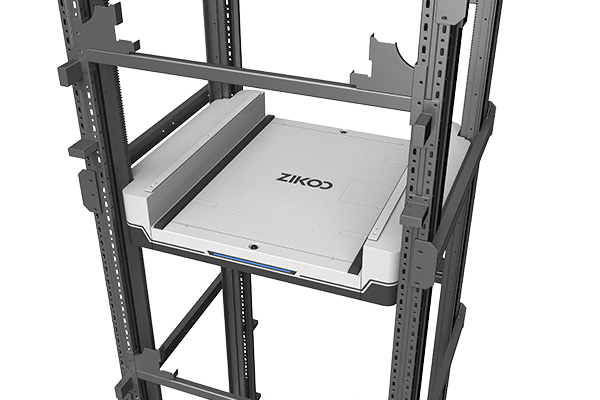
This difference decides where redundancy sits. A crane failure takes an entire aisle offline, and the inventory in it is unreachable until the machine is repaired. A shuttle failure removes one vehicle from a pool, and the block keeps working at reduced capacity. Operators who cannot tolerate a full aisle going dark often pay for a crane they do not otherwise need.
What Throughput Claims and Cycle Time Really Prove
Pallets per hour is the number buyers compare and the number that most often fails to survive commissioning. The figure is not meaningless, but it is a result rather than a property, and it depends on four assumptions that are rarely stated together.
| Published figure | What it typically measures | What it does not establish |
|---|---|---|
| Pallets per hour | A peak rate at one station under a selected task mix | Sustained output across a shift including battery changes, station waits and replenishment |
| Cycle time in seconds | A single command, meaning one storage or one retrieval between defined points | Combined cycles where a retrieval is paired with a putaway in the same trip |
| Positions per square metre | Rack footprint only | Total building area once stations, lifts, charging bays and fire access are included |
| Lift height in metres | Structural top of the rack | Usable top level after sprinkler clearance and the vehicle envelope |
| Temperature rating in degrees Celsius | The vehicle’s declared operating range | Battery runtime and charging strategy at that temperature |
These conventions appear widely in tenders, but they are not standardised definitions. Ask each supplier to state its own basis in writing, then compare like with like.
The largest of the four assumptions is task mix. A storage-only profile gives one cycle per trip. A paired profile, where a retrieval on the return leg saves a journey, gives a materially better rate from the same machine. Real operations sit somewhere between, and the ratio changes by season and by product mix. A quotation built on paired cycles will look excellent until the first peak week when inbound and outbound do not balance.
The practical answer is to replace the supplier’s benchmark with your own order profile. Take twelve months of history, identify the peak hour rather than the peak day, define the share of retrievals that can be paired with putaways, and require acceptance against that profile with the station handshake included. A rate measured at the machine is not a rate measured at the dock.
Storage Density Comes From Geometry, Not From the Vehicle
Density is a property of the building and the rack layout, not of the machine inside it. Three levers set it: usable height, the share of floor taken by travel and transfer, and the depth of each storage lane.
Height is the first. A crane system converts height directly into positions, because one machine serves every level of its aisle. Shuttle systems also build upward, but their practical top is bounded by the lift equipment and by the rack structure that carries the vehicle rails. In both cases the number that matters is usable height, not structural height. Clearance below sprinkler deflectors, in-rack sprinkler levels and the space a vehicle needs above the top beam all reduce the stack you can actually sell to your operations team.
Floor share is the second. Every crane needs its own aisle, and that aisle costs area at every level. Adding cranes to raise throughput therefore lowers density within the same building. A shuttle block avoids per-machine aisles because the vehicles travel inside the rack, but it pays for the space that lifts, stations and charging occupy.
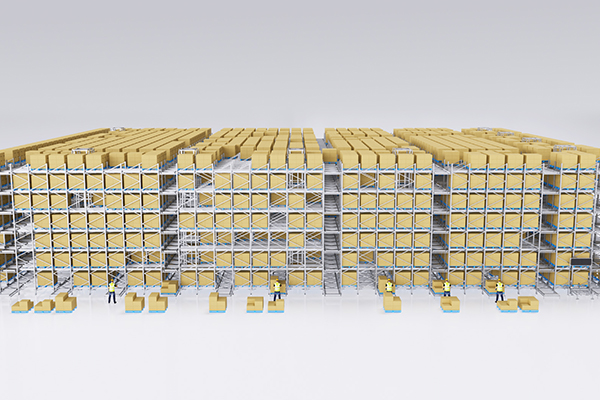
Lane depth is the third, and it is where dense designs are most often oversold. Deep lanes raise positions per cubic metre, and they also reduce selectivity. If your profile holds two pallets per SKU and the lane is six deep, four positions are unusable until the front pallets leave. That effect, usually called honeycombing, can consume the entire density gain in a high-SKU warehouse. Deep-lane storage earns its place when a small number of SKUs move in full lanes.
Lane depth and rack geometry decide how much of a building becomes storage, and the trade against selectivity is where dense designs are won or lost. <Six-Way Shuttle Powers Dense Storage: Breaking Space Limitations> covers dense storage as a way to break space limitations.
Pallet Quality, Load Weight and Temperature Limits
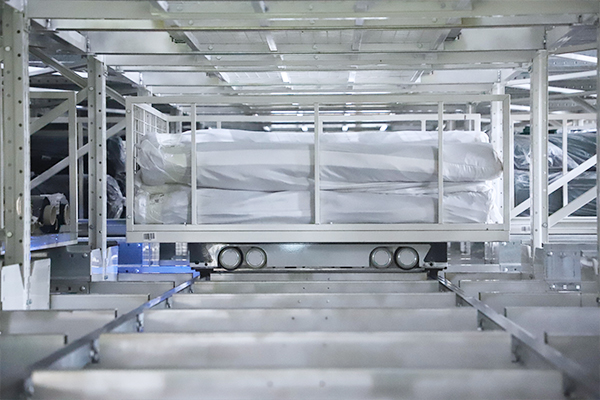
Shuttle systems are less forgiving of pallets than cranes are. A crane picks from a fork placed under the load, so a warped pallet with a protruding nail is inconvenient. A shuttle carries the pallet on rails, and the bottom boards bear the load directly. Broken bottom boards, missing blocks and swollen deck boards become faults that stop a lane.
Test this before choosing. Sample around a hundred pallets across all inbound sources over several weeks, record length, width, height, overhang, board condition and material type, and note how many would fail a written pallet standard. If a large share fail, either the shuttle case includes a pallet replacement and inspection programme or the architecture is wrong for your inbound reality. Mixed wood and plastic pools deserve particular attention, because they behave differently on rails and on forks.
Load weight narrows the field in the other direction. Pallet shuttle hardware is rated per model, and the heavy-duty variants of a four-way shuttle reach around 2 t while standard models sit at 1.2 t to 1.5 t. Crane capacities are project-specific and often larger. For ton-class loads in the energy, metals or building materials sectors, check the actual rated load of the specific model against your heaviest recurring pallet, not your average.
Temperature adds a second set of limits. In a freezer at minus 25 degrees Celsius, battery chemistry, charging ports, lubricants and sensor behaviour all change. A cold-store shuttle needs a low-temperature battery pack, heated or protected charging interfaces and conformal coating on control boards to survive condensation during defrost cycles. Crane installations move the problem instead of solving it, because the machine room can often be kept outside the cold zone while only the mast and load handler enter it. Count how many powered devices sit inside the freezer in each design; fewer devices in the cold usually means fewer interventions.
Where the Money Goes in Each Architecture
Neither architecture is cheaper in general. The cost lands in different lines, and which line dominates depends on whether you are building new or fitting into an existing shell.
In a crane system, the large items are building height and structure, the crane itself, the rack, and fire protection for a high-bay block. Because one machine serves a whole aisle, redundancy is expensive: protecting against a crane outage means buying an extra aisle rather than an extra component. The machine count is low, the machine cost is high, and the service model is simple because there are few devices to maintain.
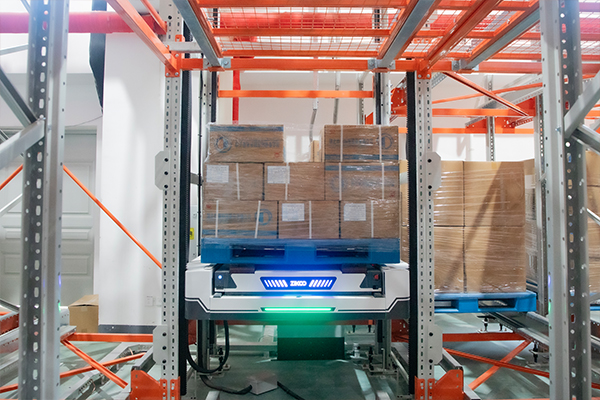
In a shuttle system, the large items are the vehicle fleet, the lifts, the stations, the battery and charging infrastructure, and the control software. Vehicle unit cost is lower and the count is higher, so capital scales more smoothly with throughput and expansion can be staged by adding vehicles. The counterweight is complexity: more devices mean more maintenance events, more spares to hold, and a control layer that has to solve traffic rather than sequence a single machine.
Both designs carry a fire protection bill that buyers underestimate. Dense rack blocks and high-bay cranes present different challenges to sprinkler design, water supply and access for the fire service, and the position is normally settled with your insurer rather than with the automation supplier. Treat the fire engineering review as a gate on the layout, not as a detail after the layout is fixed.
Capital cost is only half the comparison, because the labour and energy profile of each architecture continues for the life of the installation. <Six-Way Shuttle: The Ultimate Warehousing Solution for Cost Reduction and Efficiency> covers cost reduction and efficiency in a six-way shuttle system.
Which Architecture Fits Your Operation
The comparison resolves fastest when you use exclusion conditions instead of feature scores. Each row below identifies a condition, the architecture that usually handles it better, and the situation in which committing would be a mistake.
| Operating condition | Crane-based unit-load ASRS | Shuttle-based dense storage | Do not commit if |
|---|---|---|---|
| Tall new building, density is the priority | Strong, because one machine serves every level | Workable, but bounded by lift and rack-carried rails | Usable height was taken from the structural drawing without deducting sprinkler clearance |
| High SKU count with few pallets per SKU | Moderate, random access within the aisle | Weak, because deep lanes create honeycombing | Lanes cannot be filled and selectivity still matters to the order profile |
| Throughput concentrated in a short daily peak | Bounded per aisle and hard to stretch | Fleet absorbs peaks up to the lift capacity | The peak hour was never tested at the station with your own task mix |
| Poor or mixed pallet quality | Tolerant, since a fork works under the load | Intolerant, since rails and vehicles need sound bottom boards | No written pallet standard or inbound inspection exists |
| Existing building with limited height and floor | Weak, since each crane needs an aisle and a tall envelope | Strong, since rails mount in the rack and blocks stay modular | The existing rack cannot carry rails or floor deflection is unchecked |
| Cold or restricted-access environment | Fewer powered devices inside the cold zone | More devices and batteries inside the cold zone | Service access and battery strategy are unresolved |
Two conditions deserve extra weight. The first is pallet quality, because it is the single most common reason a dense shuttle project underperforms in its first year, and it is fixable before the order rather than after. The second is peak shape. A brief daily peak favours a fleet that idles the rest of the day. A flat, continuous load favours a machine that runs near its rated cycle all shift.
There is also a third path for buildings that suit neither. An omnidirectional stacker robot drives in an aisle of roughly 2.1 m, lifts to 8 m and serves existing racking without rails, trading fleet-level throughput for installation flexibility. It is not a substitute for either architecture at scale, but it changes the answer in constrained retrofits.
Controls, Integration and the Checks That Settle the Choice
Above the equipment sits a control stack. The warehouse management system owns inventory, orders and slotting. The execution and control layer decomposes orders into transport tasks and dispatches them. Vehicle controllers handle motion. In a crane system the scheduling problem is small: sequence one machine per aisle and manage the station queue. In a shuttle system the same layer must allocate a fleet across a shared grid, avoid two vehicles meeting in the same rail run, queue pallets at the lifts, and rotate batteries around charging windows. The architecture moves cost from steel into software, and that software is where integration projects fail.
Safety compliance follows the same split. Rail-dependent storage and retrieval equipment is covered by EN 528:2021, which sets safety requirements for that equipment family [1]. Free-ranging driverless vehicles fall under a different route, ISO 3691-4:2020, which addresses driverless industrial trucks and their systems [2]. A hybrid site may need both, and the risk assessment has to cover the interfaces between them. Confirm the applicable route with your supplier and your insurer before signing, since a machine classification determines the documentation you will be handed at handover.
Five checks settle the decision faster than any further comparison:
- Survey pallets across all inbound sources and write a pallet standard with an inspection rule.
- Extract the peak hour, not the peak day, plus lines per order and pallets per SKU, from at least twelve months of data.
- Measure usable height after sprinkler clearance, and check floor flatness and deflection where rails or crane rails will land.
- Agree an acceptance protocol that counts completed cycles at the station under your task mix, over consecutive days, including recovery from a deliberate fault.
- Ask each supplier to define what its control layer decides and what stays with your warehouse management system, and to name the failure mode when a lift or a crane goes down.
Run these before the specification is frozen. A layout that survives all five is worth pricing. A layout that has not been tested against them is a drawing.
Send Your Pallet Survey and Load Profile for an Architecture Review
The fastest way to get a defensible answer is to send the inputs that decide it. Include clear height under the sprinklers, a floor plan with column positions, pallet dimensions and condition findings, the recurring load weight range, SKU count with pallets per SKU, inbound and outbound peaks per hour, the operating temperature range, and details of any racking you intend to keep. With those, an architecture can be narrowed before a single drawing is issued.
Email info@zikoo-int.com or call (+86)-19941778955 to start the review. A drawing review is not a substitute for a fire engineering assessment or for your own acceptance testing, and it should not be treated as one.
FAQ
Is a pallet shuttle system a type of ASRS?
Only when it is fully automated. In a shuttle-based ASRS, vehicles move pallets between stations and storage positions without an operator. Radio shuttle racking is different, because a forklift driver still lifts to level and serves the aisle face, so the shuttle only handles the in-lane move. Both raise density, but only the automated version removes the driver from the storage function. Confirm which product a supplier is quoting.
Which gives higher throughput, a stacker crane ASRS or a shuttle system?
It depends on where the constraint sits. Crane throughput is bounded per aisle by cycle time, and adding output means adding aisles. Shuttle throughput is bounded by the lift count and station capacity rather than the vehicle count alone. For a narrow, deep building with steady demand, a crane system can be competitive. For peaky demand across a wide block, a fleet with enough lifts usually absorbs peaks better.
Can a shuttle system be installed in an existing warehouse?
Often yes, and that is its main advantage in retrofits. Rails mount directly in the rack, so the building does not need the tall clear envelope a high-bay crane requires. The limiting factors are rack condition and load capacity, floor flatness and deflection under the new loads, clear height after sprinkler clearance, and whether a lift can be placed without blocking existing circulation. Survey these before committing to a layout.
Do both architectures need the same fire protection?
No, and the difference can affect the whole layout. High-bay crane installations and dense rack blocks present different challenges to sprinkler design, water supply and fire service access. In-rack sprinkler levels and smoke venting also reduce usable storage height. Settle the fire strategy with your insurer and a fire engineer early, because late changes to sprinkler design can invalidate a layout that already fits the building.
Which architecture suits a cold store better?
Both work, and the deciding factor is how many powered devices sit inside the cold zone. A crane keeps most of its machinery outside and sends only the mast and load handler into the freezer. A shuttle block puts vehicles, batteries and charging inside, which requires low-temperature packs, protected charging and conforming coatings for condensation. Fewer devices in the cold usually means fewer interventions, but a fleet can still win when the building is low and wide.
References
[1] EN 528:2021, “Rail dependent storage and retrieval equipment: Safety requirements,” CEN, 2021.
[2] ISO 3691-4:2020, “Industrial trucks: Safety requirements and verification, Part 4: Driverless industrial trucks and their systems,” ISO, 2020.
If you’re interested, check out these related articles:
PTP Intelligent Warehousing Platform: Building a Flexible and Smart Logistics Ecosystem
Six-Way Shuttle Powers Dense Storage: Breaking Space Limitations
Multi-Scenario Smart Adaptation: Zikoo’s Six-Way Shuttle Powers the Digital Transformation of Warehousing