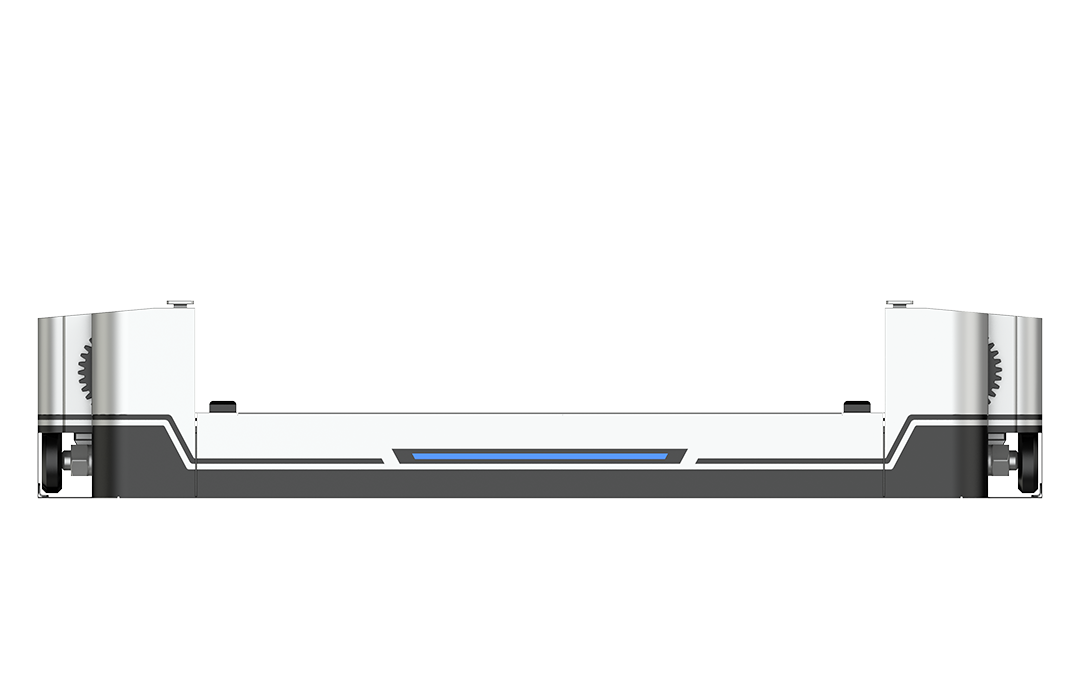
An automated pallet ASRS project rarely fails because the wrong robot was delivered. It fails because the design solved the wrong constraint. Cold chain, e-commerce and manufacturing all store pallets in high-bay racking served by shuttles, lifts and conveyors, and the equipment catalogues overlap heavily across the three. What separates them is the requirement that governs every other decision: in a freezer it is temperature and moisture, in a fulfilment centre it is the retrieval rate at the peak hour, in a factory it is the production cadence the line cannot miss. Identify the binding constraint first, and vehicle type, lane depth, redundancy and software scope follow from it instead of from a standard configuration.
What Changes When Pallet ASRS Meets Three Different Warehouses
The three sectors buy from the same hardware families: four-way shuttles running on rails inside pallet racking, vertical bidirectional lifts that move a shuttle or a pallet between levels, unit-load stacker cranes in very high bays, and conveyor or lift interfaces at the workstation. A pallet does not care whether it is being retrieved for a supermarket replenishment or for a press line. The requirements wrapped around it do, and those requirements decide the sizing, the redundancy and the software.
| Requirement | Cold chain | E-commerce | Manufacturing |
|---|---|---|---|
| Binding constraint | Temperature and moisture control | Retrieval rate at the peak hour | Production cadence and line uptime |
| Pallet and load profile | Frozen and chilled goods, damp or iced pallets, mixed case and pallet | Mixed pallet and carton, high SKU count, fast-changing range | Raw material, work in progress, tooling, heavier components |
| Temperature envelope | Sub-zero rooms, setpoint defined by the product and the refrigeration design | Ambient, sometimes chilled for fresh categories | Ambient to warm, with dust, oil mist or fume present |
| Throughput pattern | Steady, driven by trailer arrivals and production output | Sharply peaked around campaigns and carrier cut-offs | Matched to takt time, shift patterns and changeovers |
| Control integration | WMS plus door, airlock and defrost interlocks | WES and WCS wave management, order sequencing, cut-off rules | ERP or MES call-off, batch and FIFO traceability, line-side buffering |
| Cost of a missed move | Temperature excursion or a defrost delay | Missed carrier cut-off and a late order | A stopped line |
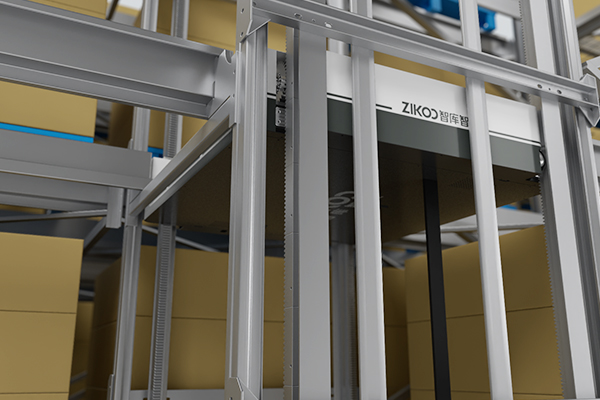
Read the table as a set of design inputs rather than market segmentation. A food manufacturer can appear in two columns at once, holding a frozen store for raw material and an ambient store for a retail channel that ships direct to consumers, and the two stores will need different vehicles, different lane depths and different control logic inside the same building. Combining a four-way shuttle with a vertical bidirectional lift turns a single-level grid into movement across three axes, sometimes described as six-way because the vehicle can travel in both directions along each axis. That matters most where the building is tall and narrow and a crane aisle cannot be justified.
How Cold Chain Conditions Reshape Pallet ASRS Design
The first cold-store question is not which shuttle to buy. It is what temperature the room must hold and how often the doors open, because those two answers set the battery, the lubricants, the seals, the electronics protection and the maintenance regime before any layout is drawn. Treat the design temperature as a project input with a tolerance attached, not as a catalogue default.
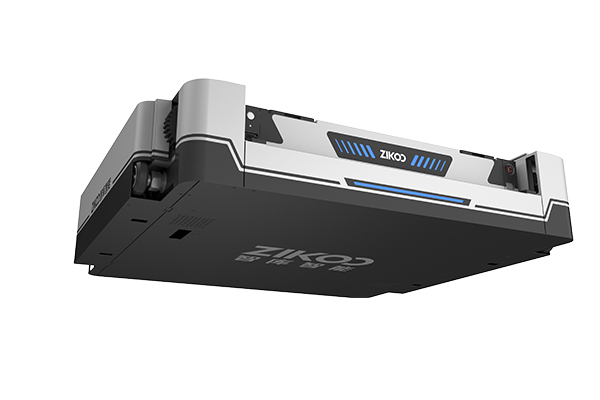
Battery behaviour drives most of the difference. Standard lithium packs lose usable capacity and charge acceptance as cell temperature falls, so a cold-store configuration changes the pack, the charging interface and sometimes the charging location. Zikoo’s R-bot cold chain configuration, for example, uses a low-temperature lithium battery rated for rooms at -25 °C, a low-temperature charging port that allows automatic charging without bringing the vehicle into a warm area, and coated circuit boards for high-humidity conditions, with 6 to 8 hours of continuous operation quoted per charge. Those are manufacturer figures for one configuration, not an independent test result. The duty cycle your room achieves still depends on travel distance, lift height, the charging window the fleet can be given and how much of the day the doors stand open. Ask for the cycle-time model behind the number, not only the number.
Moisture is the second constraint. Every door opening moves humid air into the room and deposits it on the coldest surface available, which is usually the rail, the racking or a vehicle that has just returned from the vestibule. Ice on a running rail becomes a positioning fault, and condensation inside an enclosure becomes an electronics failure. The design response is architectural as much as mechanical: airlocks sized so that only one door opens at a time, door control interlocked with vehicle missions, defrost cycles treated as planned downtime inside the availability calculation, and enclosures sealed and coated for washdown-level humidity.
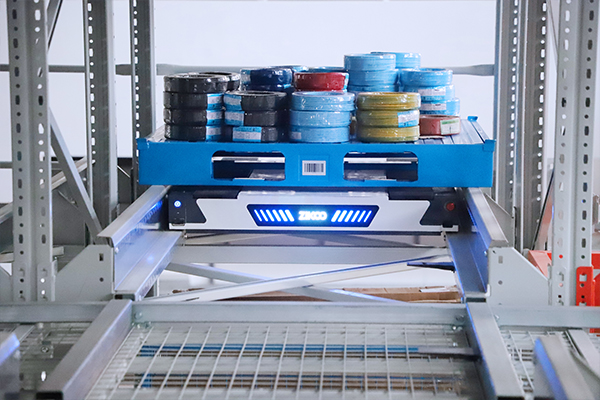
Steel and seals follow the same logic. Racking and rails in a freezer are specified with documented impact toughness at the service temperature, lubricants are rated for the cold, and flexible seal grades replace the standard ones. Safety functions need a stated basis as well. Driverless industrial trucks and their systems are covered by ISO 3691-4 [1], and the parallel American standard for automatic guided industrial vehicles is ANSI/ITSDF B56.5 [2]. A supplier should be able to say which functions are safety-rated, which are monitored by software only, and what happens when a person is detected inside an operating aisle.
What E-Commerce Demand Does to Pallet ASRS Throughput
In e-commerce the pallet store usually sits behind the pick faces as a replenishment and full-pallet buffer, with the picking itself happening at pallet-to-person stations or in split-case zones. That position in the flow explains the sizing rule: the store has to deliver the right pallet to the right station inside a dispatch window, not simply hold the most pallets per cubic metre.
The number that sizes the system is the peak hour of the peak day, not the annual average. Designing everything for that peak, however, leaves expensive capital idle for most of the year. The practical answer is to separate the two: build the racking and the level structure for the peak year, and buy shuttles in increments as the peak grows, so capacity tracks demand instead of anticipating all of it at once.
Lane depth is where density and responsiveness pull against each other. A deep lane is cheap per stored pallet and expensive per retrieval, because a pallet behind three others has to be shuffled before it can leave. Fulfilment centres usually resolve this with velocity zoning: shallow, fast-access lanes for the small share of SKUs that generate most outbound volume, and deeper reserve lanes for slow movers whose retrieval latency rarely matters.
The tension between lane depth and retrieval rate is the defining design question in a fulfilment centre. <Six-Way Shuttle: The Dual-Engine Solution for High-Density and High-Throughput> covers how a single architecture is positioned to serve both goals at once.
Sequencing belongs to the software rather than the hardware. A warehouse execution layer has to release missions by carrier cut-off and station demand, which means a pallet needed at 15:00 can outrank one that has waited longer in the grid. First-in-first-out of the storage area is the wrong rule for this environment and it is a common reason a technically capable system still misses dispatch times.
The throughput arithmetic is not complicated, even though the inputs are. Take the pallet moves required in the peak hour, divide by the availability you are prepared to run at, and multiply by the cycle time of one vehicle on your own layout, counting travel out, level transfer, transfer at the station and travel back. The result is the number of vehicles that peak needs. Run the same calculation at the daily average to see how much of the fleet sits idle for most of the year, because that gap is the real cost of peak capacity.
How Manufacturing Plants Use Pallet ASRS as a Production Buffer
A factory store has a different job. It buffers raw material against supplier variation, holds work in progress between processes, stages tooling and dies, and feeds the line in the sequence production needs. Its performance measure is line uptime, not orders shipped per hour, and that single change of measure reshapes the design.
Load data matters more here than in either other sector. Pallets carrying machined components, coils or tooling are heavier and less uniform than retail pallets, and the rated load has to cover the heaviest pallet plus tolerance, with the load centre and any overhang stated explicitly. Pallet condition deserves equal attention: a damaged pallet that jams a rail in a fulfilment centre costs a few minutes, and the same jam on a line-side feed costs a production stop.
Traceability requirements are usually stricter as well. Batch and lot tracking, FIFO or FEFO by expiry, quality-hold locations that the system cannot release automatically, and call-off from an ERP or MES system all need to exist in the warehouse control layer rather than in a spreadsheet beside it. If the plant runs changeovers with different packaging formats, lane assignment has to be reconfigurable without rebuilding the racking.
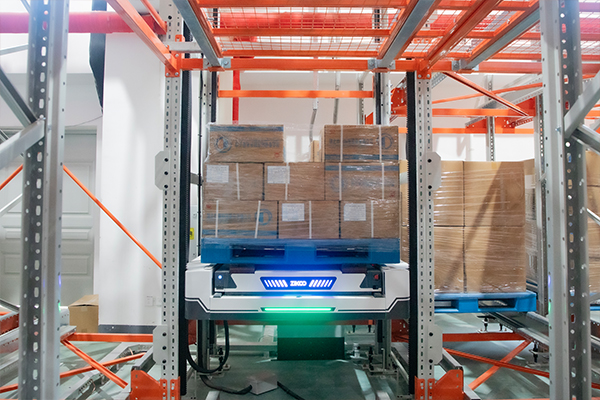
Redundancy is the design decision that separates a working installation from a fragile one. When a single vehicle serves a level and that vehicle faults, the level stops until it is recovered. Adding a second vehicle per level, or a spare that can enter any level, usually costs less than the downtime it prevents, and the calculation is straightforward once the cost of one stopped hour is known.
Choosing Between Shuttle, Crane and Vertical Lift Architectures
Architecture selection follows from the constraint, and the same four options come up in most projects.
| Architecture | Where it fits | What to watch |
|---|---|---|
| Four-way shuttle in pallet racking | Dense storage where throughput must scale with fleet size | Retrieval latency in deep lanes and transfer equipment at every level |
| Four-way shuttle with vertical lifts | Tall, narrow buildings needing multi-level storage without a crane aisle | The lift becomes a shared resource, so a lift fault affects a whole level |
| Unit-load stacker crane | Very high bays with moderate throughput and single-deep selectivity | One crane per aisle caps throughput and the aisle cannot be shared |
| Narrow-aisle stacker robot | Retrofits into existing racking with limited building change | Aisle width and floor flatness set the limit, and travel is slower than rail-mounted shuttles |
The decision rules are easier to apply than the table suggests. If the building already has the height and the retrieval rate is moderate, a crane in a high bay is the simplest machine to specify. If the retrieval rate is the pressure point and the racking can be new, shuttles give you a way to add capacity one vehicle at a time rather than one aisle at a time. If the building cannot change and the racking must stay, an aisle-based stacker robot may be the only option that avoids a construction project.
Crane and shuttle architectures are often compared on speed alone, which hides the very different ways each one adds capacity. <Stacker Crane vs Four-Way Shuttle: Which Fits Your ASRS Warehouse Best> covers the selection criteria behind that choice.
Specification Inputs That Decide Whether the System Works
Most of the risk in a pallet ASRS project is settled before the quotation, in whether the inputs were complete. Six sets of information do most of the work.
| Input | What to supply | Why it changes the design |
|---|---|---|
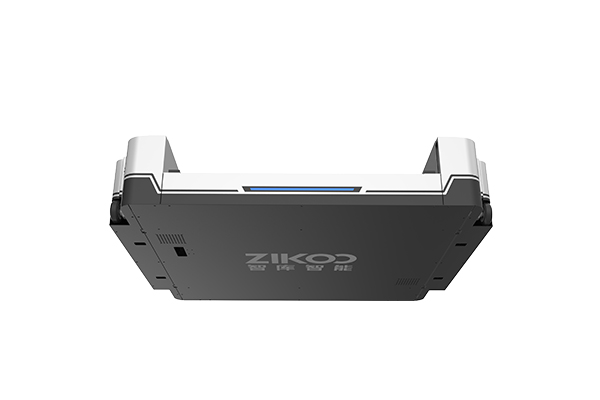
| Pallet and load | Footprint, load, load centre, overhang, pallet material and condition | A 1200 × 1000 pallet and a 1200 × 800 pallet can require different vehicle models, and damaged pallets cause more faults than control software does |
| Temperature and humidity | Design setpoint with tolerance, defrost regime, door openings per hour, zone transitions | Battery, lubricant, seal and electronics specifications all follow from it |
| Throughput profile | Pallets in and out per hour at average, peak day and peak hour, plus the inbound and outbound mix | Fleet size and redundancy are sized on the peak, not the average |
| Inventory profile | SKU count, velocity split, batch and expiry rules, FIFO or FEFO requirements | Sets lane depth, zoning and the retrieval logic |
| Building | Clear height, footprint, column grid, floor flatness, fire protection strategy | Determines whether a crane, a shuttle and lift combination or an aisle robot fits at all |
| Interfaces | Host system, labelling, cut-off rules, network and access requirements | Software scope is the largest single source of late change |
The interface row deserves its own paragraph, because it is where projects overrun. The control layer has to translate host orders into vehicle missions, handle exceptions without a person in the aisle, and report back in a form the host system accepts. A warehouse control platform sitting between the host and the equipment is what makes that translation auditable.
The interface list is where most late change lands, because the control layer has to convert host orders into vehicle missions without manual intervention. <PTP Intelligent Warehouse Software Empowers Enterprises for Smart Upgrades> covers the software layer that sits between the host system and the equipment.
Vague requirements are the most common cause of quotes that cannot be compared. A request written as “we need a pallet ASRS for about 20,000 pallets with high throughput” will produce offers that differ by a factor the buyer cannot explain, because each supplier invented its own assumptions about the missing fields. Replace it with a statement that fixes them: X pallet positions at [pallet footprint], [average] and [maximum] kg including overhang, design temperature [value], [X] pallet moves per hour at the peak hour and [Y] at the daily average, [N] active SKUs with [share] driving most outbound volume, [H] m clear height with a [G] m column grid, and host system [name] with cut-offs at [time]. The bracket fields are yours to fill; the point is that none of them should be left to the supplier’s guess.
Verification then has to test the right thing. Ask for the cycle-time model behind the quoted fleet size, for reference sites at the same temperature class or the same throughput profile, and for an acceptance protocol that names the window, the pallet mix and the temperature at which availability will be measured. A factory acceptance test run in a warm hall does not demonstrate freezer performance, and a two-week site acceptance test does not demonstrate behaviour in the peak season.
Where Pallet ASRS Stops Making Sense
Automation is capital that arrives before the savings do, and there are configurations where the payback does not survive contact with the operating reality.
If daily pallet movement is low and labour is inexpensive, semi-automatic shuttle racking or a very narrow aisle truck does the same work with far less capital, because the operator is only in the aisle when a pallet moves. If the lease on the building ends before the payback period does, mobile racking or semi-automatic equipment keeps the investment recoverable. If pallet quality is uncontrolled, fix the pallets before buying the robots: faults per thousand moves, not vehicle specifications, will dominate the operating cost.
Peak-dominated demand deserves a separate warning. A fleet sized for a peak that lasts a few weeks idles for the rest of the year, and the payback calculation rarely survives that utilisation figure. Modular capacity, seasonal labour or overflow to a third-party logistics provider can absorb the peak more cheaply than permanent equipment can.
Structural constraints can also decide the question before the equipment does. An automated store is still a steel structure, and EN 15635 covers the application, inspection and maintenance regime for static storage equipment [3]; automation removes none of those obligations. Floor flatness, column spacing and available height above the top beam frequently force a redesign whose cost exceeds the difference between two equipment options, so survey them before comparing quotations.
None of this makes pallet ASRS a poor investment. It makes it a specific one, and it is worth saying plainly that the technology is the easy part of the decision.
Tell Us Which Constraint Your Project Has to Meet
Cold chain, e-commerce and manufacturing projects fail on different constraints, so the useful first conversation is about which one governs yours. Send the design temperature and door-opening pattern, the pallet footprint and maximum load including overhang, the peak-hour and average pallet move rate, the SKU count with the share that drives most outbound volume, the building’s clear height, column grid and floor tolerance, and the host systems the control layer has to talk to.
Zikoo Smart Technology reviews that set against its R-bot four-way shuttle, H-bot vertical lift and PTP warehouse software platform, and can indicate where the design is likely to bind before a layout is drawn. Email info@zikoo-int.com or call (+86)-19941778955 to start that review.
FAQ
Can one pallet ASRS design serve a freezer, a fulfilment centre and a factory?
Only at the level of hardware families. The vehicle, the racking and the controls may come from the same catalogue, but the constraint that sizes them differs in each case. A design optimised for retrieval rate will under-serve a freezer, because battery capacity and moisture control were never priced in. A design built around temperature will not absorb a campaign peak. Where one company runs both, the usual answer is two stores with different vehicles sharing a common control layer.
How cold can an automated pallet shuttle operate?
It is a configuration question rather than a single figure. Many shuttle platforms are rated to roughly -15 °C in their standard form, and colder rooms need low-temperature cells, a charging interface that works without a warm area, cold-rated lubricants and seals, and coated electronics. Ask for the design temperature as a stated condition of the offer, together with the duty cycle guaranteed at that temperature. A temperature figure quoted without a matching duty cycle is incomplete.
How much throughput can a pallet ASRS deliver?
There is no catalogue answer, because throughput is a function of layout. The calculation starts with the pallet moves required at the peak hour, divides by the availability you are prepared to run at, and multiplies by the single-vehicle cycle time for your travel distances, level transfers and station positions. Fleet size follows from that. Two suppliers quoting the same vehicle can produce very different numbers because their assumed aisle lengths and lift heights differ.
Does pallet ASRS require a new building?
No. Retrofits are common. Narrow-aisle stacker robots work in aisles of roughly 2.1 m, and shuttle systems can be installed within the footprint of existing racking when the structure, floor flatness and clear height allow it. The real limits are usually the floor tolerance, the column grid, the fire protection strategy and the space available above the top beam. Survey those before comparing equipment, because they can eliminate an option regardless of price.
What should be measured before accepting a pallet ASRS?
Availability and throughput, measured over a defined window, at the design temperature, with a representative pallet mix and the agreed fleet configuration. The protocol should name the start and end conditions, how faults are logged, and what counts as a stoppage. This matters most in cold stores, where a warm-hall factory test proves the controls work and proves nothing about performance inside the freezer.
References
[1] ISO 3691-4:2020, “Industrial trucks. Safety requirements and verification. Part 4: Driverless industrial trucks and their systems,” ISO, 2020.
[2] ANSI/ITSDF B56.5-2019, “Safety standard for driverless, automatic guided industrial vehicles and automated functions of manned industrial vehicles,” Industrial Truck Standards Development Foundation, 2019.
[3] EN 15635:2008, “Steel static storage systems. Application and maintenance of storage equipment,” CEN, 2008.
If you’re interested, check out these related articles:
Six-Way Shuttle Empowers 3PL Providers to Build Next-Generation Smart Logistics Hubs
Looking for Reliable Four-Way Shuttle Manufacturers? Choose Zikoo Robotics
Six-Way Shuttle: Pioneering the Future of Smart Warehousing