Pallet shuttle material handling connects conveyor receiving, dense pallet storage and pallet-to-person picking into one controlled flow. The shuttle rack is not only a place to store pallets; it is the buffer that absorbs inbound surges and feeds workstations in the sequence that order picking requires. When the transfer points are engineered correctly, each pallet is checked at the conveyor, stored by address in a high-density lane, retrieved by software command and delivered to the right destination. That sequence reduces the distance forklifts and operators travel and keeps the loading dock rhythm from becoming the picking rhythm. This article explains the flow stage by stage, the conditions that make it stable and the checks to run before connecting the equipment.
When Pallet Shuttle Material Handling Fits the Whole Flow
Pallet shuttle material handling fits operations where pallets arrive steadily or in batches, need to be held before use, and must later move to full-pallet dispatch or case picking. A conveyor can move many pallets, but it cannot provide long-dwell storage or selection by order. A conventional rack gives selection but requires aisle space for every reach. A shuttle lane compresses the storage footprint while retaining pallet addresses and automated access. The strongest fit is a warehouse with palletized unit loads, moderate to high storage depth, and active order volume that justifies automated retrieval. It is not the right first move when inventory is very low, pallets are nonstandard, or picking is mostly manual without a stable task sequence.
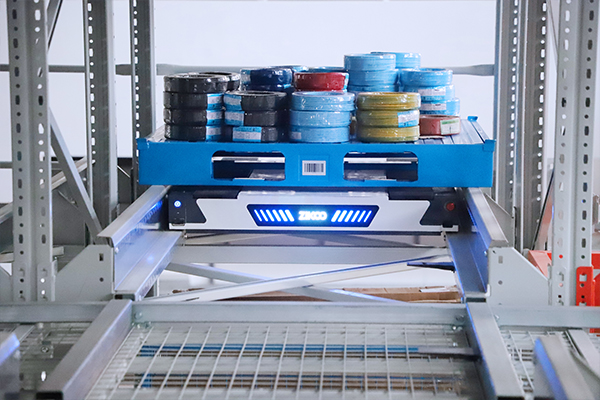
Stabilize the Conveyor Handoff Before Pallets Enter Storage
The first engineering problem is not speed; it is stable pallet qualification. A pallet that leaves the conveyor with damaged bottom boards, excessive overhang, unread labels or unknown weight will create an exception inside the automated zone. The inbound loop should identify the pallet, confirm that the load fits the shuttle model, and stage it on a transfer stand that the shuttle can enter safely. For example, a standard R-bot four-way shuttle may be configured for 1200 mm by 800-1000 mm pallets and a 1200 kg rated load. Pallets outside that envelope must be routed to an exception lane before entering storage.
| Control point | What to check | Failure to prevent |
|---|---|---|
| Pallet base | No broken bottom boards, protruding nails or unstable feet | Load drop or shuttle refusal |
| Load overhang | No overhang beyond the supported pallet footprint | Rack beam collision |
| Weight and height | Confirm rated load and pass the profile check | Shuttle overload or rack impact |
| Label and data | Capture barcode or RFID before lane entry | Unidentified pallet in deep storage |
| Transfer alignment | Confirm the pallet is centered on the transfer stand | Shifted pick-up or fall |
| Exception routing | Route failed pallets to an accessible staging lane | Manual recovery inside the automated zone |
The table is a basic qualification sequence, not a complete automation standard. Operators still need a clear rule for what happens when a pallet fails a check. If the exception lane is reachable by forklift and the WCS knows that pallet has not entered inventory, the system can continue without blocking the inbound line.
How Dense Shuttle Storage Buffers Pallets Without Losing Access
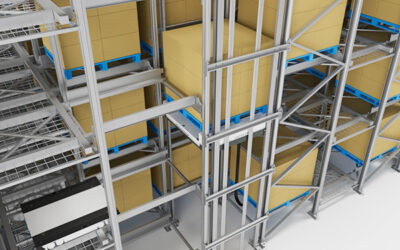
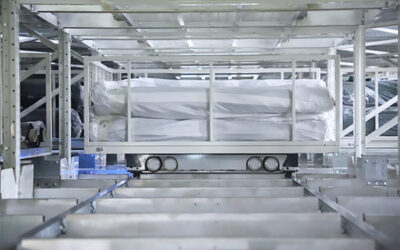
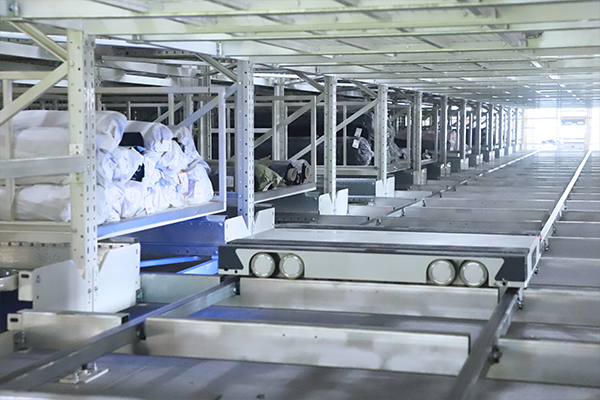
Once a pallet is accepted, the shuttle moves it into a storage lane and places it at a recorded position. The four-way shuttle travels along the rack rails in four directions, so it does not require a crane aisle for each level. In many configurations, a vertical shuttle or lift connects the levels, allowing the pallet to move from an inbound level to an upper storage tier before returning to a pick face. This creates three-dimensional dense storage while preserving automated selection.
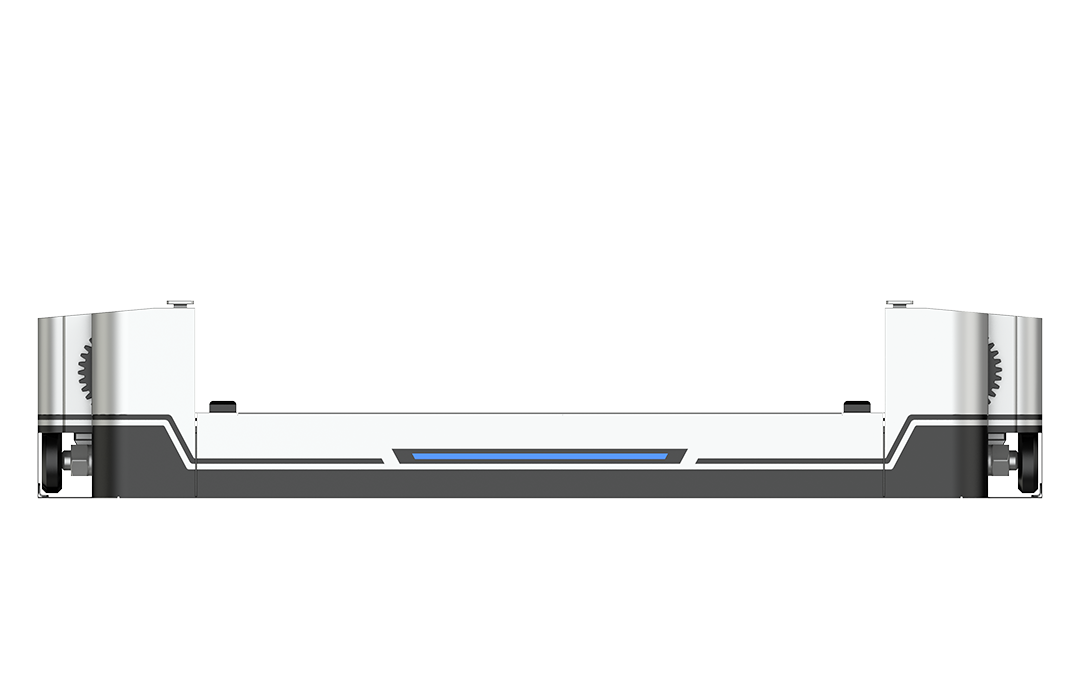
Zikoo’s R-bot four-way shuttle is designed for this pallet-to-person dense storage role with a 125 mm body height and a rated load of up to 1.5 tons depending on the model. On some standard models, loaded speed reaches 1.2 m/s and empty speed reaches 1.6 m/s. These figures describe the robot’s design envelope; they do not by themselves tell you how many pallets per hour a warehouse will move, because throughput also depends on lane depth, number of shuttles, lift cycle time and order pattern.
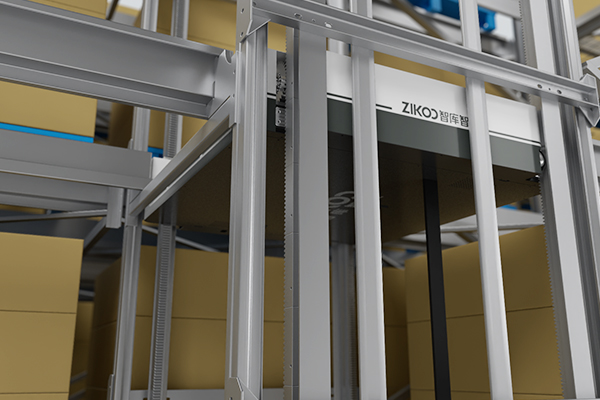
Deep lane storage has a real tradeoff. A deep lane stores more pallets per square meter, but the pallet at the end of the lane cannot always be reached without relocating the pallets in front. Slotting should place fast-moving pallets near the lane opening and slow-moving or full-pallet reserve loads in deeper positions.
Dense shuttle storage only works when the storage architecture, shuttle count and retrieval rules are matched. <Smart Storage Revolution: Comprehensive Overview of Four-Way Shuttle Systems for Automatic 3D Warehouses> covers the four-way shuttle architecture used in automatic 3D warehouses.
How Retrieval Turns Stored Pallets Into a Work Sequence
Retrieval is not simply the reverse of storage. The WMS or WCS selects the pallet that the current wave requires, then issues a task that moves the shuttle to the lane, picks the pallet and transfers it to the next stage. The requested sequence matters because picking productivity depends on how cleanly pallets arrive at the workstation. If the order wave needs reserve pallets after active pick-face pallets, the system must stage those transitions without forcing an operator to wait.
Vertical transfer is the critical handoff when storage is on multiple tiers. A shuttle cannot leave its working level unless a vertical device carries it or the pallet across levels. The landing position must be precise enough for safe pallet handover, and the level transfer must be scheduled as part of the same task chain as the horizontal shuttle move. A small position error at this interface can stop a pallet or damage the load, which is why alignment accuracy and transfer interlocks are part of acceptance testing.
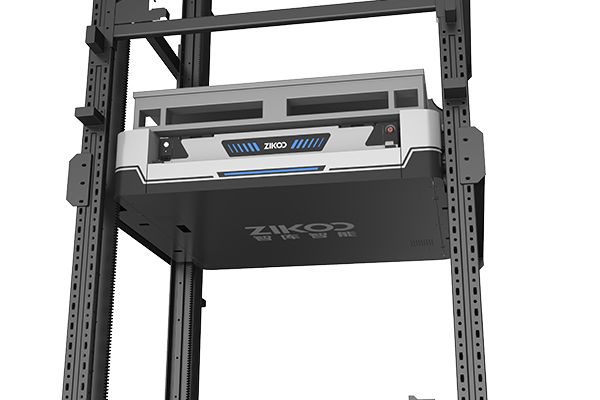
Vertical transfer changes how pallets are sequenced for picking because movement across width, depth and height must be coordinated. <Six-Way Shuttle Unlocks the Era of True 3D Intelligent Warehousing> covers how shuttle networks coordinate movement across three dimensions.
Picking Options After the Shuttle Delivers the Pallet
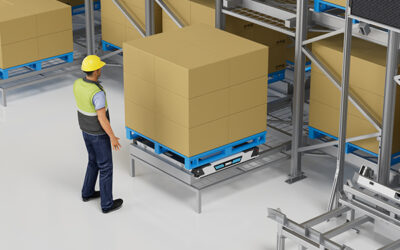
After the pallet arrives at the outbound transfer stand, the next destination depends on the order profile. Full-pallet outbound sends the pallet directly to a marshalling or shipping conveyor. Pallet-to-person case picking presents the pallet to a workstation, where an operator takes cases according to an order and the residual pallet returns to storage or moves to the next pick position. Split-case and mixed-SKU operations may combine automated pallet stores with AMRs, robotic arms or goods-to-person stations.
A narrow-aisle robot and AMR picking system can be configured for inbound and outbound capacity of at least 80 pallets per hour and picking efficiency of at least 300 pieces per hour, with support for up to 10,000 SKUs in the supplied system specification. These values are design points for a defined layout and product set; they are not a universal result. The important design question is what happens to the residual pallet after picking, because that return path can consume as much capacity as the original retrieval.
Food and beverage operations often run this pattern when production pallets, distribution reserve stock and picking lines share the same dense storage buffer.
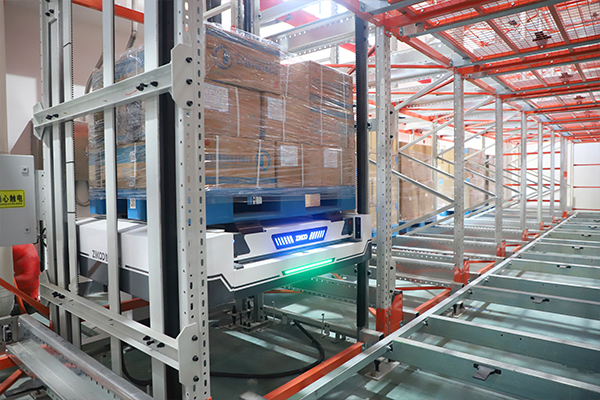
How Warehouse Software Connects Conveyor, Shuttle and Picking
Hardware handoffs fail without a software status chain. The WMS decides what to store and what to pick; the WCS translates those decisions into equipment tasks; the RCS monitors the robots, lifts and conveyor sections. A pallet moving from conveyor to shuttle needs a destination before it leaves the inbound stand. A residual pallet returning from picking needs a return instruction before the operator releases it. If these statuses are not synchronized, the equipment may be mechanically able to move a pallet but operationally unable to continue it.
The task message should carry more than a move command. It should include pallet identity, source position, destination position, priority, current status and exception state. This allows each handoff point to confirm that the load has arrived as expected and allows the WCS to retry, reroute or alarm when it has not. In brownfield integrations, the biggest effort is often mapping the existing conveyor controls and warehouse data into the shuttle system, not installing the shuttle rack itself.
Without this status chain, even sound shuttle hardware will wait at the wrong handoff point. <PTP Intelligent Warehousing Platform: Building a Flexible and Smart Logistics Ecosystem> covers how smart warehouse software connects automated equipment into one logistics ecosystem.
Design Checks Before You Link Conveyor to Storage to Picking
Before finalizing a layout, run a set of interface checks rather than only comparing storage capacity. First, profile the pallet base, footprint, weight, height and load stability across the real inbound mix. Second, calculate the flow by stage: inbound conveyor peaks, storage moves, lift cycles, retrieval returns and picking capacity must be able to operate together during the same peak window. Third, define the return path for residual pallets before commissioning, because that path is often missed in early layout drawings. Fourth, test exception handling: what happens when a pallet fails an inbound check, loses its label, arrives at a workstation without an order, or cannot return to its original lane?
Industry conditions also change the design. A pharmaceutical or food-grade environment may require controlled temperature, smooth surfaces, battery restrictions or documentation for cleaning and access. A cold storage or special industry layout may need different battery options and material restrictions. These requirements should be specified before the shuttle and rack are selected.
Plan the Handoffs Before You Commit to a Layout
A conveyor-to-storage-to-picking flow succeeds on its transfer points, not on any single robot specification. To get a more specific layout review, send the pallet footprint and weight range, inbound and picking peaks in pallets per hour, expected storage days and active SKU count, plus the picking method. Zikoo Smart Technology can review where buffer capacity, vertical transfer and software integration belong in the flow.
Contact Zikoo Smart Technology at info@zikoo-int.com or (+86)-19941778955.
FAQ
Can a pallet shuttle system connect to an existing conveyor line?
Yes, if the interface is designed as a controlled transfer stand rather than a simple end-of-conveyor drop. The main checks are pallet direction, load footprint, height, weight, conveyor accumulation logic and the data trigger that tells the WCS a pallet is ready for the shuttle. The physical connection is usually the easy part; the control mapping and exception lane are what determine reliability.
Does a pallet shuttle work for both full pallet dispatch and case picking?
Yes. The storage and retrieval side can feed multiple destinations. A pallet may go directly to an outbound route for full-pallet orders, or to a pallet-to-person station where an operator picks cases and returns the residual pallet. The WCS needs separate destination logic and a defined return path, otherwise the residual pallet can stall the flow.
When does the design need a vertical lift or bidirectional shuttle?
A vertical transfer device becomes necessary when a pallet must move between the conveyor level and an elevated storage tier, or between tiers for retrieval. A single-level shuttle system can work without one. In multi-level dense storage, the vertical shuttle or lift is part of the same task chain as the horizontal shuttle and should be scheduled by the WCS.
Can the same system support temperature-controlled or clean environments?
It can be specified for those conditions, but the battery, materials, coatings and maintenance rules must match the operating environment. Cold storage, food-grade and pharmaceutical areas have different constraints. The system design should be validated against those requirements before equipment selection, not treated as a standard catalogue option.
If you’re interested, check out these related articles:
Smart Warehousing Starts Here: Cost-Effective Four-Way Shuttle Systems
Six-Way Shuttle: The Dual-Engine Solution for High-D
Six-Way Shuttle Drives Warehouse Upgrades: Building an Intelligent Automatic 3D Warehouse
Revolutionizing Cold Chain Logistics: Zikoo Robotics Six-Way Shuttle Powers High-Density, High-Efficiency Warehousing