When warehouse operators evaluate a four-way shuttle system, one question comes before all others: how much faster will pallet handling actually be? The answer isn’t a single number and it rarely matches supplier brochures. From our engineering work across manufacturing, cold chain, and 3PL projects, a four-way shuttle system typically delivers a throughput improvement of 40% to 80% over manual forklift operations, but the final figure depends on factors that many early-stage buyers overlook: shuttle fleet size, vertical lift integration, and software coordination. This article examines those levers so you can build a realistic expectation before committing to a configuration.
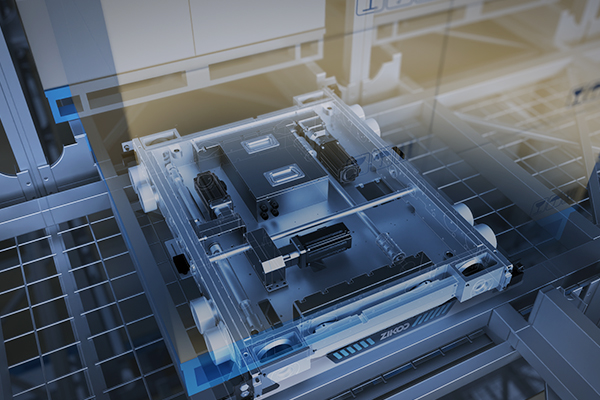
What Determines Throughput in a Four-Way Shuttle System?
Throughput in a pallet shuttle system isn’t defined by top speed alone. It is the number of pallet moves completed per hour across an aisle or a floor, a metric shaped by travel distance, lift transfer time, and how well the control software sequences tasks.
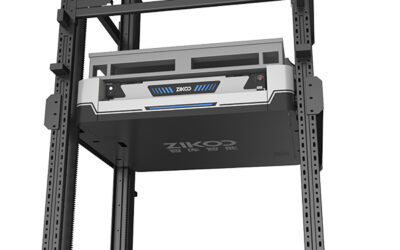
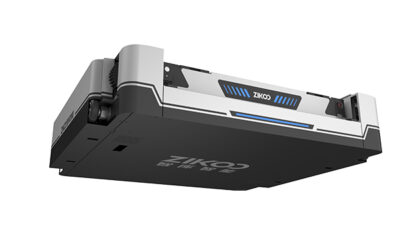
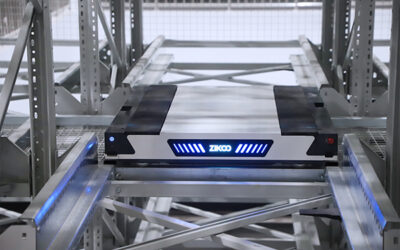
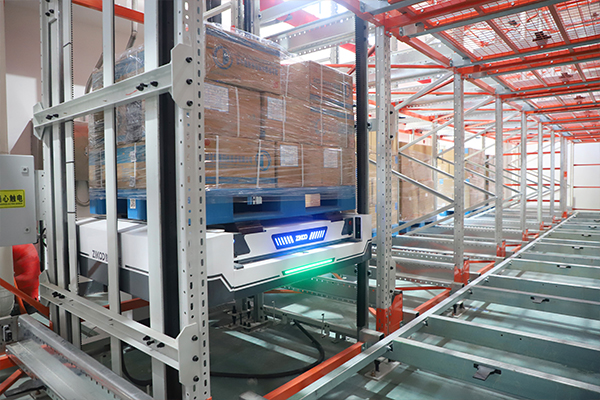
Take the R-bot four-way shuttle. Its standard model runs at 1.6 m/s empty and 1.2 m/s when loaded with up to 1,200 kg. In a 50-meter aisle, a single loaded trip takes roughly 42 seconds, not counting lift time. Without a vertical shuttle, that translates to roughly 40 to 50 pallet moves per hour per shuttle. But when you introduce waiting at a shared lift, that number drops quickly. The real bottleneck is rarely the shuttle’s ground speed; it is the vertical transfer. I’ve seen facilities where adding a dedicated H-bot vertical shuttle per aisle end raised throughput from 35 to 70 pallet moves per hour for the same floor fleet, simply because shuttles no longer queued for the lift.
How Does Vertical Integration with H-Bots Multiply Throughput?
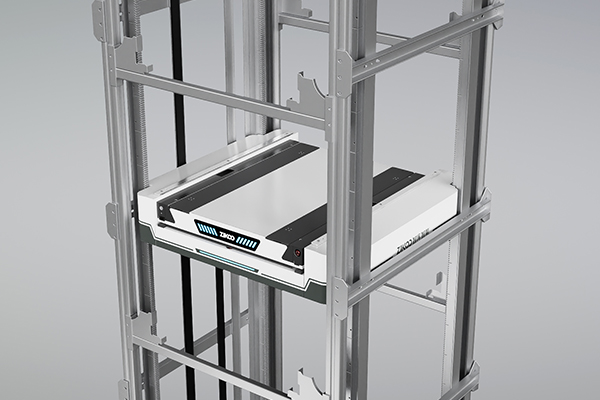
A four-way shuttle layout that relies on a single pallet lift at one end creates a serial dependency: every level change forces a shuttle to wait. Integrating H-bot vertical bidirectional shuttles at both ends of each storage aisle removes that choke point. The H-bot moves at 1 m/s empty and 0.5 m/s loaded with positioning to ±1 mm, which keeps level-switching time consistent and predictable.
Shuttle waiting time at lifts is one of the most underestimated throughput killers in multi-level systems. <Six-Way Shuttle Powers Dense Storage: Breaking Space Limitations> covers how pairing R-bots with H-bots creates a six-way flow that removes serial dependencies, and why that matters for operations running above 100 pallet moves per hour.
In our own system designs, moving from a single central lift to dual H-bot vertical shuttles per floor typically doubles the throughput capacity because the system can handle inbound and outbound pallets simultaneously without interference. This gain is not incremental; it is architectural.
If your warehouse layout involves multiple floor levels and tight throughput targets, the interaction between shuttle count and lift capacity is worth confirming before finalizing the equipment list. Reach out at [email protected] for a quick review of your layout assumptions.
How Should You Size Your Shuttle Fleet for Maximum Throughput?
Adding more shuttles per floor increases concurrent pallet movements, but after a certain point the gains flatten. I’ve observed that the throughput curve bends when the lift-to-shuttle ratio falls below one vertical connection per 3 to 4 shuttles per floor. With too few lifts, shuttles waste time waiting, regardless of how many are deployed.
The R-bot family includes models rated from 1,200 kg up to 2,000 kg, with the heavier units running slightly slower at 1.35 m/s empty. In high-density cold storage, where the low-temperature lithium battery supports 6 to 8 hours of continuous operation, we often spec the R1500B or R2000B for heavier loads. For lighter pallets, the standard R1200B at 1,200 kg and 1.6 m/s empty achieves more moves per hour, and a fleet of three to four of these per floor with a dedicated H-bot per aisle end can deliver 70 to 90 pallet moves per hour in a distribution center. Going from three to five shuttles on the same floor rarely adds more than 10% to 15% additional throughput because the lift becomes the constraint.
What Throughput Gains Can You Expect in Different Warehouse Scenarios?
No single number covers every installation. The table below shows throughput improvement ranges we’ve validated across multiple configuration types, compared to the same facility running manual forklifts.
| Scenario | Configuration | Throughput Gain vs. Manual |
|---|---|---|
| Standard DC, 8 m ceiling | 2 R-bots/floor, 1 H-bot per 2 aisles | 40% to 55% |
| High-rise cold storage, -25 °C | 4 heavy-duty R-bots/floor, dedicated H-bot per aisle | 60% to 75% |
| 3PL multi-SKU, mixed pallet sizes | 3 R-bots/floor, WCS optimization, dual H-bots per aisle | 50% to 70% |
These ranges come from observing systems after software tuning and operator ramp-up. The cold storage numbers reflect the slower acceleration in extreme temperatures but also the benefit of dense rack layouts that shorten travel distances.
How Does Software Scheduling Boost Throughput Beyond Hardware Limits?
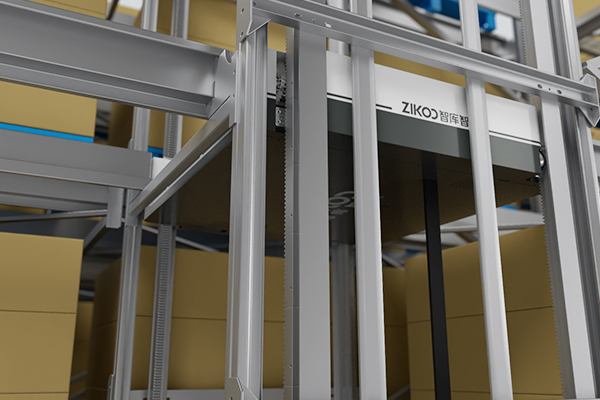
If hardware defines the ceiling, software scheduling decides how close you get. Basic FIFO task assignment leaves shuttles idle between moves while waiting for the next command. Our PTP software platform uses dynamic mission assignment, continuously reordering tasks based on shuttle location, battery state, and order urgency. This alone can lift effective throughput 15% to 25% without adding hardware.
Hardware speeds set the ceiling, but software scheduling determines how close you get to it. <Software-Driven Hardware: [Six-Way Shuttle](https://www.zikooint.com/solution/r-bot-h-bot-six-way-shuttle-dense-storage-system) Maximizes Warehouse Efficiency> details how PTP’s task allocation logic pushes throughput to the upper limit of shuttle capability by minimizing deadheading and idle time.
I’ve worked on projects where upgrading from a third-party WCS to our integrated software reduced average shuttle idle time by over 30%, directly adding 20 pallet moves per hour per shuttle. That isn’t a speculative improvement; it’s a measurable result of reducing command latency and optimizing travel paths.
Evaluating throughput gains without a system-level simulation is risky because your specific SKU mix and order wave patterns create unique demand spikes. Our engineering team runs capacity analyses using your actual facility dimensions and product data to project throughput before any hardware is ordered. Send your warehouse drawings and daily pallet movement targets to [email protected], or call (+86)-19941778955 to schedule a technical review.
Common Questions About Four-Way Shuttle Throughput
How do I calculate expected throughput for my own warehouse?
Start with the number of shuttles per floor and the average pallet move cycle time derived from travel distance and lift transfer duration. Multiply that by the number of working hours, then derate for shift changes and battery swaps. I always recommend asking your supplier for a discrete-event simulation report rather than a single formula, because wave patterns and SKU distribution create peaks that a steady-state calculation misses. Share your order data and floor plan, and we can build that simulation.
Is a four-way shuttle always faster than a forklift?
It depends on move density. For an aisle that needs fewer than five pallet moves per hour, a reach truck works fine. But when throughput climbs above 15 to 20 moves per hour per aisle, or when operations run multiple shifts, the shuttle’s ability to work continuously without operator fatigue delivers a clear advantage. In cold rooms, the gap widens further because shuttle batteries are designed for sub-zero conditions, while human operators need breaks.
What is the biggest bottleneck that limits throughput?
Vertical transport. I have seen more throughput lost to under-sized lift configurations than to sluggish shuttles. A single lift serving an entire floor will bottleneck the moment pallet movement exceeds 25 to 30 moves per hour. Adding a second lift, or better yet deploying H-bots at both aisle ends, immediately resolves that queue. In six-way layouts, the lift bottleneck disappears, and throughput scales with the number of shuttles.
How long does it take to reach design throughput after installation?
Mechanical commissioning is typically two to three weeks, but the real ramp-up happens as the WCS learns your order patterns. During the first month of live operation, throughput usually sits at 70% to 80% of the design target. After three months of software tuning and operator familiarity, systems consistently reach 90% to 95%. The final 5% often requires fine-tuning pick-and-drop station assignments, which we handle during quarterly system reviews.
Does a six-way shuttle system cost more to achieve higher throughput?
The hardware adds H-bots and support rails, but the total cost per pallet move is often lower because we can deploy fewer shuttles per floor. With a six-way layout, shuttles spend less time waiting, so fleet size can be reduced by 20% to 30% compared to a four-way system targeting the same throughput. The upfront investment is higher, but the five-year total cost of ownership usually favors the six-way approach for high-throughput operations. For a detailed cost-benefit comparison tailored to your layout, send us your warehouse drawings and daily pallet movement volumes, and we will map out the throughput you can realistically achieve with a four-way or six-way configuration.
If you’re interested, check out these related articles:
Six-Way Shuttle: The Smart Warehousing Tool for Cost Reduction and Efficiency 2
Six-Way Shuttle: Empowering Industries to Embrace Smart Warehousing