An automated warehouse rarely stalls because one robot is too slow. It stalls when the system that manages orders and the system that manages machines disagree about what should happen next. That is the practical difference between a warehouse management system and a warehouse control system—and why the boundary between them matters as much as the hardware on the floor.
What a WMS Does in an Automated Warehouse
A warehouse management system operates at the business and inventory level. It decides what should move, when it should move, and why the movement supports an order, replenishment task, or inventory adjustment.
Typical WMS responsibilities include:
- Receiving and putaway planning
- Order allocation and wave release
- Inventory tracking by SKU, lot, batch, and location
- Replenishment calculation
- Picking, packing, and shipping workflows
- Cycle counting and inventory reconciliation
- Labor task assignment at a broad operational level
In an automated warehouse, the WMS does not attempt to command a shuttle motor. Instead, it passes a work request such as “move pallet 4729 from location A-08 to outbound station 3.” The WMS remains focused on order priorities, inventory accuracy, and operational planning.
<img src="https://www.zikooint.com/wp-content/uploads/2025/12/high-rise-automated-storage-system_20251205_100550.jpg" alt="High-Rise-Automated-Storage-System" style="max-width: 600px; height: auto; display: block; margin: 20px auto;" />
This layered approach follows the enterprise-control system integration model defined in ISA-95/IEC 62264: business planning systems, manufacturing or warehouse operations systems, and real-time control systems operate at different decision horizons [1]. The WMS sits at the operations level.
What a WCS Does in an Automated Warehouse
A warehouse control system operates closer to the equipment. It translates work requests into machine-level instructions, manages traffic, selects routes, and monitors execution.
Core WCS functions include:
- Accepting tasks from the WMS or a warehouse execution system
- Breaking down moves into equipment-level commands
- Assigning tasks to shuttles, lifts, conveyors, or robotic workstations
- Managing intersection traffic and queue positions
- Coordinating handshakes between automated equipment and PLC systems
- Handling exceptions such as pallet misalignment, device faults, or communication loss
- Feeding execution status back to the WMS in near real time
Time scale explains the division. The WMS can work in seconds, minutes, or hours. The WCS often works in milliseconds because it must decide whether one shuttle should wait while another enters a transfer point. That speed difference makes a single unified system difficult to operate cleanly at scale [1], [2].
<img src="https://www.zikooint.com/wp-content/uploads/2025/12/flexible-pallet-shuttle-warehouse-flow_20251205_100107.jpg" alt="Flexible-Pallet-Shuttle-Warehouse-Flow" style="max-width: 600px; height: auto; display: block; margin: 20px auto;" />
WMS vs WCS: The Control Boundary That Prevents Chaos
| Control dimension | WMS | WCS |
|---|---|---|
| Primary focus | Inventory and order operations | Machine task execution |
| Decision horizon | Minutes to weeks | Milliseconds to seconds |
| Typical output | Wave plans, work orders, stock transfers | Move commands, routing, PLC handshakes |
| Owns | SKU, location, order status, lot data | Robot position, traffic state, device status |
| Planning question | What should move and when? | Which equipment moves it and how? |
| Exception focus | Shortages, priority changes, order exceptions | Collision avoidance, fault recovery, route changes |
In practice, a WMS may approve a batch of outbound pallets. A WCS decides the sequence, chooses the nearest available four-way shuttle, reserves a lift, and confirms the pallet arrived at the outbound station. That is why both systems must share one operational version of reality without crossing into each other’s role.
How WMS and WCS Exchange Information
Integration quality determines whether an automated storage and retrieval system behaves as a coordinated flow or as disconnected equipment. The most common integration points include:
- API-based task creation and status updates
- Message queues for asynchronous equipment events
- Shared location and container tables
- Webhooks or polling interfaces for order changes
- Fixed handshake points at stations, lifts, and scales
Before integration begins, the project team should define the task payload: pallet ID, source location, destination, priority, order reference, and required handling rule. The WCS should return a clear execution state for every task: created, queued, moving, completed, failed, or blocked. Without this contract, status confusion becomes difficult to troubleshoot.
A clear system contract becomes even more important when software drives dense shuttle operations. <Software-Driven Hardware: [Six-Way Shuttle](https://www.zikooint.com/solution/r-bot-h-bot-six-way-shuttle-dense-storage-system) Maximizes Warehouse Efficiency> covers how real-time equipment constraints reshape task execution beyond the WMS wave plan.
The Real Test: WMS and WCS in a Six-Way Shuttle System
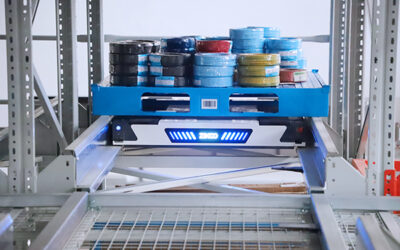
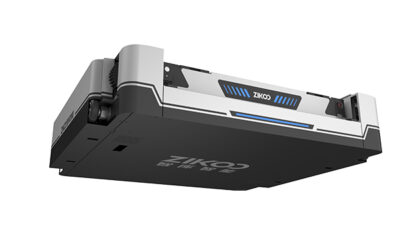
Pallet-to-person and dense storage systems expose the WMS-WCS boundary quickly. A six-way shuttle network combines four-way shuttles moving horizontally with vertical bidirectional shuttles or elevators moving pallets between levels. The WCS must coordinate multiple machines at transfer points where timing is critical.
From a software perspective, that means the WCS is not simply a message router. It must manage lane selection, charging strategy, shuttle repositioning, vertical transfer reservations, and fault-handling logic. The WMS remains responsible for deciding which pallet is needed next.
Some platforms, including PTP Smart Warehouse Software, separate the roles across WMS, WES, WCS, and RCS layers. A warehouse execution system adds an order and resource orchestration layer between WMS and WCS, which can help when order priorities change more often than equipment commands.
WMS and WCS integration is most visible when inventory, orders, and robot fleets must operate as one control loop. <PTP [Intelligent Warehousing](https://www.zikooint.com/asrs-automated-storage-and-retrieval-system-solutions) Platform: Building a Flexible and Smart Logistics Ecosystem> covers how that loop becomes a repeatable system architecture.
<img src="https://www.zikooint.com/wp-content/uploads/2025/12/traditional-four-way-shuttle-scenario_20251205_100645.jpg" alt="Traditional-Four-Way-Shuttle-Scenario" style="max-width: 600px; height: auto; display: block; margin: 20px auto;" />
When the WCS receives a clear task, the shuttle system can execute dense storage work without constant WMS intervention. That allows the warehouse to maintain throughput even when hundreds of pallet moves are active at once.
Common Integration Challenges and How to Avoid Them
The most frequent automation problems are not mechanical. They come from incomplete software logic or mismatched data.
1. Inconsistent location naming. The WMS may call a location “A080101,” while the control system knows it as “Zone 8, Row 1, Depth 1.” Both systems need a shared mapping table.
2. No defined exception flow. If a pallet is damaged, misplaced, or too high for a bay, the WCS must know the recovery steps: reject to inspection, return to storage, or ask the WMS for new direction.
3. Overloaded interfaces. A WMS that polls every shuttle position at one-second intervals may create unnecessary traffic. Interfaces should separate high-frequency telemetry from business-level status updates.
4. Poor handshake testing. Integration is rarely verified by moving one pallet. It must be tested with bursts, cancellations, priority changes, and communication interruptions.
5. Undefined ownership of charging and maintenance windows. Shuttle charging and lift maintenance affect task availability. The WCS should communicate degraded capacity to the WMS so the plan can adapt.
If you are selecting a WMS/WCS architecture for a shuttle-based AS/RS, define the integration boundary before signing the equipment order. Send your current WMS interface document and throughput targets to [email protected], and a warehouse automation engineer can help you structure the control layers.
How to Evaluate WMS and WCS for an Automation Project
When buyers evaluate warehouse automation, they often focus on shuttle speed, load capacity, and rack density. Software deserves equal scrutiny. A faster shuttle does not help if task allocation logic is poor.
Evaluation criteria should include:
- Whether the platform supports the required equipment types from day one
- Integration maturity with your current ERP and WMS
- Visibility into task status and exception reporting
- Whether the WCS includes simulation or digital twin testing
- How the system handles priority changes after tasks are released
- Whether degradations, such as a shuttle being taken offline, are visible to the WMS
- Support for multi-level operation and multi-zone traffic control
- Availability of documented interface specifications rather than closed proprietary handshakes
For dense storage projects, ask the supplier where the WMS stops and the WCS begins. The answer should be specific: which system owns task creation, which owns route selection, which owns traffic clearance, and which owns fault recovery. A vague answer usually means integration risk.
<img src="https://www.zikooint.com/wp-content/uploads/2025/12/retail-multi-sku-storage-scenario_20251205_100130.jpg" alt="Retail-Multi-SKU-Storage-Scenario" style="max-width: 600px; height: auto; display: block; margin: 20px auto;" />
A useful benchmark is whether the supplier can demonstrate the control flow with a simulated order wave: inbound pallets, replenishment tasks, urgent outbound orders, and a shuttle fault introduced mid-operation. That test reveals how well the software layers share responsibility.
Plan Your WMS-WCS Integration Early
Warehouse automation projects perform best when software integration is treated as a design task, not a commissioning afterthought. The WMS defines what the warehouse needs to accomplish. The WCS determines how the equipment accomplishes it. When the contract between them is clear, dense storage, high-throughput picking, and future expansion become much easier to deliver.
To plan your integration:
- Map the current WMS, host system, and interface method
- List all automated equipment that must be coordinated
- Define the required task payload and status responses
- Identify exception paths before commissioning begins
- Plan for peak-hour task bursts and priority changes
- Confirm how degraded equipment capacity is reported
Email: [email protected]
Phone: (+86)-19941778955
Frequently Asked Questions
Is a WCS the same as a WES?
No. A warehouse execution system typically sits between WMS and WCS. It adds order orchestration, resource balancing, and more sophisticated execution logic that spans multiple work zones or equipment types. A WCS focuses more directly on machine coordination [2].
Why cannot the WMS control robots directly?
A WMS is designed for inventory and order planning, not millisecond-level traffic control. Direct control would mix business logic with machine logic, making upgrades, fault recovery, and system validation more difficult [1].
Do small automated warehouses need a separate WCS?
Some small or single-zone systems can combine WMS and WCS functions. However, once multiple shuttles, lifts, conveyors, or picking stations are involved, a dedicated control layer usually improves reliability because equipment states can be managed independently.
What happens if the WMS-WCS connection fails?
Most automated warehouses require a defined fail-safe mode. Depending on the installation, the WCS may complete active moves, hold new tasks, or execute a controlled stop. The recovery procedure should be documented before commissioning.
Does WCS integration work with any WMS?
Not always. The WMS must support the required task types, status updates, and exception messages. Older WMS platforms may need middleware or a WES layer to handle equipment-specific execution logic.
How long does WMS-WCS integration take?
It depends on interface maturity and the number of equipment types. A standard interface with documented APIs can often be tested in weeks, while highly customized integrations involving legacy WMS platforms may take months. Scope definition usually takes longer than the technical connection itself.
References
[1] ANSI/ISA-95.00.01-2010 (IEC 62264-1), Enterprise-Control System Integration—Part 1: Models and Terminology, International Society of Automation, 2010.
[2] ANSI/ISA-95.00.03-2013, Enterprise-Control System Integration—Part 3: Activity Models of Manufacturing Operations Management, International Society of Automation, 2013.
[3] MHI, “The 2024 MHI Annual Industry Report: The Roots of Supply Chain Transformation,” mhi.org, 2024.
[4] Warehousing Education and Research Council, “Warehouse Management and Execution System Glossary,” werc.org, accessed 2026.
<img src="https://www.zikooint.com/wp-content/uploads/2025/12/seamless-warehouse-interconnection_20251205_100603.jpg" alt="Seamless-Warehouse-Interconnection" style="max-width: 600px; height: auto; display: block; margin: 20px auto;" />
If you’re interested, check out these related articles:
Six-Way Shuttle Unlocks the Era of True 3D Intelligent Warehousing
Smart Cold Chain Era: Six-Way Shuttle System Redefines Storage Efficiency with Maximum Density
Smart Warehousing Starts Here: Cost-Effective Four-Way Shuttle Systems
Six-Way Shuttle Powers Dense Storage: Breaking Space Limitations